





Ryan Weathers’ first season in the Bronx hasn’t gotten off to the start everyone hoped it would. Expectations went through the roof when he showed up to Steinbrenner Field for Spring Training sitting 98, but that proved to be ephemeral. He settled into a range similar to previous seasons, although with some changes to his stuff resulting from him lowering his arm slot. There’s a lot to like about how Weathers has pitched this season, despite the frustrations he’s caused. However, there is also a significant issue with his game that needs to be addressed, ideally sooner rather than later.
Cloudy with a Chance of Meatballs
“Meatballs” is a bit much, but I couldn’t pass up the opportunity. Despite what the header of this section would suggest, Weathers actually has a lower-than-average meatball rate. He doesn’t throw as many pitches middle-middle as most pitchers do. Unfortunately for him, a pitch doesn’t need to be right down the middle to be poorly located.
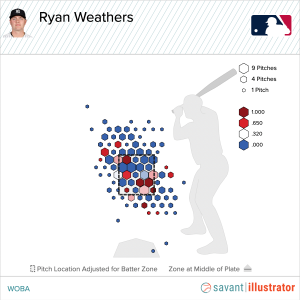
This is a chart of hitter performance when Weathers throws 4-seam fastballs to right-handed hitters. As a lefty with a 4-seam shape that is just ok, one of the two places he absolutely cannot be throwing this pitch is down and in to righties. That is too easy for them to turn on, and they are crushing them. His loLoc% is in the 84th percentile, and while there may be some strategic value to low 4-seamers setting up secondary pitches below the zone, that value goes out the window like the 4-seamers are going out of the yard. Limiting those pitches should be priority one, especially given how often he’s doing it.
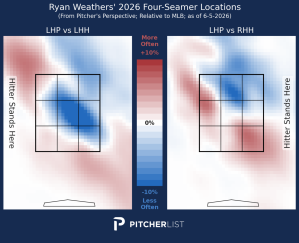
That red blotch in the exact spot that I just complained about is the problem. It’s how we see a fastball that should be league-average or better run stats that look like this:
That, dear reader, is how you rack up the third-worst individual fastball run value from a qualified starter. The only guys below him are Aaron Nola and Kyle Freeland. As much respect as I have for both of those pitchers, they are distinctly in a different tier in terms of fastball quality. Weathers does not belong down there with them. Yet, he’s earned most of the punishment he’s seen this pitch take. The expected numbers aren’t substantially lower than the results.
Functionally, his fastball is very similar to Brewers’ rookie Shane Drohan, as seen here. The key difference is that Drohan’s has been performing like one of the best fastballs in the league, as opposed to one of the worst. The reason why is about as simple as you’d probably guess, considering the tangent I’ve been on.
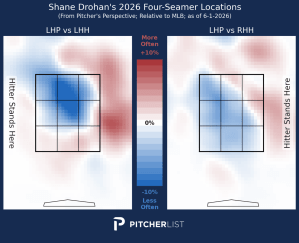
It’s not even that impressive a zone frequency chart. There’s a thin cloud of red directly above the zone. This indicates that he’s throwing it there slightly more often than the league-average rate. This is a pretty normal chart without many clear extremes, which makes sense because Drohan’s fastball locations are good, but they’re not outstanding. He avoids the center of the zone well, but so does Weathers. The contrast in batted ball performance couldn’t be more stark, however.
The irritating thing is that Weathers is set up for fastball success just as well, if not more so than Drohan. He throws a bit harder and with an extra inch of vertical movement. He also cuts his 4-seam slightly more. As for arsenal fit, they’re at a near-identical 4-seam usage rate with Drohan having a slightly more deceptive arsenal, but Weathers counters with an excellent changeup. They both supplement their 4-seam well, and it’s likely why Weathers is putting up above-average numbers on 4-seamers that aren’t put into play.
Weathers hasn’t consistently located his fastball high since his days in San Diego. If this is an intentional thing, please stop. Year after year of low 4-seamers is probably a good part of why Weathers hasn’t had a single season in which his 4-seam RV was positive. There have been other contributing factors, of course. Overuse, subpar shape (especially before his velocity bump), lack of complementary pitches, and so on. He’s fixed all of those problems. The only one left is the pitch locations.
Enough harping. That was a lot of complaining about one specific problem, especially a fixable one. The exciting thing about Weathers is that that issue is far and away the biggest thing holding him back. He’s doing so many other things well, we should break those down too.
Heat Wave
Weathers’ stuff is well above-average, which serves him extra as a lefty. As previously stated, his 4-seam shape isn’t worth talking about much, as it’s a bit generic, but throwing with a reasonably flat approach angle in the mid-high 90s as a lefty is enough to land a 55 stuff grade from me.
His changeup is where that potential starts to shine. This is a unique pitch with a 2-seam grip that he treats almost like a splitter when he throws it. It reverse engineers a splitter shape, not with low spin, but with normal-to-high changeup spin rates and low spin activity. That, on top of the hour’s worth of seam-shifted wake, makes for a pitch that dives below the zone on its way to the catcher. While the odd spin has the potential to be something of a tell for hitters, it hasn’t stopped Weathers from running great chase rates with this pitch ever since he started throwing it this way with the Marlins. Getting consistent chases on a changeup that has 10 mph of velocity separation and 14” of vertical separation is as sure a recipe for success as there is for an offspeed pitch.
Another pitch that comes from his time in Miami, Weathers’ sweeper doesn’t have any outlier characteristics. However, league-average sweepers from lefties tend to be high-performance pitches, getting whiffs and weak contact alike. If a pitcher can locate one well, it can be a weapon against both handednesses, and in particular an absolute destroyer against lefties. Check this out:
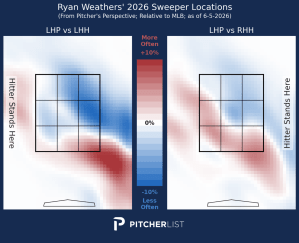
That’ll play. Landing this pitch backdoor against righties, down in the zone, and toward the back foot at above-average rates is all you can ask for. He’s also more than capable of sending it out of the reach of lefties. The combination of stuff and locations has Weathers’ sweeper tied for the second-best flawed swing rate AND perfect contact rate among all sweepers that have been swung at as many times as his.
While Weathers’ sinker lacks exceptional depth or SSW, it is still a sinker with just shy of 18” of run at 94 mph, that looks nearly identical to his 4-seam out of his hand. It’s more of an arsenal fit than a great pitch on its own, but it’s more than good enough for the role it serves. While it isn’t a ground ball machine, it induces average contact for a sinker while nabbing him plenty of called strikes and setting up his other pitches nicely.
Weathers’s last pitch is a retooled version of the gyro slider he came up throwing. This pitch is awesome, and I wish he’d throw it more. His command of this pitch is a work in progress, as it sometimes slips out early and lands high and toward the arm-side compared to the presumed target, but he does show some aptitude for throwing this pitch just off the low glove-side corner to righties.
His usage of it is a bit odd, favoring it against lefties more than righties. I’m not sure if that’s a preference or a confidence thing. This is a new pitch for him, and even though it should play better against righties, it might be safer for him to get his game reps with it against lefties until he’s got more experience with it. Regardless, it’s a very promising pitch, as any 87 mph gyro breaker with any semblance of control is.
Sunshine and Rainbows?
Look, I’m not going to pretend Weathers isn’t making people pull their hair out when he steps out there right now. Especially as of late, seeing outings with mixed levels of success ultimately ruined by ill-timed homers. He’s given up 13 longballs this year, including 11 in just four multi-homer games. The maddening thing about this is that three of those four saw him get 7, 10, and 10 Ks, respectively. He is doing things well, even in his blowups.
As we’ve gone over, his biggest problem has been plaguing him for years. The current 39.1% HR/FB rate his 4-seamer sports is almost certainly unsustainable, but it’s born of his questionable fastball placements. I know it’s easier to tell a pitcher to do something than it is for them to follow through on it, but please, man, elevate this thing. Let it ride up high, I don’t care if it lessens the effect of the other pitches, it would be worth it.
High fastballs do carry the risk of barrels. It’s easier for hitters to get under pitches up in the zone, but I sincerely believe we’d see the pitch’s performance improve. If we call back to the chart that showed right-handed hitter success on his 4-seaamer, outside of the triple that he gave up on a high and away fastball to Heriberto Hernández, they haven’t touched this pitch when he actually does throw it high.
This isn’t to say he’s perfect outside of this flaw, but nearly everything else he’s doing out there is functioning at a high level. Sure, the sinker’s given up some hits to lefties, whatever, they’ve all been singles. In fact, the only pitch he’s given up a hit worse than a single to lefties on is his 4-seam. Admittedly, it’s two homers on high 4-seamers. In his defense, one of them came on pitch 108 to Nick Kurtz on his fourth time through the order. The other was just a good piece of hitting by Soderstrom in the same game.
As stated earlier, despite all of his fastball woes, it’s still a pitch with the potential to be quite good. When you look at everything else he’s got going for him, the idea of him having a fastball that’s performing as it should makes him a very scary pitcher. That’s probably why the Yankees gave up the prospect package they did to get him. The potential is there, and he’s likely just one shift away from actualizing it.
Photo by Icon Sports Wire & Adobe Stock | Graphic by Carlos Leano
