





The hype around the Detroit Tigers this year revolves around a young hitter who already signed an extension that runs into the 2030s. Kevin McGonigle might have stolen the show early in Detroit, but there’s another on the roster.
Colt Keith signed a six-year, $28M extension in January 2024, before he debuted in the majors. Already in year three, the results in the first two years didn’t stand out in a way that many expected for a guy who earned an extension before seeing a major league pitch.
He was slightly below average in his rookie year (driven by an atrocious 10 wRC+ in April, and a subsequent 114 wRC+ the rest of the season), and then was nine percent better last year.
Nothing changed substantially in the surface-level stats, but he nearly doubled his walk rate and increased his barrel rate by 3.6% — both developments that made him a good big league hitter, but not in an eye-popping way. For a guy who had 60-grade power potential (and 70-grade raw power), this didn’t seem like his final form.
His 2026 is looking a lot stronger, even if the surface stats haven’t come to fruition yet.
Despite an increase in strikeouts and a drop in walks, Keith has been a better hitter so far this year. It hasn’t culminated in home run power yet, but his approach has improved in two facets this year: quality of contact and plate discipline. He’s hitting the ball hard consistently off the back of an increase in bat speed and is chasing pitches out of the zone less.
So far this year, only four players (min. 60 plate appearances) have improved their bat speed by at least one mile per hour and improved their chase rate too.
It’s a fun list of young players, but this combination of improvements only has a 50% hit rate so far. Matt McLain and Miguel Vargas have slightly underwhelmed on their 2025s so far, and McLain’s 70 wRC+ is barely playable at the moment. Cam Smith, on the other hand, has been one of the early breakouts of 2026 — his 3.5 mph increase in bat speed is the biggest in baseball.
That leaves Keith, who has only seen a modest improvement in results while making these changes. The big results from these changes haven’t happened yet, but those days are looming.
Starting with the bat speed, a two-mile-an-hour difference is significant. Keith went from 27th percentile to 61st percentile, playing closer to the bigger power profile that scouting reports gave him. It hasn’t culminated in power results, but Keith is mashing the ball consistently.
His 58.3% hard-hit rate, which measures batted balls above 95 mph, ranks 11th in baseball (min. 60 PA). Impressively, his max exit velocity this season has only been 105.9 mph, down from 110.0 mph a year ago. Obviously, it only takes one batted ball to change that, but it’s a weird dichotomy to see a 14.6% increase in hard-hit rate and a significantly lower max EV at this point, especially with an increase in swing speed. It’s helping him keep his .317 average up, with average estimators generally believing in him.
When looking for power, especially for a hitter without upper-echelon exit velocities, the next natural spot is in the batted ball direction and launch angle. Keith hits the ball in the air 56.3% of the time, down 5.7% from last year but still above league average. His distribution of batted balls in the air (fly balls, line drives, and pop-ups) is relatively consistent with years past. Hitting the ball hard in the air is good, and he’s doing so.
Furthermore, he’s hitting the ball in the air to his pull side. This is the best way for a hitter to get to their power, and yet it isn’t culminating for Keith yet. He currently has a 20.8% pull-air rate, up from 18.0% last year, and above the 16.7% league average. This is ten batted ball events so far this year:
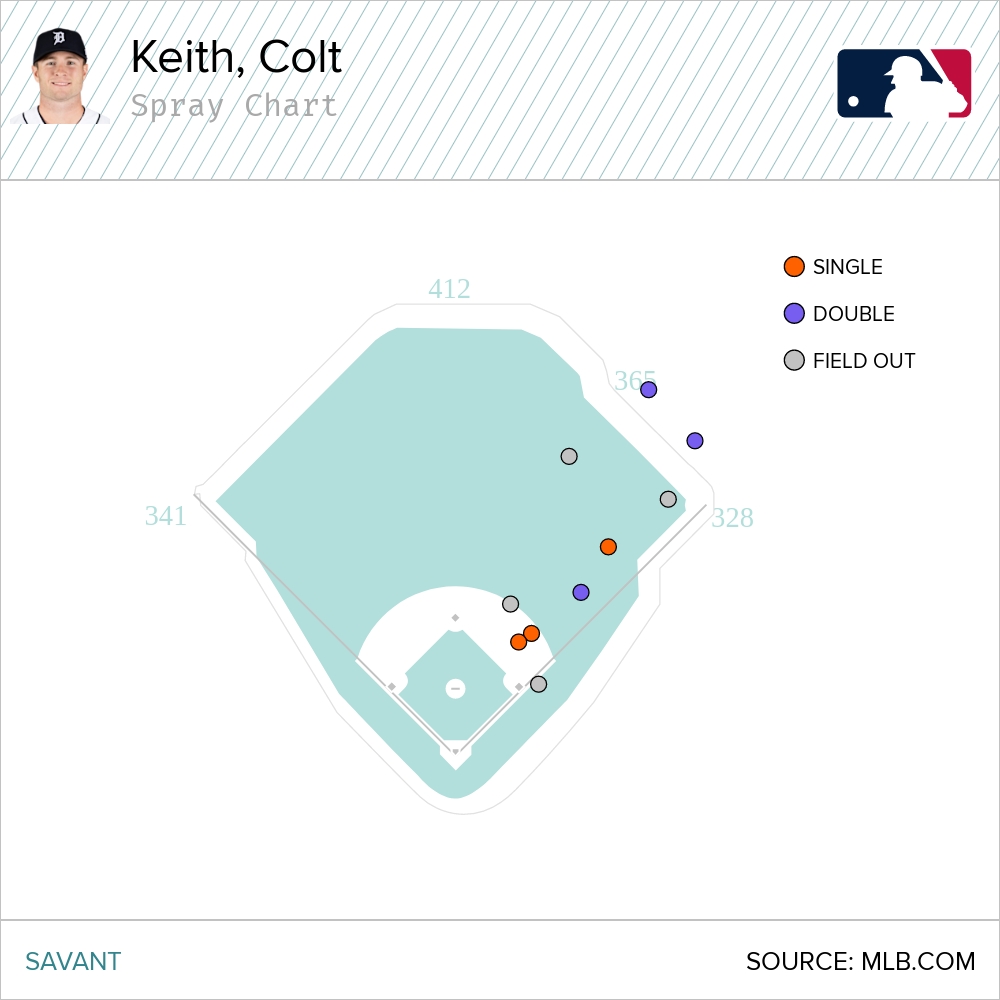 He’s hitting .600 with a 1.058 xSLG on these batted balls, both above league average. His .900 actual SLG is well below how the league performs on pulled-in-the-air BBEs (1.186). Naturally, two batted balls would be over the fence in Detroit. One of those batted balls in Arizona literally could not get closer to clearing the fence.
The results are going to come for Keith. He’s doing all the right things in terms of what the batted balls look like.
As for the plate discipline, the decrease in chase rate doesn’t exactly come with any additional benefits. He’s still whiffing around the same amount, which means it’s coming on pitches in the zone. Keith’s 84.5% zone-contact rate is around league average, 2.8% down from last year. Over 50% of the pitches Keith has seen have been in the zone – pitchers aren’t trying to tempt him outside. Instead, he’s getting tons of opportunities to make swings count.
The increase in zone rate has also counteracted any potential increase in walks. Even if he isn’t chasing, he’s putting enough balls in play early in the season to keep his 4.5% walk rate less than half that of his 10.3% figure last year. He’s hitting well enough that he’s getting on base as frequently as last year, and that’s a tradeoff he’s seemingly willing to make.
Keith is taking bigger swings on more pitches in the zone and trusting the process to put up production. If he’s going to make this much quality contact, it seems like the hitter that was on the scouting reports might actually be here to stay.
