





A batting stance is a very personal part of baseball. Similar to a pitcher’s wind-up, it’s one of the only visually personal aspects of watching a baseball game, with professionals making everything else look almost automatic. As a kid, I often imitated the bat waggle of Gary Sheffield or Kevin Youkilis, and I tried to adopt the same intimidating stance as Albert Pujols.
There are some stances that you just know when you see them today. Whether it’s Bryce Harper’s bat resting on his shoulder or Shohei Ohtani’s bat sticking straight up, you immediately know who’s up to the plate even without seeing a face (if you’re skilled enough, I recommend trying Batter Up). Stance changes are usually reserved for those who are struggling and haven’t found consistent performance in the majors, as they try something new to hold a roster spot.
Enter Corey Seager, a player who has more in common with the Bryce Harpers and Shohei Ohtanis of the world than those who normally change their batting stance. The 31-year-old has 38.2 career fWAR, 18th among active players, and his 134 wRC+ ranks 8th among players with at least 1000 career games. He has two World Series rings, the latter of which is the product of an iconic game-tying home run.
Despite the 6’3″ frame, Seager’s lowkey stance and extremely short swing helped him make consistent contact and tap into upper-echelon power. In his first three years in Texas, Seager topped 30 home runs each season, something he’d never done in Los Angeles. With generally strong averages and low strikeout rates, he averaged a 143 wRC+ while playing over 100 games in three straight seasons (another career first).
This season, things look different for Seager. His 114 wRC+ would be the lowest of his career (excluding the 26-game 2018 season, where he underwent Tommy John Surgery). His .243 average rivals 2022’s .245, but he’s only projected to reach around 20 home runs.
Seager has played around with different batting stances this year, swapping between them on a whim throughout the first three months of the year. It started business as usual, but quickly devolved into batting stance chaos. For a star without much flash, these changes are seemingly out of nowhere. Not surprisingly, it’s been a turbulent year under the hood for Seager: he’s making less contact than ever, but still has an excellent batted ball profile.
The Batting Stance Timeline
On Opening Day, things appeared normal for Seager. His stance appeared marginally more upright compared to years past, but still with the slightly open foot positioning.
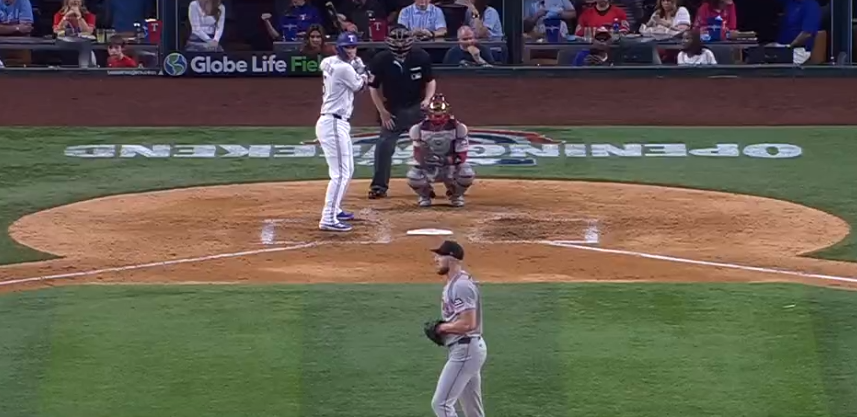
Like the rest of the Rangers’ offense, Seager got off to an incredibly slow start for the first nine games. He slashed .161/.235/.258 with one home run and a 32.4% strikeout rate in 34 plate appearances to start the year. Not good at all, but rarely do nine games mean anything significant over the course of a full season.
His attack angle and bat speed were consistent with years past, though his swing length was slightly longer than in years past. In 2023 and 2024, Seager had a 6.6 ft. swing length, which is well below the league average of 7.3 ft. Regardless, there’s a league-wide correlation between whiff rate and longer swings. His attack direction was 1° toward the opposite field, whereas historically, Seager was a slight pull hitter. His slugging and whiff rates were both down, but in a small sample, this wasn’t overly concerning.
On April 8th, we saw the first stance change from Seager. This game was the second in a series against Chicago, so the change was not an off day or a new series decision. He opened up the front half completely and bent more at the knees. Although we can’t see the front foot, his heel is up and not flat-footed (here’s a different angle from this stretch).
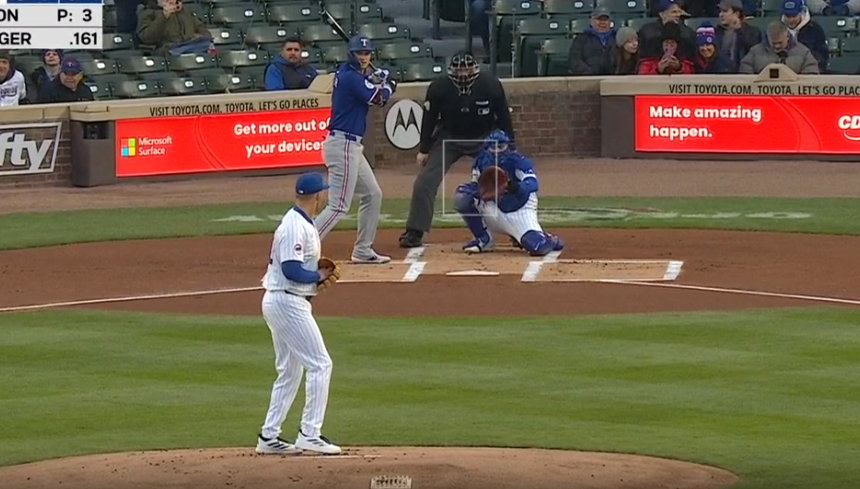
This change worked for Seager, and he became the hitter we all remember. In his 50 plate appearances with this stance, Seager slashed .370/.420/.609 with three home runs and an 8.0% strikeout rate. Was he back? A rare, dramatic stance change working in his favor is a reason Seager is one of the greats; he clearly found a new path to success, or so we thought.
The open stance helped Seager add almost a tick of bat speed while cutting down the swing length to his previous norm. It helped the batted ball quality significantly, but his whiff rate was above career norms, and he had shifted even more to the opposite field in attack direction. Through all of this, the attack angle was good, which turns hard-hit batted balls into extra bases.
In true Seager fashion, he landed on the Injured List on April 23rd when he hurt his hamstring. He only spent the minimum time possible on the IL and got reactivated on May 3rd. Upon return, Seager had a more aggressive heel lift on his front foot, but still open.
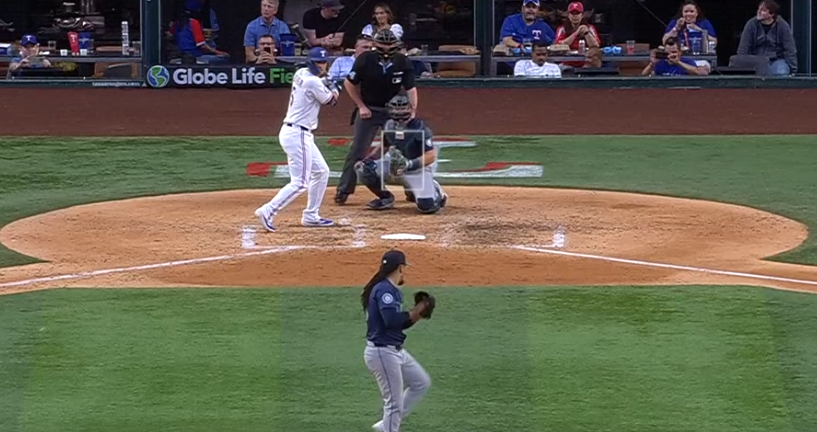
This only lasted one day, as he was back to the flat heel raise for the next week.
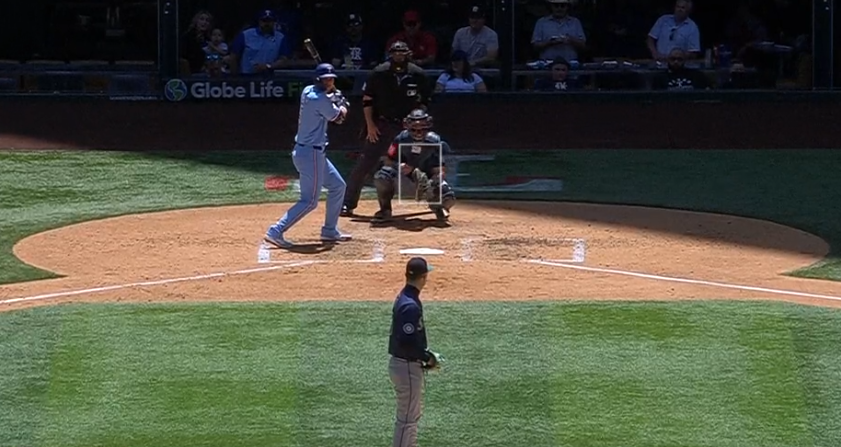
For the next week post-injury, Seager picked up where he left off. He hit two home runs in just five games while slashing .348/.348/.696.
His bat speed was up significantly, partially driven by a longer swing. The attack direction also moved more towards his normal tendency, helping the two home runs get out to the pull side.
Regardless of performance, Seager wasn’t fully healed from the hamstring strain and landed on the IL again. Seager missed more than the minimum, returning May 28th.
This is where things get funky. Over the course of the next five games, we saw five different stances from Seager.
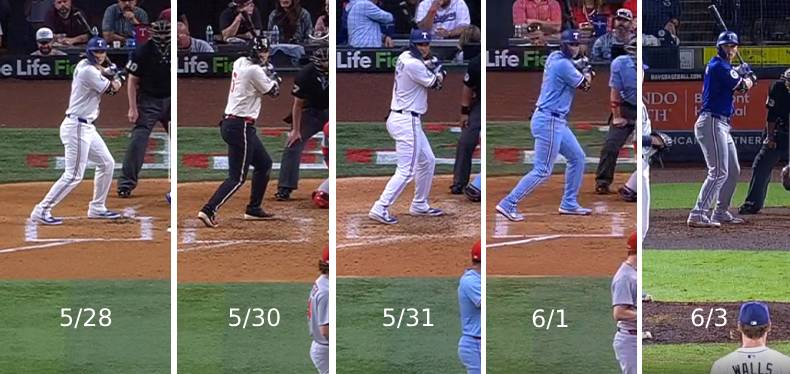
On May 30th and 31st, Seager opted for an aggressive inward turn of that front foot and then a similar, but subdued version. He was all over the place with his open stance in the four games at home after returning, but returned to his original stance against Tampa Bay on June 3rd.
The four-game stretch was atrocious from Seager: in 16 plate appearances, he had two hits and six strikeouts.
Interestingly, none of the swing peripherals stand out from what we previously saw. His whiff rate wasn’t terribly out of place, but the high HardHit% came from ground balls and pop-ups.
That June 3rd stance looked to be a reset, as his feet came closer together again. This was the first time since the opening stretch of the year that his front foot was in line with his back foot. After a rare Saturday off-day for Seager, he came back with his most closed stance of the stretch.
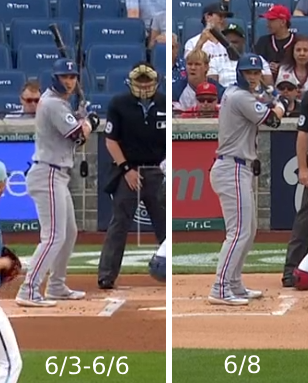
Continuing the trend from the first week of the season, this week was a disaster as well.
That’s 22 plate appearances without a hit and a 31.8% strikeout rate. It seemed like this might be the end of Corey Seager’s classic stance. Like the series before, he was making hard contact, but not at a launch angle that was conducive to damage.
Sure enough, Seager comes to the ballpark on June 10th with an open stance again.
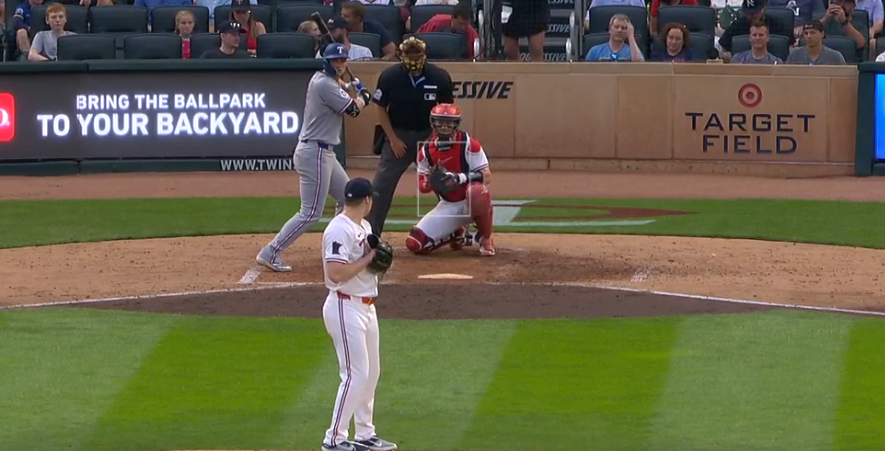
While this stint was only just a three-game series (spoiler alert), it appeared that Seager was breaking out of this slump.
He had five walks in 14 plate appearances while only striking out once, so the low batting average is misleading. His xSLG improved from the cold streak, but it was his longest swing of the season.
You might think that he’d stick to the open stance, but Seager was fighting to reclaim his old stance. He comes out more closed yet again in his next game.
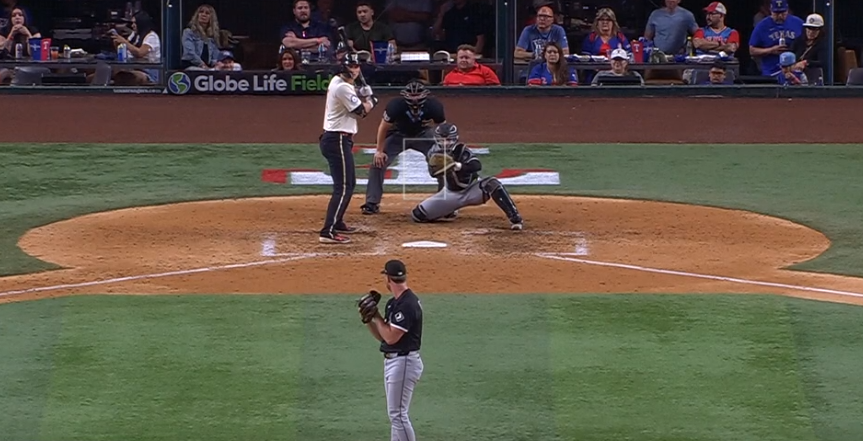
This stuck with Seager, as he finally found success with his old stance for the first time this season. Across 55 plate appearances, one of the longest stance stints of the year, Seager slashed .256/.400/.442.
He shortened his swing a bit and still whiffed a decent amount, but he was making an adequate tradeoff for hard-hit batted balls. He posted a 139 wRC+ over the past two weeks, aided by a 16.8% walk rate. This wasn’t “the return” to the Seager we knew, but it was something.
Finally, as of June 29th, we’ve seen yet another stance change.
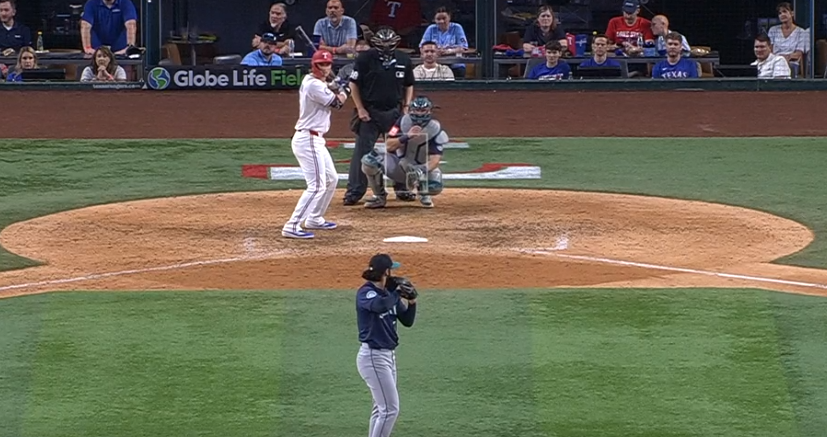
This looks similar to what he displayed from 6/3-6/6, but the knees are slightly more bent and the bat is less vertical. All in all, it looks to be the midpoint of everything we’ve seen this season.
It’s only been two games, but they were good ones: he’s had five hard-hit batted balls in seven at-bats, two of which were home runs. He also had three walks, keeping up the improved discipline.
Seags squares things up again! #AllForTX pic.twitter.com/9CCXQIxl8X
— Texas Rangers (@Rangers) June 29, 2025
Zooming Out: What Does the Whole Season Look Like?
On the whole, Seager has a 114 wRC+, which is a productive bat. It’s not anywhere close to the 140 we saw a year ago, but a 114 wRC+ isn’t in “hit the big red emergency button” territory. Exclude the one horrendous stretch from 5/28 to 6/8 where he was playing with his stance the most, and it’s a 145 wRC+. I don’t believe you can exclude that period when he’s played with his stance all season, but it’s a reminder that there is still elite talent.
These changes have primarily resulted in a loss of contact ability, rather than a decline in batted ball quality. Seager has an 81.6% zone contact rate, which is the first time it’s below 86% as a Ranger. His out-of-zone contact dropped 10% last year, going from above-average to just the 5th percentile compared to the league. To combat the extra whiffs, Seager has been more passive. He has the highest walk rate (12.8%) and lowest swing rate (50.8%) of his career.
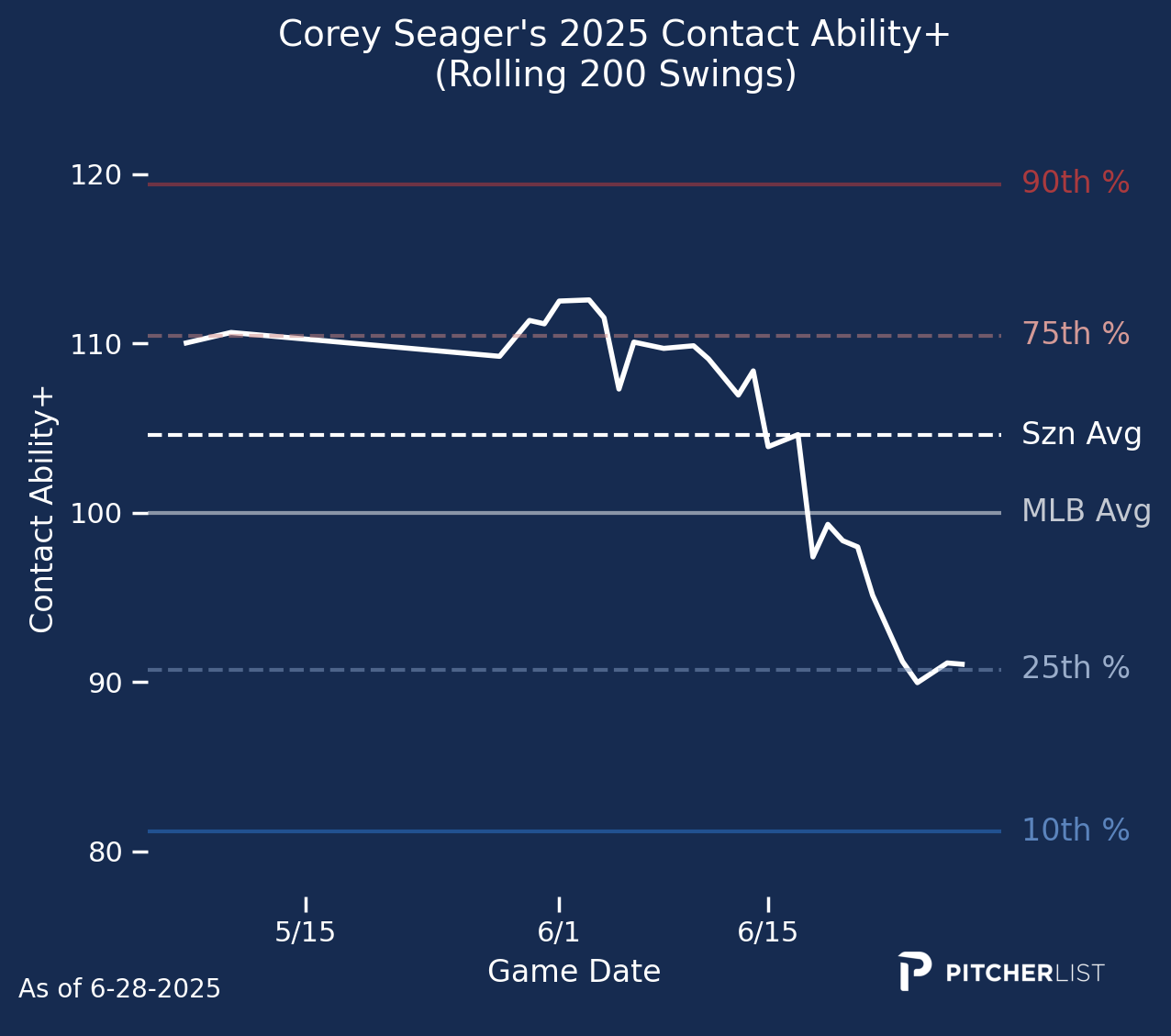
As for the batted ball quality, there’s little worry. Seager has a .536 xSLG, which is equal to his career figure. The 14.4% barrel rate is a tick below his last two seasons, but still above his career rate of 11.2% and is in the 88th percentile among all hitters.
The only aspect of his batted ball profile that is affecting the surface-level stats is the fact that his attack direction has been consistently more towards the opposite field. This has reduced his AirPull% from 19.7% to 11.0%, a change that moves him from elite territory to well below the league average.
Once he’s making contact, all of the worries around a batting stance go away. It’s just about how he’s getting to that moment.
Overall, the stance angle increased from 8° open last year to 30° open this year. That is the third biggest stance change in baseball, behind Ketel Marte and Jorge Polanco. Considering this includes the more closed stances from Seager, his stance change is likely the biggest in baseball (Baseball Savant doesn’t allow you to filter by stance angle date range, so I cannot confirm it).
So… Is There a Takeaway from the Batting Stance Saga?
So, after eight different stances this season, there is not one stance that appears to feel like home to Seager. The recent change to his more closed stance indicates that he wants to revert to his classic slightly open stance, but he’s getting better results when he’s more open.
Seager’s swing is longer than it has been, pushing his attack direction away and limiting the number of pulled batted balls in the air. His pulled groundball rate has increased to a career high at the same time, which further proves how dysfunctional Seager’s approach is this year.
Across these various stance changes, nothing has unlocked anything near 2024’s 19.7% AirPull%. Until that shows up again, I think Seager is going to continue to tweak his batting stance. We are witnessing a great hitter deal with adversity as publicly as possible, and we’ll see in real time if he can figure out a stance that can keep him at prime production.
