





Baseball, like most sports, can be quick to move on to the next big thing and leave previous versions behind. It’s a “what have you done for me lately” kind of game, and going 21 months between MLB starts has a way of dimming an up-and-comer’s star. Eury Pérez came up to the majors a month after turning 20 years old and immediately established himself as “The Guy”. He was younger than most college pitchers are when they get drafted in the first place. Yet in the time between the end of Eury’s rookie season and the next time we saw him on an MLB mound, he was replaced. Paul Skenes swooped in and became the new face of the future of pitching after flamethrowing his way through about 200 innings of 2 ERA ball. I’m sure most of you didn’t forget about Eury, but he certainly moved into the background as far as baseball fans as a whole were concerned.
Now he’s back, and he’s picked up exactly where he left off. It looks a little bit different than it did two years ago, though. He’s made some adjustments to his game, and there’s still a lot to do. It’s rare to see a pitcher that’s already as good as he is with so much room to grow. You don’t need me to tell you that Eury has a nearly limitless ceiling, and that’s not what I want to get at anyway. Let’s break down the steps he’s taken since his rookie year and what the next steps look like as well.
A Rundown of His Current Arsenal
One thing that remains the same about Eury two years later, he still throws pure fuel. His fastball is coming in even harder than it did in his rookie year. Visually, it looks about the same, but he made a small modification. He dropped his arm slot just a bit, resulting in marginally different movement. At 98.1 with above-average movement in both directions from a generic release point, this is already a great pitch. It is enhanced by its expected movement separation from his arm slot, as well as his massive 6’8” frame dropping down to release pitches from a normal height. This creates a unique visual that hitters tend to struggle with. From the perspective of stuff, it’s about the same quality of pitch as it was in 2023.
While his fastball is mostly unchanged, the same cannot be said for the rest of his arsenal. I’m not entirely sure what he’s doing differently with his slider, but its shape is distinctly improved. The release point is the same; he didn’t change his arm angle like he did with the fastball, but he’s getting around it much better. Its active spin percentage dropped from 37% to 24%, creating a tighter gyro breaker shape. It also has a slightly different spin direction, further adding to the improved depth and slight increase in horizontal movement. Going from 6.1” iVB with no horizontal to 3.4” iVB and 2” horizontal with no velocity loss is a noticeable upgrade for an already very effective pitch.
Much more obvious when watching him pitch are the changes made to his curveball. This is an entirely different offering.
Gone is his old gyro curve, replaced with a big slurvy breaker. It’s similar to the ones thrown by Soroka, Strider, and Scherzer, all of whom have had success with their versions.
While his changeup is only slightly modified in terms of shape, and the alteration could be reasonably explained away by him dropping his arm slot a bit more to throw it, that’s not the whole story. I honestly can’t tell if it’s that he’s fighting to keep the pitch consistent or if he’s using a new grip. The velocity and spin rate are unchanged. The initial spin direction has dropped by 30 minutes, which could be explained by the arm angle, but the spin activity is up, and the seam-shifted wake it used to have is gone. It’s still a great pitch. The arm angle drop would ordinarily cause concerns as to making it less deceptive. However, as previously mentioned, his fastball arm angle dropped as well. They’re about the same distance apart as they were in his rookie season when his changeup was arguably his best pitch. Anything it may have lost in spin deception (likely not much, if anything at all) would be made up for in the pitch’s improved depth.
He’s also added two new pitches. The one he’s using more often is a… “sweeper”? I don’t know what this pitch is or what it’s trying to be. With 9.4” of iVB and 7.4” of glove-side horizontal at 83.6 mph, there’s not a great classification for this. It’s like a slow cutter with more horizontal movement than you’d expect, I guess? The only comparable pitch I could find was Ryan Pepiot’s slider, which is thrown much harder and from a different arm slot. For a partial comparison, Steven Okert’s slider sometimes gets into a range similar to what Eury’s “sweeper” is doing, but not consistently.
I don’t know what to make of this pitch; there’s not much of a precedent for it. The few of them he’s thrown have performed well, but it’s way too small a sample to make any judgments yet. The other new pitch he added is a sinker. This one is far easier to judge. Its shape is fine if lacking in depth, but it should be a great weapon for him to run in on the hands of right-handed hitters once he learns to command it.
Acknowledging Imperfections
The following statement is meant both as a criticism and a source of awe: Eury could be pitching better than he has so far this season. It sounds ridiculous on the surface. His numbers are great, and his underlying metrics back them up. He’s avoiding hard contact and getting whiffs at will. Bear with me, I promise I can prove that this is what he looks like when he’s rusty. There is much more in store.
It starts with his fastball. In what I assume is a choice made to make up for the feel to locate the secondary pitches being slow to return, his fastball usage is up. Unfortunately, his ability to locate the fastball isn’t fully back yet. Both in his rookie season and now, he’s shown a hesitance to throw his 4-seam high above the zone. Instead, he likes to pelt the zone as much as he can, even working low in the zone with it to set up his secondary pitches out of it. His fastball is good enough that he can get away with this, and that’s what’s happened this season. Even in hittable locations, batters are struggling to do anything with his 4-seam.
However, he’s an extreme flyball pitcher who also gives up a lot of pulled contact as hitters gear up to get ahead of his 4-seam. This becomes a dangerous game to play, especially at his fastball’s current usage rate. The absurdly high pop-up rate on his 4-seam will not last forever, and hitters will adjust to his strategy. When that happens, something will have to give. He will either need to start working higher with the fastball or start throwing it less often.
He’s been a bit unlucky when his slider gets put into play this season, maybe the scales are balancing for the luck on his 4-seam. He has, however, opened himself up to this possibility by not locating the slider quite as well as he did in his rookie season.
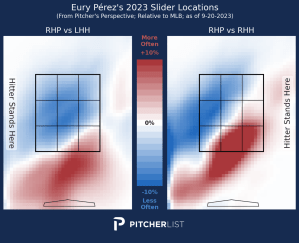
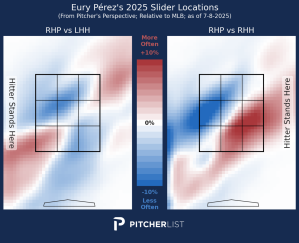
I’m chalking this up to post-Tommy John rust more than anything else. When the sliders get below the zone more consistently again, they will return to their previous unhittable status.
His new curveball has seen very strange results in the small sample. A comically low whiff rate of 9.7% has been offset by a lot of useless contact that turns into outs. Like the slider, the locations have been a bit all over the place, but I don’t think that’s what’s causing it. I’m ruling this as small-sample weirdness that will even out more as time goes on. I don’t think this will be a particularly high whiff pitch unless he locates it exceptionally well. That said, I also don’t think this is necessarily something he’ll be using to intentionally induce bad contact long-term either. This is a pitch to watch, even if it’s not vital to his success.
The other pitches we only need to touch on briefly, as he hasn’t thrown very many of them. 35 changeups isn’t enough to make any real judgments on his ability to locate it, though I like how often he’s dropped them right below the zone. He misses by too much more than I’d like, but his plan with them is clear and I like said plan. The “sweeper” thing is weird. I’m not going to pretend like I can tell what he’s trying to do with it. It’s gotten great results in a microscopic sample. That’s about all I have on it. The few sinkers he’s thrown have been all over the place. Should he develop command of it, it would be good.
What’s Next For Eury?
Most of what stands in the way of Pérez reaching his astronomical ceiling boils down to execution. It doesn’t feel particularly fair to criticize his command as he’s shaking off the cobwebs and getting back into a groove of pitching consistently. Most of the negative comments related to that come with that caveat: that they should improve with time, even without intervention.
With that said, I am unconvinced that his fastball is going to continue to perform as it has this year. Last year, it was hit well and had a below-average whiff rate. After a stuff change I would classify as lateral, and making more mistake pitches while working with what looks to be a similar game plan, and throwing it more, it should not have jumped to the unhittable whiff and pop-up machine it has been this year. It’s earned some of its jump; the underlying metrics represent that. The underlying metrics improvement is what I don’t trust to hold, though. It doesn’t make sense that they would be down so far. Normally, I don’t like to try to predict regression of expected metrics, but when the batted ball profile is as unsustainable as Eury’s seems to be right now, I have to.
This is not to say that Eury is pitching poorly; he’s still got a monstrous arsenal of pitches at his disposal. The fact that he’s been able to coast at an elite level while he works through the post-TJS funk is a testament to just how good his stuff is. I’d love to see him advance his game, with more elevated fastballs, and a well-rounded use of his whole arsenal. Until then, I suppose he’ll have to get by ripping some of the nastiest pitches in the game and daring hitters to do anything with it. It’s worked well enough so far.
