





The 2026 New York Mets are an unmitigated disaster.
There are few better ways to describe the most disappointing team in the National League. New York has been exhausting at best and outright miserable at worst, sentencing the die-hards to 162 games of existential crises and social media tirades.
Everyone has played a hand in this mess. But some players lack the watchability to shed criticism, and instead catch the flak of a fanbase. Catcher Francisco Alvarez hasn’t had a bad 2026 season, and on an underperforming roster, he’s far from the biggest hole in the lineup. Ask your friendly neighborhood Mets fan about their impression, though, and you’ll likely hear about his 16 double plays or 30.6% strikeout rate.
It’s been a brutal watch. His 1.6 fWAR ranks seventh among the 27 Mets to take a plate appearance in 2026. His -1.38 WPA tops just Jorge Polanco, Mark Vientos, and Marcus Semien.
Alvarez is far and away the most likely of that quartet to see real playing time next season, penciled in as the starting catcher and carrying the optimism of his distant prospectdom. But as he enters his fifth full season, his ability to transcend the Baby Mets moniker and become something greater could decide his long-term future with New York.
Throw It Back (to 2023)
Barring further heroics in the final week of the season, Alvarez will finish with fewer WAR than each of the past three seasons. Injuries have undoubtedly played a role, limiting him to fewer than 120 games in each year since 2024, but the shape of his production has shifted, too.
Alvarez debuted in 2022 with a five-game stint showcasing the bat that made him baseball’s top prospect. His first full season still managed to take fans by surprise. He struggled at the plate, logging a 96 wRC+, but posted 3.0 fWAR on the back of a defensive breakout the scouting reports didn’t see coming.
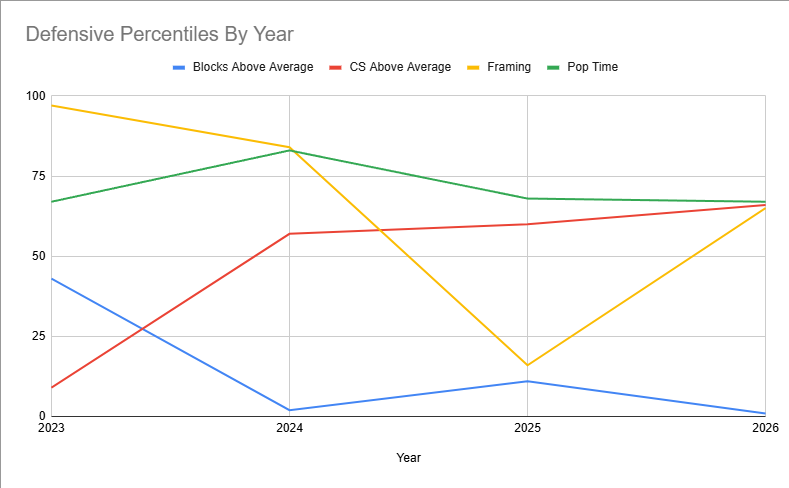
It proved to be short-lived. After ranking fourth among catchers with 500+ innings in Fielding Run Value as a rookie, he’s ranked 18th, 31st, and 18th, respectively, among 40 qualifiers. We can attribute this to a handful of factors, but Alvarez has never been able to balance throwing out base runners with framing and blocking balls in the dirt. He won’t top defensive leaderboards until he gets his blocking back up towards average, and there seems to be a relationship between this skill and an emphasis on framing. Alvarez loses ground to his peers most frequently on “Easy” block opportunities, defined by Savant as pitches with a block probability greater than 95%.
Anecdotally, this manifests itself in missing pitches that he is attempting to frame. I also don’t think it’s a lower-body stance issue, as Alvarez has been a knee-down catcher upwards of 90% of the time in each season, and the blocking issues have persisted non-linearly throughout his increase to a 98% knee-down rate.
Percentiles via Baseball Savant
If we assume that the blocking isn’t coming back, it’d behoove Alvarez to recapture his once-elite framing. The Mets have already made some progress down this path.
“When his posture was bent, his head moved a lot,” said catching coach J.P. Arencibia, via Mark W. Sanchez of the New York Post. “There was a lot of movement at the catch, and you want to try to stay as still as possible. The best receivers are very stable, and it’s a lot of just hand movement.
“Alvy has some of the quickest hands in baseball. And so once we were able to get to a good posture where his head wouldn’t move, essentially all the leverage was going onto the glove — into the movement of the glove — and so that’s really what’s changed the game for him.”
Alvarez has improved month-over-month this season, starting the year off cold and ending it with his best receiving stretch. While the progress is admirable, New York leveraging his physical tools should create optimism elsewhere.
Rounding Out Power
Arencibia referred to Alvarez having fast hands, a tool that defines his offensive profile. Raw power has never been the problem. He hit 25 homers in 2023, 11 in each of the next two years, and has hit 16 in 2026. The last two years would put him on pace for 24 dingers over 600 plate appearances, and the batted-ball data is strong, too (97th-percentile barrel rate, 94th-percentile FB exit velocity).
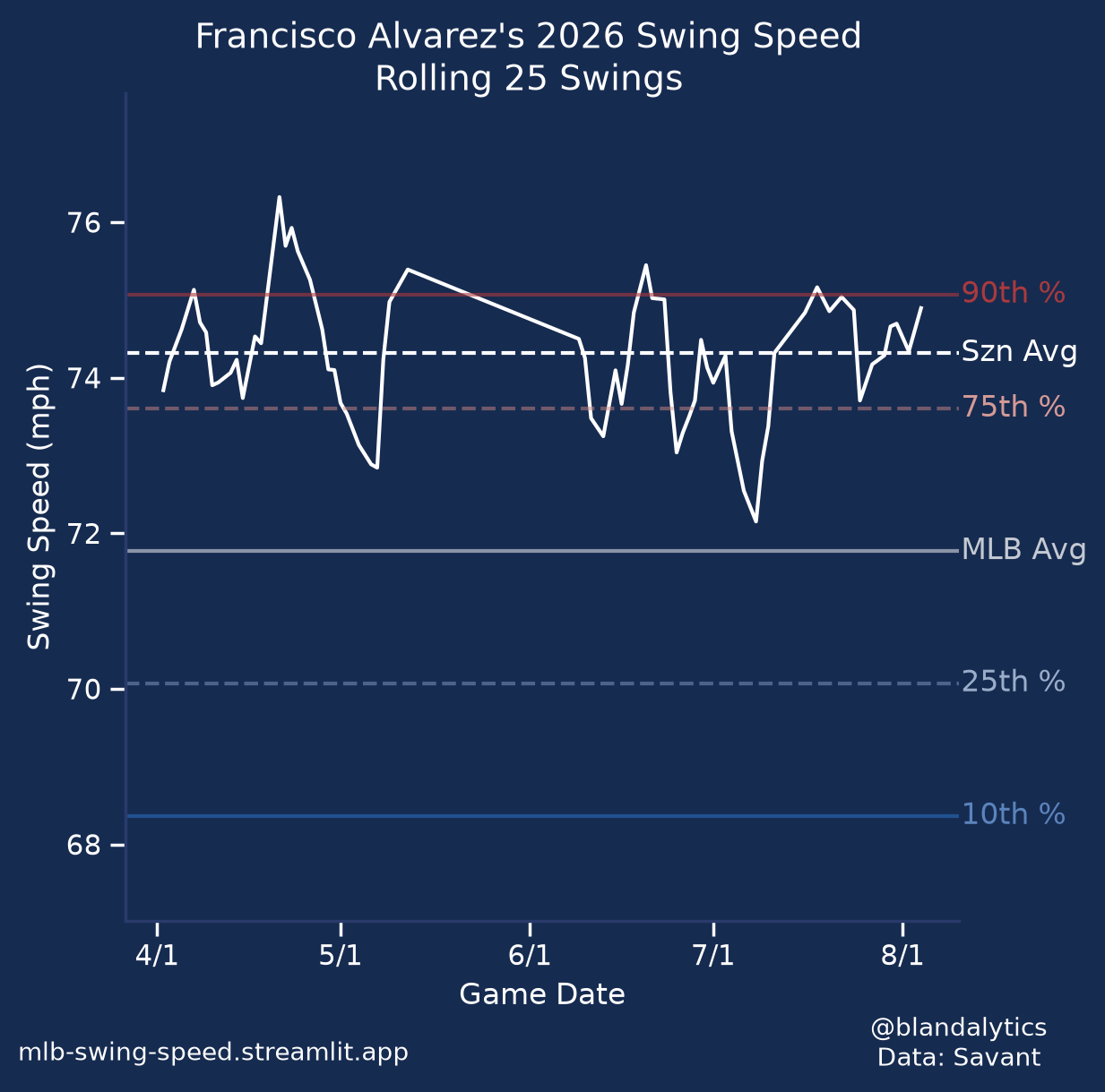
Alvarez is also tugging at my heartstrings by pulling the ball in the air. Freed from Eric Chavez, Alvarez has jumped from a Pull AIR rate of 9.2% to 15.9%, the best mark since his 25-homer rookie campaign. Accessing pull-side power is the single biggest adjustment Alvarez could make to his long-term power projection, and it doesn’t have to limit his ability to do damage elsewhere.
Of the 228 qualifiers, Alvarez ranks 55th in slugging on contact and 20th in 90th-percentile EV. Even so, there’s room for more pulled fly balls and better launch angles in general. Among that same cohort, Alvarez has the 30th-highest GB%, which hurts his power potential and explains his propensity for grounding into double plays.
The issues here are twofold: Alvarez lacks the bat-to-ball skills to actualize his raw power, and his plate discipline struggles to set him up for success. Getting one of these to approach league average would make him the hitter Mets fans expected upon his promotion.
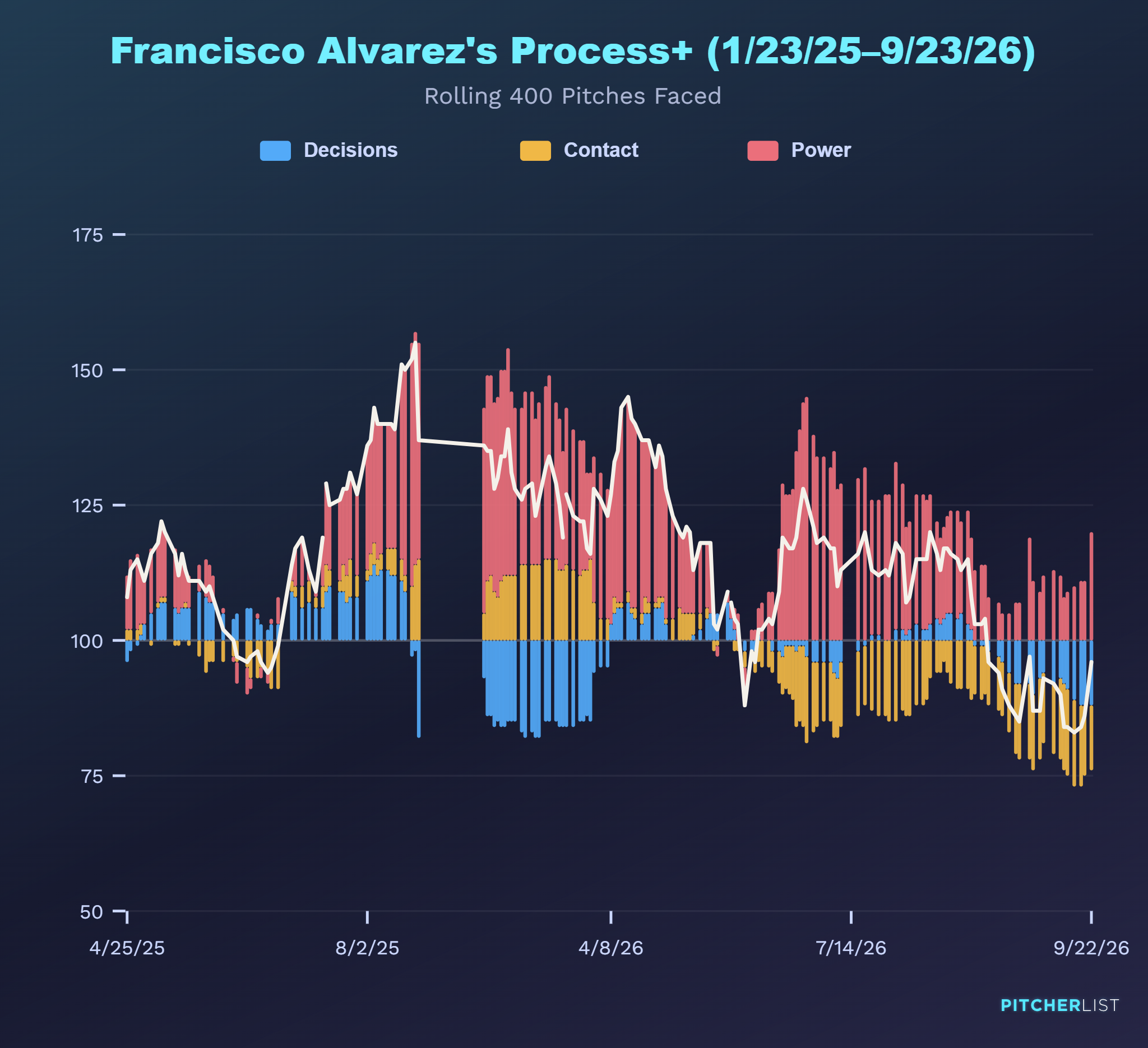
Alvarez is never going to carry a 55 hit tool. He’s currently running a 5th-percentile contact rate, including a 7th-percentile contact rate on pitches inside the zone. Alvarez lives below the Z-Contact shelf where hitters see significant gains from each improved percentage point. Therefore, there may be outsized production benefits from relatively minor improvements in Z-Contact. What might he look like if his career-best 81.1% Z-Contact held steady for multiple years? He probably wouldn’t be striking out 30% of the time.
More batted balls would be nice, although trading swings and misses for hard grounders isn’t going to win New York many games. Strikeouts are inherently paradoxical, so Alvarez must trade those swings and misses for pitches he could damage. This season, Alvarez’s plate discipline has disintegrated, including a decrease in SEAGER, which measures swings and takes on pitches he can damage, rather than just balls and strikes. That mark fell to 26th in baseball after being top 10 the year prior. While that’s not disastrous, it’s a symptom of the funk he was in.
Similarly, even basic looks at plate discipline paint a not-so-rosy picture. In 2026, Alvarez swung at a career-low percentage of pitches in the zone and a career-high percentage of pitches outside of it. For reference, his Z-O-Swing% ranks 264th of 290 qualifiers, sandwiched between Salvador Perez and Chandler Simpson. Only Bo Bichette ranked worse in a Mets uniform this year.
This skill also helps tell the story of Alvarez’s season; on a monthly basis, his Z-O-Swing% has a .537 R^2 with his wRC+. He hasn’t always been so tied to his swing decisions, but he’s also posting the lowest contact rate of his career. Having swung and missed at so many same-side breaking balls and struggling with velocity, there’s a chance he just wasn’t seeing the ball as well as he needed to.
Can Alvarez Flip the Script?
Therein lies the make-or-break aspect of Alvarez’s production. It is well established that he can hit the ball as hard as the game’s best, and he has done a better job of spraying/launching balls to improve his damage on contact. But he’s not doing enough damage given the bat-to-ball woes, and his plate discipline is allowing pitchers to get in and out of at-bats without giving him much to hit. There are downstream effects to improvements in either department, largely by way of putting the ball in play more often. Whether that comes from making contact on a higher rate of swings or swinging at more strikes (without spiking his chase rate) doesn’t matter; merely checking one box should be enough.
Every viable hitter is strong enough from a contact, power, or decision-making perspective to see playing time. The best of the best do all three well, and the ones coming up empty are relegated to defensive substitutions or Triple-A. Improving enough on a second skill lends itself to stardom, with no case more obvious than Pete Crow-Armstrong improving his plate discipline enough to tap into his power and pop a 10-WAR season.
Alvarez, in all likelihood, will not follow in his footsteps. But his proximity to a 4-WAR season, which would immediately thrust him into the conversation for one of the best catchers in baseball, is tantalizing.
The good news is that Alvarez’s physical tools offer multiple paths to breaking out. If he sustains 2025’s 123 wRC+ over a full season, rather than 277 plate appearances, he’d get most of the way there. Any defensive gain would take less off the shoulders of his offensive performance, and I don’t think it’s a guarantee that he never returns to his 2023 form behind the dish. And finally, his contact or decisions taking a step forward could make his plus power play up.
For now, though, Alvarez is a 2- to 2.5-win player whose health has kept him from compiling those wins. He’s an average starter and, by way of frustrating slumps and ugly swings, a below-average watch.
Several factors are working in Alvarez’s favor, including a new season offering a fresh bill of health. New York also has a backup catcher capable of responsibly managing his workload, continuity with (presumably) much of the coaching and pitching staffs, and enough talent to keep Alvarez away from the lineup spots he has struggled in. Perhaps most importantly, he’ll play the entirety of 2027 as a toolsy 25-year-old.
Alvarez, to this point, is tracking for about a median outcome for a 60-FV prospect. Given the hype and early “peak,” that might be a disappointment, and if his bat continues to be league-average, his defensive flaws might eventually run him out of town. Still, Alvarez’s pedigree as a top-five prospect doesn’t have to factor into his 2027 projection, but it’s part of the reason why New York is unlikely to pivot off him this winter. With that opportunity comes the chance for his tools to shine, and a right-tailed 2027 season would fundamentally change the Mets’ odds of bouncing back. That’s a bet David Stearns is going to make every time with so much team control remaining, and it’s one the New York faithful should approach with an open mind.
