





When the question “who’s the most underrated hitter in baseball” gets asked, most baseball fans (and players) have an easy answer: Jose Ramirez. The Guardians’ third baseman has been considered everyone’s underrated darling to the point that he might be perfectly rated now. There are plenty of articles about it; they’ve gone on for years, and he’s still posting in a way that makes him hard to ignore.
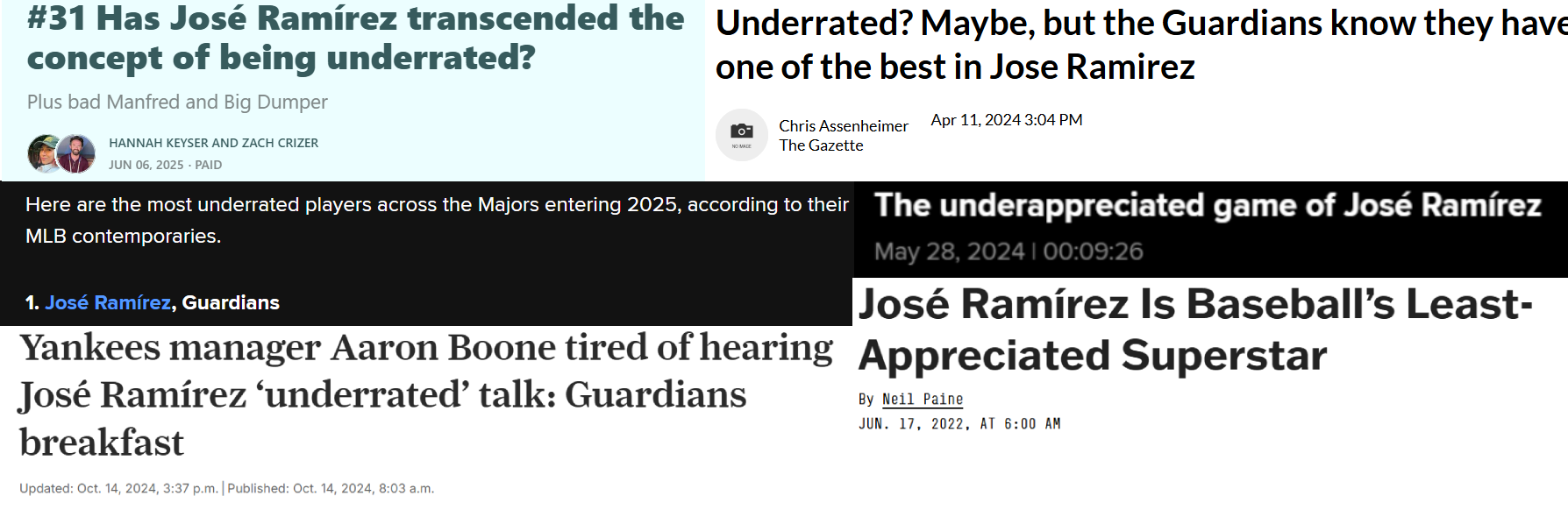
This does not even scratch the surface in terms of J-Ram discourse.
A real “most underrated player” is one that fans can’t agree on, or someone whose stat line surprises many people who follow the game closely.
Enter Geraldo Perdomo: the Arizona Diamondbacks‘ 25-year-old shortstop. He surprised many when he was selected as an All-Star replacement during his sophomore year, and replicated our surprise with his stellar 2025 campaign. The team inked him to a four-year extension this January, buying out two years of arbitration with a club option for 2030, and he’s arguably outperforming it already.
He’s had a breakout season this year, posting a 131 wRC+ and 4.8 fWAR. That’s elite territory. Assuming he crosses the 5.0 fWAR threshold, he’ll become one of just 17 players under the age of 25 to have a 5.0+ fWAR season since 2020. Every one of those players except two (Andrés Giménez and Austin Riley) is a bona fide star. Perdomo’s 4.8 fWAR through mid-August ranks ninth among all hitters.
He’s underrated because he’s elite in making contact and decision-making, not by providing jaw-dropping power that shows up in highlights. Perdomo makes it almost impossible for pitchers to beat him without a ball in play, and he’s improved his power just enough to make it meaningful.
Succeeding by Not Filling Up the Highlight Reel
When you think of the best contact hitters, everyone goes to those who have elite bat-to-ball but horrendous decision-making. Take everyone’s favorite contact hitter, Luis Arraez: he has the best contact ability according to our Process+ data, but lacks in decision-making.
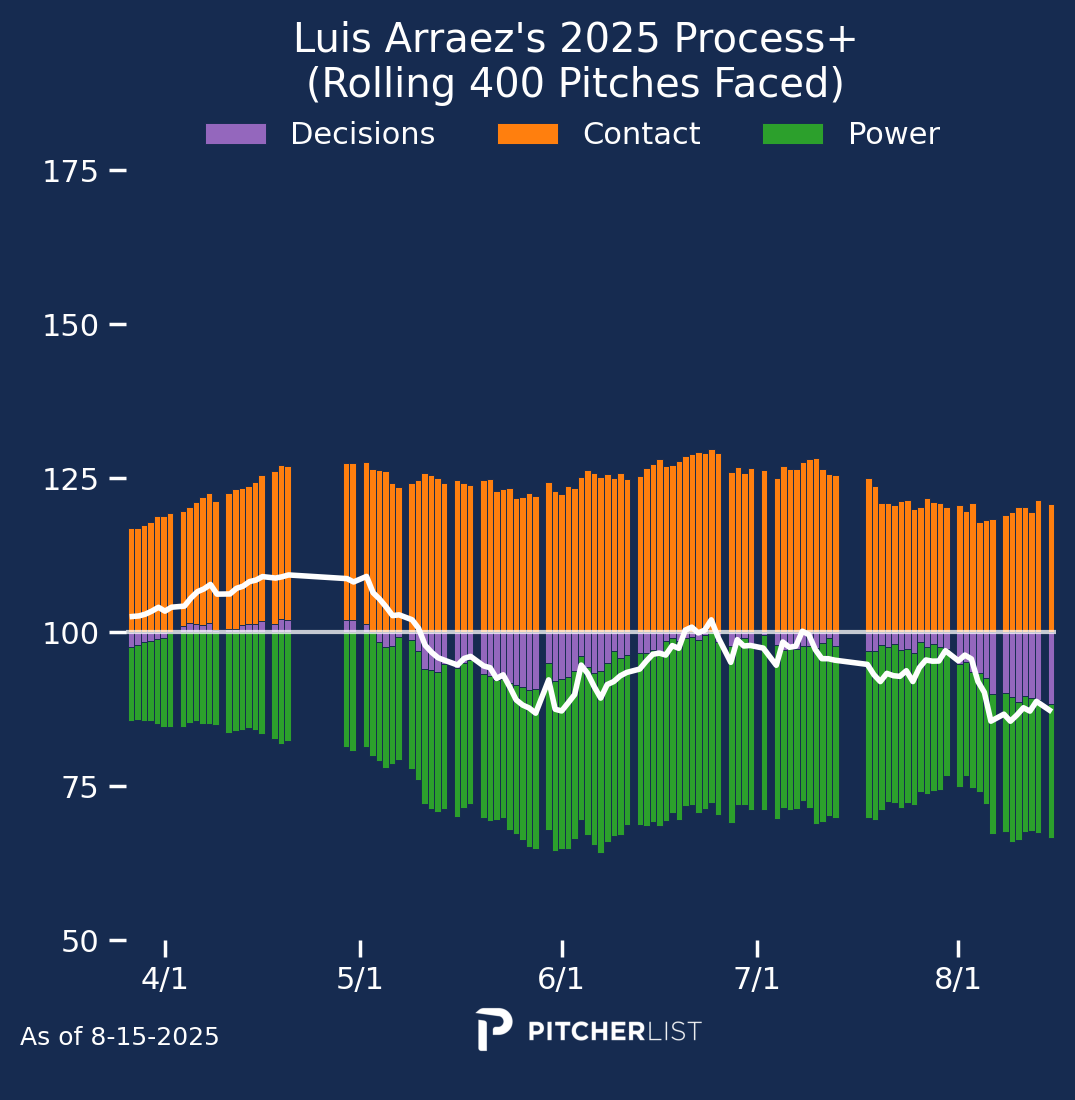
When Arraez swings, he’s almost always making contact. However, he isn’t always swinging at the best pitches, but he doesn’t prefer hittable pitches. His chase rate is in the 15th percentile, and he’s hitting .351 on pitches out of the zone compared to .281 inside the zone. His 92.0% O-Contact% is by far the best in baseball. He thrives on flailing swings that he can flair batted balls into the shallow outfield with. Arraez’s ability is elite because he’s swinging at what he wants. His overall swing rate is an average of 49.6%, so he isn’t swinging at everything to achieve his high average.
You can also see Arraez’s contact ability at play. Watch an at-bat and see him swing at a bunch of pitches out of the zone, making contact with all of them somehow.
Perdomo, on the other hand, possesses similar contact ability but thrives on passivity outside the zone and taking advantage inside the zone. His Contact ability ranks sixth in baseball and is only nine less than Arraez’s 142. He doesn’t swing much at all, but doesn’t miss when he does. It’s certainly an archetype already (Chase Meidroth, Alex Call, Bryson Stott), but Perdomo is taking it to new heights.
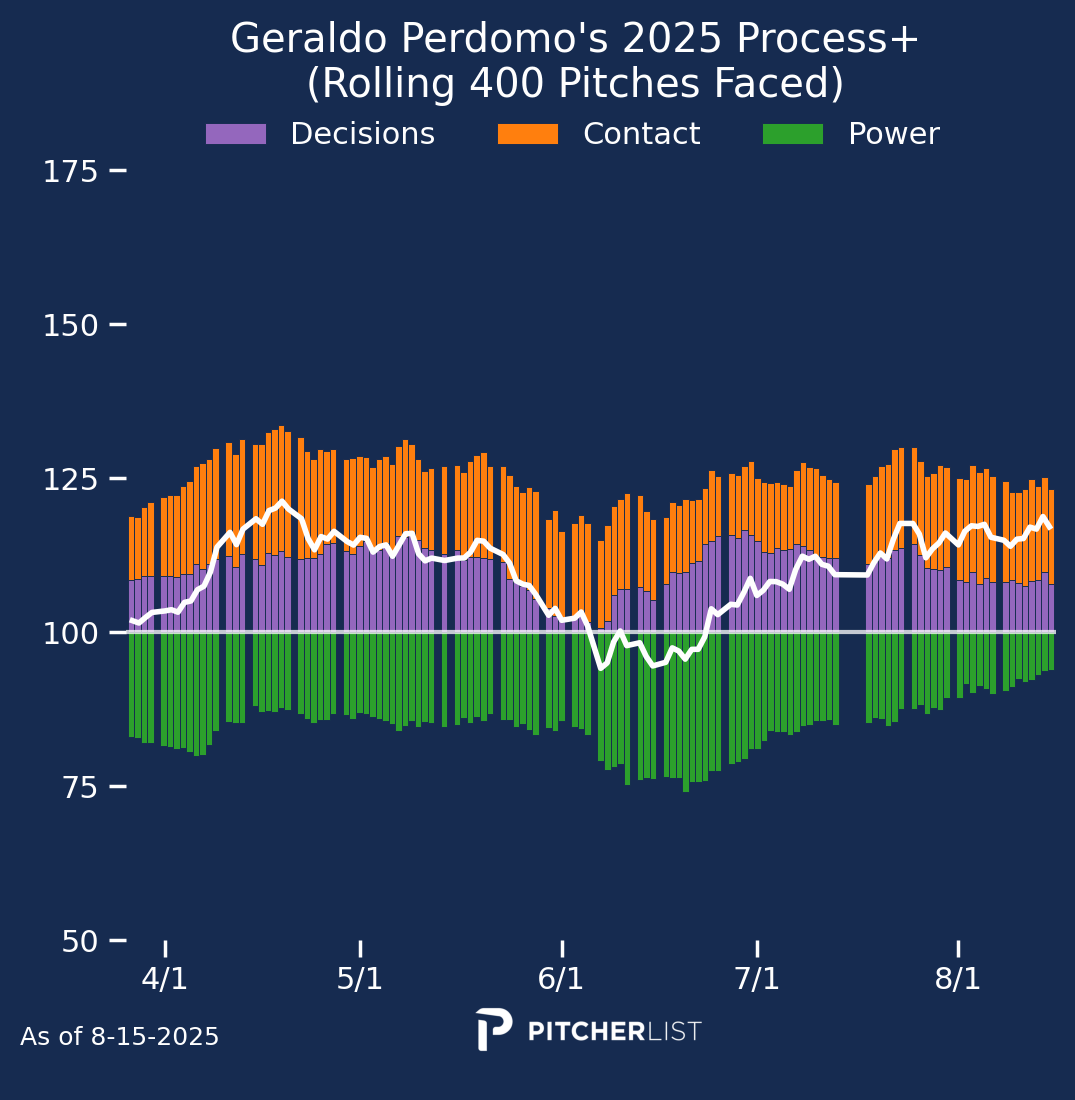 Perdomo has a lowly 39.0% swing rate, but it’s paired with a 92.4% Z-Contact% (96th percentile) and 75.7% O-Contact% (97th percentile). This creates an elite combination for drawing walks and avoiding strikeouts. He stands out with a 10.7% strikeout rate and 13.8% walk rate, making him one of three qualified hitters with more walks than strikeouts. Being in the company of Kyle Tucker and Arraez isn’t half bad, and Perdomo has the largest gap between strikeout and walk rate of the group.
His contact ability also doesn’t shine like Arraez’s. Making contact with a pitch inside the zone? Well, yeah, that’s what a hitter is supposed to do.
Combining his Contact and Decision Value, he ranks first among all qualified hitters with a combined 255, ahead of Liam Hicks and Mookie Betts. Since Power is still the most important for run value, Perdomo’s 85 Power equates to a total 108 Process+. A 108 Process+ equates to an above-average big league hitter, not one that’s over thirty percent better than league average. I don’t believe he’s overperforming, though. He’s made changes to what pitches he does damage against and his batted ball profile.
Finally Hitting Fastballs
Perdomo has improved his performance against fastballs year-over-year. He went from a -13 run value and .177 average in 2022 to a +7 and .281 average this year, a complete transformation of a weakness into a strength.
The difference is that he’s now able to handle velocity, as evidenced by his last two seasons. In 2022 and 2023, he hit .150 with a .235 xSLG on fastballs above 95 mph. In 2024 and 2025, that turned into .282 and a .367 xSLG. His whiff rate on 95+ also dropped by 5.2%.
I believe Perdomo’s swing speed increase might help him catch up to fastballs, where he didn’t need to change his pitch recognition process. While we only have data going back to 2023, his swing speed currently sits at 68.2 mph for both-handed swings combined, up from 66.9 mph a year ago and 65.7 in 2023. This leap is still well below the 71.6 mph average, but it’s a notable jump from 1st percentile to 6th percentile swing speed. That’s come at a small increase in swing length, but his swing speed was previously as poor as it gets.
The additional swing speed makes it fractionally later for Perdomo to be able to make a swing decision, but also to generally catch up to velocity. Getting out of the bottom of the swing speed floor was essential to achieve sustained success.
A New Batted Ball Profile
It also opened up a new right-handed swing, allowing him to get hit for more average. Over the last two years, Perdomo has hit for average as a righty and for more power as a lefty.
His right-handed swing this season has a much more defined A and B swing, which is helping him make weak, Arraez-type contact that is helping keep the average up.
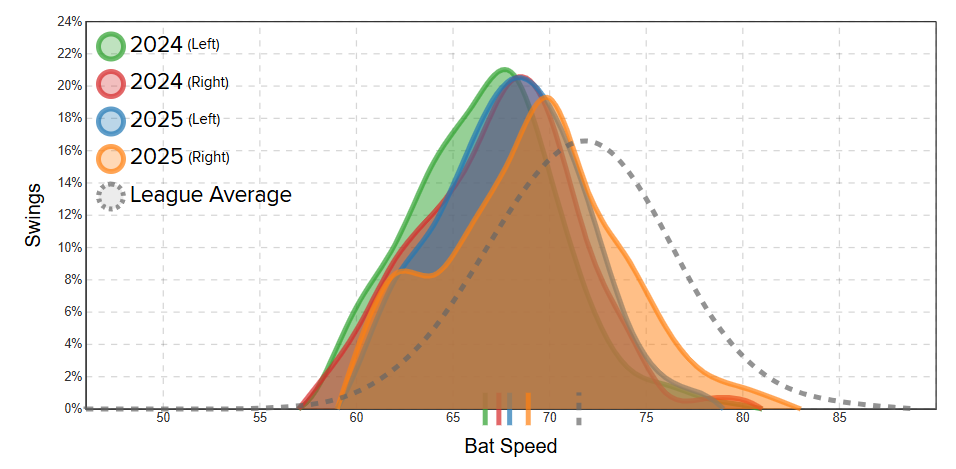
On swings under 64 mph, Perdomo is hitting .417 with a 5.6% whiff rate this year. That’s lightyears better than the .100 average and 13.8% whiff rate in 2024. It culminates in base hits that don’t feel significant, but are.
Conversely, his confidence in this right-handed B-swing is allowing him to try to take bigger hacks earlier in the count. His fast swing rate (swings above 75 mph) as a righty is 8.5% this year; it’s never been higher than 2.6% before this. He’s hit his hardest batted ball of the season as a righty (108.2 mph), but it hasn’t culminated in power yet. It’s helping him put more batted balls in the ideal launch angle, though. His Launch Angle Sweet Spot%, which is the rate of batted balls between 8-degree and 32-degree launch angles, has improved from 24.7% to 34.9%.
For his left-handed swing, he’s taking similar gains in LA sweet spot% to hit for average and tap into power. He’s improved it from 33.0% to 38.0%, above the 33.2% league average figure. His Air Pull%, where batters get the most out of their power, has risen from 16.0% to 19.2%. By mixing better launch angles and more swing speed into an approach that squares up fastballs well now, he’s seeing significant improvements in the damage from his pulled batted balls in the air. His xSLG is 1.143 this season, compared to .743 last season.
Perdomo does just enough right for it all to come together. He’s hit 13 home runs this year and swiped 21 bags, too, so it’s not a completely empty stat sheet. He possesses the decision-making and contact skills that are some of the best in baseball, and is just now hitting for enough power to make it all show up.
He’s the most underrated player because you don’t see him putting up star-type value. Even his defense is only league-average at shortstop, which is valuable, but not in a mesmerizing fashion like other star shortstops. The Diamondbacks believe that Perdomo’s production is sustainable, and that looks true from my public-facing analysis. Paired with Ketel Marte at second, Arizona might have the best up-the-middle duo in the sport right now.
