





(Photo by Gavin Baker/Icon Sportswire)
A good portion of what a catcher does behind the plate cannot be measured by statistics; game management, pitch selection, the ratio of pitches called by a catcher then shaken off by a pitcher, etc. We could consider those just as important as the information we can gauge, mainly because a catchers influence over a pitching staff isn’t something we can necessarily quantify outside of what we witness. What we are able to measure are certain defensive aptitudes such as framing ability, caught stealing rate, and defensive runs saved. We’ll discuss those shortly.
Sure, we can look at a pitching staff’s performance with the two (or three) catchers on a roster but variability can make that data somewhat unreliable. It’s not often that a team goes through a whole season (or multiple seasons) with the same pitching staff nor is it always the case that there is a fair catching split in terms of innings caught. If you have a catcher who plays 80% of games, you can’t really compare staff ERA with a teammate who only catches 20% of games due to the imbalance of sample. But, he’s the backup for a reason.
To declare one better than the other in that case is to ignore the underlying information; familiarity (or lack thereof) with the pitcher and catcher, the way he calls the game, and his defensive and/or framing ability. Several pitchers on your staff may work much better under one catcher than the other. Does that make the backup that much worse, defensively? Would he fit in better with the pitching staff of another team? What I’m saying is yes, the intangibles are important, but they don’t make or break a catcher. And that leads us to what I want to discuss; what goes into making a great overall catcher and who that is right now.
How do you determine playing time? What if you’ve got a phenomenal defensive catcher but can’t hit and another that is average at best but can produce a lot of runs with his bat? Depending on team strategy, you’re going to have different answers especially if that differential is very large.
I collected data from the last ten years, found the median amount of plate appearances, and eliminated the outliers of excessive and lowered playing time to accumulate 68 samples. I also ensured that the catchers in my sample size sat behind the plate for at least 75% of all total games played. Here are two charts that compare overall catcher defense (Chart 1) and wOBA (Chart 2) to plate appearances.
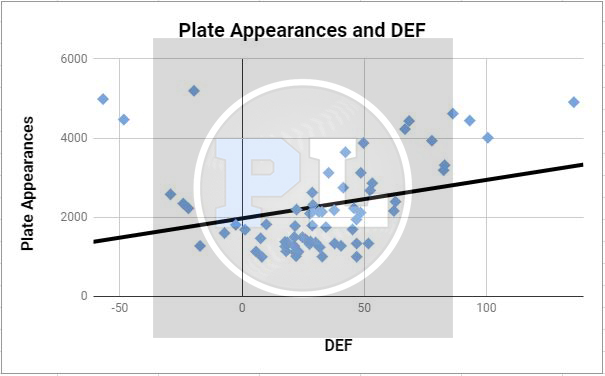
CHART 1, 7.8% correlation
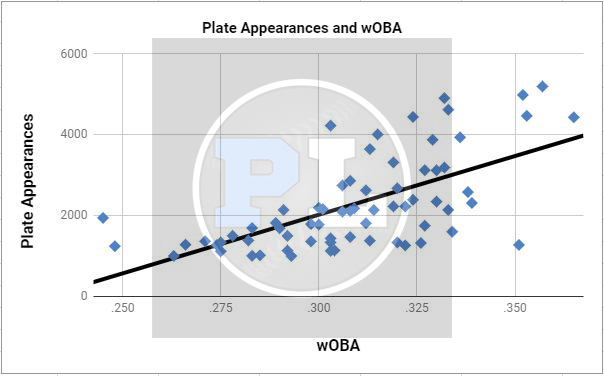
CHART 2, 40.8% correlation
Nothing mind-blowing here, though not as strong a correlation as I expected, but we see how offense is heavily favored over defensive ability/results. Is that the right way to look at it? Managers seem to think so, but I digress.
Lets first look at hitting metrics. Examine Chart 3 below; the top 10 Major League Baseball catchers with at least 100 plate appearances in 2018 using wRC+ as the measure:
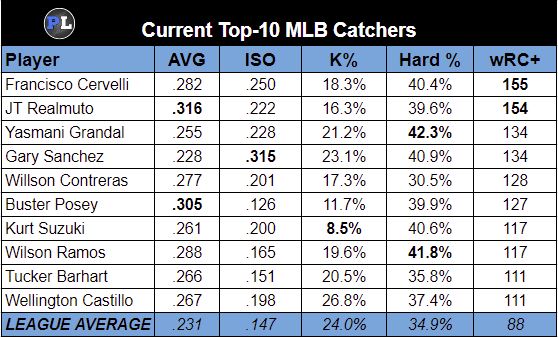
CHART 3
We have a clear standout; J.T. Realmuto of the Miami Marlins. He’s the best hitter in terms of batting average and is 1 point behind Francisco Cervelli for the best wRC+. Also, note the big dropoff after the two of them. So I would deem Realmuto, at this point in time, the league’s best catcher when looking at just offensive metrics. But, does he pass the defensive ability test?
Pop time is a good Statcast measurement to look at how fast a catcher can get up to throw a runner out trying to steal or to attempt to catch a runner off base following a pitch. You’d think the faster you get out of the crouch, the better your stolen base metrics. See Chart 4 below, courtesy of (former) Fangraphs writer Max Weinstein:
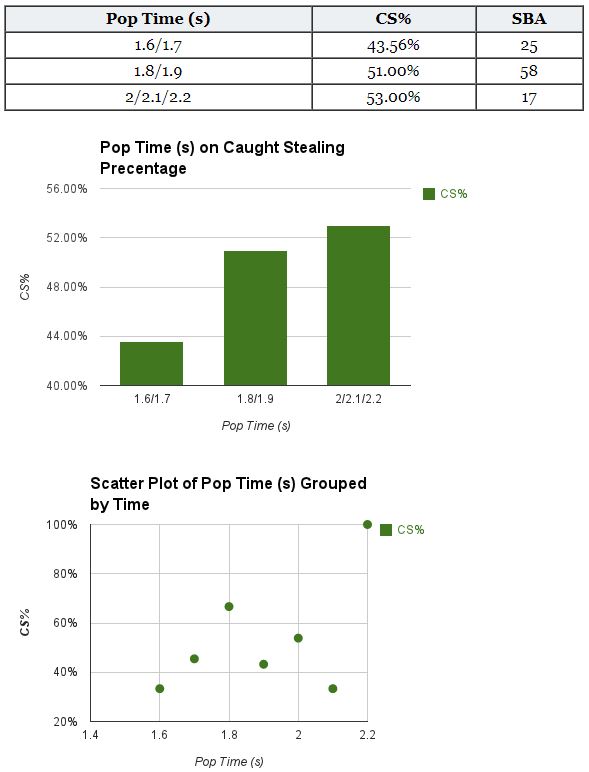
CHART 4, (circa NOV 2013)
Further info from Weinstein:
I have chosen not to include outliers in the below (sic) correlation calculations, but they will remain in the charts and tables below. Reason being, given the small sample size we are working with, small outliers have a disproportionate influence. In doing so, we are keeping this analysis statistically sound.
As you can see, there isn’t a correlation between pop time and runners caught stealing. That’s because its more dependent on the pitchers delivery, velocity, and location. You could have a lightning-quick pop time and a rocket for an arm, but if the pitcher throws a breaking pitch low and the runner gets a good jump, there isn’t much chance you’ll get him out. Yet we don’t want to completely discredit it; a good pop time is a valuable asset but you’re going to need more working in your favor to have the best chance to catch a baserunner.
Let’s look at last night’s game between the Atlanta Braves and Philadelphia Phillies. The catcher is Jorge Alfaro, who I’ve heard some feel is the best catcher in the game currently. You’ll see why they feel that way in a second. During the top of the seventh, Braves (very fast) outfielder Ender Inciarte attempted to steal second base against Alfaro and Jake Arrieta. Let’s see how that worked out, in gif form, so you can fully appreciate the artistic way this play unfolded:
[gfycat data_id=”CaringBetterAmurminnow”]
I’m not certain that Arrieta was aware Inciarte was about to steal or if he and Alfaro worked a pitchout to try to catch him if he went; the pitch was somewhat outside of the zone, but hittable. Regardless, it was a perfectly smooth transition from pitch delivery to tag, thereby facilitating the out due to Alfaro’s pop time along with a strong and deadly accurate throw. Had this pitch been a bit more erratic, they may not have thrown him out no matter how well Alfaro was able to react.
With no surprise (and no charts necessary) there is a highly positive correlation between release time (88%) as well as what Weinstein called ‘battery time’ (81%), the process of pitch delivery to the throw at the applicable base.
So what does all this mean? All we can say is that if a catcher has a strong arm and quick reactions, that can catalyze high CS% so long as the pitcher is able to put the catcher in a good position to throw the runner out like we saw in the above gif.
Let’s inspect the top 5 catchers (minimum of 5 attempts) in terms of arm strength (Chart 5), exchange (Chart 6), and pop time (Chart 7) thus far in the 2018 season.
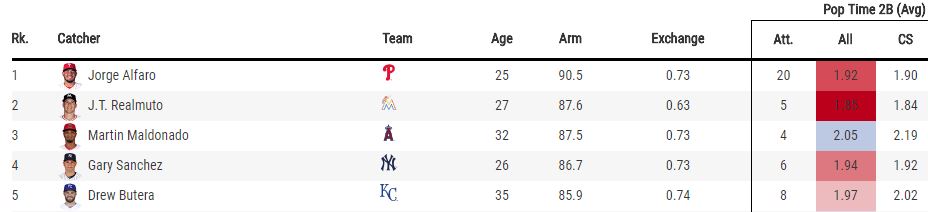
CHART 5, c/o BASEBALL SAVANT
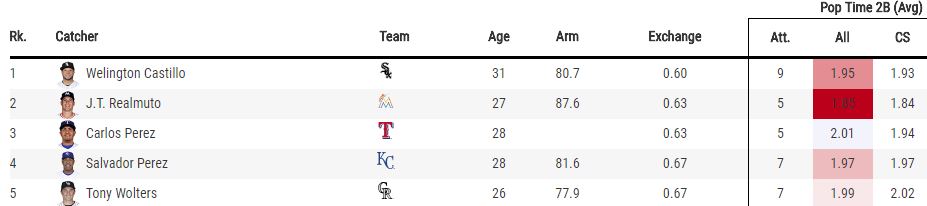
CHART 6, c/o BASEBALL SAVANT
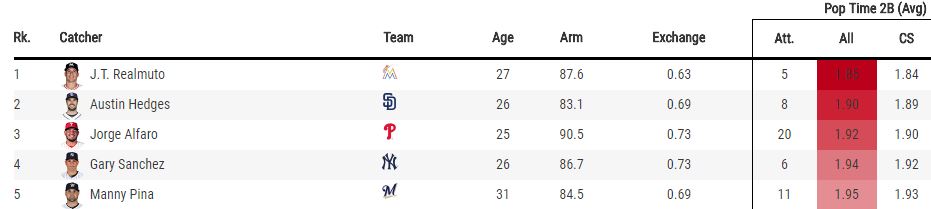
CHART 7, c/o BASEBALL SAVANT
What’s the constant here? None other than the top-hitting Realmuto. One thing working against him when looking into advanced catching metrics is that Realmuto is the 9th worst at both RAA (min 1000 pitches) and calls per game (strikes called OOZ because of framing). What are we to ascertain from that? Perhaps it’s due to the Marlins pitching staff; let’s not forget that the Marlins are 28th in team pitching WAR and 27th in team ERA. Realmuto has all the tools to keep a run game in check but apparently doesn’t frame his pitches well and loses a lot of runs due to the latter. Or, his pitchers are that inaccurate. Notwithstanding, Realmuto also has a 47% caught stealing rate. So given the chance and the right circumstances, Realmuto would certainly be regarded as an elite defender.
Realmuto doesn’t play in a big market but his play is big enough to garner a decent amount of exposure. Taking offensive statistics into consideration as well as defensive ability (independent of results), Realmuto is the easy choice as the current best catcher in baseball. Marlins fans should admire his talent while it’s still around because I’d venture to guess Realmuto is going to be a very hot commodity once the trading deadline approaches. That is if he can keep his production somewhat close to what he’s done so far.
