





Is “disappointment” the right word to describe the current core of the Baltimore Orioles? Adley Rutschman was supposed to usher in a new era of Baltimore baseball. The Orioles won 83 games in Rutschman’s rookie year and 101 the next season before his bat went south. Gunnar Henderson’s 7.9-fWAR 2024 season kept Baltimore afloat long enough to make the playoffs, but Baltimore has spent the last 18 months mired in mediocrity.
Rutschman’s Orioles are yet to win a playoff game. With the clock ticking on Henderson’s team control, Baltimore’s sense of urgency was evident in its most recent offseason. The window may be closing, even if its catcher is bouncing back.
This team isn’t going anywhere if its stars don’t fire, and Henderson’s 2026 campaign is off to a dismal start. He’s slashing .208/.270/.443 and striking out far more than ever before, a blend of plate discipline and bat-to-ball regression that might change our priors.
The further we get from 2024, the more Henderson looks like a true-talent 125 wRC+ bat. The Orioles can win with that; it’s the offensive part of a 5-WAR profile at shortstop. However, the new shape of Henderson’s game has made his underperformance more jarring, even if the underlying changes aren’t inherently bad.
Henderson’s Power-Play Goal
Henderson’s numbers are worse across the board, except for his power. The strikeouts are up, the walks are down, and his OBP is over 50 points worse than his rookie season. Meanwhile, Henderson has slugged nibe home runs after just 17 last year, and both his ISO and barrel rate are in line with career norms.
Say what you want about the merits of average exit velocity, but Henderson isn’t hitting the ball any harder than years past. Instead, he’s optimizing his power by pulling everything.
This kind of power may be temporarily buoying his production. Henderson is tracking to leave last year’s homer total in the dust, and on a per-plate-appearance basis, he’s leaving the yard more often than his 37-homer 2024. Despite his K%, BB%, and Z-Contact trending in the wrong direction, I’d hesitate to say that he’s selling out for power.
Henderson is rightfully trying to get the most out of his batted balls, rather than squeezing the last bit of juice from a declining profile. He’s lifting more than ever as a result of a swing change, too. Its tilt is 2° steeper, paired with a 5° uptick in attack angle, and his intercept point is nearly two inches closer to the pitcher than last season.
In essence, Henderson is trying to hit home runs, and it’s working. But in reining in the downsides of this approach, Henderson is leaving damage on the table and suspending himself between two different hitters.
Gunnar Gone Hunting
Henderson has always been a fastball hitter. He’s hunting them, particularly early in counts, and that aggressiveness has had some consequences.
Pitchers are creatures of habit, so it’s of little surprise that they continue to throw 0-0 fastballs to him at a similar rate to recent years. However, when they offer him something softer to start the at-bat, they’re hitting pay dirt. Henderson is swinging and missing at breaking balls and offspeed pitches at 40- and 50-percent clips, respectively, in 0-0 counts. That seems to be an adjustment from last year, where he swung and missed at an unusual amount of first-pitch fastballs (28.2%), while faring better against other offerings.
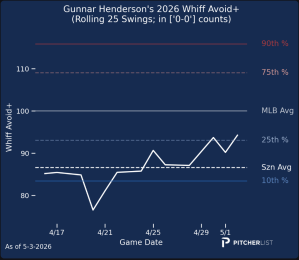
Notably, it’s the second pitch of the plate appearance that is cratering his fastball frenzy. In 0-1 counts, Henderson is seeing heaters 41.1% of the time (down from 53.9%). Even when he wins the first pitch, opponents aren’t budging. He’s getting fastballs in just 40% of 1-0 counts, compared to 60.5% last year. He’s betting that he’ll eventually get one and losing badly.
So far, this is a story of a hitter dead-set on crushing hard stuff and flailing at everything else. With two strikes, though, that changes. In losing that approach—that identity, if you will—Henderson looks lost while behind the count.
Much like his newfound proclivity for lift, Henderson’s game plan can be seen in his swing data.
Henderson doesn’t have distinct A and B swings like some of the game’s finest magicians, but there is a separation. He’s shortening his swing in hopes of not striking out. It’s not working. Henderson is getting to two-strike counts at the highest rate of his career. He’s also chasing more in those counts, and his 13th-percentile putaway rate (24.8%) is a massive increase from his prior two seasons. He’s piling up those strikeouts while making better decisions, too, which makes this feel like a bat-to-ball issue going unaddressed (or uncompensated for).
It’s unsettling to watch a great player struggle without an obvious solution. But for all the hunting he’s doing early in counts, Henderson just cannot hit two-strike fastballs right now.
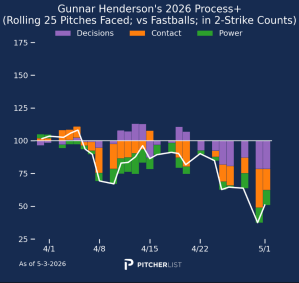
He’s made gains here against breaking balls and offspeed pitches. It’s still a losing battle. Very few hitters can make their living hitting soft stuff with two strikes, as there’s less potential for damage and more risk of chasing out of the zone. I’d wager that Henderson’s Process+ improvements here are not worth sacrificing any semblance of potency against everything else.
Who Is Gunnar Henderson?
It’s important to note that, regardless of approach, Henderson isn’t a 95 wRC+ bat. It’s probably only a matter of time before Henderson is playing catch-up in a race for down-ballot MVP votes and keeping the Orioles in the hunt. For now, though, the path back to normalcy is hard to find.
Perhaps better luck will be the catalyst. Like most underperformers, the batted-ball gods have not smiled upon Henderson in the early going. His BABIP hasn’t strayed from its expected counterpart by more than 16 points since his rookie season. Last year, they were identical! In 2026, Henderson’s BABIP (.242) is 64 points below his xBABIP.
We can attribute part of that to his Under%, which has skyrocketed with his new swing change. He’s not doing himself any BABIP favors by aiming for the right field foul pole, but regression should push his batting average closer to his career .265 line in due time.
Ultimately, Henderson’s power feels sustainable. He’s hit 37 home runs before (and 28 the year before that) while optimizing his swing for pull-side lift. Given the decline in plate discipline, that might give him a different route to the 125 wRC+ we’ve come to expect. Not every 154 wRC+ season foreshadows similar dominance down the line, and as Henderson fights the battles of other mortal players, it’s entirely possible he has already peaked.
There’s no shame in being a perpetual 5-WAR shortstop, and Henderson is too talented to convincingly cap. As he tries to identify the type of hitter he wants to be, though, the Baltimore faithful may be better served by recalibrating their expectations.
Adapted by Kurt Wasemiller (@kurt_player02 on Instagram & Threads
@kuwasemiller.bksy.social on BlueSky)
