





Nearly a month ago now, I found myself at the Rogers Centre taking in some interleague action between the Padres and Blue Jays. Toronto won 3-0 and the quality start by Chris Bassitt, as well as home runs by Vladimir Guerrero Jr. and Anthony Santander, rightfully stole headlines from that night. However, that wasn’t what stuck with me the most from this game.
It was my first time watching Luis Arraez live and in-person, and some of the things that make him such an enigma were on full display. He went 1-for-4 with a double, swung and missed just once at the 23 pitches he saw, and didn’t strike out despite seeing a total of 12 two-strike pitches. It wasn’t lost on the spectators either: When he roped a 1-2 sinker slightly in off the plate from Chris Bassitt for a double, the collective groan from the Toronto faithful was audible. The Jays ended up sweeping this series, but not before Arraez gave the Padres the lead in the 10th inning on a line drive single off a lefty. Even when his team was shut out in 2 of the 3 games in that set, Arraez captured the attention of the fanbase for how hard he was to set down.
Something funny happened that week, though. In that third and final game, Arraez did the impossible — he struck out. Toronto reliever Yariel Rodríguez blew a 98-MPH fastball by him in the 5th inning. It was Arraez’s 4th strikeout of the season; he has only added one more since then. I had seen him put up a 5-hit game against my Blue Jays back in 2023 when he was with Miami so I knew how pesky he could be. My takeaway from watching him up-close for a whole series this time around was that he was still a tough matchup for any pitcher, even though he hasn’t been his peak self for longer than you might think. Still, witnessing that strikeout in between the game I attended and the 2 clutch hits he put up late in the series finale got me thinking: How do you strike out the guy who never strikes out?
We’ll need to dig deep to provide a blueprint for one of the most difficult tasks in baseball, so I downloaded every pitch Arraez has seen since the start of 2021 using Statcast Search. 2020 was the first full season in which MLB used Hawkeye to supply their player and bat tracking instead of Trackman, but as everybody knows, that was the queen mother of all weird seasons, so I figured I’d stick to the 162-game slates for this study. Let’s begin: Since the start of 2021, Luis Arraez has struck out a grand total of 159 times. For some context, 27 men struck out more than that just last season alone. Eugenio Suárez has struck out the most (828) over that timespan. To catch up to that total at his current pace, Arraez would need until 2043, when he will be 46 years old. It boggles the mind the more you think about it, but there are still noticeable trends here — pitch types being one of them.
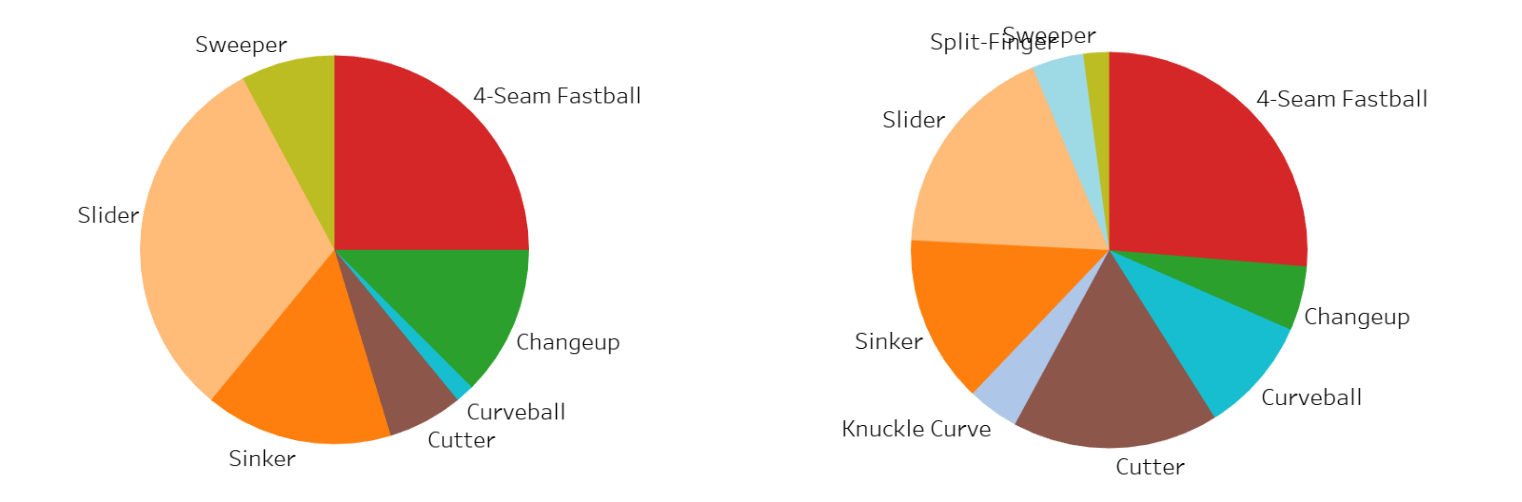
Luis Arraez strikeouts by pitch type since 2021 (left chart vs LHP, right chart vs RHP)
Lefties have struck him out mostly on sliders, followed by fastballs, sinkers, changeups, and sweepers. Righties have struck him out mostly on fastballs, followed by sliders, cutters, sinkers, and curveballs. Context and opponents’ pitch selection matters in a sample this large, though — if you go on a rate basis, this chart looks a lot different.
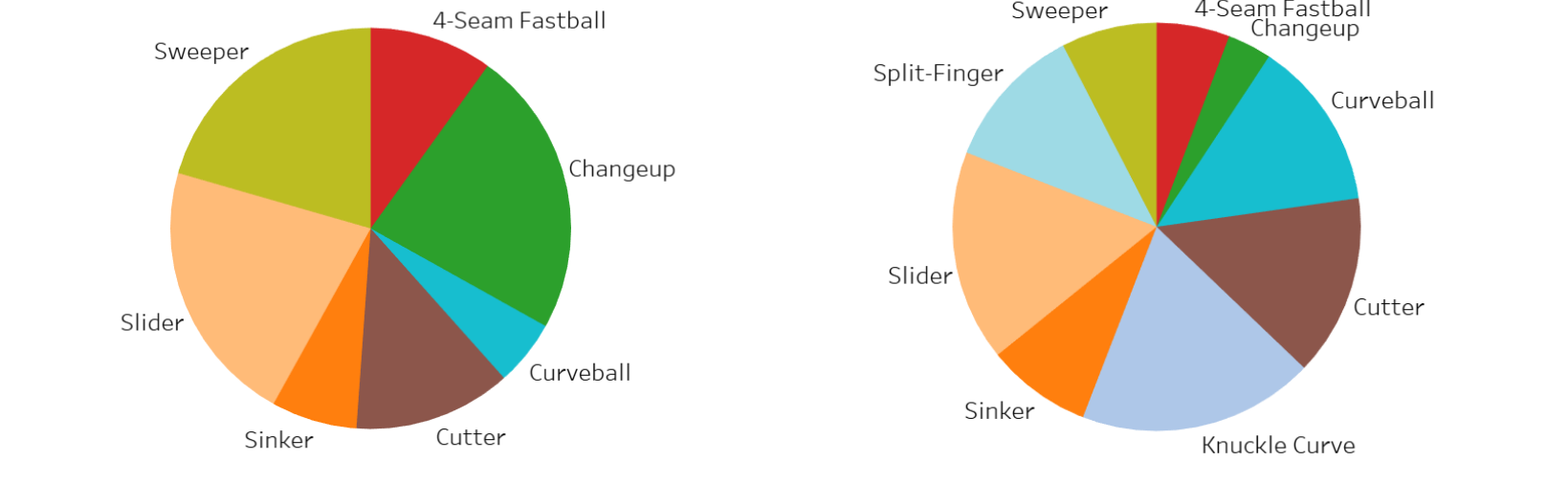
Luis Arraez K% by pitch type, 2021-25 (min. 100 pitches by type; left chart vs LHP, right chart vs RHP)
This reveals that if lefties play the percentages, the changeup has actually been the most effective at striking him out, followed by sliders, sweepers, and cutters. It’s a messier hierarchy for righties, but a secondaries-heavy approach still appears to be the move with curveballs leading the pack, followed by sliders, cutters, and splitters. I’m not sure how into-the-weeds MLB teams get during their game planning process, but it should also be noted that in 2-strike counts in general, Arraez has performed well against virtually every pitch type against the cutter.
In theory, then, there are multiple schools of thought. Yes, Arraez has struck out more against some combination of four-seamers and sliders than any other pitch over the past few years, but when taking into account the number of pitches thrown, the obvious leaders are changeups for lefties (a little weird since Arraez himself is a lefty; basic pitching intuition would suggest sliders instead) and curveballs for righties. However, looking at his performance in 2-strike counts in general illuminates that this is a high-risk, high-reward play. Arraez is clearly sitting secondary in most of these situations, so the safest bet looks like the cutter from that vantage point. We’ve analyzed pitch usage with just about every lens possible, but what about the location of those put-away offerings?
From lefties (catcher view):

Luis Arraez strikeout locations vs LHP, 2021-25 (left chart fastballs, middle chart breaking, right chart offspeed)
And now righties (catcher view):

Luis Arraez strikeout locations vs RHP, 2021-25 (left chart fastballs, middle chart breaking, right chart offspeed)
It’s interesting how these locations deviate depending on the handedness of the pitcher. One of the most uncomfortable pitches possible for a lefty is the hard fastball up and in, but even in scenarios where the strikeout is in play, southpaws have had a much easier time living on the outer and lower halves. They don’t elevate against him at all, while the righties essentially have a safe peninsula going downward from the top of the zone in either direction on fastballs. Meanwhile, look at how far out of the zone those breaking balls from righties have to be to get him. It’s basically walking the tightrope between getting Arraez to chase and hitting him.
One of the most important factors that cannot be overlooked in striking out Luis Arraez, though, is getting to strike 2, which is easier said than done. Sure, he swings at everything and is far less likely to be in a 3-ball count instead, for example, but he puts the ball in play so much that even getting that second strike is an achievement. He has seen 9,927 pitches within this sample. 2,658 of them, just over a quarter, have been in 2-strike counts. Below is a chart of all the pitches since the start of 2021 that have taken him from a 1-strike count to a 2-strike count. Here, fastballs are much more advantageous, with sinkers, sliders, changeups, and cutters also standing out.
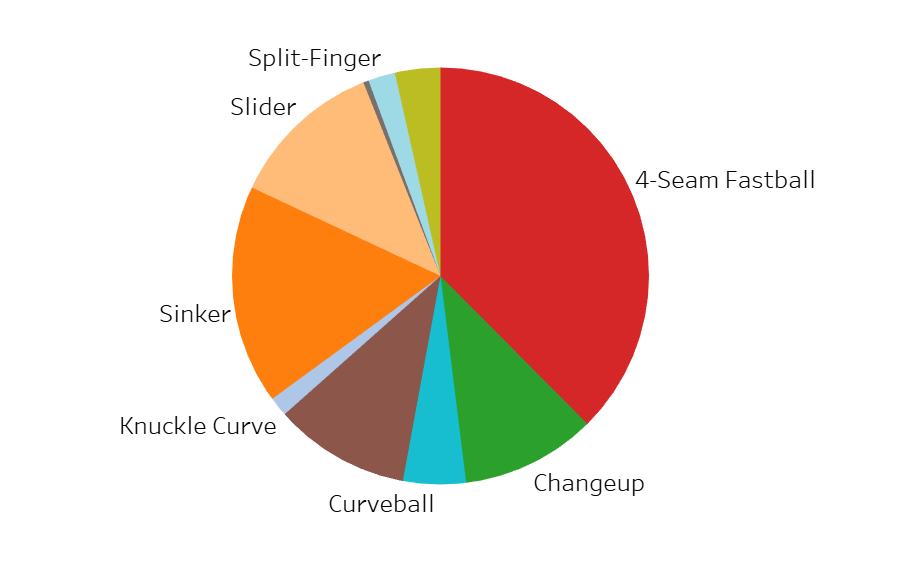
Luis Arraez strikes in a 1-strike count by pitch type, 2021-25
We now have a pretty formidable procedure. If you’re a lefty who wants to strike out Luis Arraez, track records indicate the way to go is setting it up with either something in the fastball group or a slider, before going with something in the slider group down and away off the outside of the plate (or a changeup down off the inside half if you’re feeling frisky). If you’re a righty who wants to strike out Luis Arraez, set it up with either something in the fastball group or a changeup before backfooting a curveball to the inside of the zone. Alternatively, if you’re scared off by how well he performs overall against breaking balls when behind in the count and want to pump a hard fastball or cutter in there instead, lefties should try to dot the corner down and away, while righties should do the same on the corner up and away, although the latter group could generally live anywhere on the inside, upper, or outside edges of the zone and not hurt their chances.
There’s one more angle from which we can explore this: By opponent. Arraez’s 159 strikeouts in this time frame have come against 126 different pitchers, but of those 126, only 25 have done so more than once and just 5 have done so more than twice. Patrick Sandoval and Jon Gray can claim to have struck out Arraez 3 times each, and the co-kings of striking out the man who never strikes out with 4 apiece: Carlos Rodón, Corbin Burnes, and Cal Quantrill. In one of the wildest pieces of trivia I have ever seen, both Rodon and Burnes punched Arraez out twice in the same game…multiple times. The former got him twice on July 6, 2021 when Arraez was a Twin and Rodon played for the White Sox, and again on April 9, 2024 during an interleague clash between their current clubs, the Padres and Yankees. Burnes got him on April 3, 2021 and July 27, 2022 when he played for the Brewers. I have no idea what Quantrill is doing up there; he’s a righty with a career K/9 of 6.72 and a fastball that barely touches the mid-90s on a good day. Maybe the matchup between extreme contact pitcher and extreme contact hitter creates a weird, glitch-in-the-matrix-style double negative that causes Arraez to be helplessly tied to the fate of striking out in that scenario but practically no others? If that isn’t baseball in a nutshell, I don’t know what is.
Based on this experiment, Burnes has the perfect arsenal for striking out Arraez (cutter then curveball/sinker/slider), so their history tracks perfectly. Unfortunately, he was just shelved and needs Tommy John surgery so Arraez will be spared from his one true nemesis for the time being. There isn’t a lefty with a mix crafted in the Build-an-Arsenal-to-Strike-Out-Luis-Arraez-Lab (trademark pending) quite like Burnes’, but on that earlier note about lefty-lefty changeups working in the correct doses, Diamondbacks reliever Jalen Beeks has both the highest total and rate of lefty-lefty changeups thrown in 2025. This is the first season in which the two have been division rivals, and they’ve yet to square off during it, but once they do, don’t be surprised if Beeks pulls the string on him.
I wasn’t expecting the answer to this research question to be a simple one given how little Luis Arraez strikes out, but it’s more cohesive than I thought it would be. With all the information at the disposal of MLB players and coaches, it may be a waste of both time and energy for opposing pitchers to calculate a plan to strike him out. If anyone out there is crazy enough to take it upon themselves, though, may this guide serve them well.
All stats entering June 11, 2025
