





One of the first tremors of the 2026 trade deadline came from the American League. In a move of soft buyers looking for steadier ground, the Chicago White Sox dealt reliever Seranthony Domínguez, outfielder Nolan Jones, and prospect Boston Smith to the Seattle Mariners for veteran starter Luis Castillo.
That move effectively fulfills the promise of this article. A byproduct of this trade is that Chicago’s closer-by-committee question has been answered. What has quickly seemed like Grant Taylor’s job has officially become Grant Taylor’s job, at least in terms of being the White Sox’s premier right-hander out of the ‘pen.
Domínguez has struggled in 2026, pitching to a justified 4.89 ERA and opening the door for Taylor to move up the depth chart. In the month-plus since Domínguez was demoted to middle relief, Taylor has continued rolling, taking a bit longer to match last year’s 1.7 fWAR but doing so with more sustainable luck and an improved K-BB%. While his stuff has taken a step back in his second season, the trade-off appears to be above-average command, a worthwhile endeavor that has unlocked the rest of his arsenal.
Nothing To Worry About
By Stuff+, Taylor’s four-seamer has dropped from 120 to 110. His slider has decreased from 129 to 106, his curve from 118 to 105. His overall Stuff+ is down eight points from his electric rookie year, and each of his pitches is taking a little longer to get to the plate.
I’m not concerned, because his heater is still ridiculous.
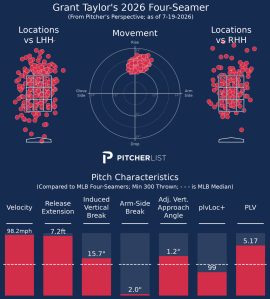
Taylor’s signature pitch is an over-the-top cut fastball with elite velocity (98.2 mph) and extension (7.2 feet). It lacks elite HAVAA and isn’t quite as firm as last year, but I’m not entirely convinced the latter isn’t a result of 11 two-inning outings. The raw characteristics that slightly declined have had an outsized impact on his Stuff+, but there’s no doubting that this is his headliner. If nothing else, its nearly-50% usage agrees.
It also pairs wonderfully with the traditional 12-6 curveball that mirrors the fastball’s spin and movement. With similar release points (especially for a curveball), spin, and minuscule horizontal movement, the pairing checks several tunneling boxes. In 2026, his command has taken the pairing to the next level.
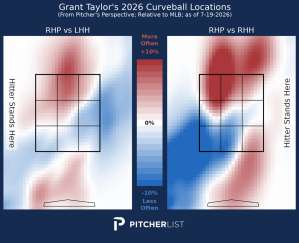
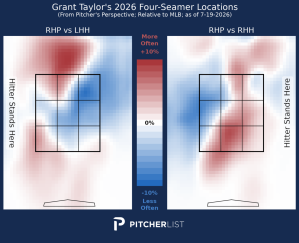
Taylor is throwing his fastball higher in 2026, keeping it conducive to whiffs above the letters and setting up the curve that he’s happy to throw for strikes (71st-percentile zone%). The results have proliferated throughout his results.
Taylor’s heater has been zoned less but returned more strikes, spiking on swings out of the zone while maintaining its called-strike rate. More fastballs above the zone have kept hitters off curveballs in it; a 3.6% drop in O-Swing% is offset by called strikes jumping from 24.6% to 31%. In turn, the pitch’s CSW% has improved to 43.3%, a 94th-percentile mark. His slider, finally returning whiffs inside the zone, has grown efficient with more usage. Nearly tripling its called-strike rate has made its CSW% playable (27.9%), a significant improvement from 21.1% in limited usage last year.
The slider also had a legitimate shape change. Taylor leaned into his supination bias and shed some of the bullet-ness, gaining two inches of glove-side movement and losing nearly three inches of drop. It’s a more horizontal offering than he’s used to, which makes sense given the introduction of his sinker.
A New Fastball Has Entered the Villa
Taylor bridged his fastball and slider with a cutter last season. PLV loved it (5.40, 92nd percentile) but Stuff+ didn’t, and the results were modest. He threw it 102 times and returned a 68% strike rate with a .422 xwoBACON.
It has since been replaced by a sinker. While the offering lacks significant arm-side run, he benefits from the cut on his four-seamer. The difference creates a similar effect to more prototypical fastball-sinker pairings, and right-handed hitters are struggling to square it up. The pitch’s 74.1% strike rate comes from an abnormally strong ability to generate swings and weak contact, sporting a .173 xwoBACON and 68.8% GB%. At the end of the day, 99 mph in on the hands is a nuisance.
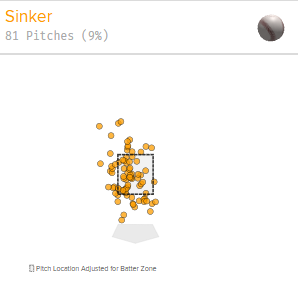
via Baseball Savant
His contact suppression has spread throughout his arsenal, capitalizing on the gravity of his four-seamer and his newfound ability to stretch hitters vertically and horizontally.
Taylor’s four-seamer is getting damaged at an average rate (.377 xwoBACON), albeit down 50 points from last season. His curveball, slider, and sinker are logging xwoBACONs of .274, .240, and .173, respectively. As the four-seamer is logging 83rd-percentile whiff rates, Taylor is missing bats when he’s not dampening them. Neither the four-seamer nor the ancillary offerings are generating in-zone whiffs at an insane rate. But guys aren’t making much contact out of the zone, they’re taking tons of called strikes, and the in-zone contact isn’t killing him.
The downstream effects of those dynamics are found in his ERA-adjacent results. On its face, 2.51 runs of ERA improvement stands out. However, the xERA is only 59 points better (2.91 to 2.32), and the FIP and xFIP are trending in the wrong direction. Fear not, neither of those marks exceeds 2.80. More importantly, he’s earning better luck and operating in a more sustainable luck environment.
Last year, Taylor suffered from brutal batted ball luck (.420 BABIP) and sequencing (61.5% LOB%). While the BABIP was absurd, he wasn’t totally innocent. He ran a .359 xBABIP and walked over 3.5 guys per nine innings, so he didn’t set himself up to outperform ERA estimators anyway.
Throwing (and earning) more strikes has helped his cause this year. His BABIP is still nearly 50 points above its expected counterpart, but it now sits at a more reasonable .283. The walk rate (8.0%) gets him below 3.00 per nine, and more guys are getting stranded. Subsequently, his WHIP has approached 1.00, without adding a ton of damage or sacrificing strikeouts.
Taylor is striking out over a third of the batters he has faced. He’s getting more swings out of the zone, fewer swings in it, and the latter are hurting him less than last year. It all seems so easy right now, and it’s proving to be possible with 60-grade stuff, instead of 70, because of his jump in command.
To the Ninth (And Beyond?)
The White Sox are still playing around with other late-inning arms, and modern baseball has ensured that Taylor won’t be locked into ninth-inning duty. But his main competition for leverage innings is Sean Newcomb and Bryan Hudson, both of whom are as close to their last DFA as Taylor is to his top-100 prospectdom.
He’s the future of Chicago’s bullpen, and that has quickly become a matter of October baseball. Taylor is succeeding sustainably. While that’s probably only as sticky as his command (and one’s belief that command can be sticky), we know he has the stuff to buy him some strikeouts when other things go awry. His stuff sets a pretty high floor, relative to other relievers, and the growth of his arsenal gives him additional off-ramps to success.
The fastball-curveball combination isn’t going anywhere. But the sinker and slider work on their own to right-handed hitters, too. The former is being thrown to better spots in 2026. It’s hitting the low glove-side corner (a little) more often than in 2025, is generally less scattershot, and is more cohesive with a fastball he’s consistently throwing to the arm side. The addition allows him to shapeshift between vertical and horizontal plans of attack, particularly to righties, and each additional pitch is one he might be able to lean on if the four-seam command buckles.
There also might be some meat left on the bone.
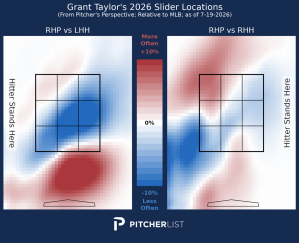
I really like his current slider locations to left-handed hitters (taken with a big grain of salt; he’s thrown 12 of them). His slider may be more effective there with last season’s gyro-based shape, and it would give him another option to tunnel with whatever fastballs land around the knees. Furthermore, Taylor is a supinator with 84th-percentile spin and 88th-percentile glove-side movement on his slider. Who’s to say a sweeper isn’t in the cards? It might just be a matter of feeling comfortable commanding a certain amount of pitches, and not needing another weapon to righties.
Oh, and the stuff gains he lost this winter might come back. I’ve framed much of this as a trade-off between stuff and command; there’s a chance this was merely stuff fluctuation amid a separate skill jump.
Playing with new pitches and seeing an extended run of success as a reliever then lends itself to one conversation: becoming a starter.
I won’t wholeheartedly endorse the decision until I’ve sorted out my feelings on stretching out one-inning fireballers. Or, like Mason Miller, a starter-level contract gets signed. But the White Sox have used him as an opener before, and they aren’t shy about his multi-inning role.
He’s thrown 19.1 more big-league innings than last year (7 fewer if we include his 15 Double-A outings). Come October, Taylor will have left that mark in the dust, and he already has a Tommy John surgery to his name.
That’s a lot to consider, and yet, Chicago also needs starting pitching help in the short and long term. This version of Taylor might still project as the White Sox’s best long-term starting pitching option, and if these command gains persist, so will the conversations.
Fortunately, neither of us have to make that decision. Instead, we can celebrate that Chicago is one of the defining stories of this summer, and that the final pages of each chapter will be written by one of the best closers in baseball.
Photo by Icon Sports Wire | Graphic by Carlos Leano
