





Every year, new protagonists emerge across the baseball world, taking the industry by surprise by succeeding when they weren’t expected to and capturing the attention of fans in search of a heartwarming story to follow. This season, one such team has been the Chicago White Sox, who entered play on Wednesday with a 25-23 record and sit comfortably in the American League’s 2nd wild card slot.
Yes, there are four whole months of regular season baseball yet to be played, and the fledgling Southsiders have been fortunate on multiple fronts: Their run differential suggests they should be 2 games under .500, not 2 games over, and the AL is bad enough that the 17-32 Angels are still only 6.5 games out of a playoff position. Still, we’re talking about a team that lost 121 games just a couple of years ago. They won the World Series in 2005, but besides that, they’ve only even appeared in 2 ALCS since 1959. Unless your affiliation lies with one of their division rivals or you’re a diehard Cubs fan with the unforgiving belief that two Chicago teams cannot co-exist in MLB, it’s hard not to look at their success this year and be happy for them. This is a fanbase that has endured a lot of suffering lately.
A big reason the tides have turned is the arrival of Munetaka Murakami, whose production to this point has made the rest of the league look foolish for devaluing him in free agency on account of bat-to-ball concerns. His 17 home runs lead the American League, and his .939 OPS is top-10 among qualified hitters. There’s also Colson Montgomery, who, for all the swing-and-miss in his game, has 13 homers of his own. Meanwhile, there are pleasant surprises on the pitching side that warrant further investigation. Grant Taylor has assumed a bullpen role and looks like a top-5 reliever in the sport, Davis Martin has a 1.61 ERA and a 2.40 FIP through 9 starts (?), and not one but two lights-out lefty relief specialists have emerged in Bryan Hudson and Sean Newcomb (???).
Also right in the middle of it all is Miguel Vargas. Did you know that he leads qualified AL third basemen, a group that includes José Ramírez and Junior Caminero, with a 146 wRC+? Or that he has 11 home runs in 206 plate appearances, when he only had 16 all of last year? This is quite an improvement for someone who had a career wRC+ under 90 coming into the season. He’s still only 26 years old, but this has been a long time coming for Vargas, who was once projected to be a core infielder with the Dodgers after signing there as an international free agent in 2017. He never came into his own offensively with L.A. and was dealt to the White Sox in the dog days of that 121-loss season in 2024. While the pieces going the other way in that trade helped the Dodgers finally get over the hump and win consecutive championships, Vargas went viral for his lifeless, despairing looks in the dugout as the defeats mounted for a team he was never supposed to be a part of.
Two years later, he has emphatically redeemed himself by hitting like one of the best third basemen in the game, but this isn’t to say there were no redeemable qualities to his offensive profile before. Last season was his first as an everyday starter at the big league level, and he made better swing decisions than almost anyone. In the Decision Value component of Pitcher List’s PLV (presented on the ‘+’ scale, where 100 is average), Vargas scored 129 last year, which put him right between Kyle Tucker and Fernando Tatis Jr. His modeled strike zone judgement was 25% better than league average. Combine that with a contact rate just shy of 80%, and you get a hitter with elite pitch recognition and solid contact-ability. His strikeout and walk rates were both better than the 70th percentile.
Vargas is also a hitter that we’d define as having good batted ball distribution. Last year, his swing tilt was steeper than average at 35°, and his contact point was a little farther in front of his body than it is for most MLB hitters. These are essential traits for pulling the ball in the air, which he did a lot. 11 of his 16 home runs, and 15 of his 32 doubles, landed between the left field foul line and the left/left-center boundary. The launch angle of his hard-hit balls placed in the 76th percentile. His exit velocity benchmarks were thoroughly unremarkable, but essentially half of his extra base hits were a direct result of his ability to lift and pull. Between that and his plate skills, his profile had a decent enough foundation. Raw power was the final infinity stone he had yet to collect.
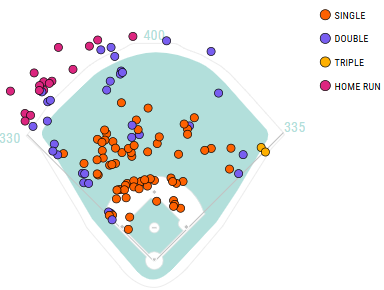
Miguel Vargas hits spray chart, 2025 (Baseball Savant)
As the sudden surge in home runs indicates, Vargas’s breakout has been all about that power. Before 2026, he had never slugged higher than .401 in a season, hit a ball 111 MPH or harder, or had a barrel rate better than the 54th percentile. This year, his bat speed is up from an average of 70.6 MPH to 73.7. He didn’t artificially manufacture that 3.1-MPH jump by making his swing longer or moving forward in the batter’s box either; all the other major components of his swing path and stance haven’t notably changed. As Fangraphs’ Michael Baumann noted in his latest delightfully-titled article, Brice Turang is the only other hitter to produce a year-over-year bat speed increase this large since MLB unveiled bat tracking data. When a guy who already made great swing decisions and produced ideal batted ball angles learns how to tap into more power, the change in results starts to make a lot of sense.
The positive implications of this newfound bat speed are more far-reaching for Vargas than they would be for hitters with different skillsets. Plate approach is context-dependent, and many hitters will adjust their plan of attack as the count changes, which means evaluating bat speed as a single average can be an oversimplification. There are instances that call for more aggressiveness, such as a 3-1 count, just as there are situations better suited for a defensive swing. Because Vargas is so good at knowing what to swing at – his already-strong chase rate has improved to the 98th percentile in 2026 – he finds himself in hitter’s counts a lot, which is the exact type of scenario to apply high-level bat speed on pitches in the zone.
Last year, Vargas’s bat speed in hitter’s counts was 1 MPH higher than his overall average. It’s good to see an increase of any kind, but most hitters aim higher than that when they swing while ahead. That 1-MPH gain was among the smallest in the league in those scenarios. This year, it’s up to 2.5 MPH. He’s already swinging faster to begin with, but he gets into favorable counts, and he’s more intent on doing damage in those spots. It’s paying off.
A look at his basic splits shows that Vargas, a right-handed hitter, has improved against both righties and lefties, as well as all pitch groups. The most significant of those changes, though, has been against southpaws, especially on fastballs. If I were a lefty pitcher about to throw him a fastball in the zone, I’d count my blessings because he’s 10-for-29 with 5 homers and 8 extra base hits when facing them. The bat speed gain obviously helps, but he has made some small tweaks to his swing trajectory here as well. A 2° increase in attack angle and a 1° shift in attack direction toward the pull side may not sound like much, but he has combined that with more bat speed and is now pulling fastballs from lefties at a career-high rate.
It’s also worth pointing out the strides Vargas has made against changeups and splitters. He’s always seen plenty of fastballs at the big league level because he wasn’t much of a power threat before this year, but off-speed pitches account for around 20% of the pitches he has seen against lefties since the start of last year, and the results against them weren’t good in 2025. He had no trouble making contact, but these were the pitches he was most prone to chasing, and he only slugged .314 against them in 35 at-bats. He had a very high attack angle and a pull-oriented attack direction against lefty changeups and splitters last year, and while a lift-and-pull approach is good for power production in general, you don’t want to see outsized swing angles on these pitch types because it’s usually a sign that a hitter is too far out in front of them, which is exactly what most pitchers who throw off-speed pitches are trying to accomplish.
His attack angle in these situations is now indistinguishable from fastballs, and his attack direction has notably shifted back towards the middle of the field. In other words, he’s doing a way better job of sitting back on off-speed pitches from lefties. It’s a small sample, but he’s 4-for-11 against them on the season. He has swung at 26 of these pitches so far and missed none of them.
The changes we’ve seen from Miguel Vargas are plentiful, and it’s evident how certain adjustments in his process have led to career-best results in 2026, so what does it all boil down to? It takes tremendous physical and mental willpower to commit to adding 3 MPH of bat speed in a single offseason, so he deserves a ton of credit for that. However (and I don’t think I’ve ever uttered these words in my life), this also seems like a player development victory for the White Sox, who hired Chicago area native Derek Shomon away from the Miami Marlins after last season to be their new hitting coach. Shomon was an assistant hitting coach with the Marlins as they welcomed some intriguing young hitters to their lineup and briefly flirted with a wild-card position in the second half of the season. He drew praise from Miami’s manager Clayton McCollough, not just for his energetic and infectious personality, but also his knowledge of the modern game:
“He could liven up a room. He’s a very good hitting coach. Sho knows the swing technically, understands the biomechanical aspect and is very good with game planning.”
At the end of April, Shomon had this to say about Vargas, who was in the midst of his first extended hot streak of the season at the time:
“Coachable, receptive, willing to make micro-adjustments where needed, when needed. He’s a good hitter. And this is a guy, who, historically, Miguel Vargas has not chased, he does not miss on the strike zone and he can do damage. It just takes a little bit of realignment here and there to get him in a spot where he can go out and do what he does best.”
This sounds like someone who recognizes that Vargas already had a workable baseline and didn’t need to be pulled away from his strengths in order to address his weaknesses. For the White Sox, a franchise with the reputation of being stuck in the past, early indications point to this being a strategic, forward-thinking hire that embraces biomechanical information to make hitters better. Props are also due to Vargas for his willingness to be open to input from unfamiliar voices he hasn’t worked with before.
Next time you tune in to the 2026 White Sox, don’t hesitate to marvel at Munetaka Murakami’s game-changing power or the wonderful quirkiness of the back end of the bullpen, but don’t let that stop you from noticing Vargas, a talented player who is re-establishing his ceiling to be one of the highest among all third basemen in the game and proving that he’s much more than a castaway from a good team that didn’t need him anymore.
All stats entering May 20, 2026.
