





In 2019, Isiah Kiner-Falefa was just plain bad. His OBP was stuck under .300, he managed to hit only one home run in 222 ABs, and his strikeout rate ended up below average. He didn’t make it up in other categories either. Although speed is one of his best assets, he only stole three bases all season, and not a single number on his Fangraphs page seems to be above average. Quite frankly, he was a living testament to the idea that catchers are a wasteland to be avoided at all costs.
And then, as we finally trudged our way through an endless month of July and into the heart of summer camp, Kiner-Falefa started to pick up a whole lot of hype. Defensively, he was moving away from playing catcher full time and moving towards playing both third base and shortstop. In fact, not only was he playing at those positions, but word was that he was looking really good at it.
Isiah Kiner-Falefa with another stellar diving stop at SS to take away a hit from Yadiel Rivera. He's had the two best plays of camp. There is belief he is the Rangers' best infielder.
— Evan Grant (@Evan_P_Grant) July 18, 2020
Rumors also swirled that Kiner-Falefa was hitting extremely well in camp. As the hype train grew, suddenly many of us collectively decided that Kiner-Falefa was going to turn into a speed demon, about to finish at the top of the league in steals. An infielder who was going to play every day, but had catcher eligibility? All on top of a player who suddenly could rake, and was going to steal three bases a week all season? IKF shot up the weekly FAAB watch lists. In fact, many publications recommended that fantasy players spend 15-20% of their yearly budget on Kiner-Falefa.
The hype was becoming out of control. This was, after all, a player who had never been so much as passable in actual MLB games. His performance wasn’t even something we could back up with our own eyes–COVID-19 restrictions prevented us from seeing anything going on in summer camp. Instead of players like Kyle Lewis and Mike Yastrzemski–two players with real underlying skills who performed at high levels right away while not rostered in a lot of 12-team leagues–receiving a lot of huge early bids, fantasy players were spending their FAAB on IKF.
And yet, somehow, it’s kind of worked out. Kiner-Falefa hasn’t been good offensively, but he’s been far closer to passable then he ever was in the past. And, more importantly, Kiner-Falefa has been stealing at a high rate. He’s currently tied for eighth in all of baseball in steals, and every other player in the top-15 is either a middle infielder, center fielder, or Austin Slater.
All that’s well and good, however. A lot of us have paid attention to Kiner-Falefa so far this year, and a lot of us know how he’s performed up to this point in the season. What’s important is projecting Kiner-Falefa’s production ahead for the rest of the season and evaluating how to evaluate him both for the remainder of this season, and next year.
Speed
As mentioned earlier in this article, Kiner-Falefa is currently tied for eighth in baseball in steals. Coming from the catcher position, this is an absolutely elite number. Only once in all of baseball history has an active catcher had more than 30 steals in a season (36 by John Wathan in 1982), and only twice has a catcher surpassed the 25-steal mark. If Kiner-Falefa kept up his stolen base pace this year over the course of 130 games, he would reach 26 stolen bases, good for the third-best single-season mark for a catcher in all of baseball history. That’s a truly monumental pace that shows just how unique catcher steals are.
And yet, as unique as Kiner-Falefa’s numbers are, they aren’t as impressive as they first appear. Remember, the break-even point for stealing is success at about 70% of the time. If a player is thrown out significantly more often then that, they’re hurting their team in the long run. If, however, a player is successful significantly more often then that, then they’re helping their team win through their base stealing, on average.
| Year | ABs | Steals | CS | Successful Steal % |
|---|---|---|---|---|
| 2018 | 396 | 7 | 5 | 58% |
| 2019 | 222 | 3 | 0 | 100% |
| 2020 | 117 | 6 | 3 | 67% |
Those numbers aren’t great. Yes, Kiner-Falefa is getting a lot of attempts, which is what a lot of fantasy players care most about. After all, few category leagues have a category for caught stealing, and steals aren’t as important in points leagues. However, when a player has a career success rate below the break-even point for base stealing, that’s a major red flag for the number of opportunities a player will get moving forward. Indeed, looking at Kiner-Falefa’s game log, he’s only had one successful steal since August 15th, two and a half weeks ago. Kiner-Falefa is not helping managers win the steals category of their fantasy matchups.
Kiner-Falefa does have above-average speed, meaning that there is potential for him to become a more efficient base stealer with more practice. He’s generally had a max sprint speed of about 28.0 FPS, which isn’t elite but is easily enough to allow him to be successful on the base paths.
Altogether, Kiner-Falefa could continue to be successful on the base paths. After all, he is in rare company among catcher eligible players, and his success rate hasn’t been so terrible that he’s been a huge liability. At the same time, however, he’s hard to count on. He’s receiving fewer opportunities as of late, and his mediocre track record does not bode well for those attempts coming back. Right now, the steals are a major perk, but unless Kiner-Falefa can prove to be valuable in some other asset of his game, it’s hard to count on them.
Power
So if Kiner-Falefa has question marks in the base-stealing aspects of his game, could his power make up for those failings? The answer, unfortunately, is probably not. Kiner-Falefa has never had more than four home runs in a season, and even that was all the way back in 2018. In both 2019 and 2020, he’s had only a solitary bomb. Kiner-Falefa’s ISO so far this year is a hard to look at .089. For reference, Juan Soto leads all of baseball with a .419 mark. Kiner Falefa’s ISO? It ranks 149th out of 156 qualified batters.
And yet, somehow, the number gets even harder to stomach. Kiner-Falefa’s career ISO is just a tad higher than his mark this season, at .090. Of the seven players with a worse ISO than Kiner-Falefa this year, five have a career ISO of at least .110. Kiner-Falefa has had worse power production in the past than every full-time player in baseball this year, with the exception of Nicky Lopez and Kevin Newman.
How about Kiner-Falefa’s power going forwards?
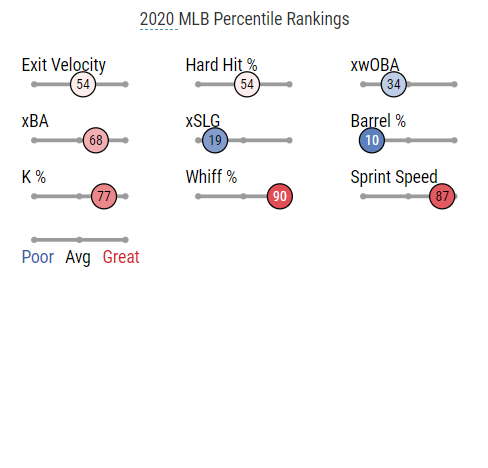
These numbers don’t look great, but they don’t look like bottom-three-power-in-baseball bad, right? After all, some of those numbers relating to power are above average, even if marginally. There are, however, two things holding Kiner-Falefa back from any power.
The first reason that Kiner-Falefa struggles to hit home runs is that even though he has a decent average exit velocity, his max exit velocity is extremely low. Kiner-Falefa has never hit a ball over 107 mph in his career, well below average. That number isn’t “third worst power hitter in the majors” bad, but in order for Kiner-Falefa to hit a home run with that kind of raw power, he has to hit a ball at the exact right angle.
That leads us to the second reason why Kiner-Falefa struggles–his launch angle. Up to this point in the season, Kiner-Falefa is hitting baseballs at an average launch angle of only 5.5 degrees. A ball hit into the ground will never become a home run, and even a line drive will likely die in the outfield if not hit hard.
If Kiner-Falefa can change his swing path so that he can lift balls into the air more consistently, he could eventually become closer to mediocre with his power production. Kiner-Falefa lacks the raw power to ever become a net positive with home runs, however, so even a period of growth in that section of his game will probably never help him reach much more than 10-15 home runs in a season.
Contact
Kiner-Falefa is hitting .271 this season, a more than acceptable number from a catcher. He also only whiffs about 17% of the time, well above average. He doesn’t chase a ton of pitches and has decently good plate discipline, all of which leads to a player who’s only struck out 19 times all season. That adds up to a 15% K-rate, which is well above average but not unheard of.
The problem is that Kiner-Falefa doesn’t do much with the ball when he does make contact. 
That’s Kiner-Falefa’s batted ball profile. The first thing that jumps out is his problem with ground balls, which we looked at earlier. Even with above-average speed, ground balls aren’t generally encouraging signs from a player. A lot of the other numbers in that profile go in conjunction with that failing. Kiner-Falefa hits over 40.9% of balls and has really low numbers for solid contact and barrels. Good players will triple Kiner-Falefa’s barrel rate and quadruple that solid contact percentage.
Overall, the similar players for Kiner-Falefa’s batted ball profile does a good job of illustrating just how poor a profile Kiner-Falefa’s hitting profile is. Remember, that even though some of these players may seem fantasy relevant, Jarrod Dyson and Mallex Smith have never been good hitters, and Kiner-Falefa compares to years in which Adam Frazier and Erik Gonzalez struggled. None of these players hit for any power whatsoever, and aside from Smith’s steals, none had so much as any redeeming factors.
Conclusion
Overall, Kiner-Falefa’s profile does not seem to be that one of a fantasy-relevant player. He’ll have a bit of empty average, because of his good contact numbers, but he won’t hit for power, and his base-stealing ways may be coming to an end. As long as he’s a catcher, he’ll have some value, just because the standard for catchers is so low. If he’s on your waiver wire right now and you don’t own an elite catcher, you might as well pick him up, just in case he starts stealing bases again.
The concern, however, is that after this year Kiner-Falefa will no longer be a catcher. Kiner-Falefa has not appeared at catcher at any point this season, and will almost certainly not carry eligibility into next season. In fact, he seems to be the rare case of a player who will instantly go from a starter for a lot of teams to an unrostorable player the day after the season ends and roster eligibility switches forwards.
Photo by George Walker/Icon Sportswire | Adapted by Justin Paradis (@freshmeatcomm on Twitter)
