





As the season continues to ripen and metrics continue to stabilize, roster decisions can become even more difficult. Is it worth waiting on slow-starting veterans to turn it around? Or is it worth grabbing hot starters with hopes they sustain their performance? Let’s look at more of those hot starters to determine whether they’re a desert oasis or just a mirage.
Michael Busch, 1B, Chicago Cubs
Michael Busch has started this year on fire. Leaning into his ability to lift the ball at ideal launch angles, he has been racking up the extra-base hits. Slotting into the heart of the Cubs’ lineup as the strong side of a first-base platoon, his production at the plate has helped the North Siders lead the league in runs scored.
Now, wait just a minute… Is anyone else feeling any Déjà Vu? Something feels so familiar about a Michael Busch hot start being discussed on an April edition of Is It Legit?… Oh, that’s right! We have been through this all before! Last year, Busch similarly got off to an incredible start before crashing back down to earth sometime around late April.
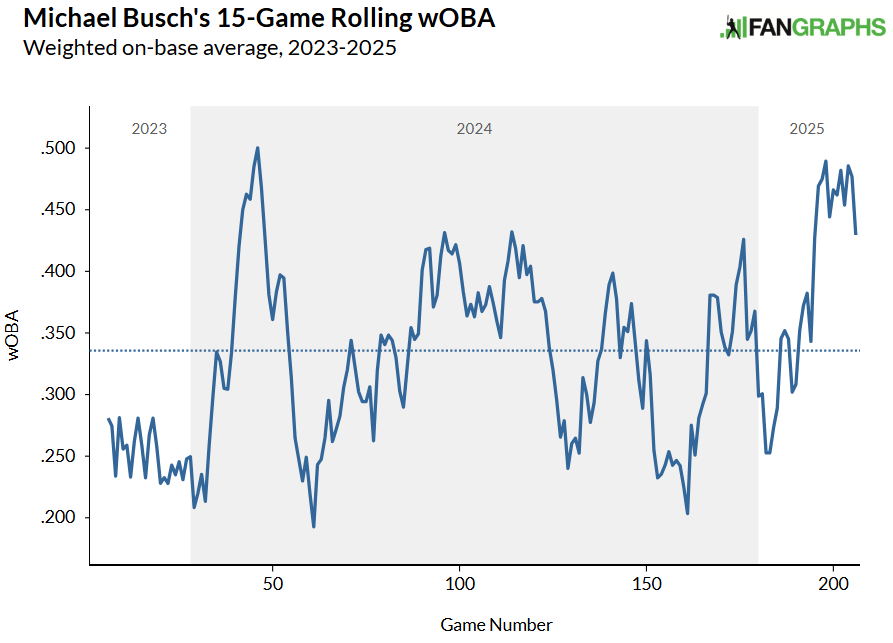
As we are once again in late April, is Busch doing anything different from last year to prevent a similar crash? The biggest issue that kept Busch from sustaining his strong performance was his propensity for strikeouts, clocking in at a putrid 28.6% of the time. This year, he’s shown improvement, striking out a more manageable 24.8% of the time. But under the hood, his contact rates haven’t shown any improvement either in or out of the zone. Even though he’s been making marginally better swing decisions, his walk rate hasn’t improved as pitchers look to exploit the holes in his swing.
Verdict: Not Legit
With poor contact rates, poor swing decisions, and a low bat speed, Busch’s overreliance on strong launch angles will continue to make him a very streaky hitter. While some players can put this type of profile together over a full year (see 2024 Jordan Westburg), Busch hasn’t made the improvements to think his hot start is sustainable over a season’s volume. He’s likely to see similar peaks and valleys to his 2024 season.
Max Meyer, SP, Miami Marlins
Max Meyer has started his 2025 campaign on fire, diving deep into games while striking out batters at an incredible rate. Meyer has been able to find success by leaning away from his fairly mediocre four-seam fastball, featuring a strong pitch mix and using his electric gyro slider 41% of the time. With five serviceable pitches, Meyer appears to be reaching the potential that made him such a highly regarded prospect.
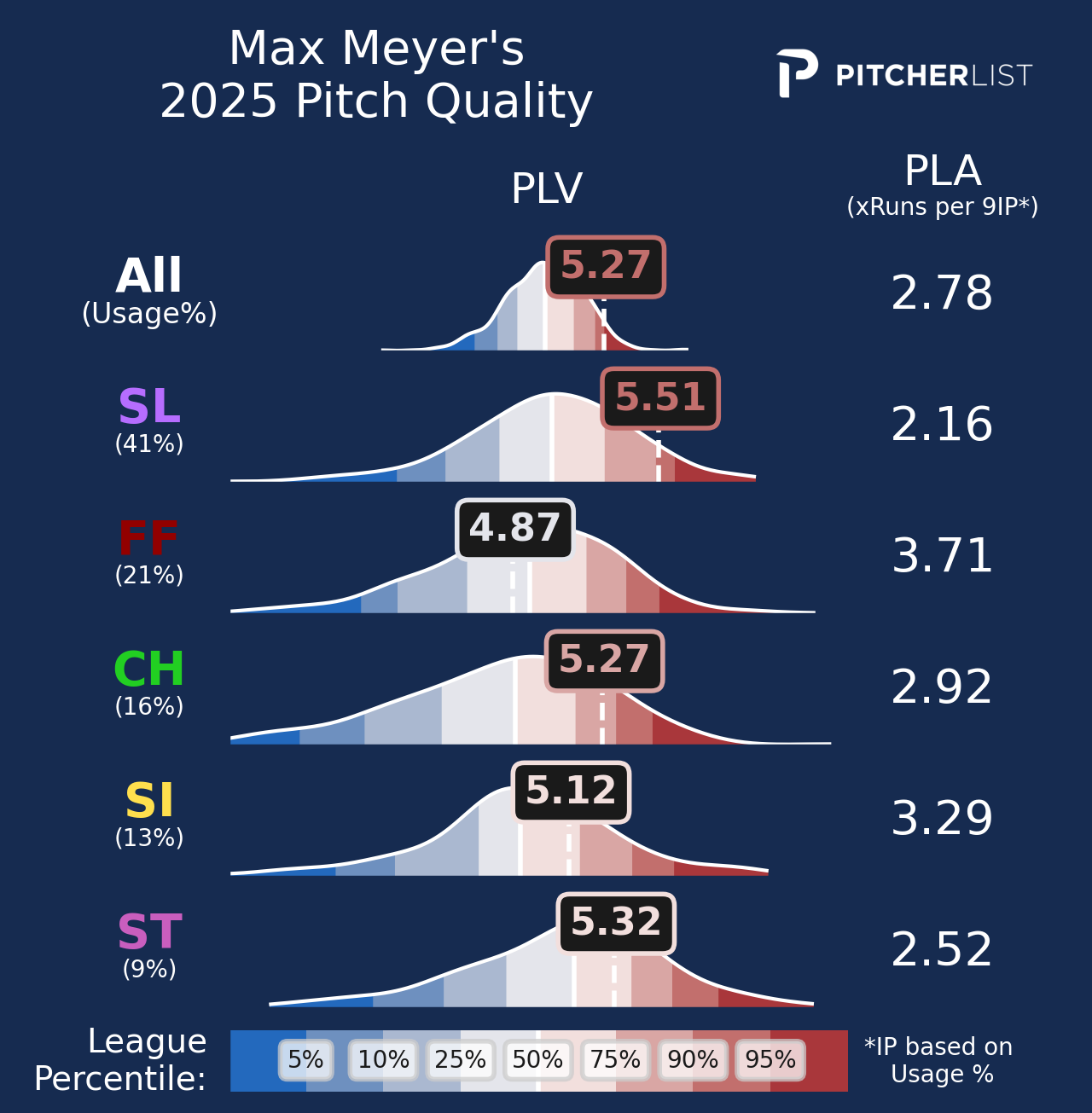
Dropping the usage of his four-seamer wasn’t the only major change that Meyer has undergone this year. His arm slot has dropped an astounding 10 degrees between 2024 and 2025. A major mechanical change like this might lead to a decrease in pitch locatability, but Meyer has actually seen an increase in his location metrics. He’s been able to slide into the bottom edge of the zone at a much higher rate than average, resulting in a strong whiff rate on his most-used pitch.
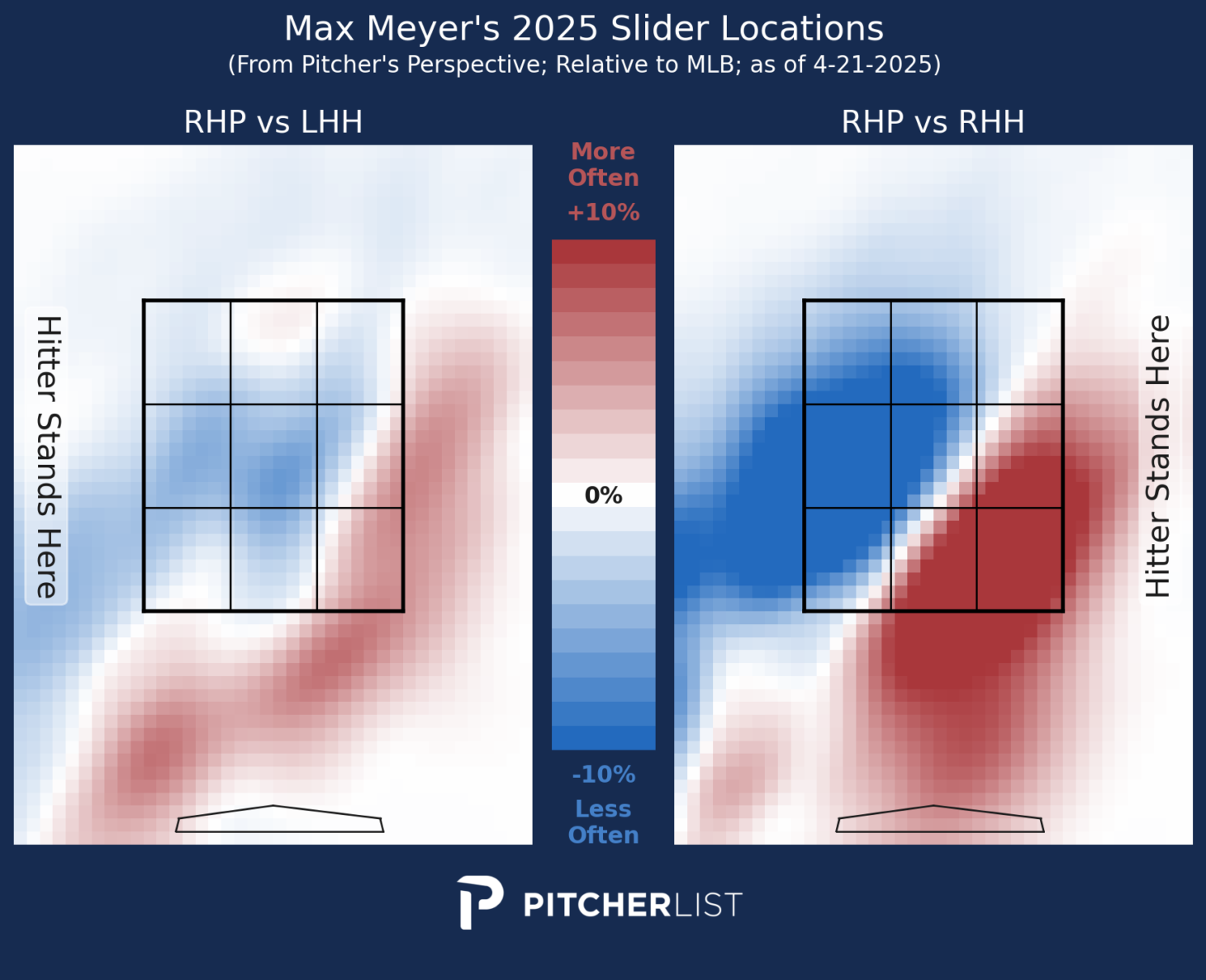
While he locates it well, his slider grades out fairly average by stuff+. Locating it effectively can certainly help this play up (as evidenced by a strong 5.52 PLV), but his slider has vastly overperformed league-average sliders at the bottom of the zone. Sliders at the bottom of the zone have returned a .240 xwOBA and 40.8% whiff rate at this point in the season across the league, and Meyer’s have carried a .119 xwOBA and 69.0% whiff rate. It’s difficult to imagine his gyro slider carrying this drastic of effectiveness compared to league-average in these locations while lacking a funky delivery or a more effective (or more used) fastball to play off.
Even with an overperforming slider, Meyer’s ability to pinpoint it will ensure that it will remain a strong weapon for him, even with some expected regression. With his feel for a wide repertoire of serviceable pitches, Meyer has the tools to fit any situation and should remain a proficient pitcher as he continues collecting both ground balls and whiffs.
Verdict: Legit
Meyer should be able to leverage his strong command and versatile pitch mix to sustain a low-fastball pitching approach. Though hitters should be able to better handle the fairly standard gyro slider that makes up such a large part of his arsenal, Meyer has the tools to survive the regression.
Eric Wagaman, 1B/DH, Miami Marlins
Eric Wagaman has had a very lengthy career in the minor leagues spanning 7 years and 10 total affiliated teams. DFA’d by the Angels at the end of the 2024 season and subsequently signed by the Miami Marlins, Wagaman has worked his way into an everyday role, splitting first base and DH duties with Matt Mervis.
Somewhat of a late bloomer, Wagaman has so far rewarded the Marlins with a very stable bat for their lineup, avoiding strikeouts at an elite rate without sacrificing power for his contact. With only a league-average bat speed, Wagaman has been able to leverage a quality bat path into a strong 18.3% Pulled-Air percentage. Though his barrel rates haven’t been too notable, he hits the ball hard enough (career 111.7 max EV) and at good angles to reasonably expect improvement over a larger sample size.
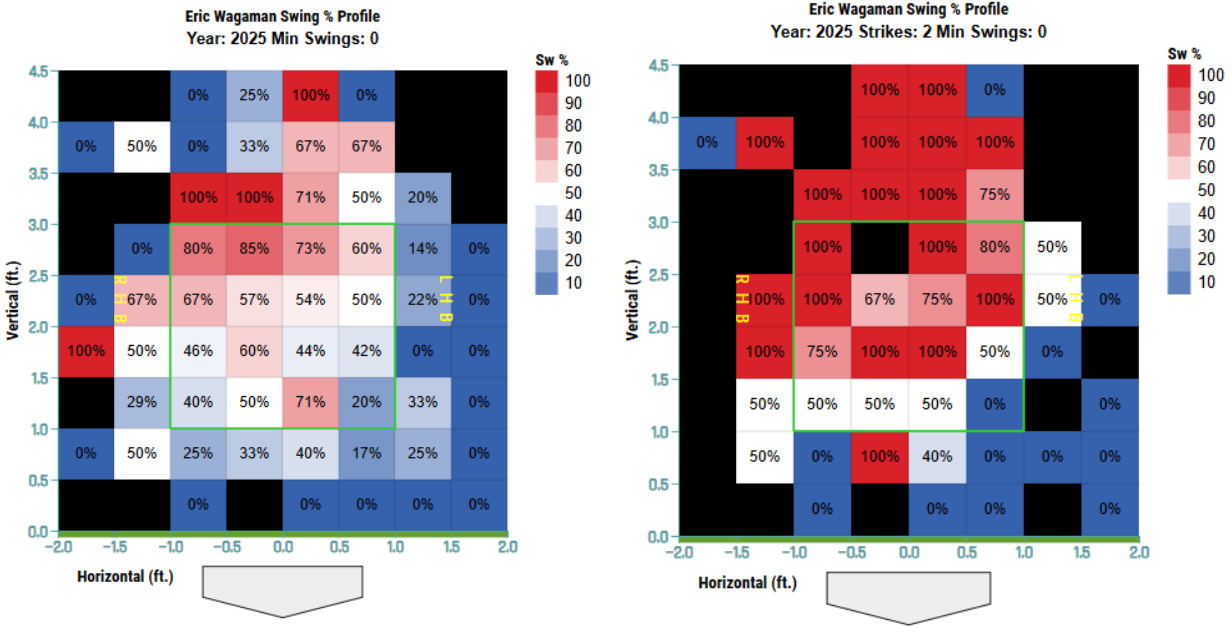
While he only has 24 games for the Marlins so far, an admittedly small sample, what has set him apart this year is his major intentional plate approach change compared to his 18 games for the Angels last year. While his contact rates have been equally strong in both seasons, he is swinging the bat far less this year compared to last. And while it looks to border on general passivity, he has been centralizing his swings towards the top of the zone where he makes the best contact, while preferring to take low pitches instead of making poor contact (if at all).

He moves away from his passivity in 2-strike counts, expanding further across the strike zone instead of picking his spots. This has enabled Wagaman to work deeper into counts, strikeout less, and walk more en route to the 20th-best Process metric among hitters that have faced at least 125 pitches.
Verdict: Legit
Certainly still a deeper league play, Wagaman’s plate approach change has enabled him to reach his strong contact skills and power potential. Getting plenty of runway with the Marlins this year, he should hit the ball in the air well enough to collect plenty of extra-base hits.
