





We’re diving further into the season, and breakouts continue to pile up. Between prospect callups, injury returns, and just solid streaks of performances, there is no shortage of players to monitor. Recognizing the real breakouts from the flashes-in-a-pan remains vital when making roster decisions to set your team up for success down the road.
Noah Cameron, SP, Kansas City Royals
With four quality starts in his first four MLB games, Noah Cameron could not have asked for a better start to his MLB career with his hometown Kansas City Royals. Debuting as a 25-year-old, Cameron has pitched into the 7th inning in each of his starts without allowing more than one run in any outing. With a minuscule 1.05 ERA backed up by a 0.82 WHIP, Cameron has picked up from where he left off his strong 2024 campaign that originally put him on my radar as a Prospect to Watch. Let’s check in on Cameron to see if his MLB success has come from the same skills that made him such an intriguing prospect.
Cameron set himself apart last year by leaning on his control of a large pitch mix to attack hitters. He achieved success through three main pillars: he limited walks, maintained a high strikeout rate through high chase rates and in-zone whiff rates, and limited hitters to weak contact when they got the bat on the ball.
Full disclosure, Cameron has only had four major league starts. But in those starts, Cameron has seen a jump from his phenomenal 5.1% walk rate last year in Triple-A to a more average 8.2% walk rate in the big leagues. This is a bit surprising, as Cameron hasn’t been avoiding hitters. He has actually been in the zone at a much higher rate than his AAA stints. While it could just be noisy variance, there’s a chance this is related to pillar #2.
His next path to Triple-A success was in a reputable strikeout rate. Cameron saw a 29% strikeout rate, which has notably cratered to a 16.3% mark in his first four MLB starts. Not good. But this also isn’t the most surprising information. Cameron’s poor-extension, slow-fastball, secondary-reliant arsenal hinges around getting chases out of the zone and whiffs on secondaries in the zone when needed. But Cameron’s secondaries aren’t as appetizing to major league hitters when he throws them out of the zone, dropping from a strong 36.1% chase rate last year in Triple-A to a more paltry 26.5% in the MLB. And when he throws over the plate, his in-zone contact rate has jumped from 80.9% to 89.8%. His arsenal is wide and well commanded, but it just doesn’t have the same bite he relied upon to overpower Triple-A hitting. All of his secondaries come within two points of an average 100 stuff+, and their PLV grades are more about their location than their pitch characteristics. Without “free” strikes, hitters can better work counts and draw walks.
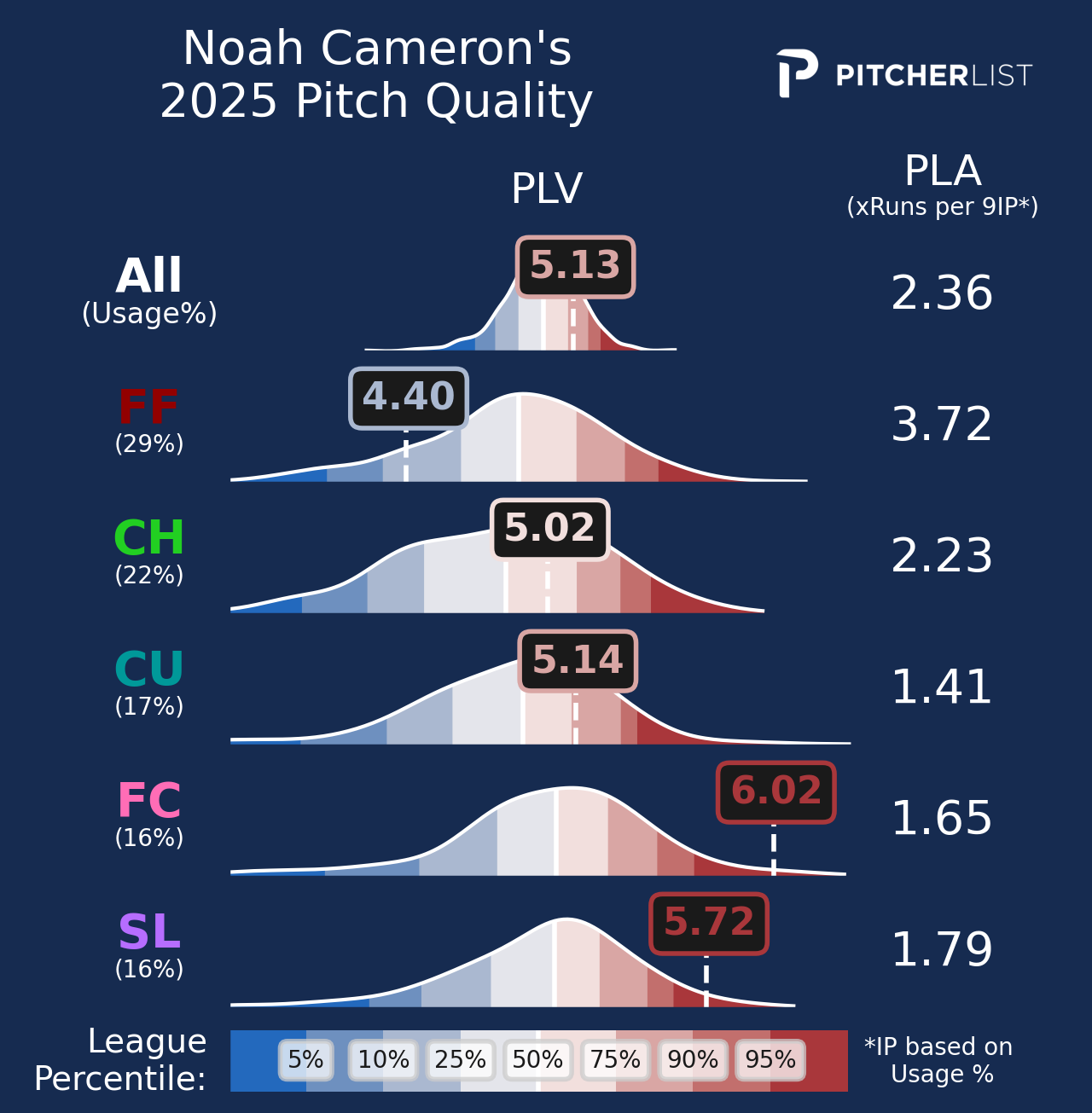
Though he got them fairly often, Cameron wasn’t reliant on those strikeouts for his Triple-A success, as he was able to induce weak contact at an elite rate. He clocked in at just an 83.8 mph EV, second-best among Triple-A starters with at least 200 batters faced and coinciding with his STRONG 0.325 xwOBA. This year, Cameron has again seen that ability to limit hard contact. He retains a better-than-average 88.6 mph EV with a 0.311 xwOBACON, pacing at a top-8% best rate among MLB pitchers. With a drop in strikeout rate and average groundball rates, Cameron is going to have to rely more heavily on continuing to induce weak contact. There’s a chance he can maintain it, as evidenced by his track record of doing so, but this puts his path to success much more in the hands of the hitters he faces.
Verdict: Not Legit – Cameron doesn’t have overpowering stuff but has found success in the minor leagues without it. As he faces major league batters that are better equipped to read and attack his somewhat hittable pitches, Cameron is going to have a harder time limiting the damage inflicted against him. Though his strikeout upside is limited, he should still retain good value in QS or points leagues. Ride out his hot streak, but if he stumbles and gets sent back to AAA, don’t be afraid to cut bait.
Ryan O’Hearn, 1B/OF/DH, Baltimore Orioles
Ryan O’Hearn has truly blossomed this May, bringing some flower power to the Orioles’ lineup. In the single calendar month, O’Hearn has put up a remarkable .370/.458/.543 slash, good for a 194 wRC+ and doing his best to help a disappointing 25th-ranked Orioles offense. Is O’Hearn separating himself in his age-31 season?
O’Hearn has been a strong-side platoon bat since his time back with Kansas City, collecting plenty of at-bats against right-handed pitching. And for good reason, as he has the 11th best xwOBA against RHP among batters with a minimum of 50 PA against righties so far this season. His platoon has enabled him to grow into strong walk rates and low strikeout rates, which he’s thoroughly improved through his Baltimore tenure.
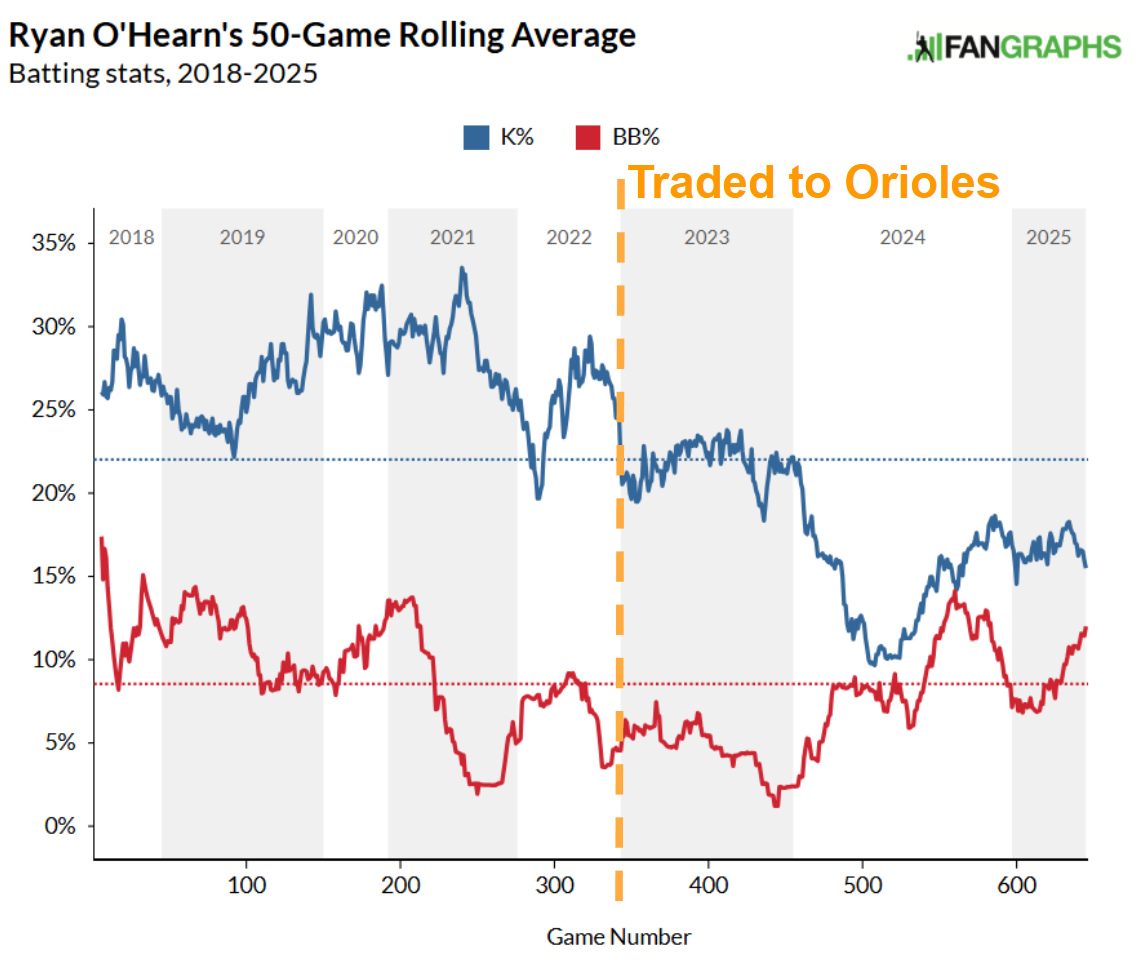
This strong plate discipline has been the foundation that enables O’Hearn to better utilize his hard-hit potential. O’Hearn has fairly average bat speed, but with his good bat-to-ball skills, he can square up balls at a high rate to maximize his exit velocity potential. In combination with his elite launch angles, O’Hearn seems like a very well-rounded hitter. That is, at least, against righties.
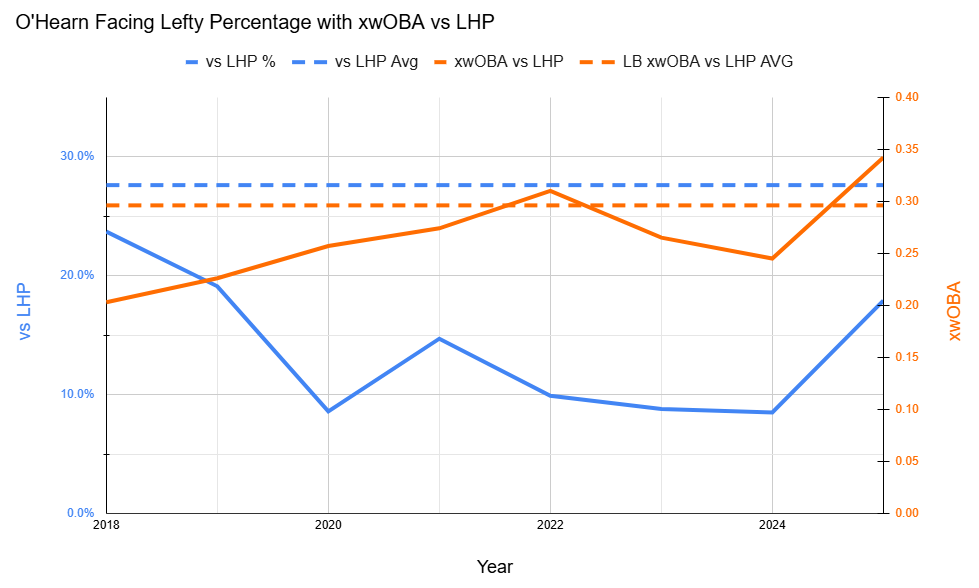
Across the last three years, O’Hearn’s xwOBA takes a significant drop from 0.358 to 0.284 in his limited instances against lefties. His whiff rate jumps from 19.7% to 26.1%, and his EV drops from 91.6 mph to 81.9 mph. Though he might not have a lot of experience against lefties, there’s enough here to think O’Hearn should stay platooned.
But O’Hearn has shown some improvement this year. He has carried a .342 xwOBA, 21.5% whiff rate, and a poor-but-better 83.9 EV against lefties. And that’s not for nothing, as O’Hearn is facing lefties at almost twice the rate he had previously. Where O’Hearn faced lefties 8.7% of the time across his 2023 and 2024 seasons, he’s seen them 17.9% of the time this year. This results in an increase in playing time for O’Hearn as he takes the bench less often against southpaws, and makes a better case to be put in weekly-set lineups.
While O’Hearn has continued his strong production against righties alongside better production against lefties, another cause for O’Hearn’s success this year has been his ability to leverage his home park. With none of his nine home runs clocking in as a no-doubter, O’Hearn carries just a 4.8 xHR. While Camden Yards agrees with his 9 home runs, no other park would have exclusively given him that many. While this is concerning for O’Hearn’s power potential, especially considering his more pedestrian 14- and 15-HR campaigns the previous two years, O’Hearn’s strong 20.6% blast rate indicates the no-doubters are on the way.
Verdict: Legit – Ryan O’Hearn has continued doing what he does best: making consistent and solid contact. He will continue taking advantage of his strong-side platoon splits, and though he should experience at least some regression to his vs-lefty splits, he’s not the black hole against lefties that he once was. This will likely result in marginally more playing time down the stretch this season, increasing his value in weekly-lineup leagues as he isn’t as black of a hole in those matchups. As Basallo also bats lefty, his eventual callup shouldn’t be a cause of playing time concern for O’Hearn if he continues raking.
Ryan Weathers, SP, Miami Marlins
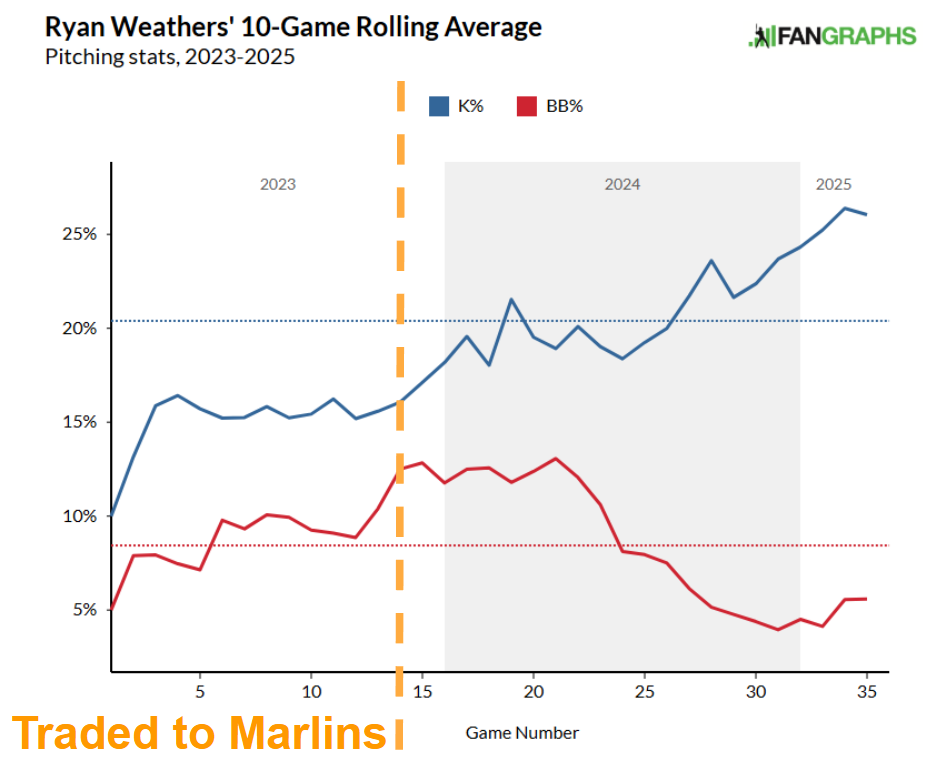
Miami southpaw Ryan Weathers was a buzzing sleeper this offseason and has continued piquing interest through the start of his 2025 season. That headline would have been unexpected a few years ago after his poor 2023 season with the Padres, where Weathers wasn’t finding much success with his four-seamer, changeup, and sweeper-based arsenal. He ended up getting traded to the Marlins late in the 2023 season, only turning in three games with the Miami squad that year. In 2024, after a full offseason with the Marlins’ pitching development staff, Weathers showed up with a more relevant sinker and vast improvements on his other three pitches.
With more drop on his changeup and more velocity on his fastball and sweeper, this improved arsenal yielded improved results. Weathers showcased improvements in his strikeout rate, walk rate, and even his groundball rate. But after a lengthy finger strain stalled the momentum in his 2024 season, Weathers found himself in yet another offseason with the Marlins’ pitching development staff. If it went well once, why not have it go well again?
Though he is only four starts into the season, these improvements are something to get excited about. Weathers tweaked his mechanics into a 7-degree-taller arm angle, unlocking more ride to his four-seamer while somehow still finding more drop to his changeup. Oh, also, his fastball velocity has increased by 1.6 mph to a resounding 97.5 mph. Though he has poor extension, this still plays very well as it‘s 4.3 mph faster than average for LHP. As a result, Weathers has seen yet another increase in strikeout rate. With his previous walk rate improvements, he seems to keep getting better.
Notably, Weathers has also (mostly) ditched the one-season-wonder sinker. Normally, if Weathers were a right-handed starter, there would be some cause for concern on such a narrow arsenal where one pitch is a sweeper. Sweepers usually have atrocious splits and would limit the tools Weathers could use against opposite-handed batters. But Weathers is a lefty, and lefthanded sweepers carry smaller split-based differences than their righty counterparts, so Weathers still has three tools against any batter.
One hesitation about Weathers’ long-term outlook is in his downward-trending groundball rates. Where this was a cause of excitement in his 2024 campaign, almost altogether dropping the sinker that yielded a 56% GB rate in 2024 will naturally result in fewer groundballs. While this isn’t a major cause for concern, it is something to monitor moving forward and will play as more of a factor if Weathers sees negative regression in his strikeout rates.
Verdict: Legit – Ryan Weathers has been making the most in his Marlins tenure, showing consistent improvements in his mechanics and pitch design. With his ever-improving arsenal, Weathers seems to be rewarding both the Marlins and fantasy managers for their investment. If the heater maintains its stark velocity increase, this should work.
