





We are about halfway through the fantasy baseball season. Instead of coasting the rest of the season with all-star players, it is still important to evaluate both new and existing hot streaks to ensure your fantasy team is in top shape for the second half of the year.
Gleyber Torres, 2B, Detroit Tigers
The 28-year-old Gleyber Torres hasn’t gotten complacent after signing a 1-yr, $15 million free-agent contract with the Detroit Tigers. Instead, he has been a major reason why the Tigers have a top-5 offense in the league. With an .823 OPS and a 137 wRC+, Torres is giving the Tigers their money’s worth while setting himself up for a potential payday next offseason.
In his first MLB season away from the Yankees, Torres hasn’t looked to reinvent his game. Instead, he has worked on improving the aspects of his game that made him such a big name in the free-agent market. Where he has had good swing decisions and contactability, Torres has reached a new level this year. He is not only experiencing career-best chase rates, but also career-highs in both in-zone and out-of-zone contact rates. This has resulted in the best swinging-strike rates and overall CSW% of his career, accentuating an already solid skillset and leading to Torres collecting more walks than strikeouts.
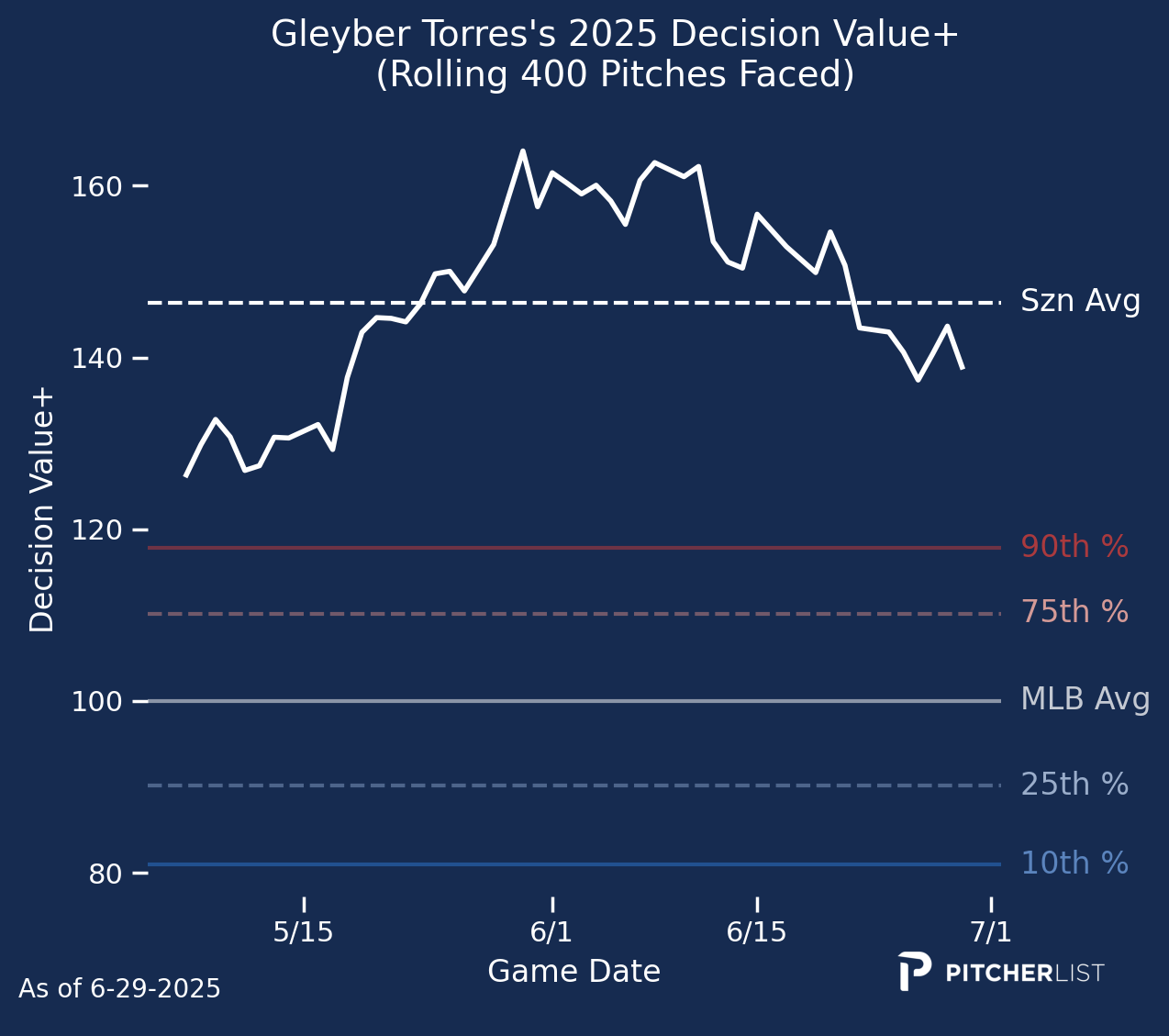
One of the main concerns with Torres’s move to Comerica Park resided in his power potential outside of the Yankees’ short porch, especially as a righty with a more all-fields approach. But Torres has adjusted his plate approach to the park he plays in, shifting his in-air batted balls more towards an even split than the oppo-focused approach in his last year. With this needed adjustment, alongside Torres’s strong squared-up ability and strong launch angles, he is able to maximize the somewhat limited juice in his slower-than-average bat.
Torres’s improvements have already manifested in strong results, with 9 home runs already this season while nearing a .400 OBP. But there is still room for these results to improve for him, as his slugging percentage is about 80 points lower than his .519 xSLG.
Verdict: Legit – Gleyber Torres has shown notable improvements in his tenure with the Tigers. His incredible plate skills and contactability help him reach his power potential and should result in low-20’s home runs with strong slash lines and plenty of counting stats on this potent Tigers offense.
Ranger Suárez, SP, Philadelphia Phillies
After a rocky first start returning from a lower back injury on May 4th, Ranger Suárez has been absolutely dominant. He has posted a quality start in each of his 10 subsequent starts, allowing just 9 runs over 68.1 innings in that span for a minuscule 1.19 ERA. This is a welcome sight after his all-star first half of 2024 unraveled as the season progressed, but for now, Suárez looks to be back in the driver’s seat.
Suárez doesn’t make his mark by overpowering hitters. Instead, he leverages a wide 5-pitch arsenal and strong command to keep hitters off their toes. This approach has worked so far this season as hitters have been limited to just a .208 AVG without much luck drawing walks. And in his age-29 season, Suárez has only been improving in this strong command. Since 2020, Suárez’s overall Location+ has improved every single year.
With an arsenal that doesn’t induce too much swing-and-miss, Suárez instead looks to get outs through his elite ability to induce ground balls and limit hard contact. While limiting hard contact isn’t usually too correlated to a pitcher’s innate abilities, he has been able to leverage his strong command to consistently limit exit velocities for long enough to assume it’s an intrinsic skill. Among starters with a minimum of 150 BBEs this season, Suárez ranks allows the lowest average EV at a paltry 84.3 mph so far this season. In conjunction with his 88th percentile ground ball rates, Suárez limits damaging barrels like it’s his job.
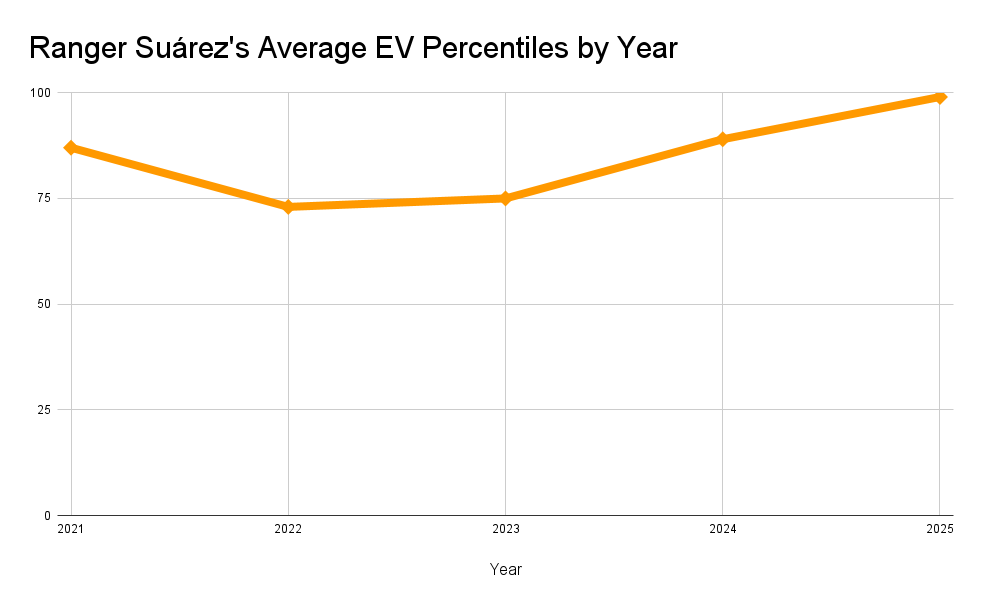
But not everything is sunshine and rainbows, and there are reasons for hesitation in Suárez’s rest-of-season outlook. As demonstrated last season, Suárez has a large 1st-half/2nd-half ERA split, jumping from 2.91 to 3.73 later in the season. While this may be attributed to the back problems he was facing in 2024 specifically, he did experience a sizeable reduction in command on his changeup and his cutter as the season went on, which wasn’t an arsenal-wide mechanical issue. He is also notably carrying a BABIP, HR/FB%, and LOB% that are better than his career norms. While some of this can be explained through his quality of contact data, this is likely to regress as he faces stronger opposition through the remainder of the season.
Verdict: Legit – Ranger Suárez limits hard contact and induces ground balls at an elite rate thanks to his ever-improving strong command. Though some signals indicate that regression is coming down the pipeline, Suárez has the skills to remain a strong fantasy contributor throughout the rest of the season.
Kody Clemens, 1B/2B/OF, Minnesota Twins
Drafted in the third round of the 2018 MLB draft, Kody Clemens hasn’t yet found his foothold as an everyday MLB starter. With his single-season maximum of 57 MLB games played coming back in 2022, Clemens is finally on pace to set a new max this year. A record workload would be surprising considering Clemens was DFA’d by the Phillies earlier this year, but the Twins decided to acquire him to fill in for an injured Luke Keaschall, giving Clemens some moderate runway this year. And though his surface stats aren’t inspiring, he has brought an underrated bat to the Twins’ keystone.
Full disclaimer, Clemens is batting .210. Not great, and likely why he was on the bench in both weekend games. But he has been vastly underperforming his strong underlying metrics of a .275 xBA and a .554 xSLG. Though they haven’t manifested real results quite yet, these strong underlying signals stem from Clemens tearing the cover off the ball. If he were qualified, Clemens’s average exit velocity of 94.0 mph would tie for 6th among qualified batters, harder than some of the premier sluggers in the league like Matt Olson and Kyle Schwarber.
Much of this stems from a sizeable increase in average bat speed (up 2.0 mph) from Clemens between last year and this year. And though his swing is faster, he hasn’t had to compromise on the good traits that his swing path already carried. He has retained a league-average swing length, carries elite ideal attack angles, and pulls the ball in the air 10 percentage points above league average. With a strong bat path, Clemens has translated his increased power potential into a career-high 9 home runs so far this season. And with a 12.8% barrel rate, the home runs should keep coming.
And it isn’t empty power. Clemens has also shown marked improvements in his plate skills to chase less while swinging at pitches in the zone more. Landing around league-average in both, Clemens has shown that his swing decisions are no longer an exploitable hole in his game.
The real concern with Clemens stems from playing time. He has mostly seen a platoon this year with only 20 of his 147 PAs coming against lefties, and missing a game over the weekend against righty Casey Mize is certainly alarming. But among twins hitters with over 50 PA’s, Clemens is tied for the second highest wRC+ (124) behind Byron Buxton (151), all while vastly underperforming his expected metrics. Though it seems Clemens might need to turn his .215 BABIP around soon, the Twins should find a way to get him in the lineup moving forward, even after the eventual return of the injured Luke Keaschall.
Verdict: Legit – Though it hasn’t yet shown in the box scores, Kody Clemens is doing many things right. If he can keep this momentum going and flash more consistent actualized results, the Twins are likely to find ways to keep him in the lineup even once Keaschall returns from his injury. Clemens is likely still a deeper-league play, but he is likely to return positive value at the fantasy baseball wasteland known as second base.
