





- 105.5 mph
That was the mark that Jacob Misiorowski reached last week against the Chicago Cubs, as the flame-throwing righty reared back and delivered everything against Pete Crow-Armstrong, who admirably was able to foul it off. That pitch, the third hardest thrown MLB pitch ever recorded, is the culmination of a 60-day span where Jacob Misiorowski has been about as good as anyone ever has. We will get into the all-time discussions later in this piece, but let’s first discuss the madness that has taken place over the last few months.
102
Since 2008, when pitch tracking began, there have been a total of 3,160 pitches at 102.0 mph or more. In that time, there have been 12,764,675 pitches and counting over that time. It’s quite possible that those are the only pitches at 102 or more, because it’s difficult to say how many pitches before 2008 touched that mark. I find it doubtful that the great power pitchers of the mid 20th century – Bob Feller, Sandy Koufax, and the underrated Sam McDowell – ever quite reached that mark. Nolan Ryan probably touched that mark on a few occasions (No, he didn’t throw 108, sorry!), as did JR Richard and the walking urban legend that was Steve Dalkowski. Randy Johnson has been clocked at 102 before, and his reputation precedes him, a rare case of a man living up to his stature.
How many pitches before 2008 do you think were over 102 mph? Could be a few thousand, could be a few dozen, only being touched on a few fringe occasions when a player was really emptying the tank. Whatever the answer, the point is that it is rare. Even in today’s game, where velocity is emphasized more than ever before, 102 mph is a mark you only see out of the hardest-throwing relievers. The most in an MLB season is 509, set in 2023 when Jhoan Duran sat 101.8 on the year and tallied up 199 by himself. Hitting 102 is almost never done by a starting pitcher, and since 2008, only 12 starting pitchers have touched that mark.
Some instances are events in and of themselves. Tarik Skubal’s only time eclipsing the barrier was to end his complete-game shutout. Justin Verlander did it when he was notoriously angry For 11 of these pitchers, these are rare, memorable moments of letting it all loose.
And then
There’s Jacob.
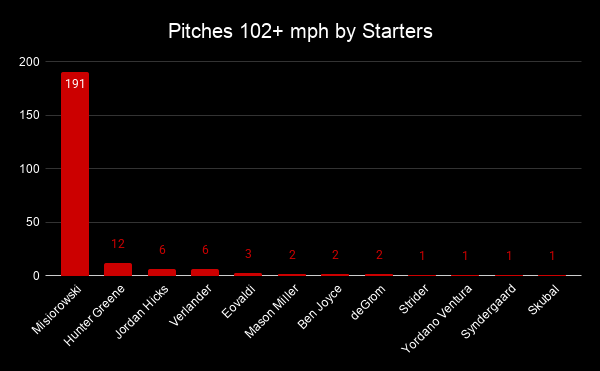
That graph speaks for itself, just absurd power we haven’t seen out of a starting pitcher likely ever.
Let’s get wilder.
There have been 43 instances of a pitcher throwing 102 mph 10 times or more in a game, regardless of role, again since 2008. Here are those outing graphed, with the X axis being the respective date of the outing, and the Y-axis the number of pitches at 102+. Misiorowski’s appearances here are highlighted in yellow:
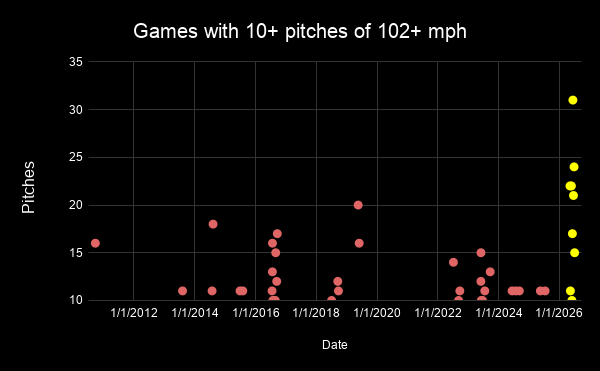
Misiorowski has 5 of the 6 outings where a pitcher has thrown 20 pitches at 102 mph or more. The only other member of that club is Jordan Hicks, who reached exactly 20 on May 19th, 2019.
What’s especially notable here is that Misiorowski is still very early in his career, so he hasn’t had much of a chance to pepper this chart with his appearances simply by measure of volume. If you’re curious, there’s six other pitchers who have games on this list, here they are, with their career appearances also listed:
Shoutout to Bruce Rondon.
Misiorowski has the opportunity to throw more pitches than relievers, but the downside is, of course, that he has to preserve his energy over the course of 85-100 pitches. The fact that he is able to sustain this outlier velocity is unheard of, and he’s only getting better at it.
Summer Heat
When Misiorowski was called up last year, his stuff was already electric, but it wasn’t all time fearsome. Misiorowski wasn’t even the hardest throwing starter in baseball, as Hunter Greene bumped his fastball up by a half tick to sit at 99.5 mph, barely edging out Misiorowski’s 99.3. That doesn’t mean it wasn’t outrageously good, but we’ve seen upper 90s velocity before. Coming into 2026, Mis obviously boatloads of potential, but it took a sec for things to take off. Through April, Mis was sitting 99.1 on the fastball, and “only” touched 102 six times – all but one in his last start of the month. Then, as April turned to May, Mis kicked it up a notch, and began annihilating hitters the likes of which we have seldom seen:
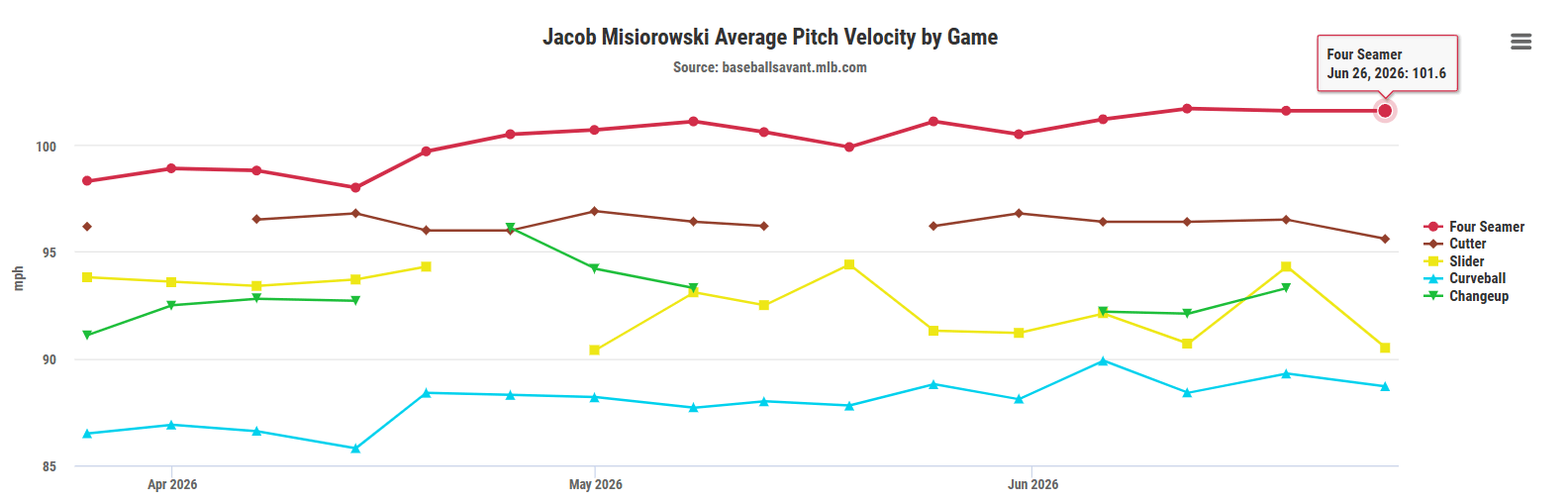
Source: Baseball Savant
Mis has cranked up the velocity to tread in waters seldom touched by even the most bombastic of relief arms. In the pitch tracking era, there have been eight occurrences of a pitcher averaging 101 mph on a fastball over any full season sample:
Compounding the truly freakish velocity is Misiorowski’s somehow improved command, which has allowed him to drop his walk rate from pushing 10% to 5.4% since May 1st, and even that is slightly inflated due to a 4 BB outing against the Cubs. Misiorowski has the longest extension in baseball, the hardest fastball ever thrown by a starter, and has been able to IMPROVE his lethality in locations. Here’s what that means:
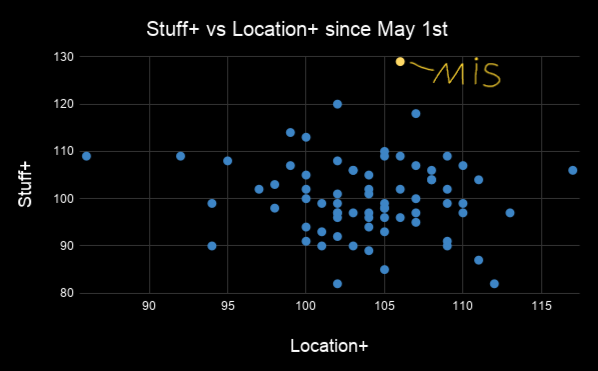
The two closest dots are Cristopher Sánchez – fresh off a scoreless month of May, and Chris Sale – who simply is one of the best to ever do it. That lethal combination has put him head and shoulders above the competition over this stretch, and that’s best illustrated by combining stuff and location with Pitching+:
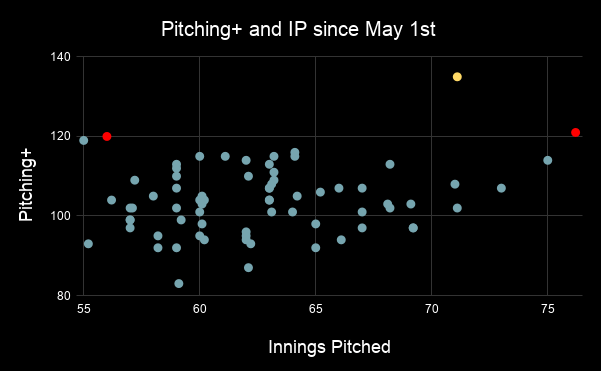
The difference between Sanchez, who is second in Pitching+ with 121, and Misiorowski’s unreal mark of 135 is the same difference as second place Sanchez to 29th place Nathan Eovaldi. Misiorowski is so far above the pack it deserves to be talked about not just with his contemporaries, but with the greatest stretches of all time.
Among The Greats
Since cranking up the heat in May, Misiorowski has been incredibly effective, dropping his WHIP to the 0.60’s. Perhaps most impressive and telling of Misiorowski’s raw dominance is his batting average against. Since May, Misiorowski has allowed just 31 hits across 11 (lengthy) starts for a batting average against of .127, which was an even lower .117 before getting knocked around a little bit against the Reds and surrendering (gasp) 5 hits.
It is a stretch of dominance that puts him in the very upper echelon of stretches by a starting pitcher. There’s already been a lot of name drops of famous power pitchers in this article, so here’s some more:
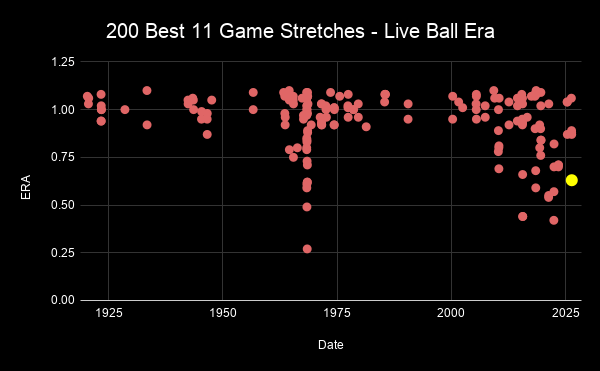
You can probably identify a lot of these dots if you know your baseball history. Most of that column in the middle is Bob Gibson’s 1968 season, which, with overlapping spans, has 17 entries on this chart just from that season. Other standouts are 2015 Jake Arietta, highlighted in blue, and 2022 Dylan Cease, highlighted in grey. Misiorowski, of course, is highlighted in bright yellow and his placement here shows that this is no ordinary run even among great pitchers.
Also evident is the cluster that starts around ~2005 and the decline of the steroid era. Teams began using relievers earlier, and thus a by start classification is a little deceiving, as pitchers from the 70s were expected to shoulder much more of the workload. So, in order to control for this, lets look at this same sample with an innings minimum of 71.1 innings – the same amount Misiorowski has in this 11 start stretch.
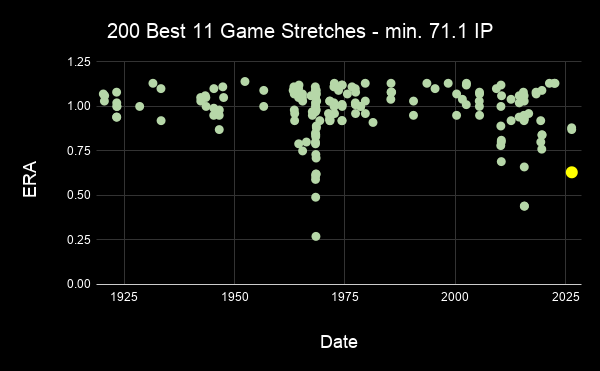
The 71.1 inning threshold is how many innings Mis has over this stretch. As you can see, the cluster of dots in the 2010s has largely dissipated, with the notable exception of Arrieta’s run with the Cubs (he won the Cy Young for a reason). This truly is a stretch that has been some of the most effective pitching ever seen in Major League Baseball.
The pinnacle of this stretch, of course, was against the Phillies on June 15th. While I could describe the start, our PLV gamecards tell the story real well.
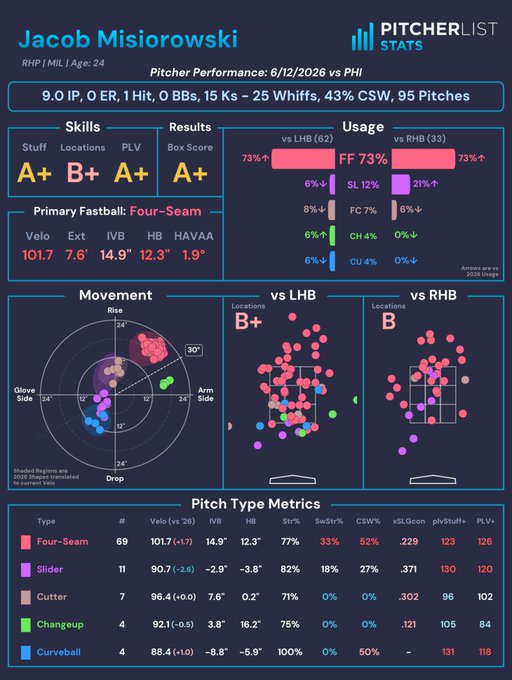
I could write several hundred words simply gawking over these numbers, but I’ll spare you that and simply say that against a real good Phillies lineup, Misiorowski cut through them like few ever have.
There are definite questions about the longevity of Mis, and while he is tall and lanky, the sheer velocity and volume should draw concerns if he can maintain this level of flamethrowing without setting off a spark in his elbow or shoulder. The 2nd hardest throwing starter, Hunter Greene, has not been a qualified pitcher in his now five seasons in MLB. Jacob deGrom, one of the only pitchers who has had a stretch of velocity and dominance similar to Mis, of course had about three seasons flying too close to the sun with the Mets.
We have never, and i mean never, seen anything like this from Misiorowski. This flame in Milwaukee is burning with the heat not of a candleflame but a nuclear reactor. With great power comes great responsibility, and for the sake of both baseball and the young arm still on a rookie’s salary, let’s hope this generational arm is handled well.
