





The final 10 days of the regular season might be our last chance to watch a Great American Playoff Race. A lockout looms, and with it, the threat of a 14-team playoff that could ensure every team with October aspirations gets its wish.
In the National League West, though, a battle for the sixth seed has all the makings of a thriller. The San Diego Padres and Arizona Diamondbacks are separated by 355 miles and 2.5 games. Both are flawed but talented, saddled with mediocrity and emboldened by their star power.
They also play in San Diego to end the regular season, setting the stage for the kind of heartbreak only observed while staring down a five-month offseason.
The Diamondbacks have gotten here in a less traditional manner, trailing the Padres by 2.2 offensive fWAR and 2.3 pitching fWAR. On paper, they are a little less talented, but they’ve bridged the gap on the margins, largely through incredibly fortunate bullpen sequencing. Despite the Mason Miller of it all, Arizona’s pen has produced 8.44 WPA, second in all of baseball and more than three wins better than San Diego. It isn’t necessarily real, but it doesn’t have to be. And after Justin Martinez’s arrival, it might have enough juice to tilt the scales down the stretch.
Back And Better Than Ever
As long as Martinez has been a big leaguer, he’s been blowing fastballs by guys. The only problems have been sporadic command and fleeting availability, having pitched in parts of four seasons but totaling more than 20 innings just once.
That was in 2024, when his 11.27 K/9 and 2.59 FIP helped establish him as one of baseball’s better leverage arms. The Diamondbacks rewarded him with a five-year, $18 million extension. But Martinez blew out again the next summer, enduring his second Tommy John surgery and thrusting his long-term viability into question.
Subsequently, Arizona has been cautious with Martinez, waiting until the middle of August to bring him back and limiting his appearances to an inning at a time. Neither Martinez nor his arsenal has taken kindly to said caution.
Martinez’s velocity is up across the board, so much so that his 9.2 innings of work have his four-seam fastball, sinker, and slider atop velocity leaderboards for their respective pitch types. We shouldn’t expect this to hold for a season’s worth of work. But we’re two weeks into September, and time isn’t on Arizona’s side. Martinez is letting it fly, and the triple digits have stayed steady with each appearance, helping us write off adrenaline as a driving force.
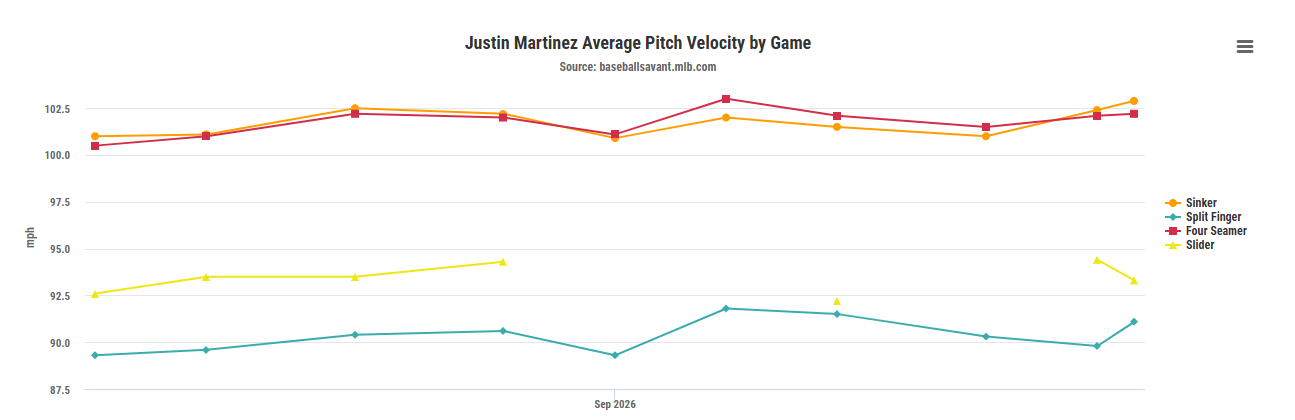
Via Baseball Savant
With the obvious caveats regarding sample sizes and reliever weirdness, throwing harder than ever has made Martinez’s stuff numbers jump, even without incredible shapes. Sitting above 100 mph has turned his four-seamer into an outlier pitch, an offering Stuff+ liked, but didn’t love, during his 2024 breakout. Even his sinker, which once dominated with a 128 Stuff+, is up eight points and gunning to be called the nastiest pitch in the sport. Martinez’s secondaries don’t have the same movement as years past, but both look better than where Martinez left them during his injury-shortened 2025 campaign.
For as long as this velo jump persists, Martinez’s stuff gains make him a different pitcher than hitters remember. I’m optimistic about that step mitigating some command concerns.
First off, command has never been anything close to a strength, and he has continued to find success. Martinez has a career walk rate north of 13% and has never finished a year with an above-average strike rate. Only in 2024 was his O-Swing% high enough to feel like his spots were intentional. Yet, he is living in the zone more this year than ever before, and he’s been rewarded by Location+, which isn’t fond of the four-seamer but loves his newfound ability to spot sinkers and splitters.
Inconsistent locations haven’t stopped Martinez from chucking fastballs more frequently. Martinez added his sinker in 2024 and pushed his four-seamer to the side until 2026, when the threat of 101 mph has made the case for increased usage. He’s throwing it half the time to left-handed batters, offsetting the platoon disadvantage of heavy sinker usage without sacrificing velocity. Right now, nobody is touching it. The four-seamer is running 98th-percentile whiff rates with a 53.3% contact rate in the zone. He’s missing glove-side a lot, but everything in the zone has been plenty productive.
PLV is unsurprisingly unkind to such a significant portion of his four-seamers missing badly. His 4.46 four-seamer PLV is a 10th-percentile mark; his sinker, at 5.65, is a 99th-percentile pitch. He’s throwing the latter just as often as his four-seamer (including twice as often to righties), so I won’t quibble with his pitch selection. I’m intrigued, though, by his sinker spots being so much better than the four-seamer. Fastball command often lags behind velocity during Tommy John rehab, but he’s throwing both over 100 mph, and the movement profiles aren’t so different as to suggest some dramatic difference.
Perhaps he has no idea where either is going and is just running hot with the sinker. I’m not fully convinced of that, either, although it does suggest that throwing this hard makes command futile (take that, Mike Rizzo).
What Has Velocity Done for Martinez?
When Martinez’s command is on, the results are tantalizing. It’s in Arizona’s best interest to give him enough leverage innings to keep taking those chances, especially when his stuff isn’t getting barreled.
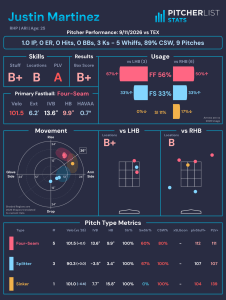
Again, small samples are at play here; his stuff hasn’t generated many swings. Even so, it makes sense that throwing turbo sinkers off of turbo four-seamers and mixing in the occasional turbo splitter is hard to mess up.
Compared to 2024, Martinez is suppressing damage better, posting better xwoBACONs on his four-seamer, sinker, and splitter. Both fastballs are better by xwoBACON than in 2024 and 2025, while his splitter is down over 170 points from 2024 (and up 40 points from last year).
Oh, and his slider hasn’t been put in play yet.
As such, Martinez is threading a needle in his first few appearances off the Injured List. Everybody is looking to take a walk, and he is ripe to give away a free pass. But the cat-and-mouse game that creates means he is getting early called strikes at a 99th-percentile rate, and going down 0-1 to a pitcher with this kind of stuff is a recipe for punchouts. Martinez is striking out 32.5% of the batters he has faced, and 23.2% of his two-strike pitches are ending with strike three.
Aside from the slider, which hasn’t been thrown enough to register, all of Martinez’s pitches have above-average putaway rates. He’s throwing the splitter enough to get free strikes early in counts, mitigating damage in the middle of at-bats, and getting enough whiffs to finish guys off. Martinez isn’t even getting chases that often, which is a symptom of his volatile control. When they do go out of the zone, though, they are coming up empty. With some of the lowest chase rates in baseball, Martinez is still posting a 94th-percentile O-Con%, which feels both like a number likely to regress and a testament to the horrible swings he is generating.
Justin Martinez pitches an IMMACULATE INNING! pic.twitter.com/UzNjg4Tu4y
— MLB (@MLB) September 12, 2026
Ultimately, Martinez looks a lot like the 2024 version of himself. However, throwing this much harder post-TJ is unique and a lesson in the importance of velocity. True 80-grade velocity, rather than 70, changes the math on swing decisions and buys newfound breathing room. Of the 313 pitchers with at least 50 innings pitched, 47 average at least 97 mph on their four-seamer. Four average at least 100 on the gun, and two of them will receive Cy Young votes this fall.
Walking five guys per nine innings only matters if those guys come around to score. By striking out almost a third of batters, he’s shrinking the portion of the pie where hitters make contact. And when they do put it in play, they are doing so with a 0% barrel rate and a .201 xBABIP. Even at 4.7 H/9, he’s getting unlucky on batted balls.
It only takes one extra base runner to turn into a blowup outing, and at this point in the season, it might end Arizona’s run. The Diamondbacks are fortunate to have Juan Morillo and Brandyn Garcia holding steady in the late innings, and Kevin Ginkel’s experience may prove invaluable at this time of the year. But Martinez’s heater-led hot streak currently offers a blend of potency and damage suppression that squarely puts him in this closer-by-committee conversation. Command comes and goes, especially in one-inning samples, and I’d rather have Martinez’s stuff extinguishing fires during the most important innings of Arizona’s season.
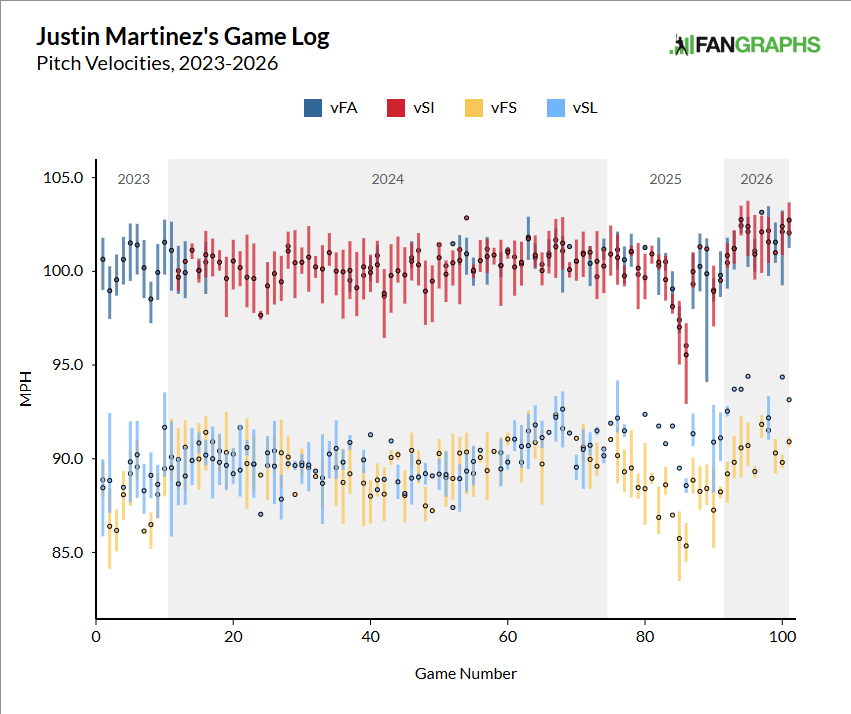
Nobody is pretending Martinez’s 0.00 ERA will last forever, nor is his 4.7 H/9 truly sustainable. In the meantime, he’s tracking to be a factor in the Diamondbacks’ last stand, a potential playoff hero, and — if all goes right — one of the best relievers in baseball next season.
I don’t know how long this will last. Martinez’s second Tommy John will likely be his last, for better or worse. He’s had similar blips on the radar before, and he could reasonably lose a tick of velo by the season’s end without much going wrong. But if this is real, and Martinez is pushing his third UCL to the limit, it’s worth admiring how he looks at the peak of his powers.
Photos by Icon Sports Wire and Adobe Stock | Graphic by Carlos Leano
