





Landen Roupp’s 2025 has gone under the radar in comparison to the rest of his rotation. Logan Webb and Robbie Ray put up All-Star first halves, while Justin Verlander’s season is not going as planned. The 26-year-old Roupp is thriving in his first year as a full-time rotation member in San Francisco, posting a 3.11 ERA in 101.1 innings through the All-Star Break.
Roupp’s role in the rotation for a winning team is a pretty unlikely one: he was a 12th-round pick in the 2021 draft that rose quickly through the minor leagues with elite strikeout stuff. He debuted last year, appearing 23 times with four starts, posting a 3.58 ERA. (fix)
After a rough start to the year, Roupp has quietly made changes to his approach that are continuing to pay off. Since June 15th, Roupp has been one of the best pitchers in baseball.
The 1.15 ERA is exceptional but quite the overperformance from his FIP — I’m not ready to declare Roupp one of the best pitchers in baseball yet. The difference between Roupp and most of the others (excluding Houser) lies in the K-BB%, where Roupp remains around league-average, while the others are in elite territory.
Roupp’s arsenal isn’t as good as the others, but the improvements are exciting. He is primarily a sinker/curveball pitcher and also features a changeup and cutter.
He throws the sinker 39% of the time, coming in at a pedestrian 92.7 mph. During this hot stretch, Roupp has started elevating the pitch more consistently against right-handed hitters.
His high location frequency has increased by over 20%, with more than half of his sinkers now coming in elevated. Roupp has already elevated the sinker against lefties, aiming it up and away, making the change against righties a lot easier.
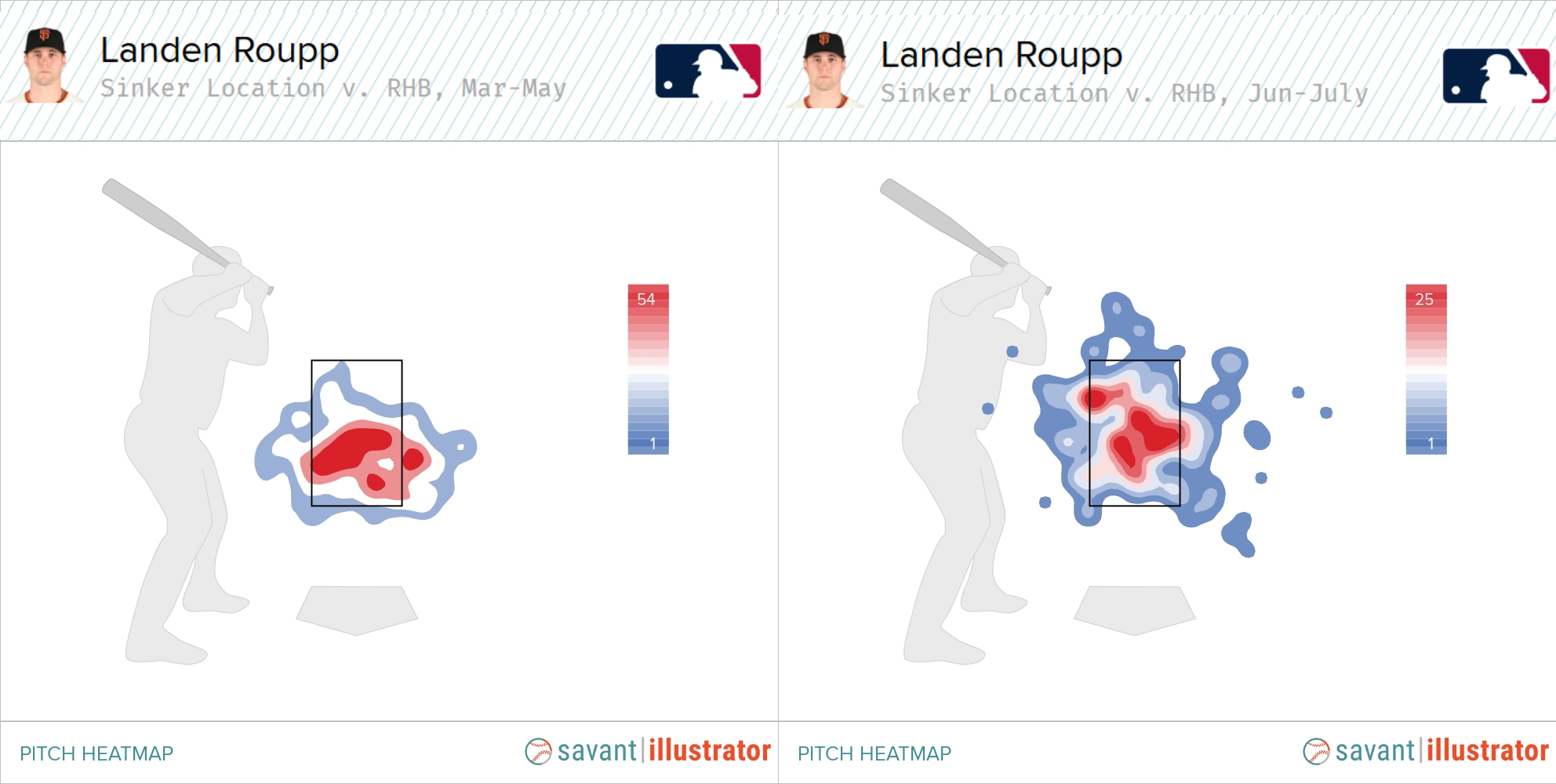
The up-and-in location hasn’t necessarily earned more whiffs, but rather more foul balls and contact. The sinker’s foul ball rate has increased from 11.0% in April to 18.8% in July, while the ICR has increased significantly.
The foul balls dramatically help Roupp get to two strikes, where he turns to the curveball 55% of the time against right-handed hitters. The curveball has a 35.8% CSW%, which has remained stable throughout the season. Roupp consistently keeps the pitch low but in the zone, forcing hitters to deal with it.
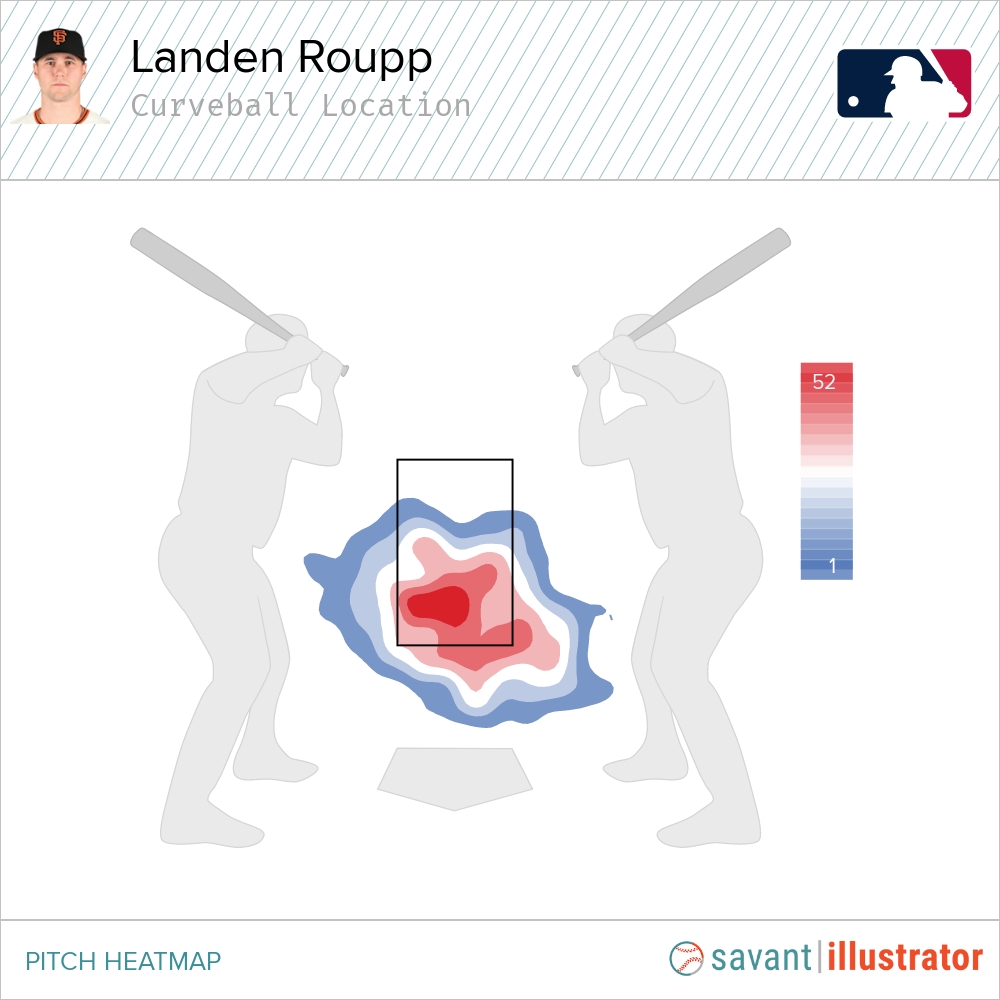
Its 64.8% zone-contact rate ranks in the 95th percentile among curveballs, and it gets a significant amount of chases too. The curveball’s movement profile is massive at a slow 76.7 mph, with nearly 20 inches of sweep and 9 inches of drop.
The sinker and curveball working together in tandem is Roupp’s bread and butter, but it comes with some drawbacks. He uses the sinker to get called strikes and the curveball to get whiffs, but the sinker still gives up a lot of base hits in the zone. Despite the 27.5% called strike rate, the recently rising ICR is where the damage has now been hyper-focused in Roupp’s arsenal.
To deal with this problem, or offset it, Roupp is using his changeup more, especially against righties.
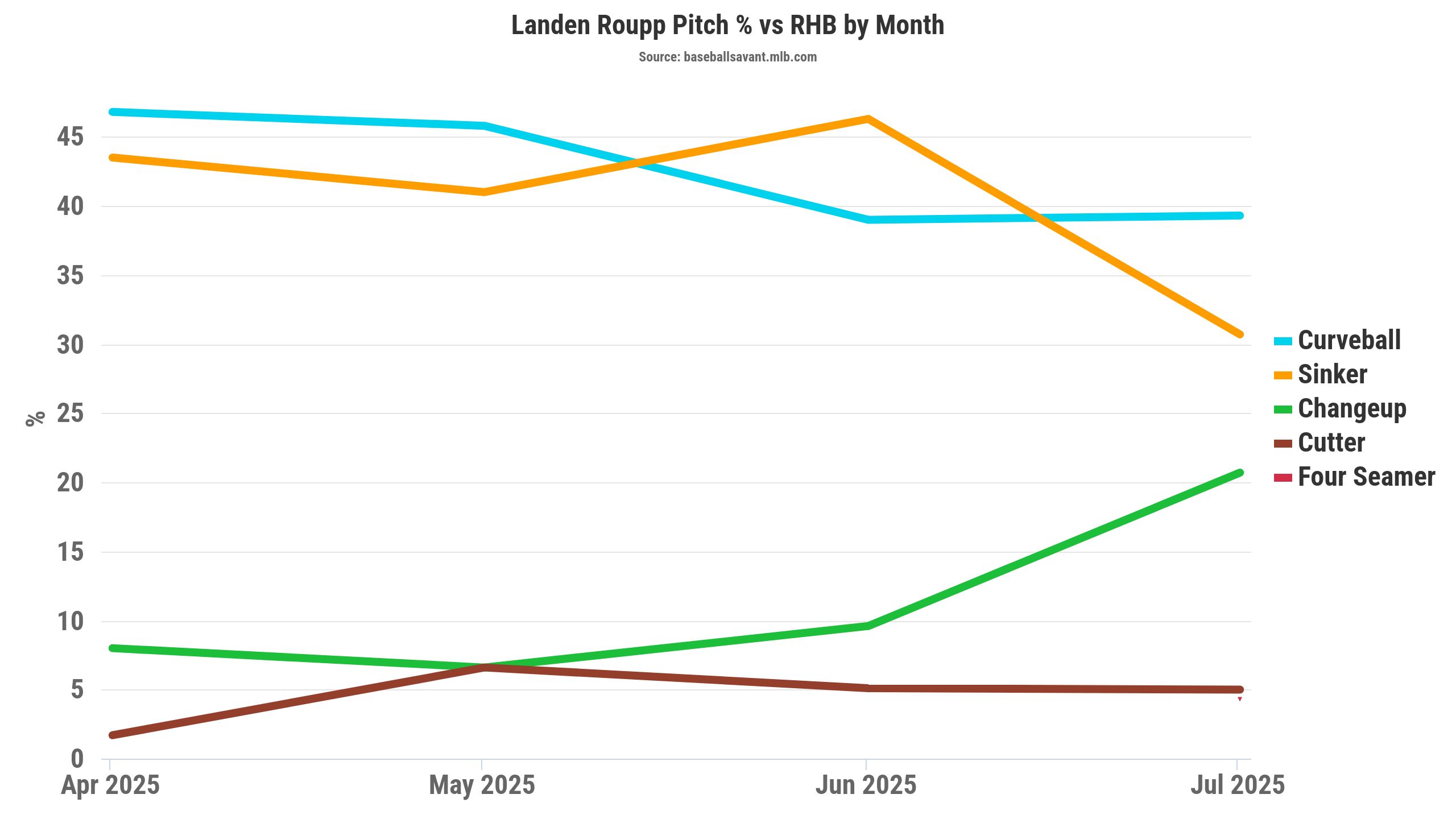
Usually, changeups are best when thrown to opposite-handed hitters. However, Roupp’s minimal other offerings and significant gap in velocity between the sinker and curveball created an opportunity.
The changeup comes in at 86.7 mph, six miles an hour off the sinker and 10 miles an hour faster than the curveball. It gets four inches of drop, a tremendous amount for a changeup, but it isn’t the greatest separation from the sinker. Regardless, Roupp keeps the changeup well below the zone, hunting for swings and misses.
Early in the season, the minimal usage and lower sinker location made it hard for the changeup to get results. There wasn’t enough pitch separation, nor were there enough pitches for hitters to consistently worry about it.
In July, Roupp has spiked his changeup usage at the sinker’s expense, turning the two pitches into a north/south combination. Mixed in with the ever-lethal curveball, Roupp found a sustainable approach for righties.
The changeup isn’t a threatening pitch to get called strikes, but it has an absurd 62.5% chase rate, nearly double the league-average for right-on-right changeups.
By increasing the number of changeups and elevating the sinker, Roupp has expanded the regions that hitters need to worry about, instead of them just focusing on pitches down and center cut.
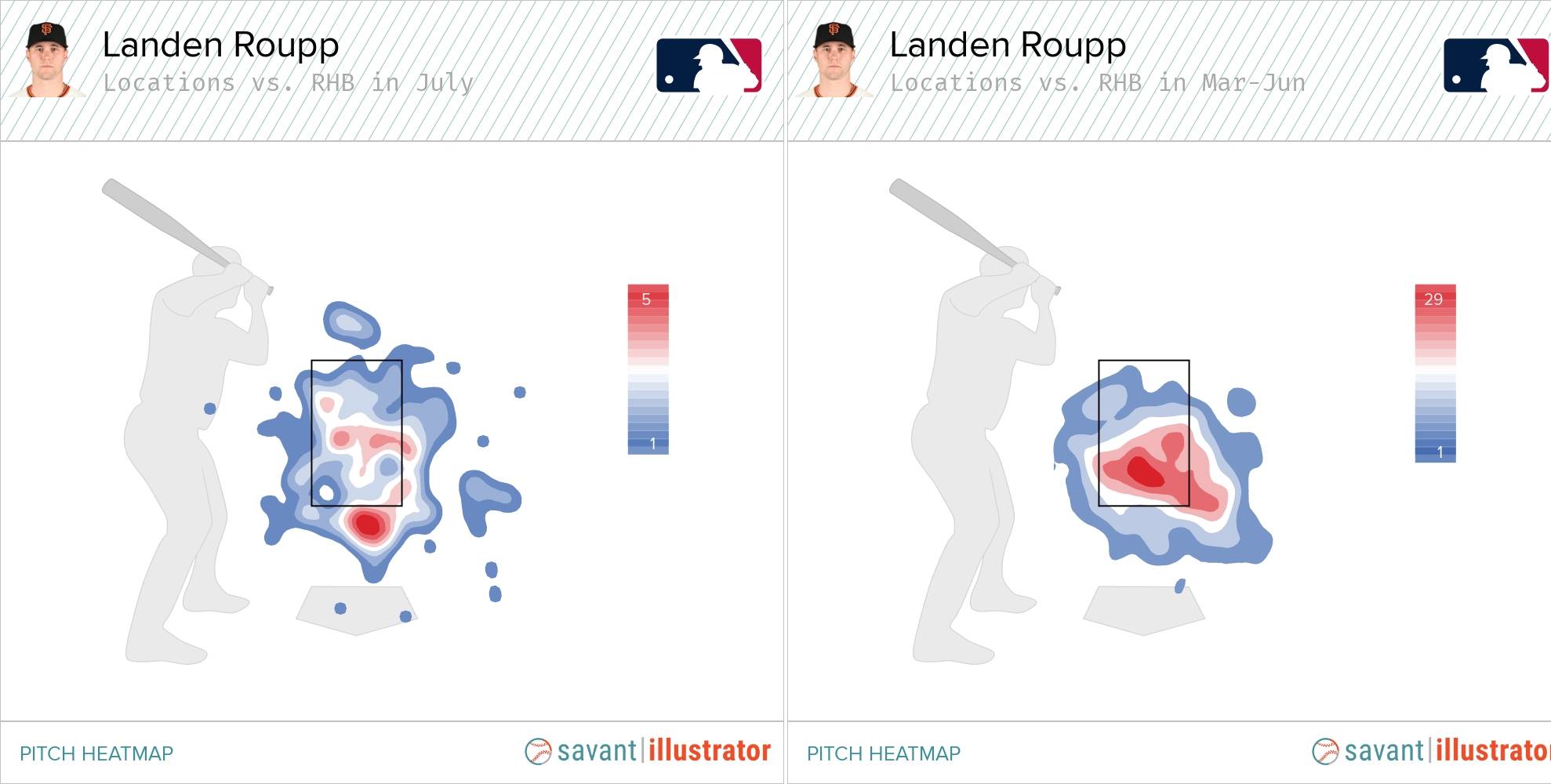
This dramatically improved his performance against righties, as he’s struck out 29.0% of them this month while limiting the walks.
His approach to lefties has remained relatively stagnant throughout the season. The cutter works in tandem with the sinker, both of which are located in the zone. Across the whole season, Roupp has actually performed better against righties than lefties. He’s leaving himself at the whims of batted ball luck against lefties, and right now it seems to be working.
In the future, the new approach against righties has significantly raised the floor for Roupp. While he’s still closer to a 23% strikeout rate & 8% walk rate arm than the current stretch, there’s a good pitcher with multiple pitches here.
The rest of the Giants’ rotation might be bigger names, but Roupp’s success is essential for a team currently vying for a playoff spot and their future.
