





KANSAS CITY, Mo. — For now, the Los Angeles Dodgers plan on keeping two-way star Shohei Ohtani in the leadoff spot, even when he pitches.
Dodgers manager Dave Roberts said this past weekend he might reconsider and drop Ohtani in batting order in the future when he’s also the starting pitcher, especially once he gains full strength and starts going deeper into ballgames. It’s all a matter of how Ohtani’s body responds to the rigors of playing both ways.
Ohtani produces more at the plate than anyone else in the National League, slashing .287/.388/.633 with 29 home runs, 11 stolen bases and a 175 wRC+ (per FanGraphs) in 385 plate appearances coming into July. Only Aaron Judge and Cal Raleigh are having better offensive seasons. It makes sense to hit him high in the order.
But hitting isn’t all that Ohtani does, of course. Ohtani made pitching news Saturday against the Kansas City Royals by reaching 101.7 mph on a four-seam fastball to Vinnie Pasquantino in the first inning. It was the hardest pitch Ohtani has ever thrown in an MLB game, and the hardest since he reached 102 mph exactly — also against Pasquantino — in the 2023 World Baseball Classic. Pasquantino struck out in ’23, and hit into a double play Saturday.
The start against the Royals marked Ohtani’s third appearance on the mound this season, with his next one scheduled for Saturday, his 31st birthday, against the Houston Astros. Until two weeks ago, he hadn’t pitched at all since having Tommy John surgery in September 2023, plus surgery in November to repair a torn labrum in his left shoulder, which he injured sliding into second base in the 2024 World Series. Ohtani’s medical recoveries delayed his return to the mound, and he didn’t ramp up his arm during spring training as a result. He’s using the regular season as a rehab assignment for the pitching side, so that’s why Ohtani found it encouraging to reach nearly 102 mph.
“It’s something I don’t think I would have been able to do in a live BP setting,” Ohtani said with the help of Japanese-language interpreter Will Ireton. “So it’s nice to be able to get this velo and see how my body reacts.”
Ohtani stepped back into the batter’s box as leadoff man and designated hitter against the Royals on Sunday, less than 24 hours after taking four at-bats at the top of the order and pitching two innings as the Dodgers’ opener in the oppressive K.C. summer heat.
Ohtani clearly enjoying his visit to Missouri. pic.twitter.com/1cwC8CKtQ6
— Nathan Pilling (@ByNatePilling) June 28, 2025
Ohtani hit a home run and a triple in the series opener, but in total over the final two games, he went 0-for-8 with four strikeouts. A tiny sample, but results that underscore something the Dodgers want to monitor, Roberts said, as they continue a dialogue with Ohtani about being the everyday leadoff hitter.
“That’s going to be fluid, as far as his position in the order, how we use him on the hitting side, with the pitching,” Roberts said, adding that Ohtani told him he feels “comfortable” leading off, even if he’s also pitching that day.
“I don’t want to put him in a box.”
Ohtani’s career hitting numbers on days he also pitches aren’t as good as his overall results, but batting .279/.388/.492 with nine homers in 233 plate appearances when also pitching would still rank ninth in wRC+ among all leadoff hitters since Ohtani came to MLB in 2018. The downside: Placing him high in the order could add a cumulative effect of fatigue the Dodgers might want to avoid if it seems prudent. After all, he’s got to pitch, too. These are nice problems to have, admittedly.
The season-long grind is one consideration in the big picture, but being the first hitter of an inning can be particularly tough for Ohtani when he pitches because it doesn’t give him much time to catch his breath (even literally) from his mound work. Such a dynamic isn’t new to Major League Baseball, because pitchers who also hit were commonplace in the National League until they permanently adopted the DH in 2022. Regardless, most of the hitting pitchers of the past were punchless at the plate, and nobody would have batted an eye at an 0-fer. Ohtani, conversely, won NL MVP in ’24 without throwing a single pitch, as he was recovering from Tommy John. Everyone expects him to produce at the plate.
New since 2023, the pitch clock also factors in, with players getting timed breaks between innings that typically last for 2 minutes, 15 seconds. Batters who fail to reach the box by the 8-second mark can be punished with an automatic strike call. An MLB spokesperson said umpires have discretion to give Ohtani more time because of his two-way status when he leads off an inning, like they do with other players who might need more time. For example: Everyone gets more time when a relief pitcher enters the game. Catchers also might need more time to get to the batter’s box (or behind the plate) because of their equipment changes. But the extra time is not necessarily guaranteed.
Plate umpire Ron Kulpa didn’t appear to give more time for Ohtani’s second at-bat against right-hander Seth Lugo in the top of the third inning. Ohtani seemed to be in a rush to reach the box after retiring the Royals 1-2-3 on 13 pitches in the bottom of the second. It wasn’t a particularly stressful frame for Ohtani to pitch, but common sense also says it wasn’t like standing in the outfield for three batters, either.
And seconds do matter. To help reduce the turnaround time, the Dodgers help Ohtani by having him use a bat-boy stool on the warning track near the plate-side entrance to their dugout. Instead of going down and up the dugout steps, Ohtani sits on the warning track and gets ready to hit. A staffer stands by, looking like a valet, handing Ohtani his batting helmet, shin guard, arm pads and the other equipment he needs to take his swings.
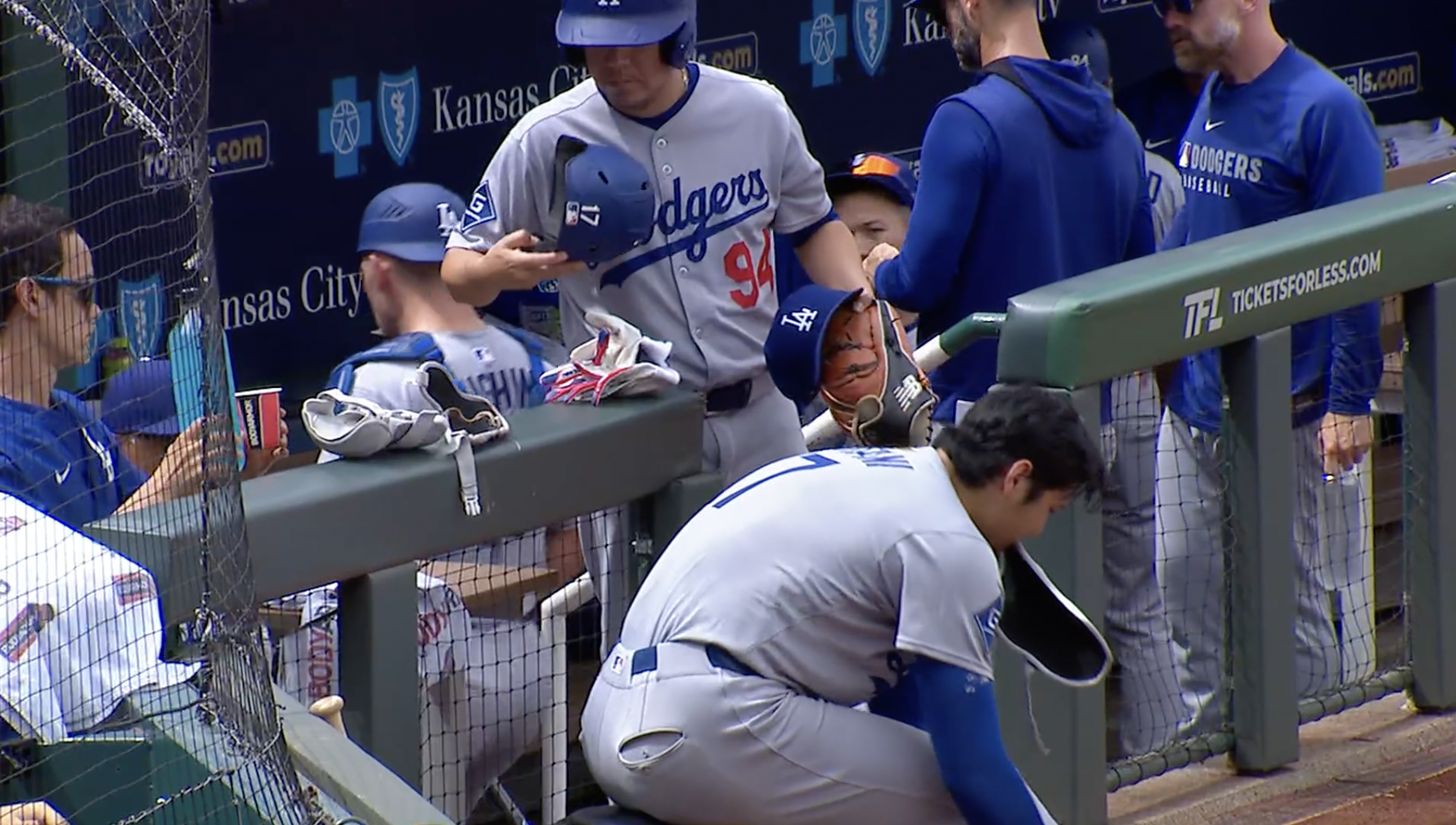
Ohtani seemed to be running low on time he hustled to the box against Lugo, who started with a sweeper (classified as a slurve by MLB Statcast) for a called strike. Ohtani didn’t swing until it was 2-2, fouling off another inside breaking pitch. Lugo struck him out on the sixth pitch of the at-bat, a cutter outside of the zone that Ohtani waved at meekly.
“I got him off-balance,” Lugo said with diplomacy.
Ohtani said afterward he was ready for the at-bat despite the quick turnaround, and did not complain about being squeezed for time, if he even noticed. In pushing back on the suggestion he might not have been ready to hit, Ohtani pivoted as if he were trying to persuade Roberts to keep him at leadoff no matter what.
“The result wasn’t good,” Ohtani said. “But I do feel like it’s more natural for me to get off the bump and go straight to hitting, rather than being a full-time DH guy where I’m just really waiting for the next at-bat to come.”
While happy with his pitching Saturday, Ohtani said of his 0-for-4: “On the hitting side, I didn’t really have a good approach. So in terms of days when I do pitch and hit, I compartmentalize it.”
Lugo had periodic command issues against the Dodgers, walking five, but he struck out eight and kept them scoreless for 5⅔ innings. The key in getting Ohtani out in his second at-bat, Lugo told Pitcher List, was to disguise his sweeper and cutter by tunneling them using the same arm slot.
And yet, if he had to do it all over, Lugo actually would have gone at Ohtani differently, even though he managed to throw a first-pitch strike. Lugo said it didn’t register in the moment that Ohtani had just come off the mound.
“I realized that last night when I rewatched the game,” Lugo said. “I wish I’d thrown a first-pitch fastball. I didn’t even think about it or consider it all, so I went with a first-pitch sweeper, trying to get him off-balance, thinking he was going to be ready to go.
“I didn’t realize he had just walked off the field and straight to the box.”
Lugo, who used to pitch in the NL, ardently supports pitchers hitting, and wishes they still did. And not because most pitchers would be easier outs as hitters. Stepping into the batter’s box and “being able to track pitches” can inform and remind a pitcher of how to attack a hitter when the pitcher returns to the mound, Lugo said. Plus, it’s fun to hit.
“I appreciate guys that can pitch and hit,” Lugo said. “I wish it was more prevalent in today’s game, but, you know, there’s only one left.”
Lugo went 9-for-58 (.155/.180/.259) with a home run, three doubles and two walks with the New York Mets from 2016-22. No more. Ohtani probably won’t be the last person to attempt being a full-time two-way player, but with rare exceptions, teams don’t have pitchers hit anymore. They definitely don’t let them take batting practice. Too many oblique injuries waiting to happen on overzealous swings, Lugo said.
“I miss it,” Lugo added. “The best part about being a kid is you can do all of it. If you get to this level, you’re only a pitcher or a hitter. I still get to swing with a Wiffel ball in the backyard with my kids. And I’m doing a full swing there.”
Ohtani pitches one time a week right now, and hasn’t gone longer than six outs yet. As the Dodgers keep an eye on getting possibly diminishing returns for Ohtani as a leadoff man on certain days, they’re also going to be careful with his workload as a pitcher. While it is believed Ohtani wants to build up to pitching six or seven innings or longer like any top starter, the Dodgers say they are staying open-minded about what his pitching role ultimately will be this season. Roberts said the Dodgers look at any innings they get from Ohtani to be a bonus.
“The great thing about where we’re at is that we just don’t have to be beholden to anything, because everything is additive,” Roberts said.
That’s how the Dodgers viewed it when they constructed their roster, but pervasive injuries to their pitching staff might change the calculus as the schedule gets closer to October. It’s hard to imagine the Dodgers in the postseason using Ohtani as a shorter-inning option, or even as a closer, if he is physically capable of pitching more often.
At his best as a pitcher with the Los Angeles Angels in 2022, Ohtani finished third in ERA and fourth in AL Cy Young voting. The Dodgers aren’t encouraging him to double up this year on MVP and Cy Young votes, and he likely won’t have the time to compete for Cy Young, but it wouldn’t be surprising to hear that winning both awards in the same season was among Ohtani’s personal bucket list. For now, in the wake of his second Tommy John surgery — with the recent one including an internal brace — he’s taking incremental steps on the pitching side.
“I felt pretty good about being able to come back and pitch well,” Ohtani said. “Especially considering when I first had surgery (in 2018), the second time through, it has been a lot better in terms of recovery than the first time. And, just talking to the doctor, he was very confident that I would be able to come back in full form. I do still feel like I have to work on little things, in terms of the pitching side, mechanically. It’s still a work in progress.”
Ohtani’s pitching destiny this season also depends on what the Dodgers receive from the rest of their starting pitchers. Entering this month, their starters were last in innings pitched, 20th in ERA and 25th in fWAR. The most effective member of their rotation has been right-hander Yoshinobu Yamamoto, an All-Star possibility who has posted a 2.61 ERA in 16 starts. Then there’s 37-year-old and likely Hall of Famer Clayton Kershaw, who has a 3.03 ERA but has made 15 starts total the past two seasons combined because of injuries. Rookie left-hander Justin Wrobleski hasn’t been a starter typically, but he has stepped up in his past four appearances as a bulk guy, posting a 1.77 ERA with a 21-3 K/BB ratio, including a dominant relief outing Sunday. Right-hander Dustin May, while finally healthy, has struggled to find his promising pre-injury form.
They have multiple starters on the big-league injured list or in the minors working their way back on rehab assignments, including recognizable names like Tyler Glasnow, Tony Gonsolin, Roki Sasaki and left-hander Blake Snell. Another righty, Emmet Sheehan, who also is working his way back from Tommy John surgery a year ago in May, has looked promising in the upper minors and is said to be close to returning. While the talent listed is undeniable, it’s impossible to know who will become available, when, how effective they’ll be, and for how long.
Ohtani is here, he is throwing 100-plus mph, and he is getting outs. That gives him the jump on a prominent starting pitching role come October. And bet on him hitting leadoff, too.
