





This season, Logan Gilbert introduced a new changeup to complement his trademark splitter. With an already diverse pitch mix, this move is currently his only true arm-side offering, used primarily for called strikes, while his nasty splitter remains a swing-and-miss weapon.
The new offering is entirely different from his existing offspeed pitch, generating strong results and helping Gilbert finish another fine season in the Mariners rotation.
This has been a fairly recurring trend in recent years; pitch mixes have gotten deeper, and the need for tools to neutralize opposite-handed batters has created demand for strong offspeed pitches. For example, Gerrit Cole has added a changeup back into his arsenal full-time since returning from Tommy John, and Paul Skenes has often employed a second, slower changeup in 2026 to complement his hard splitter.
Offspeed vs. Breaking vs… Fastballs?
These observations, however, rely on a single trait: that the changeup is literally an offspeed pitch. Why wouldn’t it be? It’s basically in the name, as changeups traditionally possess a reasonable velocity gap from a fastball with relatively similar shape.
This is not always the case. Skenes, for example, uses this slower changeup as an offspeed offering, possessing a ~8-10 mph gap from his four-seam. His splitter, however, drops an additional inch, while being ~5 mph faster. As his changeup presents more of an offspeed profile, and his splitter nears the velocity of a fastball, both serve entirely separate purposes.
A clearer example may appear from comparing a few young lefties with fairly league-average fastball velocity and game-level results. Connelly Early pitched in his first semi-full MLB season in 2026, and Joey Cantillo saw his first season pitching full-time out of the rotation. Both feature changeups as consistent parts of their arsenal.
With both pitches sharing the same label, Early’s drops over another foot, compared to their respective fastballs, at a few mph harder. Both also fill different holes in their arsenal; Early features a four/two-seam pair with decent results, while Cantillo’s poor four-seam is his only other offering with any amount of arm-side movement. This characterization makes Early’s changeup look more like a breaking pitch, with Cantillo’s fitting the mold of a traditional offspeed.
Sticking with lefties, Max Fried and Carlos Rodón have both adopted their arsenals since joining the Yankees to optimize their arm-side options. After struggling against righties in 2024, Rodon added a so-called “one seam” sinker in 2025, offering a similar shape to his high-depth changeup at roughly 8 mph harder. When Fried joined in 2025, he messed with his two-seam orientation to match Rodon’s; this gave it similar depth to his changeup while being ~9 mph harder.
Both pitches have drastic separation from their respective four-seam shapes, offering similar depth to their changeups with a few inches of horizontal difference. They have both been key offerings for these veteran starters, continuing to generate elite results.
Back to Gilbert – Bat Tracking
So how do these changeups compare to Gilbert’s unique splitter/changeup pairing? Unsurprisingly, none of them come close to his splitter’s elite vertical drop and knuckleball-esque spin. His changeup, thrown a bit harder with more traditional arm-side movement, features similar fastball separation to Fried’s change. However, while Fried has his bowling-ball sinker as an option with similar shape to his changeup, Gilbert’s only true arm-side offering is the changeup.
Still, this is not really a problem with Gilbert’s arsenal. His six-pitch mix includes a cutter as an alternate fastball shape, as well as a bullet slider and a bigger sweeper. Having such a nasty four-seam/splitter difference has been key to handling lefties, but righties have done some damage.
This would make sense, given his mix. He possesses four unique, drop-heavy shapes at lower speeds than his fastballs, generating lots of whiffs but a fair amount of hard contact. By using some of Statcast’s new bat-tracking metrics, we can compare Gilbert’s results on his splitter/changeup to those of some of the other pitchers looked at in this article.
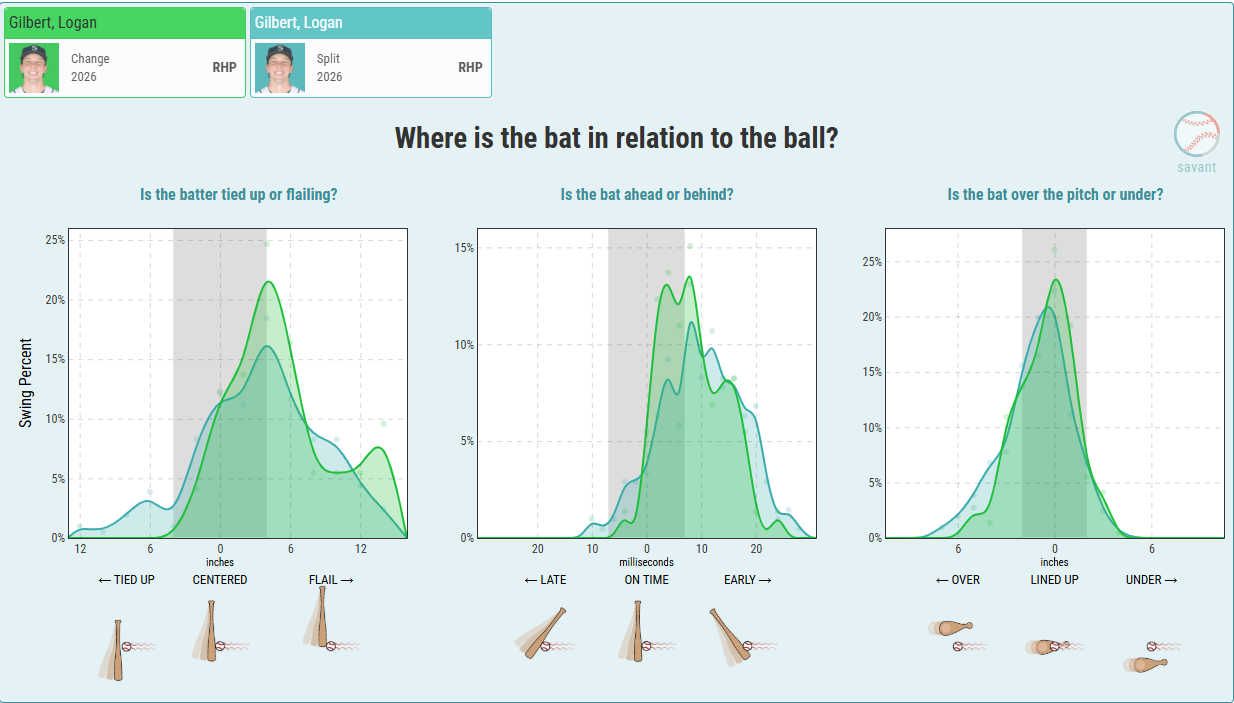
Gilbert’s changeup has gotten more end-of-the-bat, early-to-timed-up swings, and his splitter has a far wider spread across the board. One thing that stands out is their over/under; despite their velocity difference from a strong four-seam, hitters seem to be lining up his changeup quite frequently, although his splitter has gotten more swings above the ball.
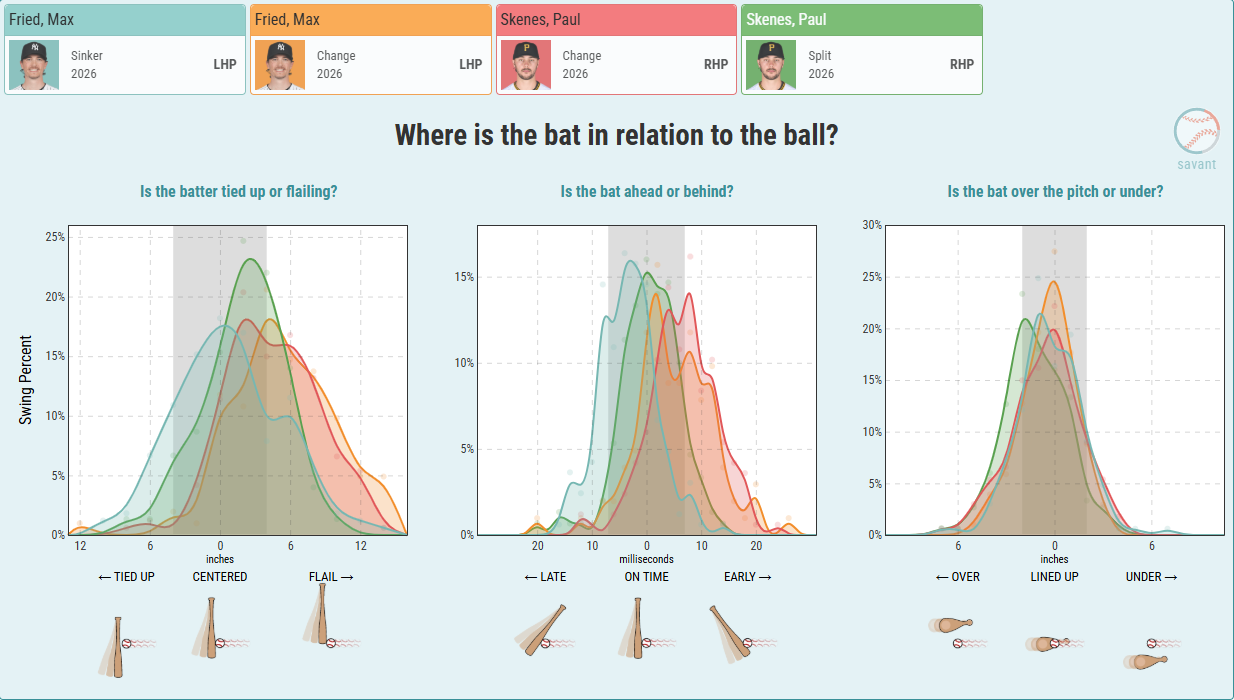
Looking at two starters with more arm-side offerings and similar vertical separation to Gilbert, both Fried’s sinker and Skenes’ splitter get later and rolled-over swings. Their changes, featuring similar shapes at lower velocity, have gotten earlier swings off the end of the bat. However, like Gilbert, they are lined up more often than not.
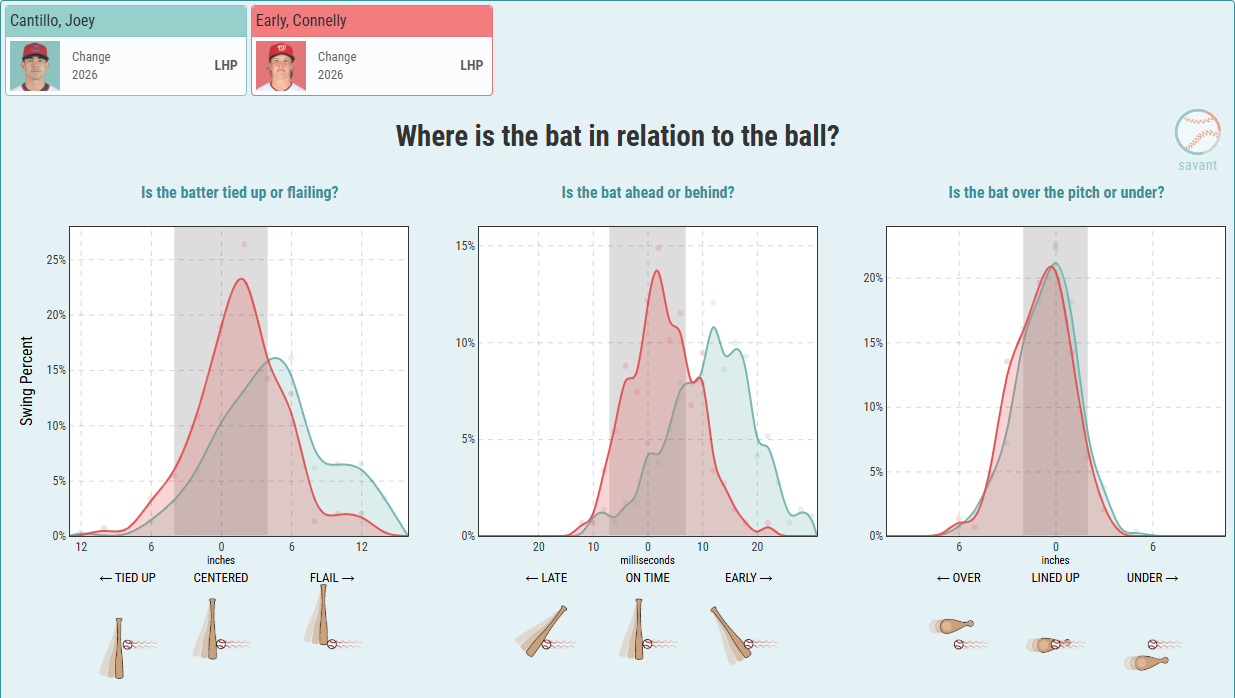
Now looking at Cantillo and Early’s polar changeups, they have a few similarities and differences. First, Cantillo’s changeup has gotten far more early, end-of-the-bat swings, whereas batters are more often making centered, slightly out-in-front contact against Early. However, both seemingly get a similar amount of lined-up contact, which would seem strange, given Early’s elite vertical drop and Cantillo’s strikingly similar shape to his fastball.
This may have to do with their pitch mix beyond a changeup. Like Rodon or Fried, Early’s two-seam offers a bridge between their four-seam and change, similar in shape to a changeup but far closer to a fastball in velocity. Given he uses both against righties quite frequently, his changeup once again serves as an offspeed pitch, working not just through its movement but also the velocity gap from his fastball. Despite their vast shape difference, Early and Cantillo’s changeups aren’t all that different, and both match the description of an offspeed pitch.
In Gilbert’s case, he doesn’t have that bridge to his changeup. Its best function has been getting called strikes and out-in-front swings early in counts, and despite its solid movement, it best functions as an offspeed pitch. His splitter, often used in two-strike counts, has been the key whiff-getter, using Gilbert’s elite extension and deception to catch hitters cheating on his four-seam, generating whiffs or rolled-over swings.
Overall, this would make Gilbert’s nasty splitter seem far more akin to a breaking ball, even with its low spin and velocity. His plethora of such offerings has allowed Gilbert to post elite strikeout rates throughout his Major League career, and will hopefully continue to do so in the future.
