





Keeping tabs on your current baseball dynasty pitching options is hard enough. Looking for the next diamond in the rough on the minor-league side is a job all by itself. Thanks to PLV, we can look at some arms of note and the pitching prospects doing the most in 2026.
With that in mind, let’s take a look at some Triple-A standouts from the season so far and check in on a Top 100 arm.
Check out the card tool at: https://milb-pitch-analysis-card.streamlit.app/ and other tools at: https://pitcherlist.com/pl-pro-tools-hub/
Top 100 Prospect Spotlight
2026 Stats: 7 GS | 33.1 IP | 2.70 ERA | 4.16 FIP | 23.0% K% | 14.4% BB% | 26.6% CSW%
Last Week: 0.1 IP | 135.00 ERA | 1 H | 5 ER | 4 BB | 1 K
Last week’s data is bad enough that it needs to be addressed directly. Ritchie failed to record two outs in his return start for Triple-A Gwinnett, surrendering five runs on one hit and four walks in a third of an inning. His Triple-A ERA nearly doubled from 1.36 to 2.70 in a single outing. It was the same command problem that unravelled his MLB stint: 16 walks in five starts, unable to throw more than 5.1 innings in any of his final four appearances. The pattern has shown up too consistently to dismiss.
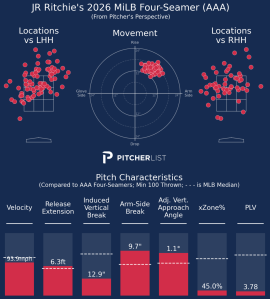
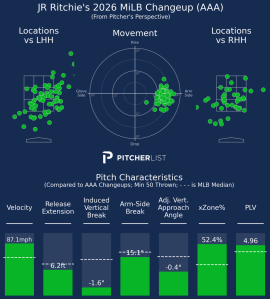
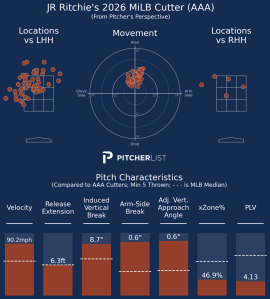
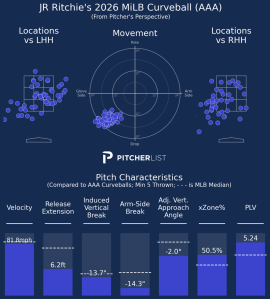
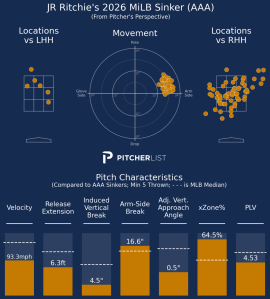
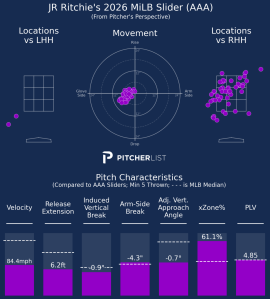
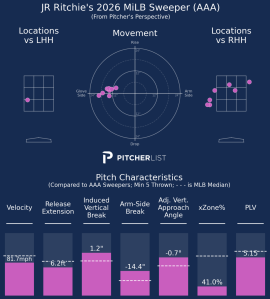
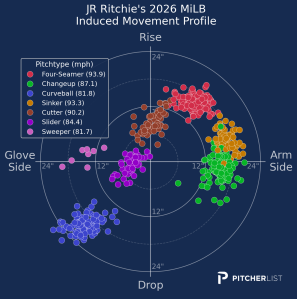
Put the last outing aside for a moment and look at the PLV cards, because they tell the story of what Ritchie actually is when the command is there. He throws seven pitches and all seven land in different quadrants of the induced movement profile, an exceptional separation that makes him genuinely unpredictable when he is locating. His curveball (PLV 5.24) is the best pitch in his arsenal by a wide margin: -13.7 inches of induced vertical break with -14.3 inches of glove-side run, a shape that is completely distinct from everything else in the mix. His sweeper (PLV 5.15) provides a flatter version of the same glove-side action at nearly identical velocity. The slider (PLV 4.85) has a 61.1% expected zone rate, one of the better marks in this week’s group.
JR Ritchie is a very old-school type of pitcher, and he looks like he’s going to stick in the Braves’ rotation for a long time 💪 pic.twitter.com/s0zm2T9NL0
— Just Baseball (@JustBB_Media) April 24, 2026
His sinker has a 64.5% expected zone rate and a PLV of 4.53. His four-seamer has a 45.0% expected zone rate and a PLV of 3.78. The 19.5-point gap between those two zone rates is where wins and losses get decided.
The four-seamer (PLV 3.78, 45.0% xZone%) is the problem. It is the pitch he throws most often and his worst offering by PLV, a combination that has produced four walk-heavy outings in his last five starts across Triple-A and the majors. The movement profile confirms the issue: the four-seamer has only 12.9 inches of induced vertical break, below the MLB median, meaning it does not ride the way elite high-spin fastballs do. It scatters to all four corners of the location chart. When Ritchie leans on the sinker (PLV 4.53, 64.5% xZone%) instead, a pitch that tunnels identically out of the hand but drops sharply, the results are dramatically better.
But, dynasty managers should still hold fast. The seven-pitch arsenal diversity and the quality of his best pitches (curveball, sweeper, slider) maintain the SP3 ceiling when command is present. The four-seamer consistency is the variable that separates the ceiling from an SP5 floor. He drops a spot in Braves prospect rankings, not because of performance, but because Didier Fuentes has emerged in the big league bullpen. Ritchie is still the more valuable long-term asset. Do not sell at a post-bad-start discount. The curveball alone is worth waiting for.
Here are his PLV cards:
Triple-A Standouts
2026 Stats: 10 GS | 47.1 IP | 5.32 ERA | 6.36 FIP | 25.9% K% | 14.6% BB% | 28.7% CSW%
Last Week: 6.2 IP | 2.70 ERA | 3 H | 2 ER | 1 BB | 8 K
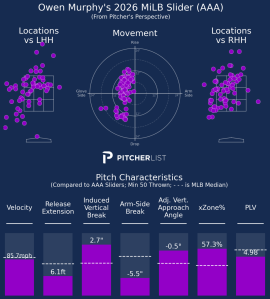
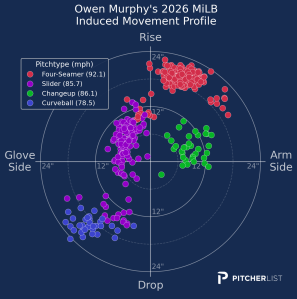
Owen Murphy is a 22-year-old Braves first-rounder who missed all of 2024 with Tommy John surgery, returned to post a 1.32 ERA in six High-A starts in 2025, and is now pitching at Triple-A Gwinnett in his first exposure to the level, striking out eight in his most recent outing. The walk rate is the first thing to look at in his season line: 4.3%. That is the best mark among all five arms covered this week, and it is the number that most reliably separates pitchers who have post-surgery command from those who are still finding it.
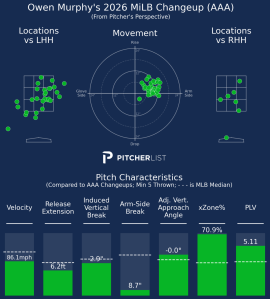
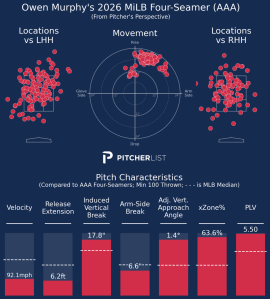
The four-seamer is the reason everything else works. At 92.1 mph, it generates 17.8 inches of induced vertical break, well above the MLB median, with a 63.6% expected zone rate and a PLV of 5.50. That is the best primary pitch PLV of this entire week’s group. The ride is elite for 92 mph, and the location chart shows a pitcher who knows where the ball is going. The changeup (PLV 5.11) is the perfect tunnel companion: 8.7 inches of arm-side run off the same release point, nearly identical velocity, and a 70.9% expected zone rate that means Murphy is throwing it for strikes on purpose, not hoping it lands.
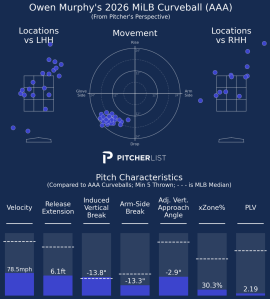
The honest problem is the curveball (PLV 2.19, 30.3% xZone%). The shape is massive, -13.8 inches of vertical break with -13.3 inches of glove-side run, but it only finds the expected zone 30% of the time. The location charts show scatter in all directions, particularly against lefties. When Murphy uses it as a chase pitch on two strikes, the shape is dangerous enough to be effective anyway. When he tries to throw it for strikes, it becomes a walk. The slider (PLV 4.98, 57.3% xZone%) does the reliable breaking ball work in the meantime and should probably be his primary secondary over the curveball in most counts.
Murphy is at a spot where a call-up is not out of the question if the need arises. Dynasty managers should look at a slim buy window as an opportunity. A 4.3% walk rate and a 5.50 PLV four-seamer are the foundation of a mid-rotation starter. The Tommy John is clearly behind him, as the command profile post-surgery is excellent. The curveball needs to become a chase pitch rather than a zone pitch, and if it does, the slider and curveball combination gives him two legitimate secondary weapons. Project as a No. 3 starter with a high floor courtesy of the walk rate and a ceiling dictated by how much he can develop the curve. The Braves will need him soon.
Here are his PLV cards:
Quinn Matthews, St. Louis Cardinals
2026 Stats: 10 GS | 39.2 IP | 5.22 ERA | 5.85 FIP | 28.7% K% | 18.2% BB% | 28.5% CSW%
Last Week: 4.0 IP | 2.25 ERA | 3 H | 1 ER | 3 BB | 8 K
A Stanford fourth-rounder who won the Pac-12 Pitcher of the Year, threw 156 pitches in a single collegiate start while striking out 16, and spent 2025 on the injured list with a left shoulder injury that derailed what should have been his call-up season, Matthews is having the best stretch of his professional career right now. His last three starts at Triple-A Memphis: 2.70 ERA, 1.08 WHIP, 25 strikeouts against five walks in 16.2 innings. The 44.4% strikeout rate is the highest of any Triple-A arm in this week’s group.
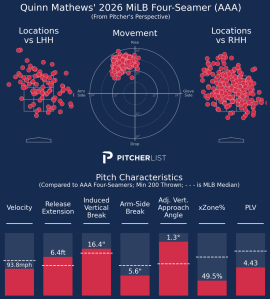
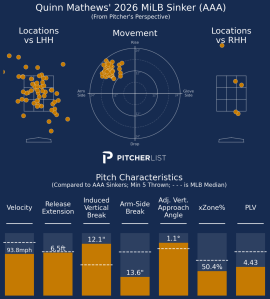
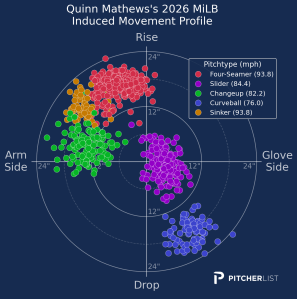
The PLV cards reveal something genuinely unusual that explains the high strikeout rate. Matthews throws a four-seamer and a sinker at identical velocity, 93.8 mph, but they land in opposite quadrants of the induced movement profile. The four-seamer rides up with 16.4 inches of vertical break; the sinker dives down with 13.6 inches of arm-side run. From the hitter’s perspective, both pitches look the same leaving his hand and then go in completely different directions. That same-speed, opposite-shape deception from a left-hander is a profile that plays up at every level.
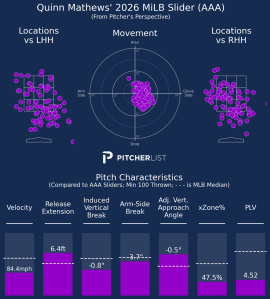
His slider (PLV 4.52) is a gyro shape that parks at nearly dead center in the movement profile. It looks like a fastball until it cuts, and at 84.4 mph it arrives late enough that hitters cannot adjust. The 6.4-foot release extension amplifies the effect.
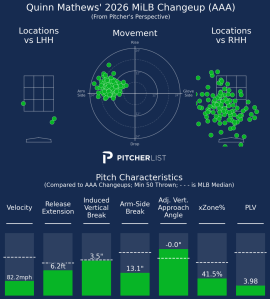
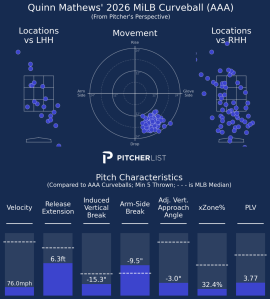
The honest concern is at the bottom of the arsenal. The changeup (PLV 3.98, 41.5% xZone%) and curveball (PLV 3.77, 32.4% xZone%) are both below average in PLV and zone rate, and they account for a meaningful portion of his secondary usage. The curveball has elite shape (-15.3 inches of vertical break) but only finds the expected zone 32.4% of the time, making it a chase pitch that walks people when it does not get chased. The path to a Cardinals call-up runs through leaning on the FF/SI/SL combination and using the curveball sparingly in deep counts.
The same-velocity fastball-sinker deception is genuinely rare and difficult for hitters to solve, and it explains the 44.4% strikeout rate at Triple-A this week. The shoulder history creates risk, but the Cardinals put him on the 40-man roster, signalling organizational belief. Project as a back-end starter with strikeout upside that grades above the stuff if the walk rate continues improving. The 25:5 strikeout-to-walk ratio in his last three starts is the number that matters most right now.
Here are his PLV cards:
George Klassen, Los Angeles Angels
2026 Stats: 8 GS | 29.1 IP | 6.75 ERA | 5.12 FIP | 18.2% K% | 14.0% BB% | 24.2% CSW%
Last Week: 5.0 IP | 1.80 ERA | 1 H | 1 ER | 4 BB | 6 K
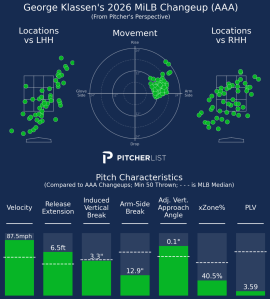
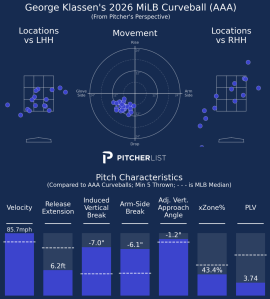
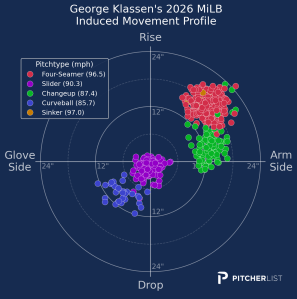
George Klassen is a 24-year-old Wisconsin native who had Tommy John surgery in 2021, barely pitched at Minnesota in 2022, bounced back to dominate Single-A in 2024, was acquired by the Angels in the Carlos Estévez trade, and made his MLB debut on April 5th. The surface numbers (.185 wOBA, 30% strikeout rate) look excellent. The underlying data says regression is coming. The PLV cards explain exactly why both things can be true at the same time.
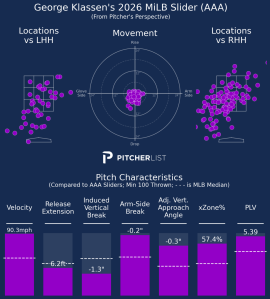
The slider (PLV 5.39) is the best individual pitch of this entire week across all five arms. It sits at 90.3 mph, essentially a cutter-slider hybrid, with a nearly flat movement profile (-1.3 inches IVB, -0.2 inches glove-side). At that velocity with that shape, it is functionally indistinguishable from the four-seamer until it arrives at the plate. The 57.4% expected zone rate means it is locatable. The 40% whiff rate from the CSW confirms hitters are not solving it. This is a legitimate swing-and-miss weapon at any level.
6.2 IP | 2 H | 1 R | 1 ER | 3 BB | 7 K pic.twitter.com/GUAaQFmYII
— AngelsMiLB (@AngelsMiLB) April 26, 2026
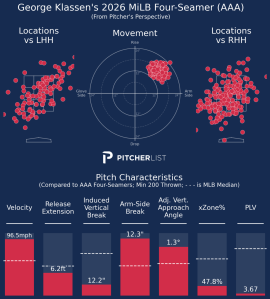
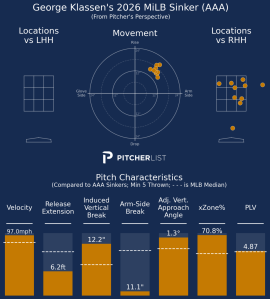
The four-seamer (PLV 3.67, 47.8% xZone%) is the problem. It is 97 mph. It is his worst pitch by PLV. The location charts show pitches scattered to every corner of the zone and beyond. The command variability on his primary pitch is the single reason for the 20% walk rate and the 125-point gap between his actual wOBA (.185) and his expected wOBA (.310). The sinker (PLV 4.87, 70.8% xZone%) is dramatically better and tunnels identically out of the hand at the same 97 mph velocity. When Klassen uses the sinker-slider combination as his primary pairing and treats the four-seamer as a show-me pitch, the profile is dominant. When he falls back on the four-seamer as his primary offering, the walk rate explodes.
Dynasty outlook: Stash in deeper formats with the understanding that the surface numbers will regress toward the .310 xwOBA as the season progresses. The slider alone justifies a roster spot. A PLV 5.39 pitch at 90 mph with that shape projects to be an above-average swing-and-miss offering at the MLB level. The Angels believe in the ceiling, and “highest ceiling of any pitcher in the system” is organizational language that does not get used lightly. The development question is whether the sinker-slider can become the primary combination and the four-seamer can be deprioritized. Kick the tires on Klassen could result in just a spot starter, but the Angels do love pushing these types to the majors.
Here are his PLV cards:
Low-A Long Shot
Ramon Marquez, Philadelphia Phillies
2026 Stats: 4 G (3 GS) | 18.2 IP | 1.45 ERA | 2.65 FIP | 43.8% K% | 8.2% BB% | 41.5% CSW%
Last Week: 4.2 IP | 1.93 ERA | 3 H | 1 ER | 2 BB | 7 K
Ramon Marquez signed with the Phillies for $10,000 during the 2025 international signing period out of Mexico. He was 19 at signing, old for his class, and Philadelphia liked him anyway because the stuff was already there. The fastball touched 96 during his debut summer. The changeup had a sudden drop and produced a miss rate of 62.1% in his first professional appearances. They sent him to full-season ball immediately.
He struck out nine in each of his first two starts of 2026. Nine. Back to back. His changeup generated a 70% whiff rate on 10 pitches in his second outing. Through his first nine innings, he had not allowed an earned run, and opposing batters were hitting .129 against him. The numbers have settled into something still genuinely impressive: 57.9% whiff rate on the changeup all season, 45.5% on the sinker, 50% on the cutter. All three of his pitches are generating whiff rates above 45%. At Low-A, that is not a profile you see every week.
Three pitches. All three generating whiff rates above 45%. A 10.5% walk rate. A 94.8 mph sinker with late arm-side run. A 60-grade changeup with sudden drop. This is a $10,000 investment the Phillies are going to get back many times over.
Ramon Marquez struck out 7 for the @Threshers yesterday! pic.twitter.com/wSMuVatsw9
— Phillies Player Development (@PhilsPlayerDev) May 31, 2026
The sinker at 94.8 mph is the most surprising number in the arsenal. That is starter-quality velocity from a compact, repeatable delivery, and the 45.5% whiff rate confirms it is not just hard, it is hard with movement hitters cannot solve. The cutter at 50% whiff provides a third distinct look. The changeup, graded 60 by Baseball America before the season began, is living up to the projection in real game data. His walk rate (10.5%) is well ahead of where you would expect for a 20-year-old in his first full season, reflecting the compact and repeatable delivery that scouts flagged when he signed.
Dynasty outlook: Buy aggressively before Baseball America’s next prospect ranking update moves him significantly. He entered 2026 as their No. 14 Phillies prospect. The in-season data makes that number look very conservative. A 60-grade changeup already producing 57.9% whiff in real Low-A games on a 20-year-old with a 10.5% walk rate and a 94-plus mph sinker is exactly the prospect profile worth overpaying for in dynasty trades. The ceiling is a No. 3 starter. The floor, based on the command profile alone, is a high-leverage reliever who misses bats at premium rates. Either outcome is useful. The price right now reflects neither.
