Keeping tabs on your current baseball dynasty pitching options is hard enough. Looking for the next diamond in the rough on the minor-league side is a job all by itself. Thanks to PLV, we can look at some arms of note and the pitching prospects doing the most in 2026.
With that in mind, let’s take a look at some Triple-A standouts from the season so far and check in on a Top 100 arm.
Check out the card tool at: https://milb-pitch-analysis-card.streamlit.app/ and other tools at: https://pitcherlist.com/pl-pro-tools-hub/
Top 100 Prospect Spotlight
Karson Milbrandt, Miami Marlins
2026 Stats: 12 GS | 62.0 IP | 1.31 ERA | 3.13 FIP | 35.1% K% | 11.6% BB% | 33.7% CSW%
Last Week: 4.0 IP | 2.25 ERA | 3 H | 1 ER | 5 BB | 7 K
The Miami Marlins just continue to churn out pitching prospects that should entice dynasty managers. Thomas White and Robby Snelling are the headline pair, but both are sidelined with injury right now. While the Marlins are above .500 and in the middle of the NL East, their rotation’s impact is greatly reduced without those two arms in the fold. But the organization should be looking at how right-handed pitcher Karson Milbrandt can help bridge the gap in 2026, even if he only has three Triple-A starts to his name.
Milbrandt started the 2026 season red-hot in Double-A Pensacola, with Fish on First saying it “was among the best for any individual month in Marlins minor league history.” It is impossible to argue with the numbers: he led the Southern League in ERA (1.34), WHIP (1.00), batting average against (.182), and strikeouts (70) across nine starts and 47.0 innings pitched. He even tightened things up in May, posting a 0.94 ERA and 47 punchouts in 28.2 innings pitched, fueling his promotion to Triple-A, where he made his debut June 7th. All in all, a 22-year-old going out for six innings and shutting out the opposition is immensely impressive, even if the three walks to one strikeout is hardly ideal. Three double plays helped his outing, which totalled 77 pitches.
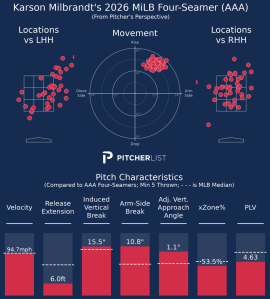
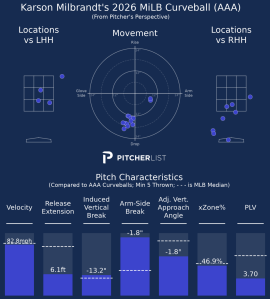
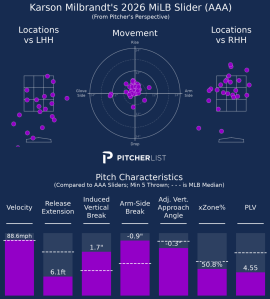
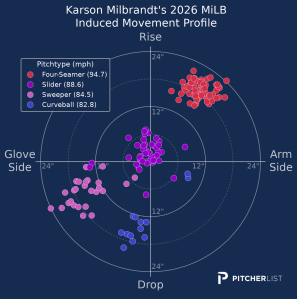
Milbrandt has yet to have that blow-up performance that can be expected after a promotion, and he has seven strikeouts in each of his last starts. But 14 strikeouts to eight walks in his last two starts remains a worrisome ratio. This is more of the same for Milbrandt, whose walks against lefties have been a recurring issue since he was drafted back in 2022. His arsenal still gets plenty of chase from right-handed batters, but lefties are less likely to chase, and that leads to more of those free bases. Milbrandt is likely never to be a pitcher with pinpoint command, but improved control would do wonders for his dynasty potential. His slider was the out pitch across his past two seasons, but it has not lived up to the hype in Triple-A. Batters are not swinging and missing on it, and with his issues putting the slider in the zone, he has a 27.1% CSW% on that pitch. His cutter has been the highest-graded pitch by many evaluators, but he has not thrown it in Triple-A, according to pitch tracking. He also has not thrown his changeup, a new addition this season that had some wicked arm-side run in Double-A.
The Top 100 prospect topped out in his June 13th start at 97 mph, keeping with his 2025 trends and continuing to work that pitch high in the zone. His not throwing the kick change in Triple-A is astounding to me, especially as he looks for better performances against lefties. His command and rough mechanics are going to keep a relief-risk label on him until he proves otherwise in the majors. Milbrandt has shown the ability to limit runs, though, and that matters most when it comes to winning at the next level.
The Liberty, Missouri, native is a pending Rule 5 draft candidate anyway, and the Marlins would be fools not to add him to the 40-man roster for protection. The Marlins roster right now is primarily players they traded for, rather than homegrown players. Milbrandt is one such player and could become a more serious promotion candidate with a few more solid starts in Jacksonville. The Marlins may rather turn to Brandon White or another older, less raw arm in Triple-A for some innings this season, but I would not be shocked to see Milbrandt at some point in 2026.
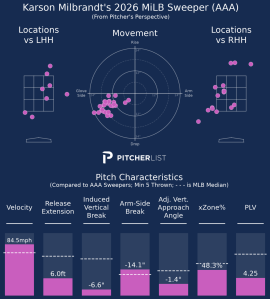
Here are his PLV cards:
Triple-A Standouts
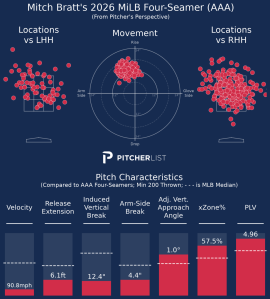
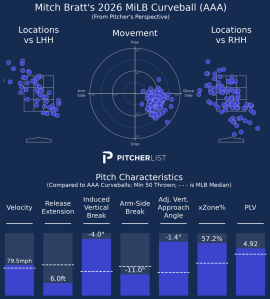
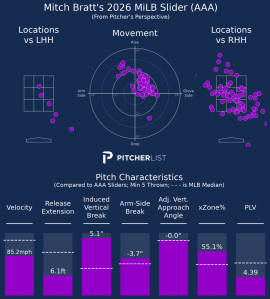
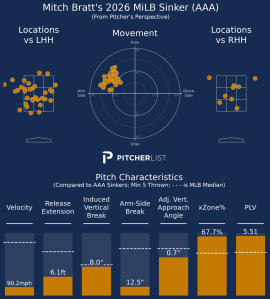
Mitch Bratt, Arizona Diamondbacks
2026 Stats: 11 GS | 44.1 IP | 2.84 ERA | 4.15 FIP | 24.7% K% | 7.1% BB% | 25.9% CSW%
Last Week: 4.0 IP | 4.50 ERA | 2 H | 2 ER | 1 BB | 4 K
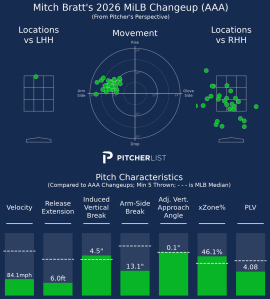
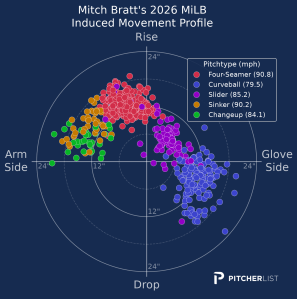
The ETA for Arizona Diamondbacks pitching prospect Mitch Bratt seems sooner rather than later. One of the key pieces in last year’s deal that sent starter Merrill Kelly to the Texas Rangers, Bratt made a seamless transition to the Diamondbacks organization last season. After Arizona acquired him, Bratt struck out 42 batters while walking only five in 31.2 innings pitched, a stellar 8.4 ratio. While Bratt’s control is commendable, it may also be the thing that holds him back in a dynasty sense.
Bratt spent all of last season in Double-A at 21, logging 122.1 innings and a 3.38 ERA between the two systems. He led Double-A qualifiers in strikeout rate (29.3%) and K-BB% (25.1%). His K:BB ratio, better than 7:1, was by far the best in Arizona’s system. Bratt’s control is impeccable, living in the zone and forcing batters to beat him rather than the other way around. Unfortunately, he allowed plenty of hard-hit balls and 1.3 HR/9 last year, thanks to lacking premium stuff. Such is the life of a pitcher with below-average velocity and trouble staying out of the heart of the zone. Bratt has gotten marginally better at limiting home runs in Triple-A, with a 0.81 HR/9 this season, but with some regression in the strikeout and walk departments. Still, it is hard to argue with his 2.84 ERA in his very first taste of Triple-A competition.
Bratt is still getting built back up after a short stay on the injured list, thanks to shoulder inflammation. Arizona farm director Chris Slivka was plenty pleased with Bratt’s return to the mound this past week.
“He threw pretty well,” Slivka said. “Obviously, on a pitch count, we’re still getting him built up, but really good to see him continue to attack the strike zone and be efficient with his stuff. It’s been good seeing him perform how he has this year at that level. The numbers he’s putting up are no joke in that league.”
I see some similarities between Bratt and Royals southpaw Noah Cameron’s prospect profile. Both lefties lack a top-end fastball and overall stuff, but Cameron found success last season and was the top AL rookie pitcher by the end-of-year voting. Bratt may not be able to tap into that same vein, but he has a high-floor approach, and PLV loves how much his offerings stay in or around the zone.
Here are his PLV cards:
Gabriel Hughes, Colorado Rockies
2026 Stats: 10 G | 8 GS | 40.2 IP |5.31 ERA | 3.06 FIP | 29.7% K% | 7.4% BB% | 28.5% CSW%
Last Week: 4.0 IP | 2.25 ERA | 3 H | 1 ER | 3 BB | 8 K
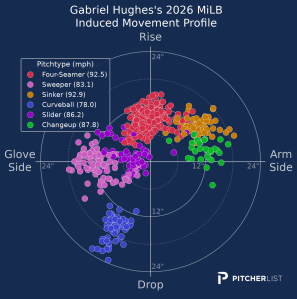
Colorado Rockies prospect Gabriel Hughes was one of those pitchers who rarely started. The 2022 first-rounder needed Tommy John in his first full season, and by the end of 2024, he was largely forgotten in prospect circles. The former two-way player made a name for himself at Gonzaga, but it is wild to me that Hughes was largely written off. While the Alaska native certainly has an injury-prone label now in 2026, his stuff this season is also impossible to ignore.
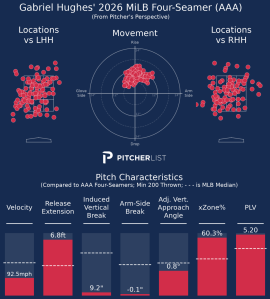
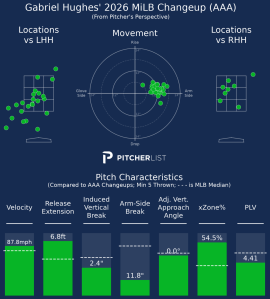
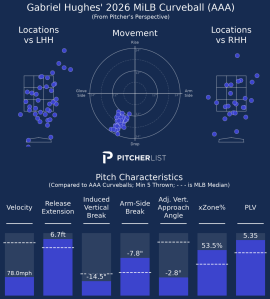
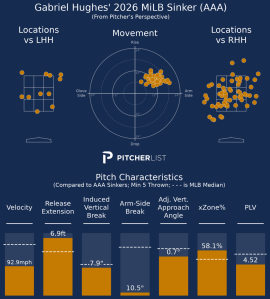
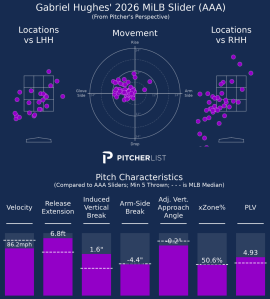
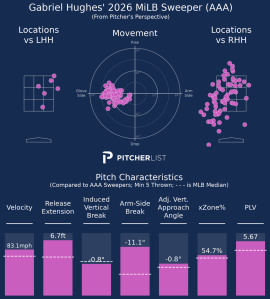
Hughes struggled mightily last season in Triple-A, posting a 5.11 ERA and 1.56 WHIP in 61.2 innings pitched at that level. Right shoulder fatigue kept him off the mound for a month, but he rebounded in 10 starts following his return with a 3.72 ERA. Hughes has been a revelation on the numbers side this season, no matter how much the 6.23 ERA overshadows it (his 3.27 FIP gives him one of the largest E-F differences in the minors). Hughes’ strikeout stuff is flashing, with both his sweeper and curveball generating whiff rates above 36% this season. Hughes, like Bratt, stays in or around the zone with all of his pitches, but Hughes induces more soft contact and racks up more strikeouts. His fastball similarly has below-average velocity, but it only records a ball 31.5% of the time. Against Triple-A competition, that leads to more foul balls, more advantageous counts, and more of those strikeouts.
Hughes’ secondaries feature a sweeper, sinker, curveball, and slider that he throws between 12% and 16% of the time each. He is a death-by-a-thousand-fouls sort of pitcher, but all of his stuff plays up thanks to the deceptive delivery and elite extension. Since he missed a month earlier this season, he has not allowed a single run and only four hits in 15.2 innings pitched. His 20 strikeouts to seven walks are keeping him on course with the gains he realized earlier this season. Hughes may not be a frontline guy, but as the season progresses or if Colorado moves pitching at the trade deadline, Hughes seems like a solid promotion candidate. Then, and only then, will dynasty managers know if he can live up to the promise of being the 10th overall pick.
Here are his PLV cards:
2026 Stats: 12 G | 11 GS | 46.2 IP | 3.47 ERA | 3.99 FIP | 26.0% K% | 8.9% BB% | 27.7% CSW%
Last Week: 7.0 IP | 1.29 ERA | 4 H | 1 ER | 2 BB | 5 K
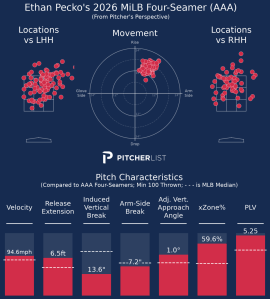
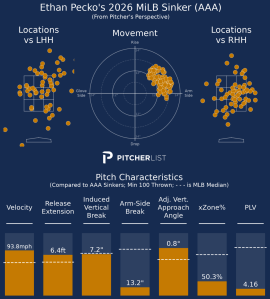
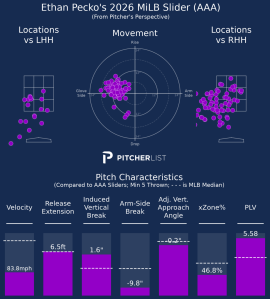
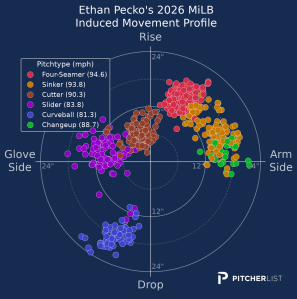
In the age of pitch variation and having multiple fastball shapes, Houston Astros prospect Ethan Pecko fits that bill. The Towson University product is no secret as one of Houston’s best prospects and entered this season as one of the most MLB-ready arms in Houston’s system. The 23-year-old right-hander has validated that outlook at Triple-A, highlighted by a career-best seven shutout innings against Sacramento on June 11, in which he allowed just two hits and struck out four. Over his last two starts, Pecko has thrown 14 innings of one-run ball, surrendering only six hits with five walks and nine strikeouts.
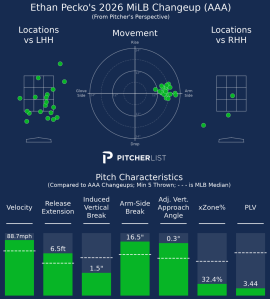
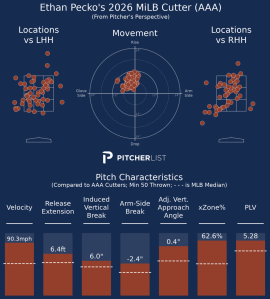
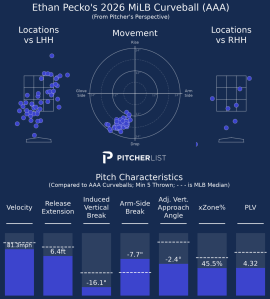
The arsenal is built around deception rather than overpowering velocity, like Hughes. Pecko works from a drop-and-drive delivery that produces a flat approach angle, making his 92-93 mph four-seamer play up despite below-average extension to the plate. FanGraphs brought up a good point that his delivery is a recurring profile in the Astros’ system. He pairs the four-seamer with a 55-grade cutter in the 89-92 mph range that protects against right-handed hitters, a low-to-mid-80s slider that serves as his best bat-missing pitch in same-side matchups, a meh changeup, and an upper-70s curveball that generates weak contact and stolen strikes. The five-pitch mix gives him an answer in every count, though the changeup command remains a development point.
Pecko is another Triple-A arm that might not be a frontline guy down the road, but feels more than likely to accrue hundreds of innings in the majors. Houston’s rotation is pretty set right now, but Pecko feels ready for a call-up in 2026. If the results go one-for-one from Sugar Land to the majors, Pecko would be worthy of dynasty consideration.
Here are his PLV cards: