





Welcome to Week Seven of our Patience or Panic series! In case the name didn’t spell it out, here we examine struggling players and issue a declaration. Should their performance incite panic or a level of calm? Or should the house feel afire?
Fernando Tatis Jr., OF, San Diego Padres
At first, Fernando Tatis Jr. was a headline. Throughout his career, yes, but more as of the last two weeks. Hitting .270/.343/.322 through the first 31 games, Tatis seemed himself minus the power. And therein lay the initial attention. Despite a strong average and OBP, Tatis had yet to hit a home run. It was fodder for some time.”The Superstar Who Can’t Slug,” “The Padres’ Power Dampener,” etc.
Fast forward to now. Tatis still hasn’t hit a home run. In fact, he hasn’t hit anything lately. Over his last seven games, a full week, Tatis has hit .160/.250/.200 with a .450 OPS and just four hits. This slump has dropped his total stats down, reducing his solid start to something a little more troubling. Moreover, this statistical malaise invites questions about El Niño’s complete game rather than his power output.
First of all, let’s get something out of the way: Tatis is still awesome. He’s still a rare caliber of superduper star, and he’s still the face of the San Diego Padres. This first month isn’t changing that. The verdict is, as it always should be with Tatis, to buy. Buy every cent. In the long run, this will be a strange blip in an otherwise extraordinary career that might lead to Cooperstown. This is not a critique of his projection. It’s an examination of what’s causing a premier bat to underperform to the extent that he’s one of six qualified players still without a home run.
The strangest thing about that fact is how untrue it should be. Because Tatis, despite his power, is still mashing the ball. His HardHit% is in the 98th percentile, only trailing power-hitters like Aaron Judge, Oneil Cruz, James Wood, and Munetaka Murakami. In fact, his HardHit% is up by 6.9%, the 13th-best year-to-year increase in baseball. Likewise, his average exit velocity is in the 91st percentile. His bat speed is strong, his Barrel% is above average, and his Launch Angle SweetSpot is solid.
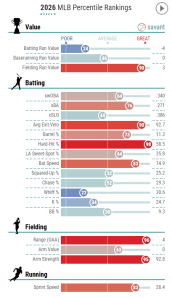
For all intents and purposes, Tatis should be hitting balls over the fence. And yet he’s not. And he wouldn’t be anywhere. According to Baseball Savant’s Expected Home Runs by Park, Tatis would only have one or two dingers elsewhere. The one ballpark where Tatis would have more than three longballs is Philadelphia’s Citizens Bank Park. It’s not a San Diego-exclusive situation. This is a ” can’t drive the ball anywhere ” type of problem.
Why? Well, despite the extraordinary nature of the quandary, the answer is somewhat simple. Tatis isn’t putting enough balls into the air. His 52.8 GB% isn’t just a career-high; it’s the 27th-highest in baseball. Factor in an increased K%, his highest since 2021, and a 47.2 AIR%, and it’s not exactly a mystery. Longballs have to sail. Right now, Tatis is chopping and fanning.
But perhaps the biggest cause is Tatis’ inability to pull balls into the air. Think back to 2021, when Tatis finished third in NL MVP voting and clubbed 42 ding-dongs. That year, he had a beautiful 22.2 PullAir%. That number has steadily decreased for Tatis since. But those drops were modest and slow. 1% declines, 2%, things like that. This season, Tatis is pulling flyballs only 5.7% of the time, 6.3% less than a year ago. Some of the only hitters with a worse PullAir%? Chandler Simpson and Victor Scott II. Not exactly power hitters. And not exactly players who should have anything in common with Tatis.
This is, in part, why Tatis has hit fewer and fewer home runs since 2021. He’s not doing what he has to do. He’s not putting it where it needs to go. And it’s the sort of strange about-face that could halt Tatis from reaching his potential. Because Tatis is a good player. But within him exists a great one that rivals few predecessors to put on a Padres uniform. That said…
The Verdict: Buy, as previously stated. This is a quirk. A very strange quirk.
Bo Bichette, 3B/SS, New York Mets
What does it say when a New York Met features almost weekly? Well, the answer lies within the question.
This week’s suspect is Bo Bichette. Bichette, the $126 million man, the shortstop-turned-third baseman turned shortstop again. Bichette is an odd case. When signed to that contract and flipped to the hot corner, the assumption was thus: He’d be a great bat and a bad glove. Yet the opposite is true. So far, Bichette’s hitting .222/.269/.290 with a .559 OPS and a career-worst 61 wRC+, all this while ranking in the 81st percentile in OAA. Go figure.
So Bo, what gives? The first answer is bad luck. Bichette’s expected numbers show a gaudy difference. a .286 expected batting average, a .402 expected slug. Talk about a gulf. If those two were even close to Bichette’s real numbers, perception would be much different. We’re talking a near-700 OPS instead of a .500 figure.
That said, Bichette has bigger problems than bad luck. His wOBA, for instance, is one of them. wOBA is an area where Bichette shone last year and in seasons prior. This year, however, he touts a .256 wOBA, which is down -.105 points, putting him in the bottom 10th percentile among all hitters. Woof. To some extent, this is also bad luck, with the -.064 difference between his success and his expected success
But enough already. Lady Luck can’t be the only person at fault for one’s own failings. What is Bichette doing to himself? For starters, he’s hitting more grounders, posting a 55 GB%, up 7.6 percentage points compared to the year before. Conversely, he’s hitting fewer line drives and flyballs. Sound familiar? It should. It sounds a lot like Tatis’s problems. And the similarities don’t end there. Like the Padres star, Bichette isn’t pulling flyballs the way he once did. Pulling 12% of his flyballs on average throughout his career, Bichette is pulling just 6.1% this season.
Instead, he’s trying to go the other way, with higher-than-average percentages on opposite-field grounders and flyballs. It’s the type of change that either seems conscious or by happenstance. He has either changed his approach or divested himself of what drove previous success. It’s strange.
Even stranger is Bichette’s inability to make hard contact. His 4.6 Barrel% is almost a career-worst and more than half of his career average. The same goes for his Barrel/PA. His Solid% is down, and he’s topping more balls. Sometimes the riddle has an easy solution: Bichette is struggling because he’s not hitting balls hard. He’s changed. And some of that can be luck, but some of the onus goes to the man holding the bat.
But there is a path back. Maybe. When Francisco Lindor got injured, the Mets tried replacing him at leadoff with Bichette. It worked. In 11 games, Bichette hit .295/.333/.409. Inexplicably, the Mets pivoted from that last week. And in turn, Bichette’s hit .183/.246/.183 in the two-hole. Weird!
The Verdict: Ride the wave. The Mets make no sense, Bichette makes no sense. Nonetheless, there’s little recourse except to let the swell guide one where it might.
Jake Burger, 1B, Texas Rangers
Jake Burger is not hitting. Through 38 games, he’s hitting .208/242/.362 with a .604 OPS and a 67 wRC+. He has six home runs — not bad –, 21 RBIs, and five doubles. He’s been a fine run producer, and that’s about it.
And to some extent, isn’t that what he should be? Unlike Tatis and Bichette, these do-it-all Adonises of the diamond, Burger is fairly one-note. He’s a power-hitting first baseman. He’s not here to notch singles or walk. He’s here to hit the ball far, and, admittedly, do so infrequently. He’s a career .244 hitter, after all. Why should it matter if he’s hitting .208? So long as he’s dropping bombs deep into Texas’ cold, gray, robot-esque park, what’s it matter?
To that, the answer is this: Burger was once little more than his stereotype. During his time with Chicago and Miami in 2023, Burger was one of the best first basemen in baseball. He hit .250 .309/.518 for a .828 OPS. All that while belting 34 home runs and collecting 80 RBIs. His 2024 encore with Miami didn’t go as well, but Burger maintained his reputation. Really, it’s been since he became Burger, Texas Ranger, that things have slipped. His power’s dipped, his average has dropped.
What changed? Well, as that answer pertains to 2026, Burger isn’t slugging. Some, yes. Like he used to? Like he should? No. His .362 slug and .154 ISO are the worst of his career, and it’s not that close. And his expected numbers offer no comfort, with a .386 expected slug. In other words, Burger is, more or less, hitting the ball as he should. And for him and Texas, it’s just simply not enough.
One way pitchers are flattening Burger is with their fastballs. He’s seeing 2.5% more than he did last year, and it’s killing him. Burger is hitting .205 against the pitch and is bizarrely whiffing through 31.2% of all fastballs thrown at him. But more troubling for Burger is how often pitchers are using it to get him out, using it 31.3% of the time to put him away. It’s part of a two-year decline for Burger, who hit .237 against fastballs a season ago, a then-career-worst.
It’s strange. Burger used to mash fastballs, hitting .292, .283, .273, and .316 against them in previous seasons. They were his favorite pitch to hit. Now, he can barely touch them.
If a power-hitter can’t catch up to fastballs, then what’s his use? That question’s validity is only increased by Burger’s inability to walk. In the past, he sported a poor yet manageable BB% somewhere in the fives. These last two seasons, he’s walked 3.2% and 3.8% of the time. For a guy who struggled to do so before, he’s only gotten worse.
All of this begs the question. Other than diesel, grease, oil, and barbecue sauce, what is in Texas’ water? Because Burger is not the player he once was. Nor is Corey Seager, for that matter, but that’s perhaps a discussion for a later date. Regardless, Burger hasn’t changed his approach. His batted-ball data differs from his career averages, albeit not drastically. His Pitch%’s are mostly in line with the past, too. So why has Burger specifically gone bad the second he’s set foot onto Texas’ soil?
That answer is largely a mystery lost to the desert. The sand, though, offers one possible solution. Maybe Burger is, pardon the pun and use of the modern parlance, cooked. His exit velocities have gone down for three straight years. His Barrel% haven’t been close to his 2022 and 2023 highs. His power, as stated, is only decreasing with time.
Really, the only positive stat that pertains to his specific skillset is Burger’s HardHit%. It’s about as high as it was in 2023. Almost identical. 49.6% to 49.5%. The latter is still good for an 86th percentile. There exists, like there is for almost all struggling hitters, a reason for hope.
The Verdict: Don’t wait around for Burger to reclaim his crown, if he does at all. There are too many other viable options to toy with in the meantime. If anything, make him a buy-low should he regain his scepter.
