





Welcome back to our Patience or Panic series, where we profile struggling players and provide recommendations on how you should react to their poor performance. I hope that appearing in this series isn’t becoming something of a jinx! Players we’ve covered in three of the last four editions have gone down with injuries since they were featured (Jac Caglianone, Chase Burns, and Jacob deGrom). This week, I take a look at one perennial first-rounder in a swoon along with two promising young talents who have hit the skids after they looked to be putting together breakout campaigns. All stats are through the games of Monday, August 18.
Kyle Tucker, OF, CHC
Last 30 days: 102 PA, .171/.327/.195 (66 wRC+), 9 R, 0 HR, 5 RBI, 3 SB
2025: 533 PA, .261/.374/.447 (131 wRC+), 79 R, 18 HR, 62 RBI, 25 SB
Tucker seemed well on his way to his first career 30/30 season after posting 17 long balls and 20 steals through June, but that now seems like a long shot. Since then, the regression has been steady and sharp, with the Cubs’ marquee trade acquisition starting to hear the boo birds in his own ballpark. One bright spot is that even during this putrid stretch, Tucker has still continued to walk (17.6%) more often than he strikes out (16.7%), as he has all season (14.8% walk rate vs. 14.4% strikeout rate).
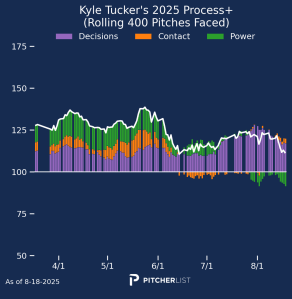
As you can see in the rolling 400-pitch Process+ chart above, when Tucker is going well, it’s because of his plus swing decisions, plus power, and slightly above average contact skills. While I’ve only included his rolling Process+ chart for this year here, he’s taken the same path to success in previous years too. But as of late, only the swing decisions have been propping him up. His barrel rate in the last 30 days is a minuscule 1.6%. In the past four years, there have only been about three months where Tucker’s rolling 400-pitch power output dipped below league average.
Verdict: Panic. It’s nice to see that the plate discipline hasn’t fallen off a cliff for Tucker, but his ability to impact the ball is clearly not what it was earlier this year. In recent months, his bat speed has dropped, potentially as the result of a finger injury sustained in early June. Tucker has always had pop, but he is not a guy with prodigious raw power. His max exit velocity, barrel rate, and hard hit rates typically rank around the 70th or 75th percentile. This year, two of the three (hard hit rate and max EV) are slightly below average, as is the bat speed. That gives me real concern about Tucker’s power ceiling, though I know his overall floor will still be high because of the lineup context and his plate discipline. Tucker is being given a couple of days off to hopefully reset and get back on track. While we can’t really take action on Tucker right now, this stretch will probably make me reluctant to take him in the first round next year.
MacKenzie Gore, SP, WSN
Last 30 days: 27.2 IP, 27 Ks, 1 W, 8.13 ERA, 1.81 WHIP
2025: 138 IP, 165 Ks, 5 W, 4.04 ERA, 1.32 WHIP
Gore is another noteworthy recent poor performer. He’s actually gotten back on track somewhat as of late (two ER in his last two starts with a 17:3 K:BB ratio) after a brutal stretch where he allowed 23 earned runs in 15.2 IP over four starts. Those four starts pretty much undid all of Gore’s great work over the first few months. It seems like we once again have to look at Gore as an arm that can’t be relied on for anything except strikeouts and a detrimental WHIP.
Though you can’t necessarily tell from the surface-level stats, Gore has made some real improvements this year. He separated his cutter/slider into two distinct offerings to broaden his arsenal and has seen notable increases in both his swinging strike (14.4% to 15.1%) and strikeout (24.8% to 28.4%) rates while posting a career-low walk rate of 8.2%.
Verdict: Panic. Even with these changes, the ratios still aren’t good, and Gore plays on a team that’s not going to help him from a wins perspective or defensively. For several years, the Nationals have ranked among the league’s worst defenses. This year, they are 29th in Outs Above Average. Unfortunately, I wouldn’t be surprised to see them remain there for as long as they keep CJ Abrams at shortstop. Poor fielding helps to explain Gore’s consistently high BABIPs (.336 this year, .328 career), but Gore’s not helping himself in that respect either. His expected BABIP of .325 falls in the 7th percentile. Because Gore already allows a lot of hard contact while not pitching in the zone much (44.5% zone rate, 15th percentile), I don’t see a path to improvement for him aside from a better team context or yet another jump in an already high strikeout rate.
Ceddanne Rafaela, 2B/SS/OF, BOS
Last 30 days: 102 PA, .189/.235/.253 (30 wRC+), 11 R, 0 HR, 4 RBI, 5 SB
2025: 451 PA, .252/.295/.426 (94 wRC+), 66 R, 14 HR, 52 RBI, 18 SB
I’m not ashamed to admit that Ceddanne Rafaela was on my shortstop busts list this preseason, but I will freely admit that call looked pretty bad about a month ago. Even after a month where Rafaela was the worst qualified hitter in the league in terms of wRC+, managers are still probably pretty happy with Rafaela’s overall line for a guy they got around pick 200. He hasn’t stood out in any one category but hasn’t hurt you anywhere either.
Rafaela posted a decent fantasy season in 2024, hitting .246 with 15 homers, 19 steals, 70 runs, and 75 RBI. But, the real life line of .246/.274/.390 and the resulting 81 wRC+ left much to be desired. Impressively, Rafaela has improved in pretty much every facet as a hitter in 2025. He’s chasing less and making better and harder contact in the zone, which has led to an increase in walks and a decrease in strikeouts. But improvement is all relative, and these changes have taken Rafaela from someone with questionable viability as a major league hitter to a guy who still chases a ton (2nd percentile) while making average zone contact and barreling balls up at a slightly above average rate (67th percentile). When Rafaela is going well, you’ll see spectacular stretches like in June and July when he hit .285 with 11 HR and 7 SB, but you’ll also see massive slumps like the one he’s mired in now.
Verdict: Panic. This one just comes down to what you are expecting Rafaela to be for your team. If you want to hold him as a positionally versatile bench bat to sub in for a resting starter or on an off day, I think that’s reasonable. If you’re expecting him to start everyday for you and post a 20/25 season, that’s a mistake. Even with the year-over-year improvements, his poor swing decisions seriously limit his ceiling as a hitter. There are also some playing time concerns because of a crowded Red Sox outfield, Masataka Yoshida clogging up DH, and the addition of Nathaniel Lowe to play first base. That will force the Red Sox to play Romy González at second base more if they want to get him in the lineup more, and the keystone is currently Rafaela’s primary position even though he’s an elite centerfield defender. Hopefully a trade clears some of this up in the offseason, but we’re focused on rest of season outlook here. If a struggling Rafaela is only going to be in the lineup 75% of the time, I think he’s best left on the waiver wire.
