





Never before in baseball history has the average player been so close to stardom.
The sport’s analytical age has slimmed the margins between the best and worst teams in the league, in part by making player development so accessible. Every team has the tools to tinker with swings, teach new pitch grips, and put their players in position to succeed, and it’s now the efficiency of those mechanisms that defines the ecosystem.
It wasn’t all that long ago that the Boston Red Sox were protagonists in this story. Their focus on bat speed created a trio of top prospects promising to usher in the next era of Beantown baseball. Like any good story, things haven’t gone according to plan, but the path to salvaging Craig Breslow’s tenure may be in his mastery—pitching development.
Payton Tolle entered the year as Boston’s top pitching prospect, sporting an exceptional fastball and the tenacity of a bulldog that endeared him to old-school fans. Halfway through his rookie season, it’s his new-school approach that’s making good on the hype.
It’s Always the Arsenal
Tolle’s first glimpse of Major League action wasn’t pretty. Between an ERA north of 6.00 with the FIP to match, Tolle was pounding the zone with his four-seamer and getting hammered for it. The pitch was both his bread and butter and his lifeblood; there is no Tolle without the fastball that FanGraphs labeled an 80-grade offering, or its heavy usage.
The excitement wasn’t misguided. Tolle was sitting at 96 mph with elite extension and a low arm angle that lent itself to an exceptional height-adjusted vertical approach angle of 1.4°. PLV loved it, too, grading it as a 94th-percentile pitch across his 16.1 innings.
Still, Tolle’s fastball was being hit harder than it should have been, posing an existential threat to his long-term outlook. What if his elite fastball, thrown 64% of the time, wasn’t good enough to miss big-league barrels?
There wasn’t an obvious replacement for a potential decrease in four-seamers: his changeup hadn’t yet materialized, his feel for spin limited the potential of his slider as an out pitch, and he was already throwing an average cutter. Ultimately, the Red Sox leaned into his natural strengths and helped add a sinker to Tolle’s repertoire.
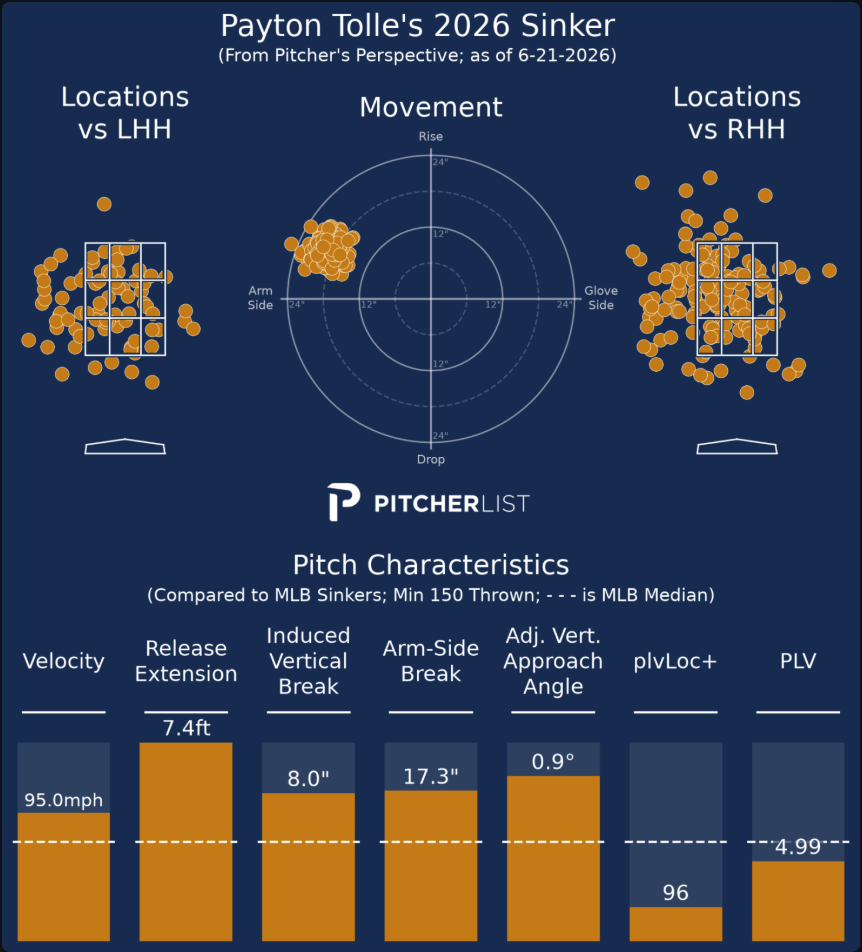
There’s an argument to be made that a pitcher’s next pitch should be the fastball he isn’t throwing, and subscribing to that philosophy often means sacrificing pitch quality. Tolle’s sinker currently sits at 98 Stuff+, with just 45th-percentile PLV. The movement profile is unspectacular, and at 95 mph, the velocity is more good than great. Yet, its added deception and damage suppression are opening up the strike zone and driving his development.
Tolle’s four-seamer is still his best pitch, but Major League hitters can time up almost any velocity when they know it’s coming. He’s inherently more deceptive with more offerings, especially when they tunnel well. In adding a sinker to his game, Tolle has made the rest of his arsenal harder to spot, as illustrated by Baseball Prospectus’s arsenal metrics.
Having three fastball options allows Tolle to maximize his biggest strength, 7.4 feet of extension, without dipping into the well too often. This is most evident in his performance in the heart of the strike zone. Last year, he generated -2 run value in this window, getting swings on 88% of those pitches (compared to the league average of 72%). Throwing all those four-seamers in the zone had guys seeing red, and all five of his home runs were on fastballs or cutters deep in the zone. In 2026, forcing hitters to worry about arm-side movement has kept them off-balance. In turn, their swing rate in the heart of the zone has dropped to 76%.
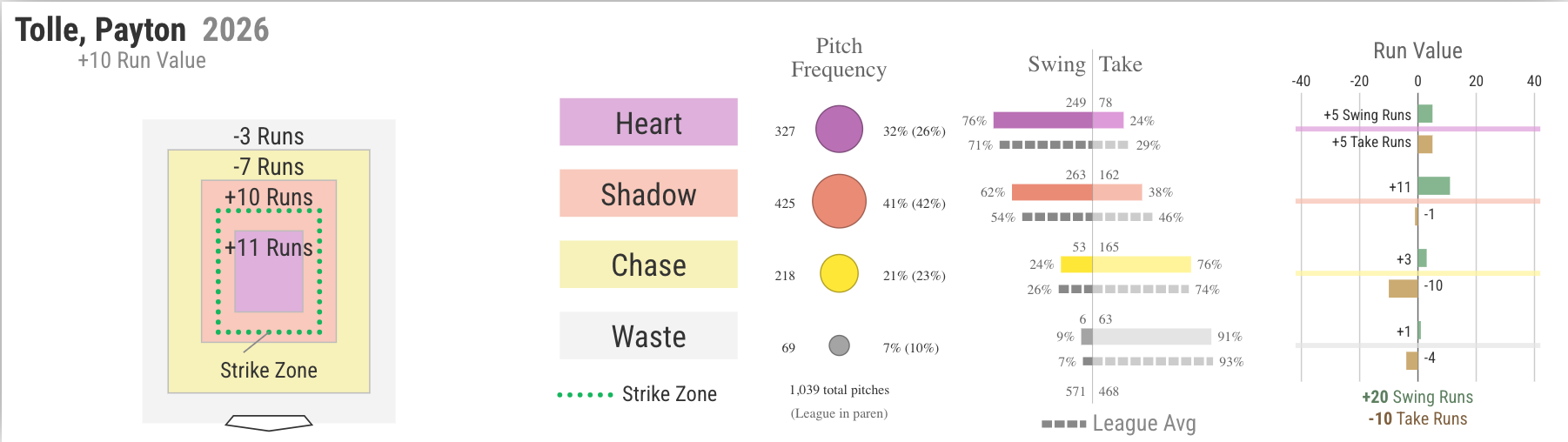
Via Baseball Savant
An uptick in called strikes has come from his cutter and sinker, suggesting hitters are expecting four-seamers and not getting them quite as often. Even so, he’s still throwing it nearly half the time, a 90th-percentile mark. This time around, he’s reaping the benefits of more optimized usage.
Tolle’s four-seamer is playing better out of the zone, where his O-Swing% has skyrocketed from 23.8% to 38.7%. Its whiff rate and called strike rate are both slightly down, but by keeping hitters just off the straight stuff, he’s getting better results. Hitters are fouling off over a quarter of his four-seamers and putting fewer of them in play, increasing his strike rate to 69.3%.
These gains are even more apparent on contact. Tolle ran an absurdly high HR/FB% in his small sample of fastballs last season, but there’s reason to believe that this season’s rate (7.4%) is fairly sustainable. Its wOBA (.209), xwOBA (.209), and xwoBACON (.252) are above the 97th percentile for fastballs. His average exit velocity and fly ball exit velocity are elite, too, and the pitch’s barrel rate has dropped to 6.4%.
In fact, all of Tolle’s fastballs are faring well on contact. While the sinker isn’t spectacular, it has remained difficult to square up (.311 xwOBA, .269 xwoBACON, 6.6% barrel rate). His cutter, emboldened by another horizontal offering, is trading whiffs for loads of soft contact. Each of his fastballs has remained platoon-neutral, too, limiting the need to rely on a mediocre slider or changeup.
Lessons Learned
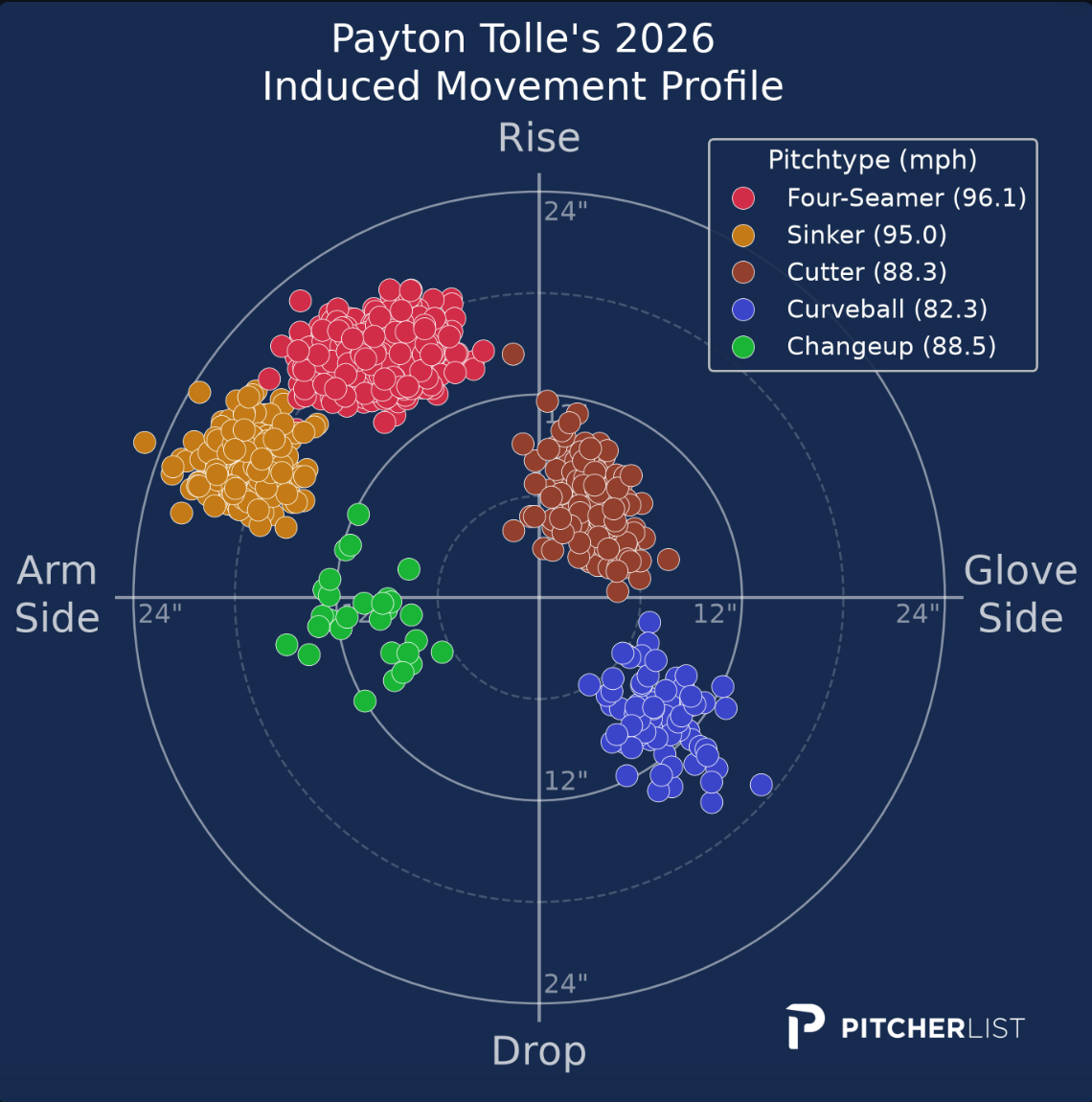
Adding another fastball option has also allowed Tolle to double down on his velo-heavy approach. Last year, his fastball and cutter combined for 83% of his pitches. The third head of his heater hydra has pushed his fastball usage to 89%. He’s getting the most out of his velocity and extension without the damage that comes with a 96th-percentile zone rate. And with a greater share of his pitches playing off the four-seamer, Tolle’s getting swings at over 37% of his pitches outside the zone. His curveball, the breaker that survived his pivot, has thrived in its limited role. There are some sample-size issues at play (most guys are throwing their curves more than 8% of the time), but the pitch is currently getting whiffs at a 45.7% rate and chases on over half of its eligible pitches. The offering is playing far above its stuff metrics and PLV because of its rarity, and outpacing those expectations is a good reason to keep its usage in check.
In a different year, Tolle’s rise to stardom might make him the American League Rookie of the Year. He’s pitched to a 2.78 ERA and 3.18 FIP in his first 12 starts, providing both length and potency.
A significant part of this success can be attributed to Boston tailoring its plans to Tolle’s natural tendencies. Pounding the zone with fastballs was always going to be his identity, and the perceived velocity from his extension had long given him a leg up when challenging hitters. Similarly, the active spin on Tolle’s four-seamer and the lack of spin on his slider suggested that he’d be more comfortable pronating and leaning into arm-side movement. His slider wasn’t particularly effective last season, and his other glove-side offering, his cutter, was more a product of seam-shifted wake than usable supination. Leaning into natural predispositions isn’t breaking any ground, but the Red Sox are running counter to most teams by emphasizing this three-fastball approach.
Perhaps they are merely joining the AL East arms race. The two obvious comps for Tolle’s arsenal are New York Yankees star Cam Schlittler and Tampa Bay Rays starter Drew Rasmussen. Neither offers much in the form of a breaking ball or off-speed pitch. Even so, they are pitching like aces, doing enough against opposite-handed hitters and returning ridiculous strike rates.
A couple of underlying skills make this possible (and applicable to other pitchers). The most obvious is a strong enough four-seam fastball that the rest of the arsenal can anchor off of. Secondly, while command is nice, the control to run (at least) average zone rates feels necessary given the lack of traditional out pitches. Swinging out of the zone is born out of a respectability within the zone, and falling behind with uncompetitive fastballs is a tough way to live without a viable breaking ball to recoup some strikes. Lastly, throwing three different heaters requires the seam-shifted wake to throw a fastball opposite one’s natural bias. Tolle and Rasmussen share the ability to find glove-side movement as pronators, while Schlittler’s supination bias makes his sinker all the more impressive. In today’s game, this skill is more accessible than ever, but it’s a box pitchers must prove they can check.
Cam Schlittler’s cutter has become a major liability.
Before 5/20, it had an xwOBACON allowed under .300 and a RV/100 over 3.5 against both LHB and RHB.
Since 5/20, LHB have a .506 wOBACON and .382 xwOBACON. Righties have an .807 and .558!
No SP pitch has less RV since 5/20. pic.twitter.com/SrKiHz4mEN
— Nathaniel Thomas (@xwOBA_enjoyer) July 1, 2026
Tolle hasn’t hit his rough patch yet, but after the worst start of Schlittler’s season, it’s worth considering how one will adjust if one of those fastballs finds less success. How committed Schlittler remains if his struggles continue could help provide the blueprint for Tolle when adversity strikes.
For now, though, Boston is reaping the rewards of its player development by amplifying Tolle’s strengths and mitigating his weaknesses. In optimizing his arsenal, Tolle found deception and damage suppression, solving the biggest riddle of his rookie campaign without sacrificing the skills that got him to the bigs.
