





Do I really need to introduce Aaron Judge? The Yankees’ superstar is tearing the cover off the ball this year at a level we didn’t think was possible. His .414/.500/.783 slashline leads baseball across all categories, giving him an OPS that is .232 higher than the next closest player, Shohei Ohtani. That’s the difference between 2nd and 42nd (Maikel Garcia, for reference).
Judge isn’t only off to a start that continues his 2024, which is already nearly 150% better than a league-average hitter, but we’re seeing a hitter that is surpassing prime Barry Bonds. Judge currently holds a 255 wRC+ this season and a 248 wRC+ over his last 365 days. Bonds peaked in 2002 with a 244 wRC+.
While going back to 1871 in the Fangraphs database, no player has ever hit better than Aaron Judge by wRC+ in history in as long of a stretch. There are a few Negro League players who rank above, such as Josh Gibson (251 wRC+) and Oscar Charleston (249 wRC+), but their qualifying seasons were under 80 total games.
The truly historic pace for Judge might not stick, as his .481 BABIP in 2025 is significantly outside of career norms. He maintains an impressive hard-hit rate of nearly 60% (the league average is 40%) and a 25% barrel rate (best in baseball). However, both of these figures are slightly lower than in previous years, indicating that his BABIP is contributing significantly to his performance. Regardless, Aaron Judge is historically great and on Bonds’ level.
When you think of Barry Bonds, or were lucky enough to watch him, you know that he got one pitch a game to hit. And Bonds did not miss that pitch. From 2001 to 2004, Bonds never walked below a 26.7% clip. Pitchers were scared to pitch to him, and rightfully so. Why even make an effort to throw something in the zone to a hitter that’s better than twice as good as a league-average bat?
Yet, when it comes to Aaron Judge, pitchers give him pitches to hit. In an age where data drives most decision-making in the sport, pitchers do the opposite of what makes logical sense. Judge’s walk rate in 2025 is significantly lower than it is over the last cumulative 365 days: he has a 13.9% walk rate this year compared to 18.1% over the last year. He only ranks 26th in baseball in walk rate this year, whereas Bonds was in a different stratosphere compared to the rest of the league.
Why are pitchers still throwing stuff that Judge can hit? And second, why isn’t Judge getting intentionally walked more often in advantageous positions?
Stay Out of the Strike Zone and Stop Throwing Fastballs!
Judge still gets pitches to hit mainly because of his swing-and-miss profile. He doesn’t have the minuscule strikeout rates that Bonds did, giving pitchers a path to succeed, even if that path is incredibly narrow.
Judge’s plate discipline metrics don’t stand out in any discernible way, unlike Bonds’ 90% zone contact and 10% chase rate (tracking began in 2002).
He isn’t a particularly aggressive hitter, but knows when to lay off. But Judge does swing and miss a fair bit. His 85.2% zone contact rate this year is the highest of his career, which is helping him surge to absurd performances, but his approach also has a glaring hole, so pitchers still attack him.
His 33.0% out-of-zone contact is one of the worst figures in baseball, meaning that if a pitcher can induce a chase swing, they are likely getting a whiff. However, with a 24.5% chase rate, that’s pretty infrequent. Judge does have a whiff rate above 40% on breaking and offspeed pitches, but his batting average against them is .282 and .241, respectively.
Regarding breaking and offspeed pitches, Judge also has a very high whiff rate in the strike zone. The damage he’s done on breaking pitches in the zone mostly comes from pitchers trying to steal a called strike: seven out of his eleven hits on secondaries come from pitches in 0-0, 0-1, or 1-0 counts. While he hit 16 home runs on breaking pitches last year, he has just two this year. You can’t throw him a middle-middle opposite-handed sweeper.
Overall, Judge has been fine against the secondary stuff. But since he isn’t world-destroying against it, pitchers can go near the zone with breaking pitches and get whiffs, mostly down-and-away.
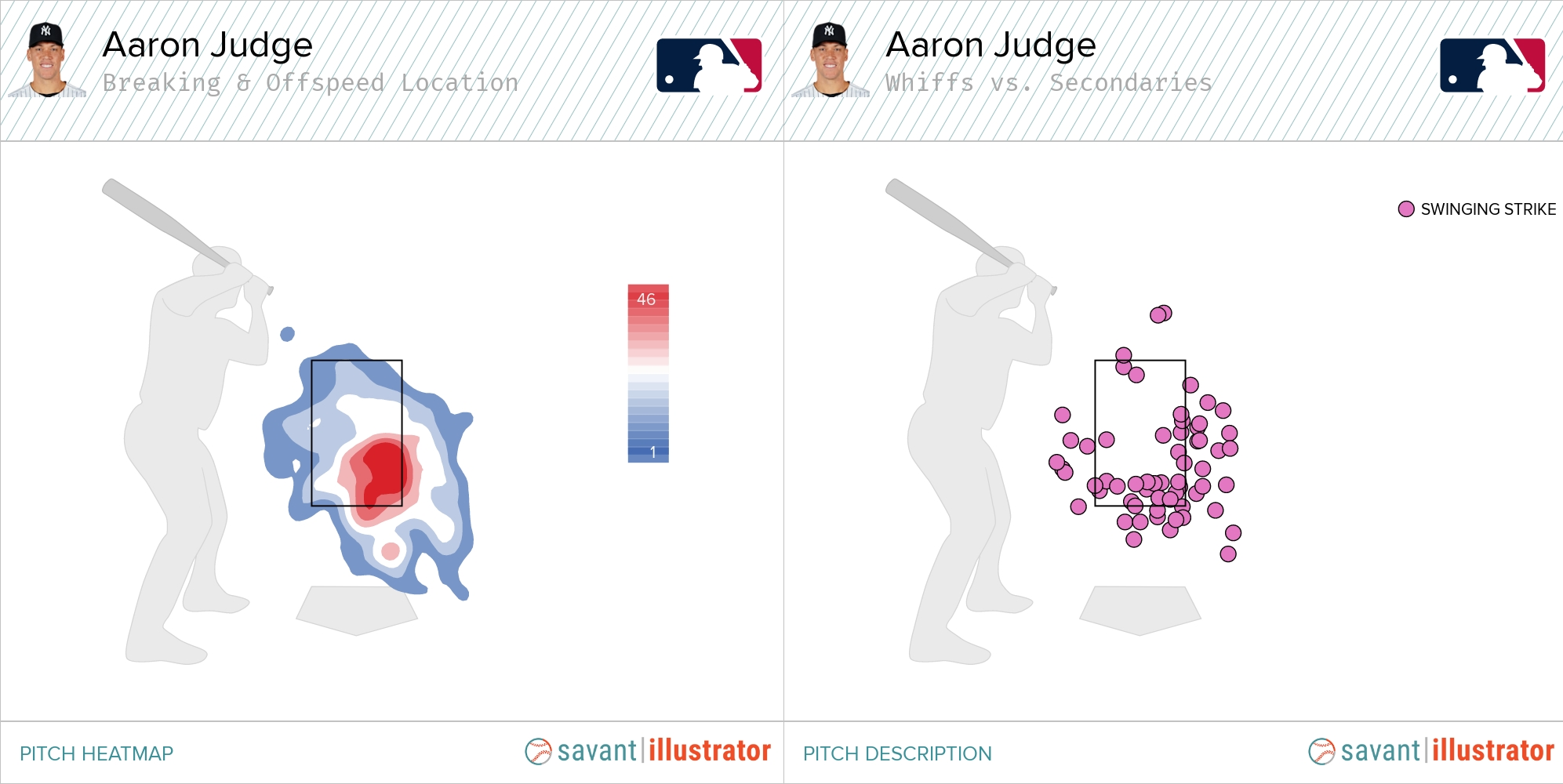
As you’re doing the mental math with me here, you’ll realize just how absurd he has to be doing against fastballs. If Judge is hitting .269 with a 44% whiff rate on secondaries, how is he getting to a .409 average?
Judge is hitting .523 against fastballs and slugging 1.035. It’s as ridiculous as it sounds.
And yet, he’s still receiving fastballs to hit. Pitchers still want to throw fastballs to set up the breaking pitches, but that leaves one big problem: Judge isn’t letting pitchers get away with easy strikes.
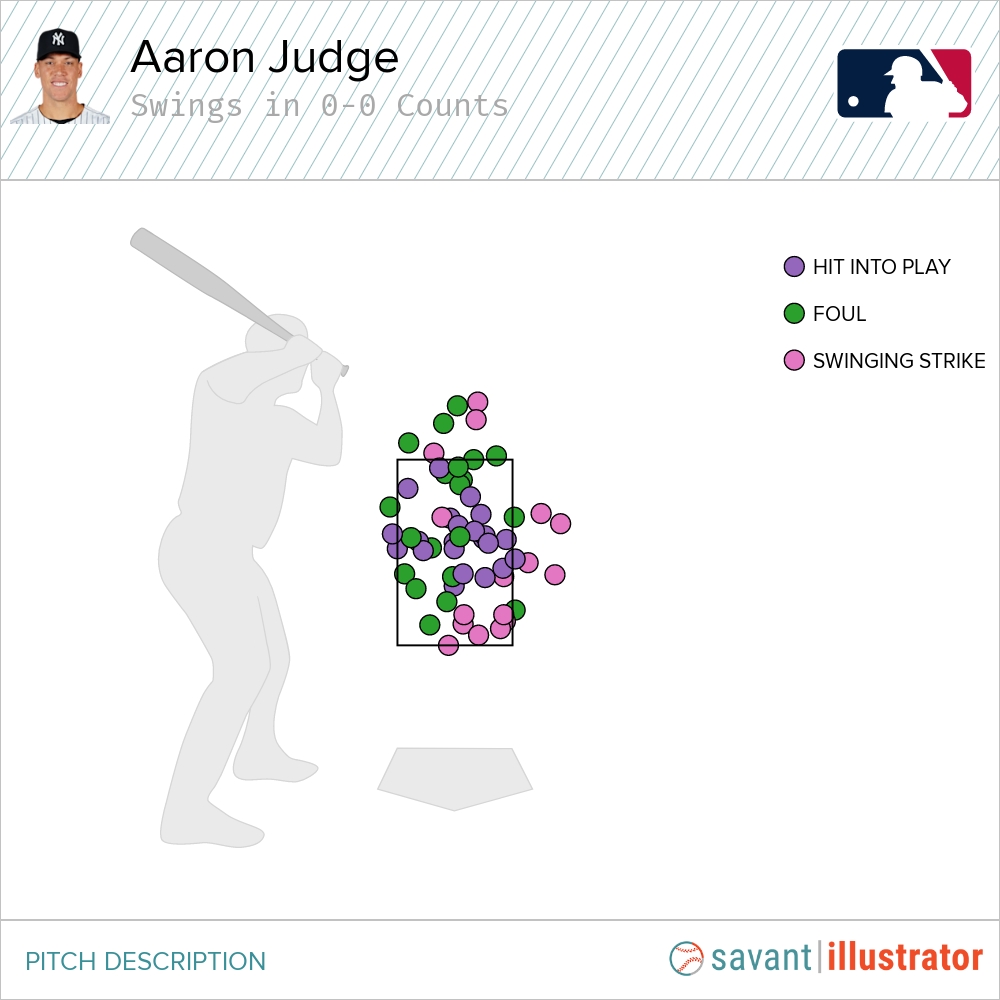
He’s seeing over 50% fastballs in 0-0 counts, and is hitting .706 with a 9.1% whiff rate! That sounds like malpractice from a pitching strategy side! Six of his fourteen home runs have come on the first pitch of an at-bat, where he terrorizes a poor first pitch.
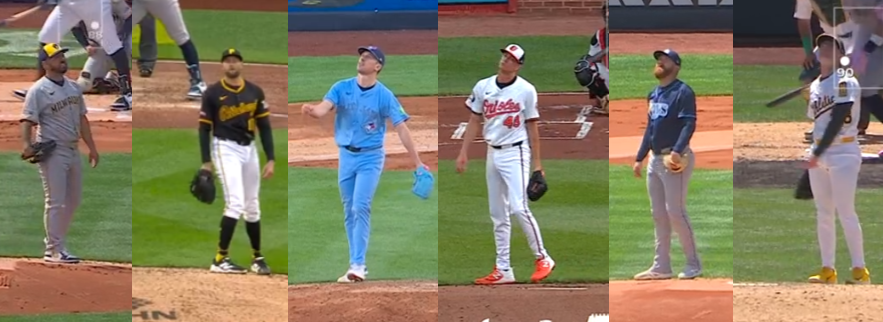
Give Judge a pitch to hit, and face the consequences. Look at all of their reactions. They all seem to think, “Why did I even try that?”
And yet, it keeps happening. Judge is incredibly disciplined on 0-0 counts, refusing to chase anything that won’t result in significant damage. Even though he does whiff on secondaries in 0-0 counts, that hasn’t been enough to persuade pitchers to do something differently.
Judge is in the 90th percentile for rate of secondaries seen overall and in the 82nd percentile for just 0-0 counts. That means pitchers are proportionally throwing him more fastballs early in the count, despite the results.
Not only should Judge be in a higher percentile in 0-0 counts, but he should probably be in the 100th percentile for the number of secondaries faced. That’s not to say that those above him aren’t good hitters. There is good reason not to throw fastballs to guys like Bryce Harper, but no one is annihilating fastballs like Judge is, potentially ever.
Among hitters with 200 pitches faced, 30 hitters see fewer fastballs than Judge. Only six are hitting over .400 against fastballs (Judge hits above .500) and three with expected slugging over .700 (Judge is at .972). There’s only one other hitter in the same area code as Judge, as Austin Hays is hitting .500 with a 1.129 xSLG against fastballs. Hays doesn’t have the same longevity to his performance as Judge, and he brings more swing-and-miss against the hard stuff than Judge.
Pitchers should stop throwing fastballs to the Yankees slugger. Why not see what happens when you rely so heavily on the breaking pitches that Judge has to consider that he might not get a pitch to hit. Bonds had to deal with this, yet Judge has somehow avoided this meticulous approach. Just because a pitcher can attempt to strike out Judge doesn’t mean they should.
Across all pitch types, Judge’s zone rate has increased by two percent from last year, now sitting above 50% for the first time in his career. The overall fastball usage has decreased, but it’s still high enough for him to hit like the best in the world. That comes simultaneously with him chasing more overall, but again, it’s not affecting the bottom line. He’s just getting more hittable pitches, which means pitchers do not truly respect him for who he is.
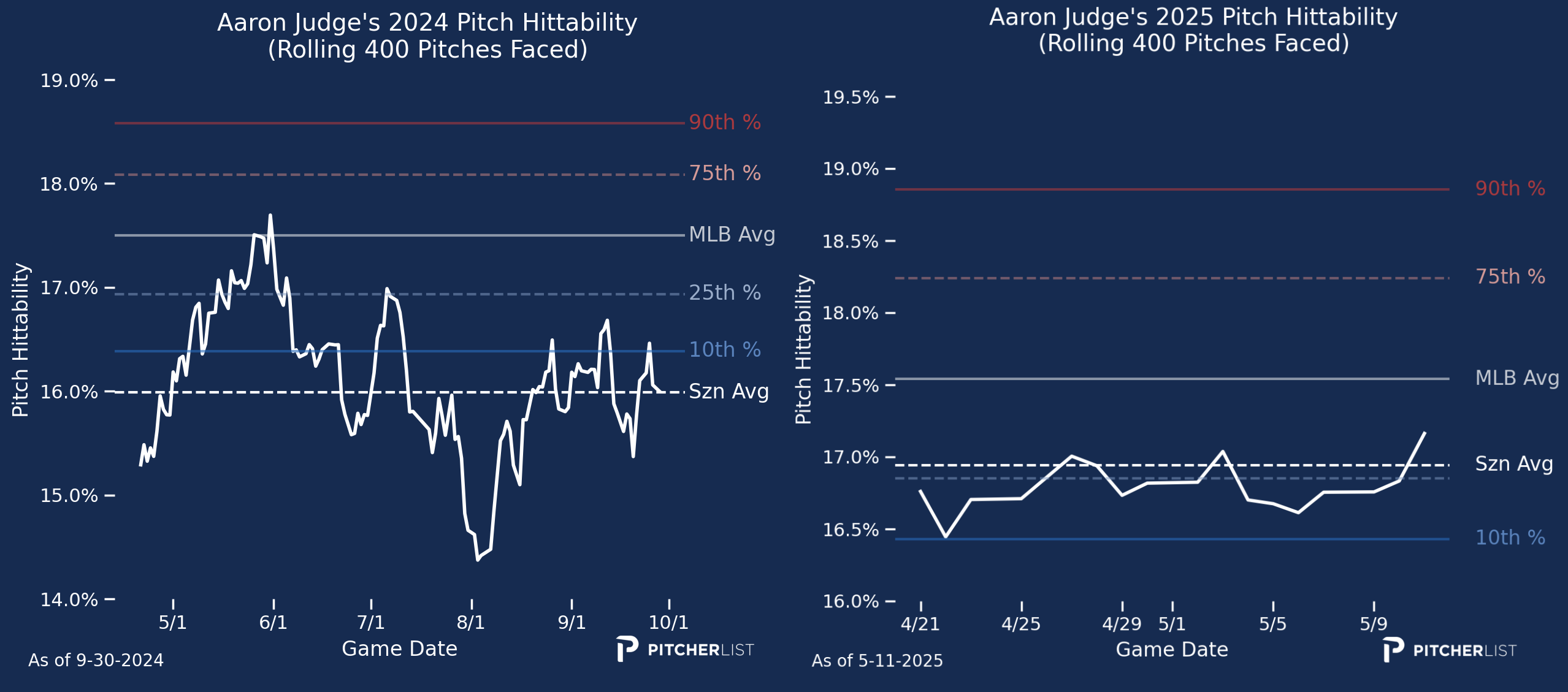 He was near the first percentile in pitch hittability across all of 2024, but is now closer to the middle of the pack this season. If Judge returns to Earth (and by that, I mean a “meager” 200 wRC+) over the coming weeks, it’ll be because of slight BABIP regression and, more importantly, less hittable pitches.
Where Are the Intentional Walks?
As mentioned at the top of the piece, Judge’s walk rate is down over five percent from 2024. With more hittable pitches, Judge gladly takes a four percent increase in balls in play. Regardless, when a hitter is operating in Bonds territory, giving him the free pass is often more productive than letting them swing.
Judge has been intentionally walked just six times this season, which is good for a 3.3% rate across all his plate appearances. For a hitter of a great caliber, that’s perfectly in line with the norm. For a hitter of his caliber? Judge gets too many opportunities to hit.
Since 2000, there have been 253 qualified player seasons with a 150 wRC+ or greater. The average IBB% for those players was 2.0%. There have been nine player seasons with a 200 wRC+ or greater, and the average IBB% is 7.7%. The only other recent player to qualify for the 200 wRC+ was Juan Soto in 2020, and he got intentionally walked 6.1% of the time.
Not all of this is directly Judge’s doing; intentional walks have steadily decreased. Teams have learned that putting a runner on base is pretty harmful. This forum discussion from 2013 calculates that the run value of a baserunner is around a third of a run per game, which adds up throughout a season. Judge has been worth 27 runs at the plate, which equates to 0.675 runs per game. For reference, the average qualified hitter is worth about 0.9 runs total this year.
This isn’t to say that Judge is worth getting walked every single at-bat. At a .400 average, he still gets out six out of ten times (though that feels hard to believe). Given his Bonds-esque performance, however, he should be walked more since the run value of a walk to Judge will be lower than the outcome of pitching to him in many cases. Judge has 74 career intentional walks, while Bonds averaged 61 from 2000-2004.
Judge has come to the plate ten times with first base open this season and has just one walk. Five of these plate appearances have come with two outs. Judge should absolutely get first base in the two-out situations and potentially all of them. It’s also not like there is a generational hitter behind Judge that is equally scary at the plate (i.e. Juan Soto). Not to discredit the quality of the following hitters, but Ben Rice, Cody Bellinger, and Jazz Chisholm Jr. are not hitters that make you decide to pitch to Aaron-freaking-Judge.
Judge has five hits in those ten at-bats: four singles, one double, and one home run. Runs scored in all but one instance.
If we rewrote all these at-bats, and Judge was intentionally walked instead (excluding the one actual walk, an unintentional-intentional walk), that would put Judge at an 8.3% intentional walk rate. This would be the highest figure for any non-Bonds player since 2000, and the highest since Albert Pujols’s 6.3% in 2009. It’s well-deserved, though. Judge is currently hitting better than Bonds.
Neither pitchers nor their managers are addressing Judge like they should, given the absurdity of his statline right now. He’s too good to see this many hittable pitches, and he’s too dangerous to get at-bats when bases are open. If opposing teams want to start slowing Judge down, they need to start treating him right.
