





As we look at risers and fallers in points leagues, the focus should not just be on how players are performing, but what their role is.
Are your hitters suddenly leading off or batting lower in the order than expected? Have they gotten an off-day, and is it because the manager put them in a platoon? Or did they get subbed out at the end of a game for defensive reasons?
As for pitchers, did they get pulled after just 70-80 pitches, or were they allowed to work deep into the game? And could anyone on the IL or in the minors threaten their rotation spot?
As volume is everything in points leagues, these are the questions you want to answer beyond just whether a player gets hot. So, given their role and their performance, who should you buy in on, and who should you leave alone?
Risers
Benge first found himself leading off for the Mets on May 12, and it seemed like a curious decision—after all, he was hitting just .215 and getting on base 28% of the time. But it’s turned out to be a genius move, as he’s batted .308 at the top of the lineup with a 36% OBP.
What’s come lately is the power, sparked by a pair of home runs on June 2. He hit another on June 7, part of a 5-for-5 gem where he raised his OPS by 50 points in a single game. Benge has steadily improved in his hard-hit metrics over the season, as he had just two doubles in April, then seven in May. Now it looks like those balls are starting to go over the fence.
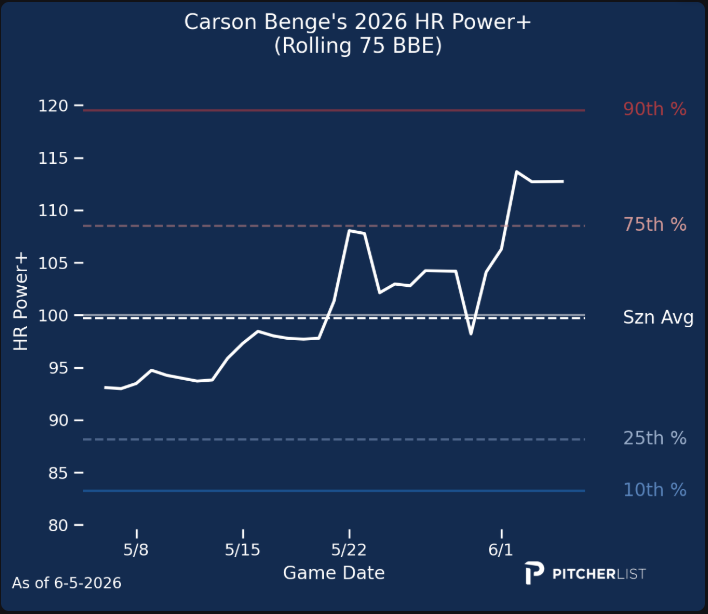
While he’s currently slugging just .405 to this point, his xSLG is considerably higher, at .472, buoyed by a solid 90+ mph Average Exit Velo and a nearly 10% Barrel rate. Given his counting stats to this point and the progress he’s made, it’s within reach to say Benge could achieve a 20-homer, 25-steal season.
While that’s great in categories leagues, points league players should mainly keep an eye on where Benge lands in the lineup once Francisco Lindor comes back from injury. Let’s assume Lindor recaptures his leadoff role (though it’s not a guarantee!)—does that move Benge down to number two, where he still hits ahead of Soto? Does management trust the rookie enough to put him in the middle off the order, or could he land back in the bottom third?
Given his overall improvement and especially how he’s performing of late, he should still land in a favorable place post-Lindor. But probably more than any other factor, that will determine how Benge fares in points leagues the rest of the way.
If you’re in that rare ‘2-catcher points league’, this one’s for you. A part-time player for much of the season—and one who batted at the bottom of the order when he did play—Valenzuela’s shown a ton of progress in the last month. Owning a 7:1 K:BB ration in April, Valenzuela took a dozen walks in May while striking out a dozen times as well. And like Benge, he’s poured on the power, with three homers so far in June where he had just four all season before that.
Valenzuela has pretty decent lefty/righty splits (.771 OPS against southpaws, .810 versus RHP), so his ceiling shouldn’t be capped by a platoon. He’s also drawing walks almost 12% of the time and K-ing just 22%. Also like Benge, he’s barreling about 10% of his balls in play.
All these improvements have moved the needle on where Valenzuela’playing, as he’s been pushed up to the 6-spot in his last two starts. And he’s stayed hot over the last week, with a 1.232 OPS so far in June. With Alejandro Kirk on the 60-day IL but due to come back soon, Valenzuela might be worth the short-term ride.
Though Cameron is 1-2 over his last five starts, don’t let that fool you. He’s completely turned his season around and is now showing elite command, with a 0.67 WHIP over that span.
So, what’s changed? Well, the changeup, for starters. He’s taken two mph off the pitch and regained his feel for it, and hitters now have just a .325 SLG on it for the season. And compared to last year, Cameron’s throwing his curveball more, 17% of the time versus 10% in 2025. It’s not only his best pitch but one of the best pitches in baseball, with a .091 Batting Average Against. He’s used it to strike out 25 batters this year—in all of last season, the curve got 42 K’s.
Fallers
A sore thumb has kept Simpson on the bench of late, but that hasn’t really been the problem. Simpson’s a unique player in that over his first 650 MLB at-bats, he’s yet to have a single barrel, which is why he was the only player to have a Steamer prediction of zero homers in a season. But even with the league’s worst Hard-Hit rate and Bat Speed, Simpson carried a lot of value in points leagues, thanks to his near-.300 average, sub-10% K-rate, and 44 steals in 441 PA’s. He was a one-trick pony, but it was a good trick.
Not so much this season. The average and OBP are down (he’s getting on base just 31% of the time), and they’re actually well above his expected numbers—his xBA is .244 and his xwOBA is a second-percentile .253.
While he was firmly installed as the team’s leadoff hitter last year, Simpson was hitting fifth in four of his seven starts before the thumb issue. Once he gets fully healthy, he may be appearing even lower in the order, especially if he’s only getting on base around three out of ten times.
Looking at Gallen’s PLV over the years, not a lot has changed. His fastball still has an 88th-percentile 5.25 PLV, exactly what it was in 2022, and it still has a decent 28.2% CSV. He does appear to be throwing it less, as over his career he’s gone to the heater nearly half the time and is now using it in 37% of his pitches. His secondary stuff has shown a slight decline compared to years past, but it still shows as decent—where he had a 5.38 PLV on the changeup in 2023, it’s now a 5.10.
What’s not decent are the results. In some respects, Gallen’s completely fallen off the table. His K-rate in every season from 2019 through 2024 was over 25%. Last season, it dipped to 21.5%. This season, it’s 14.7%, which is in the lowest fifth percentile in all of baseball.
His other numbers are just as ugly. He’s in the lowest tenth percentile in Average Exit Velocity (90.9 mph) and his expected BAA is over .300.
Gallen threw 192 innings last year, and in seasons past when he was overworked he had a hard time the following year. This looks like history repeating itself, but now at age 30 the result is even more dramatic. He’s droppable in most leagues at this point.
