





As we look at risers and fallers in points leagues, the focus should not just be on how players are performing, but what their role is.
Are your hitters suddenly leading off or batting lower in the order than expected? Have they gotten an off-day, and is it because the manager put them in a platoon? Or did they get subbed out at the end of a game for defensive reasons?
As for pitchers, did they get pulled after just 70-80 pitches, or were they allowed to work deep into the game? And could anyone on the IL or in the minors threaten their rotation spot?
As volume is everything in points leagues, these are the questions you want to answer beyond just whether a player gets hot. So, given their role and their performance, who should you buy in on, and who should you leave alone?
Risers
Varsho spent some time on the IL with a wrist issue, but it was a minimal stay and he’s been hammering the ball since coming back. He’s got five hits in the last three games and had two doubles and a homer on Tuesday, all of which were 103 mph off the bat or above. Even before the wrist took him out, Varsho was having a great June, slugging .667 with a 1.027 OPS.
I’ve brought this up before, but Varsho was a league winner for many last season, coming on in the second half and smashing twelve homers in August and September. While injury-prone, he’s got monumental power when he’s in the lineup. And while this profile might not sound like your typical points league standout, Varsho walks nearly 10% of the time and has a K-rate below 20%. He’s hitting for a better average this season over last and getting on base almost 34% of the time, and unlike last season (with some balky hamstrings), he’s running more, already tallying half a dozen steals. If he stays hot, he can carry your team a long way.
With both Bobby Witt Jr. and Maikel Garcia banged up over the last week, Loftin’s been getting opportunities—and has started in seven straight games for the Royals. While Witt should be back in the lineup in the next day or two, Garcia is headed for the IL. This should give Loftin even more time to make an impression. It’s probably just a short-term plug-and-play, but Loftin has been impressive at the dish: he’s hitting .370 with a .704 SLG of the last week. Last night against the Rays, Loftin (batting second) went 4-for-5 and scored four runs, swatting a first-inning homer of Shane McClanahan.
In points leagues, Loftin really plays—he’s got a 14% K-rate and a 12% walk rate, getting on base 36% of the time. While he’s hardly a power hitter, he’s got a dozen doubles and a triple on the season in only 125 at-bats, to go along with three homers.
In most leagues, Loftin should be eligible in both middle-infield, corner-infield, and outfield slots, so he’s a good option if you need a quick band-aid in any of those positions (or own Garcia). The Royals are playing every day this week with a four-game series against the White Sox, so Loftin should see a ton of plate appearances in the days ahead.
A single, stolen base, and a run scored are good for three total points in a points league—and that’s about what Simpson chips in on most days. He might never hit a homer in the Major Leagues, but he is second in the AL in triples. After battling a thumb injury last week (where he missed several starts and struggled mightily when he did play), Simpson looks like his old slap-hitting self again and has made seven consecutive starts. He’s stolen a base in three of his last four games and has five hits over the span, with only one strikeout.
While many of Simpson’s Statcast metrics are the deepest blue (he doesn’t have a single barrel all year, has the slowest bat speed of any MLB hitter, and his Average Exit Velo is 84 mph), he’s got a 99th-percentile Whiff rate and strikes out only 10% of the time. As long as he’s getting on base, he’s useful. Just check if your league penalizes runners when they’re caught stealing—Simpson leads the Majors in that category by a country mile with twenty since last season.
Three months into his rookie season, Antonacci is looking like a complete player. After coming up in mid-April, he showed solid plate discipline and had a decent OBP, so he should already have made your points league radar. But all he’s done is improve month after month, making strides first in his contact metrics. But now he’s starting to show a little power, with three home runs in his last ten games, pushing his OPS on the season to above .800.
Overall on the season, Antonacci’s been getting on base 39% of the time, but that’s up to 42% in June. Because of his elite bat-to-ball metrics (94th-percentile Chase rate, 89th-percentile Whiff rate) his xBA is actually 18 points higher than his actual average (.305 to .287). He’s an exciting points-league specialist but is just an exciting player to watch, period.
Summer of Sam:
Lambert’s been in and out of the Majors going all the way back to 2019, but this looks like the first season where he’s going to stick. The 29-year-old spent his early years with Colorado (not exactly where a pitcher wants to be), then was released and pitched in Japan in 2025. During his season across the Pacific, Lambert learned to lean on his fastball less and develop his secondary pitches.
These developments have carried over nicely in his return to MLB. The fastball sits at 94/95—which isn’t anything special, but since he’s only throwing it about 25% of the time, it doesn’t need to be. It’s his changeup/slider/cutter mix that’s been effective, with a combined .167 xBA across all three pitches.
Lambert’s metrics show that his success isn’t dependent on luck, but he hasn’t been unlucky either. The fastball, even as he throws it less, is still a mediocre pitch, and its xBA is 60 points higher than the actual BA (so there will likely be some regression there). His 3.28 ERA is backed by a 3.49 xERA, though, and he’s only getting barreled 4.2% of the time. He’s also showing improvement over the course of the season, offering different pitch mixes to righties versus lefties, and he’s now 4-0 in his last six starts with a 1.07 WHIP in June. He’s gone from a streamer to a pitcher you want to hang onto.
Fallers
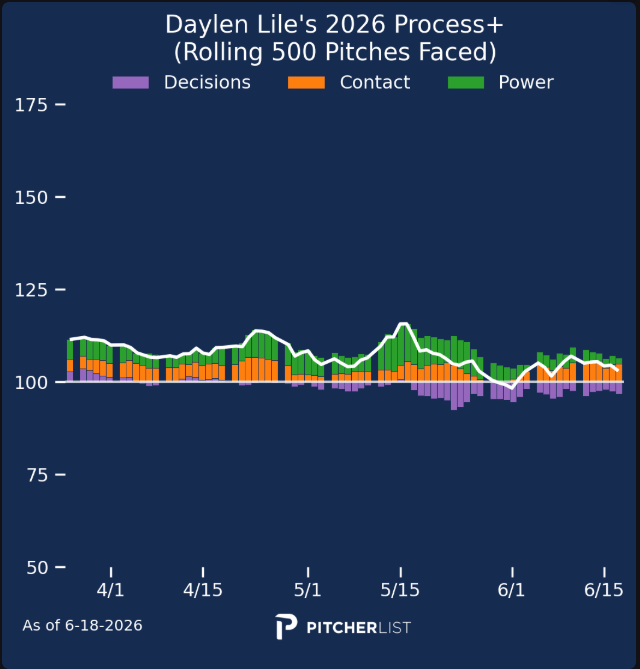
This hurts to type, as Lile was one of my favorite targets going into this year’s draft, even if it was obvious last year’s .299 batting average and .845 OPS were a little fluky. But he did have a 100th-percentile Sweet-Spot rate and a .302 xBA with just a 16% K-rate in his rookie season, so he looked like a legit points-league star in waiting.
Things were looking good for a little while in his sophomore effort, as Lile carried a .409 average after seven games. And he’s had some decent stretches here and there as the Nationals offense has turned into a scoring machine. But lately it’s all downhill, as Lile’s hitting just .100 over the last week. The last month hasn’t been much better, with a .219 average and one homer.
So, what’s changed? Well, Lile has appeared to sell out for more power. His bat speed is up almost 2 mph over last season, but he’s also swinging at more pitches with less successful results—last year, his Chase rate was a solid 26.7% and this year it’s ballooned to 36.2%. He’s also whiffing more often, up to 23% in ’26 versus 18.9% last season. So while for most hitters increased aggression is a good thing, for Lile it’s yet to work out. Going forward, he’ll need to find a way to balance out his decision-making and contact skills with the harder swing to be successful.
Like Lile, Sheehan has cratered this year after a wonderful run last season. Sheehan had a 2.82 ERA and a 0.97 WHIP in 2025, but that ERA has almost doubled to 5.32 over his first 14 starts in ’26. His last four appearances have been especially wanting, as he’s gone 0-4 with an ERA over seven.
In his first full year back from Tommy John, there might be some arm fatigue at play. In many of his outings, Sheehan is sitting at 95/96 in the first couple of innings, but dipping to 92/93 by the fourth and fifth. His BAA is ticking noticeably upward during the second time through the order, and given he throws his heater 60% of the time, a drop in velocity is especially dangerous.
Also worth noting, the Dodgers are currently running a six-man rotation. That means the Sheehan will rarely get a two-start week (if ever), and overall will start 17% fewer games than other pitchers going every fifth game. It’s one thing for the Yamamotos and Ohtanis, who are showing out in most every appearance, but another for someone who’s pitching poorly.
Sheehan’s got another problem: Blake Snell and Tyler Glasnow will be back eventually, and there are also some promising young pitchers awaiting their opportunity in AAA. If Sheehan has a few more starts like he’s had lately, he’ll likely be destined for the bullpen before long. He’s already a drop for me.
