





As we look at risers and fallers in points leagues, the focus should not just be on how players are performing, but what their role is.
Are your hitters suddenly leading off or batting lower in the order than expected? Have they gotten an off-day, and is it because the manager put them in a platoon? Or did they get subbed out at the end of a game for defensive reasons?
As for pitchers, did they get pulled after just 70-80 pitches, or were they allowed to work deep into the game? And could anyone on the IL or in the minors threaten their rotation spot?
As volume is everything in points leagues, these are the questions you want to answer beyond just whether a player gets hot. So, given their role and their performance, who should you buy in on, and who should you leave alone?
Risers
Ramos was on the shelf for about six weeks due to a quad strain and came back into action on June 28. He’d been having a mediocre season to that point—though he hit .293 in April, he was striking out more than 30% of the time and his contact metrics were well below 2025 levels. But since he’s come back, he’s been mashing the ball and now many of those metrics are above those of previous seasons.
Heliot’s best year was in 2024, where he hit 22 homers with 72 RBIs over 121 games and made the All-Star team, even though he was a May call-up (he was that good). He fell off a little last season, though he played 157 games, but his Slugging % fell 60 points and he had fewer homers and XBH’s despite getting nearly 700 plate appearances.
This is where the hard-hit metrics are a good indicator of where he is now. Ramos is absolutely crushing the ball with a nearly 17% Barrel rate, over-50% Hard-Hit rate, and his Average Exit Velo this season is 92.5 mph. These are all 90th-percentile numbers and above, and point to expected stats that should be higher than what he’s doing (this might be the San Francisco effect).
For points-leaguers, Ramos looks to be cementing a spot in the top of the lineup, batting first or third in the last four games (leading off on Monday, he belted two homers and a triple that turned into a Little League homer). While he was striking out a lot in the early going, his K-rate is 18.8% since his return and he’s got a .391 OBP in July. Ramos will likely lead off against lefties and get a middle-order spot versus RHPs, but he can do damage against both and should be a top add this week.
Lara got the call on Monday morning to come up to the Majors, and has a super-interesting profile for points formats. First and foremost, he walked more than he struck out in AAA this year (54 BB’s to 48 K’s) and had an OBP of .432. The 21-year-old also developed a little bit of power, with nine homers in 346 PA’s and a .902 OPS (compare this to two years ago, when he hit five dingers in A+ ball over 135 games).
Points league managers need someone to play every day, and that’s going to be the main issue with Lara. The Brewers currently have Jackson Chourio, Garrett Mitchell, and Sal Frelick in their outfield (and don’t forget Bauers and Yelich, who get some time out there too), and all are having decent seasons. There might be a rotation here for everyone but Chourio, while Frelick could move to 3B. It’s a good problem for the Brewers to have, but not so much for fantasy players.
Lara’s debut was a success as he batted second in the lineup, knocked in two runs with a single, walked once, and had zero K’s. This is the kind of high OBP/low OPS you should expect, but that plays just fine in points. You might want to make sure he’s in the lineup the next day, though (and the day after), before you pull the trigger.
It’s been a heckuva couple of days for Tolbert, who went 5-for-5 on Monday to tally seven straight hits, and then went five-for-five again on Tuesday. This made for twelve straight hits, which tied an all-time MLB record (one great thing about baseball: anybody can make history). Unfortunately, Tolbert had a fly-out at the end of the game to end his remarkable streak.
But streak aside, is Tolbert worth adding to your roster? Well, not yet, especially in a points league—the volume isn’t there (he had 31 plate appearances in all of June). But things are ticking up, and going 12-for-12 (isn’t that a Sombr song?) could help him get in the lineup more often. Tolbert was originally thought to be a lefty specialist, so he was getting short-side platoon appearances and hitting .345 with an .870 OPS against southpaws. But thanks to the streak, he’s now getting chances against RHPs, and has lifted his average to .474 against those guys (with a 1.132 OPS).
So will we see more of him? Time will tell, but Tolbert also brings 95th-percentile sprint speed and a solid glove to the table, so he’s certainly earned it. The Royals are currently batting a catcher at leadoff and could use a speedster with a high OBP at the top of the order. Tolbert might fit that bill.
Like Tolbert, Carrigg has mainly been a lefty specialist who warrants more playing time. Starting in the last four of nine games against RHPs, all he’s done is hit .302 against them on the season with a .628 SLG and 1.064 OPS. He’s on a heater in general with a .476 average in July, including five hits in his last two games—both of which were outside of Coors Field.
It’s hard to believe that just last year, Carrigg was an unremarkable AA hitter, with a .237 average in 123 games and 15 homers. But he did steal a ton of bags with 46. Promoted to Albuquerque at the beginning of this year, he continued to run wild with 30 SB’s in just 57 games, but he also leveled up his bat with a .338/.529/.943 slash.
And that’s carried over to the Majors. While Carrigg’s expected stats point to some regression (his BA is 59 points higher than his xBA, for instance), he’s striking out less than 20% of the time and walking more than 10%, both great benchmarks for points-league players. I’d grab him now to see if the Rockies play him as often as they should.
Boyd missed most of both May and June before coming back on 6/25, and while he’s yet to have things really working compared to 2025’s career year, his latest outing was a good start. Appearing against the O’s, Boyd threw six innings for just the third time all year, struck out seven, and allowed just five baserunners and zero runs. The performance lowered his ERA by three-quarters of a run.
Boyd’s known as a three-pitch pitcher, but he’s really a two-pitch pitcher depending on which side of the plate you’re batting—he’ll mix in a fastball-slider combo to lefties and a fastball-change to righties, with the occasional cutter mixed in. While the contact metrics can sometimes be rough, Boyd’s been historically good at getting hitters to chase, and his Whiff rate is greatly improved over last season. The Hard-Hit rate, currently sitting at an unsightly 50% (that’s second-percentile) should have positive regression toward his career mark of 35% (and he’s never been worse than 38.1% before). All in all, Boyd looks like his old self again now that he’s had a few healthy appearances and could be a top-40 points-league starter going forward.
Fallers
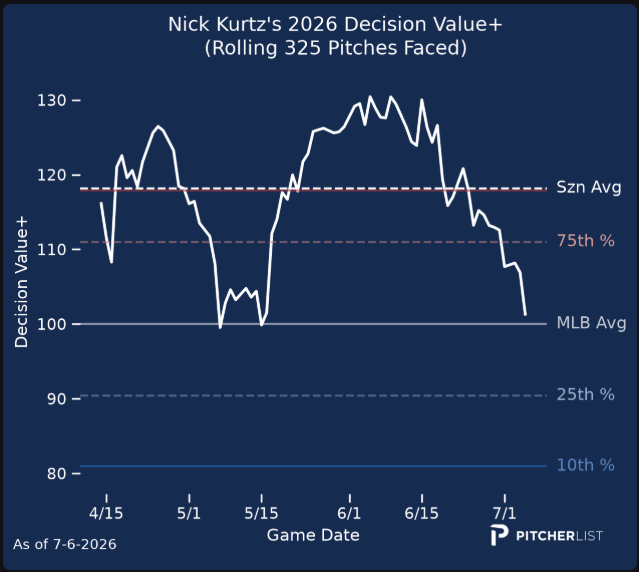
Back in March, Kurtz had a 38.7 ADP in ESPN points leagues (compared to being a borderline first-round pick in categories). For a while, he was making that number look silly given his massive OBP buoyed by a nearly 20% Walk rate. But things have been going the other way for a while now: he struck out 41% of the time in June and is hitting .190 in July. Even worse, he’s only walked once in his last seven games with a .227 OBP, and has ten K’s to boot.
Kurtz is trying to swing his way out of this slump, but he needs to rediscover his patience at the plate instead. Normally an excellent decision-maker, he’s now regressed to league average. Given he already swings and misses a lot of strikes already, things get much worse when he’s swinging at balls outside the zone. Points-league players can stomach a 30% K-rate if the hitter’s productive and getting on base, but 40% is pretty much untenable no matter who you are.
You’re not dropping Kurtz, but if July continues like this, you might have to consider it (in categories, of course, the K’s don’t matter so much).
I’ve been a Lugo fan for many years, especially after his 2024 season where he won 16 games and carried a 1.09 WHIP over 206+ innings. Alas, he’s not been the same since. While the volume’s still there (he’s already over a hundred innings this year), the results are not. And based on his advanced metrics, the results could get worse.
Those metrics are almost universally blue, save for his walk rate, which is still a solid 7.4%. But his xBA and xSLG are easily the highest of his career and both rank in the bottom 10% of starters. His xERA (5.45) is nearly a run higher than his actual ERA (4.56), his K-rate’s dipped below 20% for the first time since 2017, and he’s getting barreled more than 10% of the time.
Lugo actually started the season hot, hanging onto a 1.15 ERA after his first 30 innings. But it’s been a slippery slope since. He’s droppable until he can string a few good starts together.
