





I’ve never liked the term “non-prospect.” For one, there’s no agreed-upon definition of what it means. Some interpret it as: “Unranked in major publications’ team prospect assessments.” Others take it to mean: “There is no chance this guy ever makes the majors.” This judgment could be for a variety of reasons, such as a hit tool so bad he’d whiff too much to ever be effective. For a pitcher, it could be a combination of bad command and low velocity. But in the modern game, especially, I’m not sure any pitcher can be fully discounted. Some of you may have watched that video of Schlittler throwing 90 mph fastballs in his first stint as a professional.
A year and a half ago, Shane Drohan had just turned 26 years old. He was coming off an injury-marred campaign that saw him pitch just a handful of abysmal innings in AAA. This was the same year he had been picked in the Rule 5 draft; he wasn’t on anyone’s radar anymore. He started the 2025 season in AAA with the WooSox and had a great first month before being shut down for two months with forearm inflammation. He had a rocky go of things coming back, but seemed to regain form in September. The Red Sox selected him to the 40-man roster after the season ended, before including him in the trade that sent Kyle Harrison to the Brewers. He was still mostly considered an afterthought.
He didn’t break camp with the Brewers, though he was called up in early April, and had a disaster debut that saw him sent back down immediately. A couple of weeks later, a spot opened up and his number was called again. He never looked back, and that brings us to now. We’ve seen the Brewers use him in a mix of roles out of the bullpen so far this season. He even picked up a rare three-inning save following six dominant innings from Misiorowski. At the start of June, they moved him back into a starting role. The first results have been mixed but promising. Let’s break down what he does that makes him a candidate to continue this breakout.
The Arsenal
Drohan leads with his 4-seam fastball. What it lacks in movement, it makes up for by being a 95 mph fastball from a lefty with a reasonably flat approach angle. It’s not the best fastball ever, but it’s a strong offering, and he’s been using it well. It plays very well off of his second-most used pitch, his sinker. While this pitch has below-average depth for his release, it fits into his arsenal brilliantly. We’ll get to that.
His slider is excellent, a tight gyro breaker in the mid-high 80s. It’s worth noting that gyro breakers on the outer ends of the spectrum of spin rate, both high and low, tend to perform slightly better than expected. Drohan’s rotates like a bullet at 2836 RPM on average. Admittedly, it’s not high on the list of prioritized qualities in gyro breaking balls due to the low active spin percentage. That causes the spin to contribute less to the pitch’s shape, but my longstanding theory is that the high and low spin rates look strange to hitters and make the pitch even harder for them to pick up.
Due to new trends in how they play, I’ve adjusted how I evaluate curveballs. I don’t care about what I would have previously designated a “bad shape” nearly as much as I used to. I do think curveballs that don’t have ideal shapes are more limited/require other factors to perform like elite pitches, but it doesn’t give cause to write the pitch off as mediocre immediately. Drohan’s curve does not have a great shape. It is nearly perfectly equal in its induced horizontal and vertical movement, and it doesn’t have a ton of either, at 80 mph. Curveballs do not get much more generic than his. However, as we’ll get into in the next section, this is a solid pitch due to arsenal fit and command.
Drohan’s cutter is still a work in progress, despite it regularly featuring in his mix. It may be his fifth pitch, but he throws it 13% of the time, a not insignificant portion. The Brewers reworked his mechanics after trading for him, and I’m not sure he’s fully figured out how to throw his cutter with his modified delivery. The shape varies a bit, often running back to the arm side instead of actually cutting toward his glove side. While it still “cuts” relative to his other fastballs, this is something I would expect to see the Brewers continue to try to iron out.
Drohan’s last pitch is a prospective changeup. It’s taken multiple forms this season, so I left it off the chart as the numbers are jumbled. When he debuted, it was a pretty standard changeup, with a spin axis around 10:00, spin rate just under 1600, with 5.1” IVB and 14.9” HB. When he came back, it had been replaced by a splitter-ish change with a spin rate in the triple digits that averaged 3.1” IVB and 8.0” HB until after his May 22 outing, at which point it disappeared. He brought it back a couple of weeks ago against the Phillies, and it looked similar to how it did in his debut, though with a slightly lowered arm slot, suggesting he’s doing something different.
For now, we can mostly write off the change. We can hope it develops into a bigger part of his arsenal eventually. No lefty feels complete without an offspeed pitch, but he’s making do right now without one.
Command and Convergence
Drohan has a starter’s arsenal, changeup or not. For the most part, the pitches don’t stand out on their own, but they work exceptionally well together. This is no clearer than with his fastballs. They come out of his hand with highly similar spin direction and active spin percentage. He also repeats his release across his mix as well as any pitcher I’ve ever looked at. This is especially impressive given the recent change to his delivery. Back on topic, while his fastballs don’t have a massive movement gap, they play off of each other because of how he uses them. His sinker locations build the foundation for one of the most effective fastball pairs in the game right now.
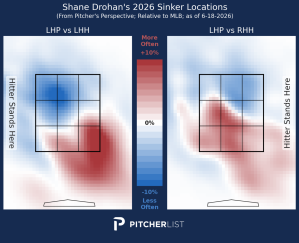
Not pictured here because the chart itself is unremarkable is his 4-seam. He takes advantage of his 4-seamer’s run and lands it on the glove side well, but that’s the only thing that’s of note. He otherwise elevates his 4-seam at a rate that is about league average. That is what makes his numbers so interesting. His sinkers are almost always in the lower half to an impressive degree. He buries his sinker so well, and you have to guess which fastball is which as it’s coming to the plate. Furthermore, he’s great at hitting the glove side, letting the sinkers run back into the zone. The locations are what make it work more than the movement. But instead of just elite numbers for the sinker, it’s manifesting like this:
While he does have a balanced mix, this is the core of his game, and everything builds from there. He throws ~50% fastballs to both handednesses of hitters because he knows this works. It’s elevating two average fastballs into above-average offerings, borderline elite in the case of his 4-seam. Hitters are being aggressive when they see the high fastball, but frequently swinging under it, believing they had gotten a belt-high sinker instead. However, this is working twofold, rather than zero-sum. Both pitches are flourishing to their type’s traditional advantages, despite neither of them being well-built to do so on their own. You couldn’t draw up a more optimized duo.
His fastballs aren’t the only pitches he locates well, though. His overall slider plot is a little bit scattershot, but there’s a concentrated bubble low and to the glove side against lefties, and to the arm side against righties.
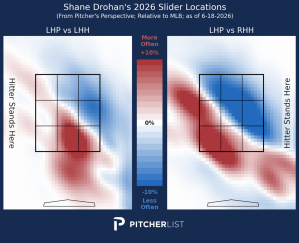
What he’s doing against his fellow southpaws fits beautifully with where he’s throwing his fastballs. I do wish he’d bury them a bit lower, but this is nitpicking, because it’s working at present. Against righties, I’d like to see him trying to go back foot against them more often. I’d like to see him throwing more sliders in general, perhaps dialing back the cutter a bit, but the current limited usage has been fine.
If you like good command, I have excellent news; it doesn’t stop there. He’s got a knack for landing his curveball back door to righties, too.
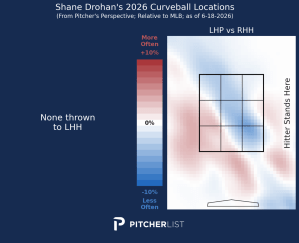
Despite the lack of bold red blotches, we can read from this that he’s avoiding the middle of the zone, and landing his curve either away in the zone, or in the chase-friendly locations just outside of the zone to righties at a better-than-average rate. That’s really all you can ask for. His curveball also creates a partial spin mirror to his fastballs. While it doesn’t match their spin activity, it does spin in a near-perfectly opposite direction. The command and fit in his mix are pushing this pitch toward elite numbers.
His cutter command, like its shape, is still a work in progress. He’s shown some ability to land it inside to righties, but it’s finding itself slipping into the middle of the zone too frequently and burning him there. Against lefties, he seems content to just aim high or away in the zone. It’s working well enough for him; it also makes sense given where he’s throwing his other pitches. Cutters are weird to evaluate. His is getting hammered by righties because of those misses, but it helps his other pitches play up. It’s like having a rug you don’t particularly like, but it really ties the room together, and it just wouldn’t be the same without it.
What They Have Brewing
The pieces are there; that much is clear. While he may not be an ace, the command of his best four pitches is a profile that should keep him in the rotation if he can stay healthy. That is the rain on this parade, unfortunately. His arm troubles were a big part of what saw him go from a fifth-round pick to an afterthought. The hope here is that his restructured mechanics keep him healthier. Also worth noting is that his move into the rotation was spurred by Henderson’s injury, and his rehab assignment starts Sunday, which could mean Drohan gets shuffled down the depth chart upon his return.
Being on the Brewers right now is a blessing; they’re churning out pitcher improvements as well as any organization in the league. Unfortunately for the pitchers on the Brewers, that means there’s a ton of competition for spots. With Woodruff back in the mix, they’ve got six guys competing for starts, including Drohan, and that’s not counting bulk guy/spot starter Chad Patrick or the soon-to-be-returning Henderson. Drohan has his start Wednesday against Cincinnati, and after Sproat’s gem on Tuesday, I wouldn’t be surprised if it’s an audition to see if he can extend his run as a starter. He’s fully stretched out now, the leash extended to 91 pitches in his last one, so they might as well see what they have there. It’s also possible he winds up in a paired role if they decide to put anyone else in the rotation on a pitch limit.
Drohan wasn’t supposed to get this far. Outside of the most obsessed (complimentary) of Brewers fans, I’m not sure anyone was excited about what he could be this year, let alone expecting the season he’s having currently. Yet with less than a dozen solid relief appearances and four pitch-limited starts with mixed results, he’s shown enough to be taken seriously as a piece of the future in Milwaukee. If that’s not a fun surprise, I don’t know what is.
Photo by Icon Sports Wire | Graphic by Carlos Leano
