





When ballplayers like Denzel Clarke and Victor Scott II make spectacular homer-stealing catches, they can begin to resemble professional musicians creating sophisticated jazz music.
While the level of full-throated athleticism differs, both kinds of performances require improvisation, along with a significant amount of practice.
When the Athletics visited Angel Stadium on June 9, Clarke took away what a sure home run by Los Angeles Angels slugger Nolan Schanuel, scaling the 8-foot fence in center, twisting and reaching well above it, and over the side, to make the best catch anyone has seen in a very long time. Clarke added an exclamation by exhaling two primal screams, plus a subtle double arm flex.
That describes what it looked like. If Clarke’s catch made a sound beyond the ambient noise on the field, it would sound like jazz. Something that John Coltrane, Charlie Parker, or Miles Davis might have played. Opinions vary about music and baseball, but most of the sport’s beauty comes on the defensive side.
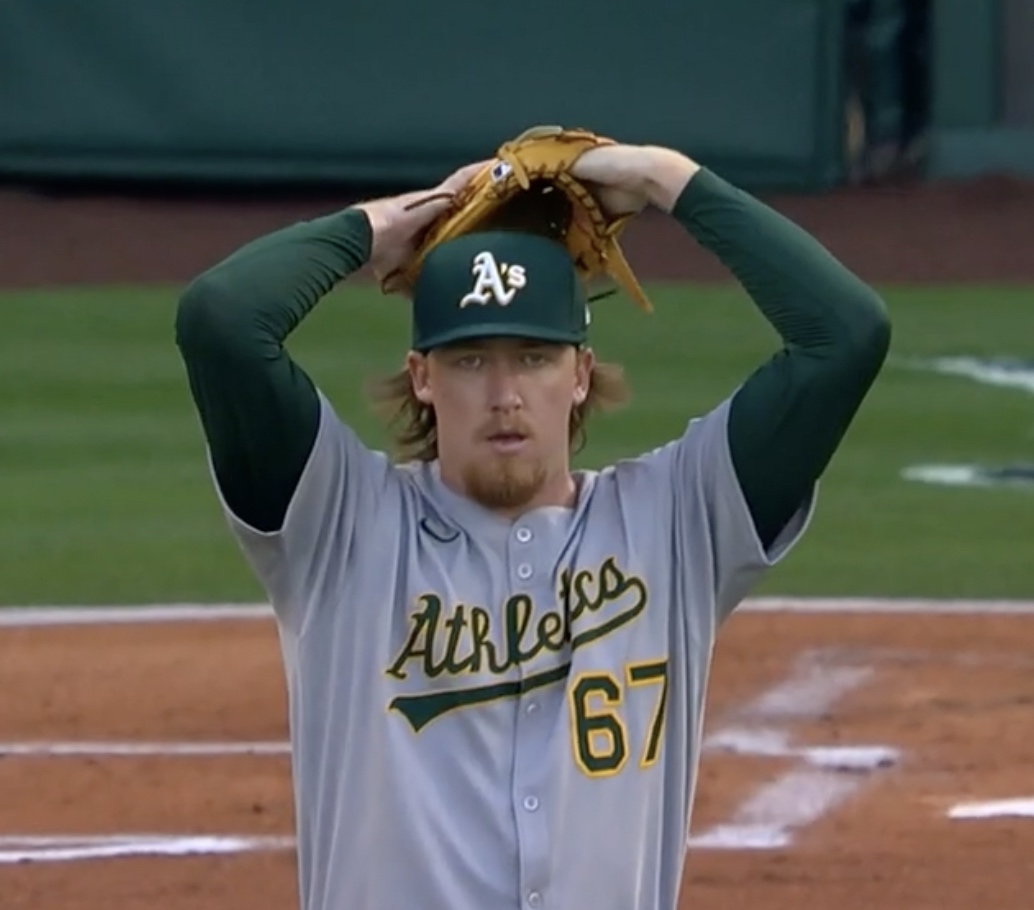
Already entering the Angels series having a reputation for making great plays in his brief time in the majors, Clarke’s catch against Schanuel was a virtuoso masterpiece, one that turned right-hander Grant Holman gobsmacked. Holman told Pitcher List he couldn’t process what happened after delivering the pitch to Schanuel.
Looking for some clarity, Holman glanced at the video board for a replay. But they didn’t post it immediately, so he just kind of stood there as the ball worked its way back to the infield.
“I’ve never been left, like, completely speechless on the mound from something that happened on the field,” Holman said. “I was just standing there, not doing anything, looking on in shock. And then I told myself: ‘All right, put your hands in the air, do something. Stop looking like an idiot.’ So then I ended up with my hands on top of my head.”
Schanuel told reporters in Anaheim that Clarke’s play put him through an emotional wringer akin to a grieving process. In addition to confusion, disbelief, and exasperation, he felt a little anger, having hit the ball 101.8 mph and thinking it was going over. Schanuel even had started a home-run trot.
“One of those courtesy jogs,” Schanuel said.
Schanuel’s first clue that he didn’t hit it far enough came when Clarke got to the fence — and didn’t stop.
“I see him climb up the wall and I’m like: Maybe he’s just doing it like a lot of guys,” Schanuel said.
When he realized the ball didn’t make it over for a homer, blood appeared to drain from Schanuel’s face. Clarke’s catch did not remind him of a piece of great music. Only pure discord.

Practice makes pouters. While it might seem fanciful, the home-run robbers themselves say they really do practice this stuff. St. Louis Cardinals outfielder Victor Scott II said he works at stealing home runs.
“You definitely have to practice it,” Scott said.
Scott earned his thieving wings May 4 at Busch Stadium by taking away a three-run homer from New York Mets outfielder Juan Soto. One of the top sluggers of his generation, Soto was struggling to hit for the kind of power the Mets expected when they signed him to the richest contract in MLB history in the offseason.
Scott did not help him get on track. Soto lined a four-seamer by right-hander Andre Pallante nearly 106 mph off the bat, sending it an estimated 408 feet to center, but the 31-inch launch angle gave enough loft and time for Scott to get close. He made a left-handed leap, crashing his back into the 8-foot fence, yet holding onto the ball.
Soto, turning his head from Scott, went to grab his helmet as if preparing to slam it down. And he might have, were it the third out of the inning. Scott just gave a big smile as he chomped his gum.
“It’s probably one of the plays in baseball that’s actually more exciting than hitting a home run,” Scott said. “It’s up there with stealing home.”
Cardinals shortstop Masyn Winn enjoyed the theater.
“I had a great view of it,” Winn said. “Soto pimped it a little bit. You know, pretty much every other park, that’s probably a homer. At Busch Stadium, it’s not. Vic scaled the wall. That was a beautiful catch.”
Chicago White Sox outfielder Michael A. Taylor recently surpassed 10 seasons of service time with MLB. A Gold Glove winner and one of the best defensive players of his generation, Taylor said catches like Scott’s and Clarke’s, or ones he has made, would be less frequent without practice. It takes more than athleticism.
“It’s important to work on it,” Taylor said. “There are ways to safely do that in the outfield during your drill work and practice. Just getting familiar and comfortable going back toward the wall allows you to make that play. It’s really hard to do a one-off, where you go and scale the wall, or run full speed, and know exactly where you are.
“Physical ability — you probably need a little bit more than that.”
Taylor practices stealing home runs by using a pitching machine that’s been adjusted to send fly balls toward the fence. It’s typically accurate and a good way to multiply reps. He starts his setup about 30 feet from the fence and hopes he gets wall-scrapers.
“That way, you’re kind of controlled going back there,” Taylor said. “You don’t want any injuries or anything like that in practice.”
Taylor started his pro career as an infielder, and said running toward the fence bothered him at first, like when you run into a curtain and can’t see what’s on the other side. The discomfort faded with practice.
“All that I know has been improved from coaches and fellow players over the years, but also through trial and error,” Taylor said.
Winn said he has noticed Scott and other Cardinals outfielders working with coach Jon Jay on defense by the warning track, even doing drills that simulate stealing home runs.
“Jon Jay will have all the outfielders out there scaling the wall,” Winn said. “I don’t know if they’re messing around or actually really trying to work on it, but either way, I think it helps them.”
Scott does it as part of his overall prep.
Before every series in a new ballpark, Scott said he gets the lay of outfield, checking the curves and angles of the fence, the distances required to run, wind patterns, how the warning track figures in, how the decks of the grandstand might change his depth of vision, and the height of the fence.
“It’s kind of a constant, one of those things that you have to do,” Scott said. “It’s not just being a good athlete or being instinctive, you have to work on it too.”
Scott’s work on defense began long before the start of the regular season or even spring training, he said. After debuting in 2024, Scott worked throughout the offseason with his dad and a personal coach back home near Atlanta. The details, like making proper reads, getting quicker jumps, being more decisive in running routes, and whatever else a consistent center fielder must do — those are what make the difference. Scott quickly showed himself capable of the spectacular, but his improved results overall are evident on the leaderboards at MLB Statcast and elsewhere.
Clarke really hit the ground (and fence) running, diving, and jumping when the Athletics promoted him from Triple-A in late May. It was obvious when he arrived that Clarke was a better defensive player than most of his peers. His pullback against the Angels was the second time he robbed a home run in two weeks, and it highlighted a series of amazing catches that marked his first few weeks on the job. No matter what, Clarke persistently works to stay ready to make the next play.
Clarke’s quick success got the attention of former ballplayers, like Torii Hunter and Adam Jones, who were known as home-run stealers in their day. A few outlets have taken to giving Clarke the nickname “Spider-Man,” but people were calling Hunter that a generation ago. Hunter suggests “Elastic Man” as an alternative.
This has to be one of the best catches I've ever seen, and I've seen my share of home run robberies. 🤩 https://t.co/fyaQakOBTv
— Torii Hunter (@toriihunter48) June 10, 2025
Clarke’s robberies also prompted a wave of media publicity, including an interview with MLB Network, where a host asked Clarke if he always scopes out the outfield fence in new parks, looking for an edge.
“I always have my whole pregame routine,” Clarke said. “I check how many steps I have to the track, how the grass plays in (batting practice), what the ball looks like going through three decks of seating, everything. So at my routine, when the wall is a decent size, I’m like: ‘OK, I can get on top of this and grab one.'”
If anyone else ever scaled a fence to steal a home run like Clarke did, and it was caught on tape, Gary Matthews Jr. was the guy. He might have even done Clarke one better on July 1, 2003. Thanks to “SportsCenter” back in the day and YouTube today, it’s a play he still gets asked about all of the time.
Of all the iconic home-run robberies in baseball history filmed for posterity — from Ken Griffey Jr. at Yankee Stadium in 1990, to Hunter robbing Barry Bonds at the All-Star Game in 2002, to Endy Chavez’s doubling up Scott Rolen in the 2007 NL Championship Series, to every amazing theft by Mike Trout, Jim Edmonds, Kevin Pillar and Kenny Lofton throughout their respective careers — the one by Matthews tops them all.
Matthews, playing center field for the Texas Rangers, robbed Houston Astros slugger Mike Lamb of a home run — and the cycle — by making a full-extension leap at the fence with his back to the field in the eighth inning. Matthews had a longer way to run than Clarke, and while he didn’t appear to jump quite as high, Matthews, having his back turned toward home and blindly pulling back the ball at the eight-foot fence, was an improvisation on a magical scale.
He might not have reached Scott’s height, but Matthews still got up there. In recalling the moment on the Bleav podcast back in 2021, Matthews said he got more air on the play than he thought was possible.
“I was so high up,” Matthews said. “I was higher up than I anticipated. You get that high up over the wall, and you’re like, ‘Whoa.’ You’re ready for the ground to be there, and the ground wasn’t there. But you realize how high you’ve gotten up, and come down with the ball in your glove.”
Once he landed, Matthews reached up with his glove to show the umpires that he caught the ball. From there, he said, Matthews tried to regain his composure. He reacted differently than players of today might have.
“Then, the game was different,” Matthews said. “There’s a lot of bat flipping and chest pounding that goes on now, but you know, you just robbed the guy of a home run, so you want to keep your composure and show a little respect, right?
“But in your mind, you’re like, Oh, my gosh, I can’t believe I just pulled that off. Unbelievable.”
Like a lot of baseball fans, Clarke said he has seen the Matthews catch. MLB Network also asked Clarke to compare it to his catch.
“The walls play a little different,” Clarke said. “He’s got to go straight vertical, which I think is harder than going up and then reaching over. They’re both hard, both pretty incredible catches.”
Could Clarke make a catch like the one Matthews did if the opportunity presented itself?
“I believe it,” he said.
No matter how much athleticism, preparation, and improvisation go into home-run prevention, not everyone (or every algorithm) comes away impressed. Despite assigning an expected batting average of .890 to Soto’s blast, Statcast also gave Scott a 95% catch probability for his robbery. If taken to mean that Soto had an 89% chance of getting a hit, but Scott also had a 95% of catching the same ball, those respective measurements would seem to be at odds.
As for Clarke’s robbery of Schanuel, which had a .690 xBA, the instant reading gave the same 95% catch probability, before they later revised it to 75%. If not an outright contradiction, it’s still a curious dissonance.
Statcast’s model accounts for details that fans don’t necessarily see, especially in a 30-second highlight clip. Here are the top factors for catch probability, right from Statcast’s own glossary:
• How far did the fielder need to go?
• How much time did they have to get there?
• What direction(s) did they need to go?
• Was proximity to the wall a factor?
Statcast accounts for the fence getting in the way of an outfielder, but it doesn’t seem to account for how high a player might need to jump to execute a catch. There are reasons for this that developer Tom Tango has gotten into. When Athletics broadcaster and former player Dallas Braden complained on Twitter, Tango replied:

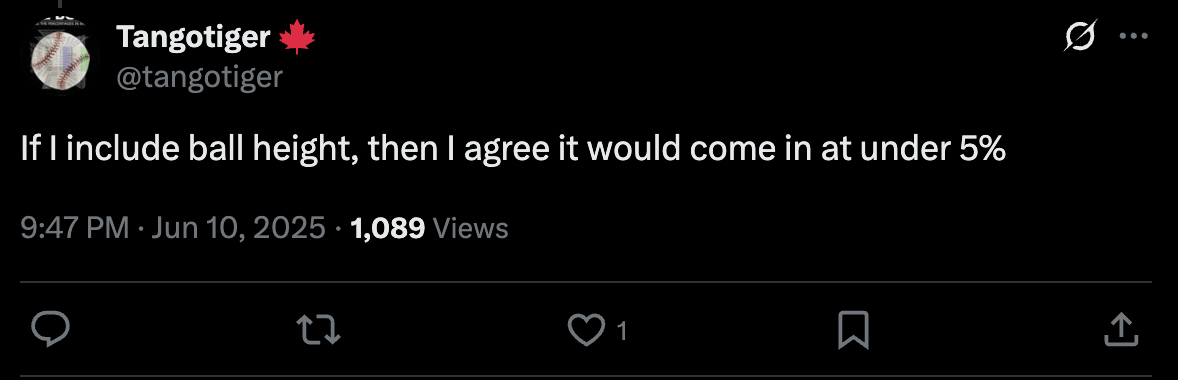
Advanced metrics certainly offer help to anyone wanting to evaluate MLB play. It’s just that some players, especially when it comes to making homer-saving catches, are more advanced than we can fully measure. Think of it as limiting the math a teacher might use to analyze poetry. Sometimes, a play has to be good enough just by looking.
One of Clarke’s teammates, Brent Rooker, played left field the day Clarke robbed Schanuel. Noting Clarke’s ascension of the fence, Rooker had a fair take on how fans probably should view Statcast metrics on homer-saving plays.
“People have a misunderstanding of what the catch probability stat is for,” Rooker said. “It’s an inaccurate representation of (Clarke’s) catch. That doesn’t make it a bad stat. But in terms of robbed home runs, it’s not fully equipped to rate those.”
Having accumulated data of his own first-hand, Rooker could tell some stories about home-run robberies. Not that he has made any. The closest he’s come happened when watching Clarke take down Schanuel. Rooker did offer help to Clarke, though he doubted it made an impact on the play.
“As he was tracking it, I was trying to communicate with him, let him know how much space he had and all that stuff — knowing that he really doesn’t need me,” Rooker said half-jokingly.
Talking from a slugger’s perspective, Rooker got nearly serious about home-run robberies. He lamented White Sox outfielder Luis Robert Jr. erasing his potential home runs multiple times, seemingly once a year (including this year). After one of the plays, Topps turned a photo of it into a Robert trading card in its 2024 set. It’s a cool shot of Robert at Rate Field hanging onto the fence with one hand and reaching for the ball with the other. Well, it’s cool depending on your perspective.
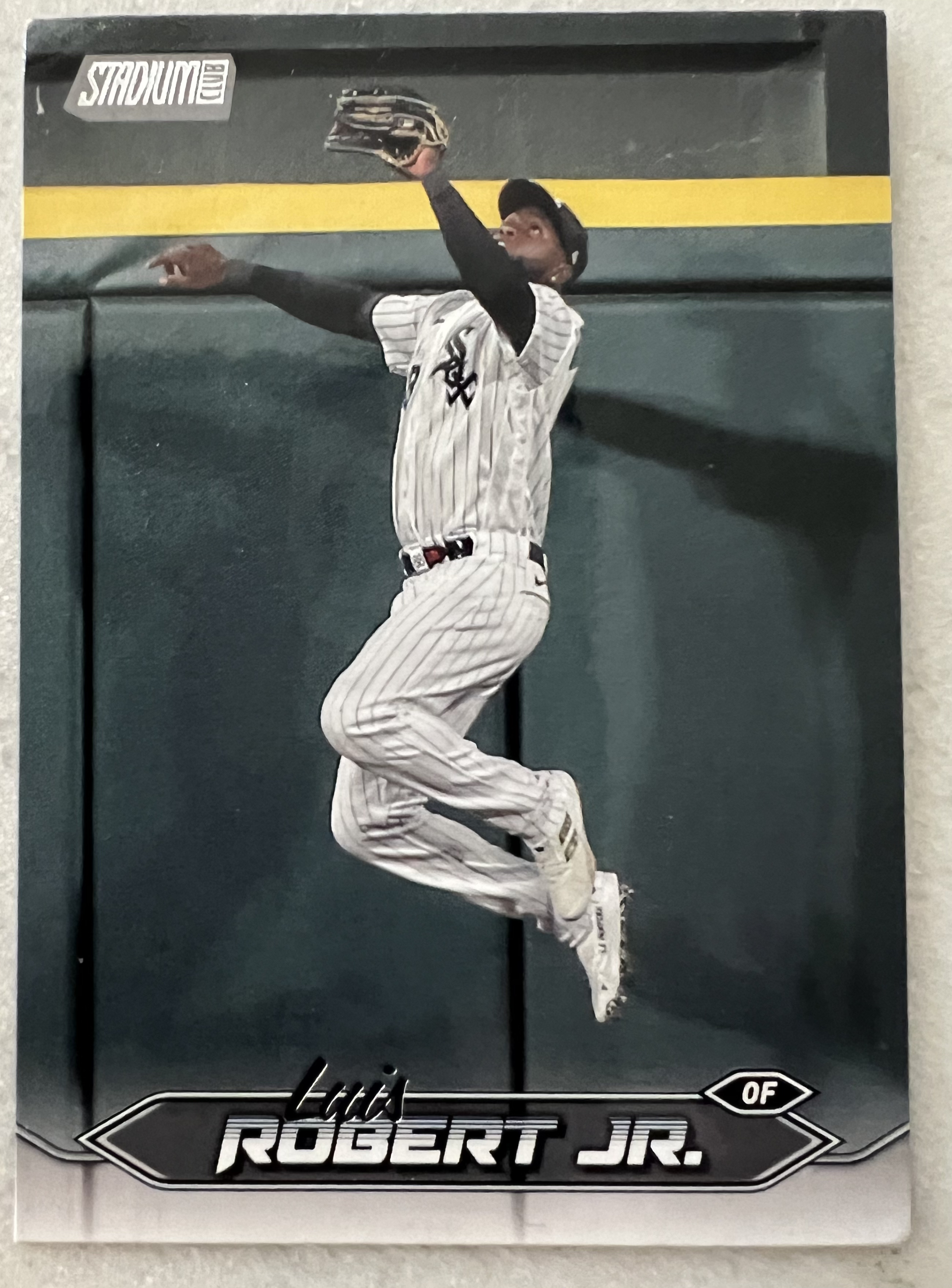
“It’s demoralizing,” Rooker said. “Because when the ball is in the air and you think you have a home run, it’s a pretty good feeling. And then when that gets taken away, it sucks for a few minutes.”
Schanuel could commiserate. He didn’t get over Clarke’s catch once he got back to the dugout. In fact, he refused to watch a replay at all until the outcome of the game had been settled. After the Angels won, Schanuel grabbed an iPad to relive the robbery. He was impressed, but …
“I just sat here for like 10 minutes watching it over and over again,” Schanuel said. “A bunch of my friends sent it to me. It hurts. It stings. But I mean it’s kind of like I get a little part of history with it because we’ll see that catch for years and years.”
Winn had a more nuanced take on Scott robbing Soto at Busch. While totally jazzed up in the moment, the part of Winn who is a hitter sympathized with Soto. He’s not looking forward to the time someone robs him of a homer.
“I feel like, the day it does happen, I will be really pissed off,” Winn said. “A lot of (hitters) tip their caps. I don’t … I don’t see myself doing that. I’ll probably be pretty hot.”
Winn was being hypothetical, but Pallante felt something real about Scott keeping Soto in the ballpark. Pallante was having a lousy day against the Mets, having allowed four runs in the first three innings before the first two runners reached in the fourth.
After getting ahead in the count 2-1, Soto squared up Pallante for what looked like a knockout punch until Scott flew in for the rescue. The Cardinals changed pitchers; reliever Michael McGreevy put up 5⅔ scoreless innings, and St. Louis came back to win the game.
Pallante said the catch meant a lot to him individually, too.
“Especially on that day,” Pallante said. “I had not done well prior and, if that was a home run, it would have set me on a bad path mentally, and with my numbers. It could start a spiral.
“Him saving that home run really gave me a lot of hope, and eased the pressure. It was awesome to see him do it, crazy for him to get up there and reach over. He’s a great outfielder. I’m sure he prides himself on being able to do that. It was so sick.”
Taylor has made multiple homer-stopping grabs in his career, but he said the one that got a reaction from right-hander Zack Greinke in May 2022 is always the first on his mind.
Then-Cardinals catcher Andrew Knizer drove a pitch to left-center that would have cleared for a homer at Busch Stadium if not for Taylor, who stuck his foot in the fence to pull himself up, and said he caught the ball on the way down with his glove already over the side.
“It’s just really hard to have the time to do all that and be able to time the play correctly,” Taylor said. “It’s just not a play that you get a ton of opportunities to do.”
Taylor said he not only got a warm response from the opposing crowd of Cardinals fans, but also from Greinke, who had a reputation for almost never reacting to anything.
“He doesn’t say much,” Taylor said. “I think he was like: ‘Wow, that was really cool.’ That’s a lot for Zack.”
It was the beauty of the ultimate defensive play, taking back a home run, that stirred Greinke’s emotions and prompted a response. He felt, in his own way, what everyone does after a home-run robbery.
“It’s pretty cool to come off the field,” Taylor said. “You’ve made a great play, and you get to, I don’t know, bask in it as you’re coming off. It’s just not a play you get a ton of opportunities to do.
“I think it’s even better than hitting a home run.”
Stealing a home run: the sweetest music in baseball.
