





Will Warren is coming off his best start of the season, allowing one run on four hits and a walk with seven strikeouts over 7 1/3 innings at the Athletics. The performance stands out even more considering how hitter-friendly Oakland’s ballpark has played this year, along with posting his best swinging-strike rate in a game this season (19.2%). While his season-long numbers remain a bit uneven, with a 4.75 ERA and 1.36 WHIP, the underlying metrics offer a more encouraging outlook. Warren has done a solid job controlling what he can, limiting walks and home runs while maintaining a strong strikeout rate. His 3.61 FIP suggests better results could be on the horizon.
Finding Answers Against Lefties
Warren is cut from the same cloth as Clarke Schmidt and Michael King, all products of the Yankees’ pitching pipeline and all supinators who thrive on east-west movement to generate outs. Because of the natural platoon splits that come with sinkers and sweepers, both Clarke Schmidt and Michael King have had to develop specific plans to handle left-handed hitters. Over time, each has made significant strides for different reasons. King now features one of the best changeups in baseball, ranking fifth in Run Value among qualified pitchers this season. Schmidt, on the other hand, has leaned on a cutter that consistently induces weak contact against lefties (.281 xwOBA in 2024), pairing it effectively with his knuckle curve to generate whiffs (18.1% swinging-strike rate in 2024).
Warren is experiencing the expected growing pains in his first extended look as a big league starter. His splits are dramatic. He has been dominant against right-handed hitters, holding them to a .233 wOBA, but has struggled against lefties, who have produced a .358 wOBA.
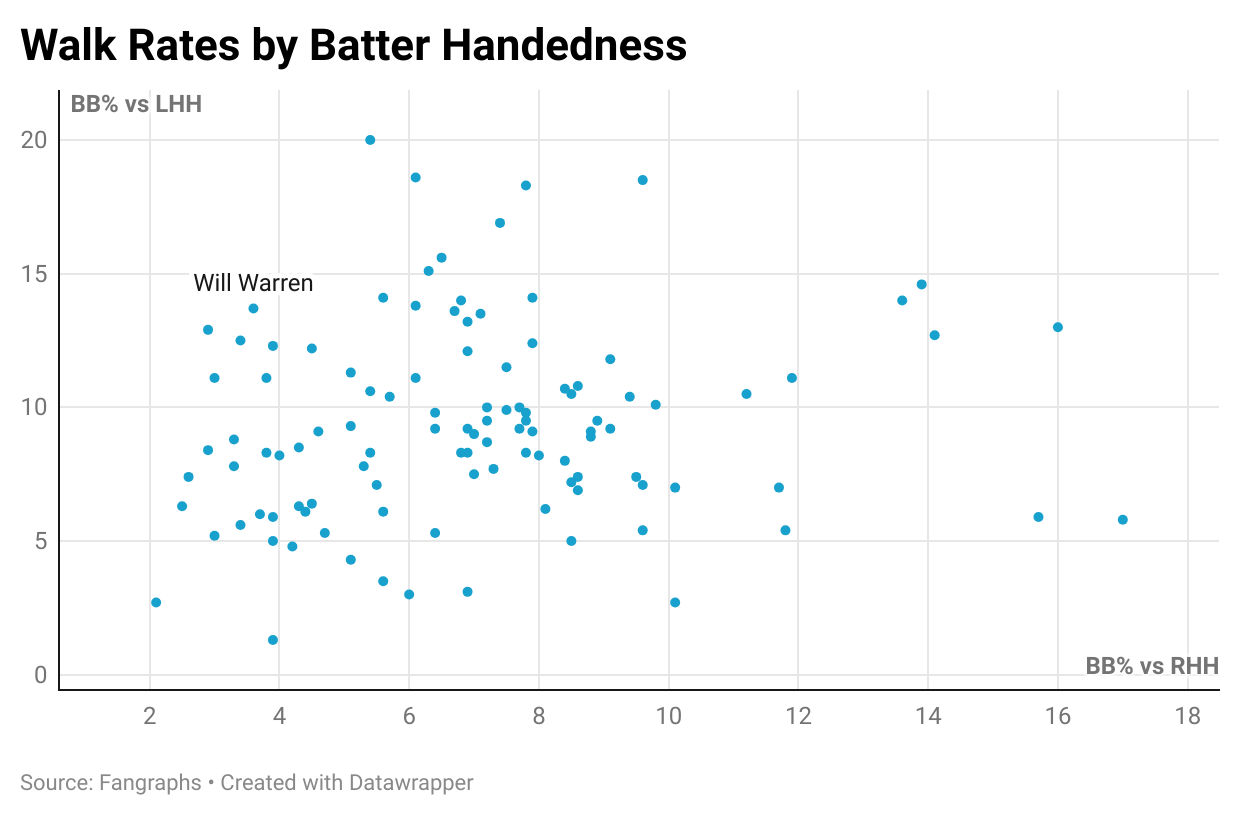
Warren appears to nibble more against left-handed hitters, posting a 13.7% walk rate compared to just 3.6% against righties. Among 110 starting pitchers with at least five starts, that gap ranks among the five largest disparities in the league. The issues extend beyond command as well. Lefties have produced a .376 xwOBA against him, compared to just .271 from right-handers. His fastball has performed decently against them, but his secondary offerings have specifically been punished.

As a pitcher with a standout sweeper, you generally don’t want to throw it to the opposite hand unless you are incredibly precise with commanding it either backdoor or to the back foot. Even then, the margin for error is small. The 25-year-old simply has not executed that plan, as lefties have oblitered him on the sweeper to the tune of a 1.498 OPS and .489 xwOBA.
A Look at the Repertoire

As mentioned, Warren’s sweeper is his primary secondary offering, and it grades out well, carrying a strong 108 Stuff+ rating. He generates nearly 20 inches of horizontal break on the pitch, the third-most in baseball. Despite the mixed results against lefties, its dominance against righties (15.9% swinging-strike rate, .172 xwOBA) helps it rate as one of the better sweepers in the league as well by PLV at 2.72.
In total, the right-hander features two fastballs that grade out at or above average, along with a pair of strong breaking balls. His command across the arsenal appears solid, but given the fastball’s average shape and velocity, improved command would help him get more out of the pitch. His minor league career 9.7% walk rate and 45 future command grade suggest this is likely the range he will continue to operate in.

Warren’s four-seamer is unlikely to become a major weapon in his arsenal. With below-average velocity at 93.1 mph, its success will depend more on usage and pitch sequencing than overpowering hitters. However, his lower arm angle (26 degrees) adds a layer of uniqueness, helping differentiate it from more traditional four-seamers. The pitch shares traits with those of Brandon Pfaadt and Brady Singer, with Pfaadt specifically being an interesting comparison for Warren.
Singer may not be the most exciting pitcher, but he has put together multiple seasons with an ERA below 3.75 and around average strikeout rates. Pfaadt is perhaps more similar in that they have the same arsenal, both wielding a four-seam and a sinker to go with a patented sweeper. However, with Pfaadt being just a year older than Warren at 26 years old, he is still managing the same issue with lefties, with a wide platoon split for his career. On a positive note, Pfaadt has narrowed the gap in his platoon splits this season, actually performing slightly worse against righties (.330 wOBA) than lefties (.325 wOBA).
That trend aligns with similar pitcher profiles who’ve taken time to craft a plan against lefties. Despite the ongoing challenge against lefties for Warren, he has underperformed his underlying metrics overall, suggesting there’s room for positive regression. The introduction of a new pitch could be the thing that unlocks him. There’s reason for optimism with Warren, both in the short and long term, that he can continue to adjust and find consistency.
