





Being a hitter in today’s MLB has to be one of the toughest jobs in sports. In just one at-bat, a hitter can see a fastball flying uncomfortably close to his face at triple digits, only to have that followed up by a nasty breaking pitch that dots the corner low and away. How anyone can do that, let alone do it well, is almost unbelievable.
With pitchers getting nastier by the day, one of the most important things a hitter can do is quickly react to a pitch and make the appropriate swing decision. That’s what Pitcher List’s very own PLV Decision Value metric attempts to measure. It’s more than just plate discipline, though. Decision Value grades a hitter’s ability to recognize the pitches he can turn into favorable contact and then make the appropriate swing decision. It’s graded on a scale where 100 is the league average, and every 15 points above or below 100 is one standard deviation.
One of the many great things about Decision Value is that we can break it down by pitch location, and that’s exactly what we’ll do in this article. Let’s take a look at which hitters have been the best at swinging at strikes that they can do damage against (zDV).
For a more in-depth description of Decision Value, check out the initial piece in this series. You can support Pitcher List and get access to all of our PLV statistics by joining PL Pro.
Jeff McNeil – 124 Decision Value, 138 zDV
McNeil missed the first three weeks of the season after suffering a right oblique strain during Spring Training, but he’s hit the ground running since his return to the lineup in late April. Through his first 128 plate appearances, McNeil’s slashing .266/.359/.532 with six home runs, 12 runs, 19 RBI, and a stolen base. His 146 wRC+ is at a career-high level.
Since debuting in 2018, McNeil has consistently posted great traditional plate discipline metrics. His career 11.8% strikeout rate is the 14th best mark among hitters who’ve amassed at least 1,000 plate appearances, and he hasn’t lost a step with age. If he had enough plate appearances to qualify, each of his strikeout, walk, and whiff rates would be 90th percentile or better this season, so it’s not shocking to see McNeil at the top of a plate-discipline-adjacent metric like Decision Value.
McNeil combines his elite eye at the plate with an aggressive approach. His 54.2% swing rate is 89th percentile among big league hitters, and this year he’s making those swings count more than ever. McNeil’s 92.6% zone contact rate is a new highwater mark, and has proved to be incredibly important given that he’s seeing more pitches inside the strike zone than all but nine percent of his peers.
Here’s a great look at how so much of McNeil’s success has come inside the strike zone in 2025.
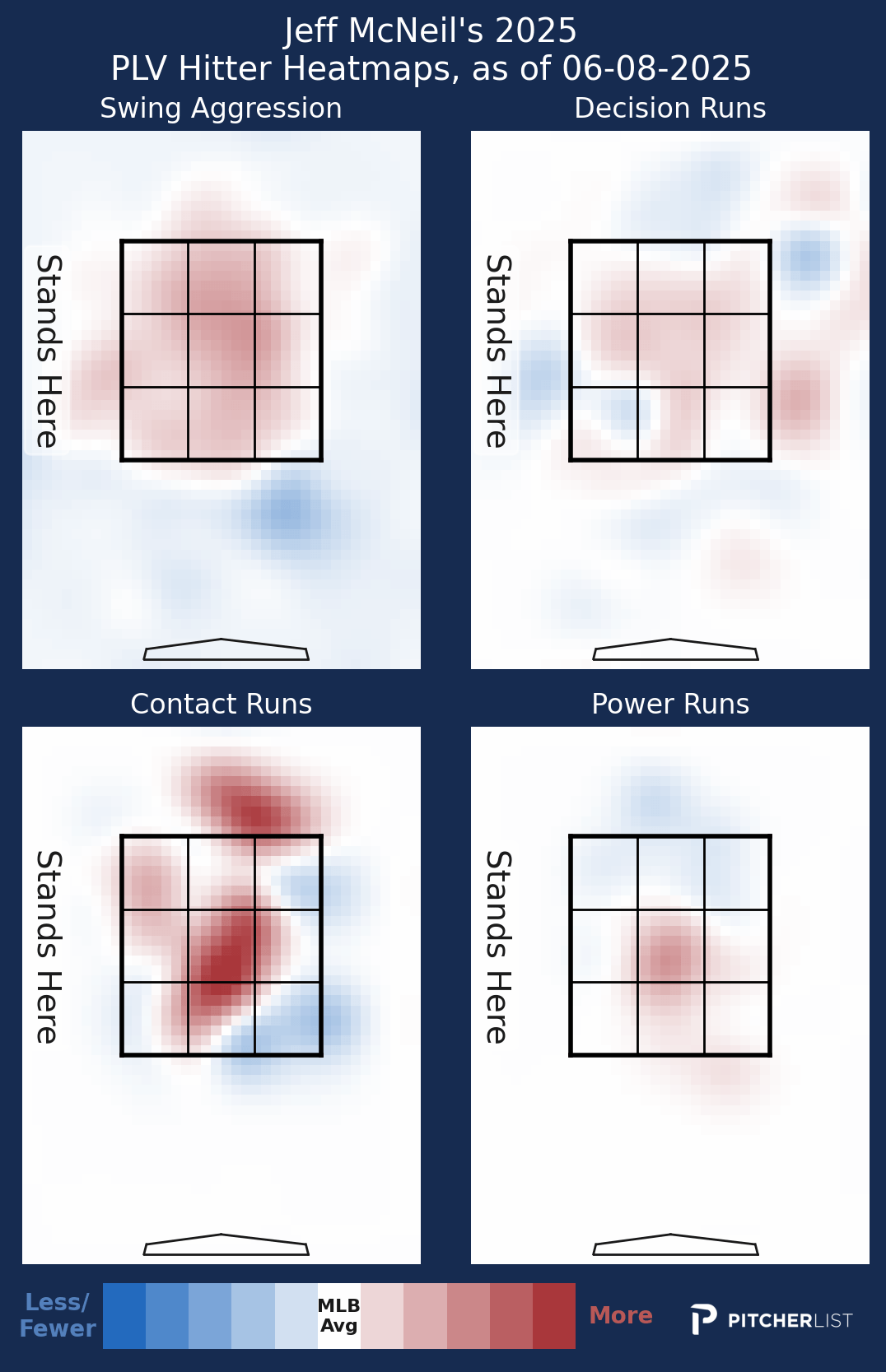
Those heatmaps show a lot of McNeil’s production coming from the heart of the plate, and that tracks in other metrics as well. His Statcast Run Value in the Heart of the zone is the best it’s been since 2019. That may be partly due to him seeing more bad pitches than a lot of hitters — PLV’s Mistake% shows that McNeil is in the 85th percentile for seeing mistake pitches.
While some of those heart-of-the-zone locations and mistakes may seem like pure coincidence, I do think some if it is attributable to opposing pitchers simply being more willing to throw strikes to McNeil. He was a league-average hitter in 2023 and 2024, so he’s seemingly one of the easier members of a stacked Mets’ lineup to attack. Unfortunately for his opponents, McNeil is making them pay for their willingness to give him hittable pitches. His great swing decisions have led to similarly great results, and it’s been in-zone fastballs that he’s particularly beat up on. His Statcast Run Value against four-seamers is sitting at 5 this year after poor returns of -7 and -1 in 2023 and 2024, respectively. McNeil is slugging .745 against four-seamers, so pitchers may need to start shifting away from the fastball when he’s in the box.
Ozzie Albies – 90 Decision Value, 134 zDV
It’s been a season to forget for Albies. The 28-year-old second baseman is slashing just .230/.307/.335 with six home runs and six steals. His 82 wRC+ makes three out of the last four seasons where his production at the plate has been below average.
Given the poor performance, it’s a little surprising to see Albies clock in with the second-highest zDV in baseball, but good swing decisions alone don’t guarantee offensive firepower. It’s absolutely a factor, but think of it this way: swinging at a good pitch to hit is just the first step in a very involved process. The hitter still has to make contact, hit the ball into play, the ball has to not be caught, etc., and that’s not even considering factors like fielder positioning, wind effects, and so much more.
While good swing decisions are not the be-all and end-all of hitter performance, they still paint an important part of the picture, and if we zoom out a bit, we can see a lot of what may be contributing to Albies’ lackluster showing. His zDV may be second best in baseball, but his oDV is one of the worst — 27th worst, to be exact. Albies’ 33% chase rate falls in the 18th percentile of big league bats, and you can see a great example of his over-aggression at pitches below the strike zone in these heatmaps.
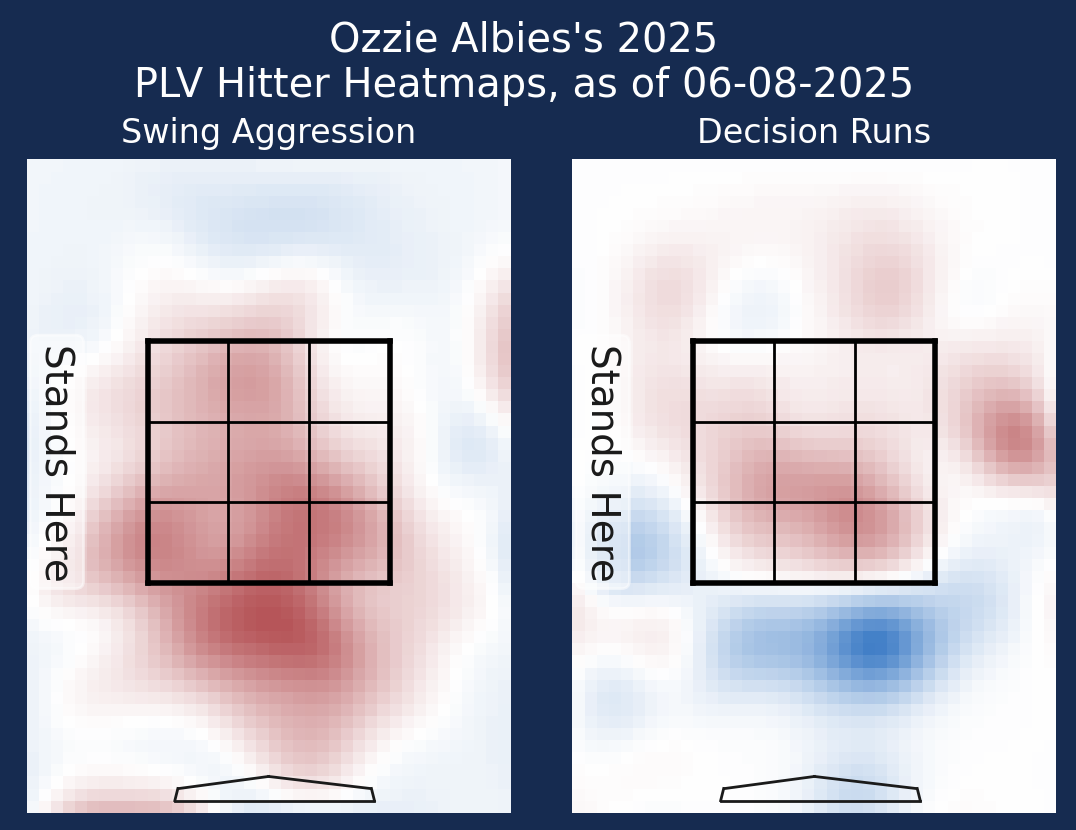
Despite the poor chase rates, Albies’ good hit tool lets him still get the bat on the ball, even when he’s swinging at those offerings below the zone. You don’t love the chases, but his 66.2% O-Con% is 79th percentile, meaning he’s able to turn those would-be whiffs into foul balls — his foul strike rate is 85th percentile. That’s allowed him to keep at-bats alive and work counts, leading him to a career-best 9.4% walk rate.
When Albies is putting the bat on the ball, whether the pitch is a strike or not, his results on contact have cratered. He averaged a 6.8% barrel rate and 33.8% hard-hit rate from 2018-2023, but has seen those numbers fall to just 3.3% and 27.5% this year. Both of those results are in the bottom 10th percentile.
Albies is a tricky hitter to get a handle on. At just 28 years old, I’m inclined to think he eventually returns to his career average performance, but there’s a big risk given that 2025 is the third out of the last four years he’s posted disappointing numbers, he may not recapture the electric play we saw from him during his early years. I’m willing to bet on the three-time All-Star turning things around, but targeting him as a buy-low candidate in fantasy is not without risks.
Jackson Merrill – 82 Decision Value, 132 zDV
Baseball’s third-best in-zone swinger is also one of the sport’s most aggressive swingers overall. Jackson Merrill’s 60.3% swing rate is 99th percentile — for context, the league average swing rate is 47.7% — so we can confidently say that Merrill doesn’t let a pitch he can hit go by. You can see his aggressiveness in a lot of his PLV metrics. Like Albies, he excels at zDV (132, 3rd best) but struggles with oDV (71, 12th worst). PLV Swing Aggression grades him as the second most aggressive hitter in baseball, trailing only fellow young centerfielder, Pete Crow-Armstrong.
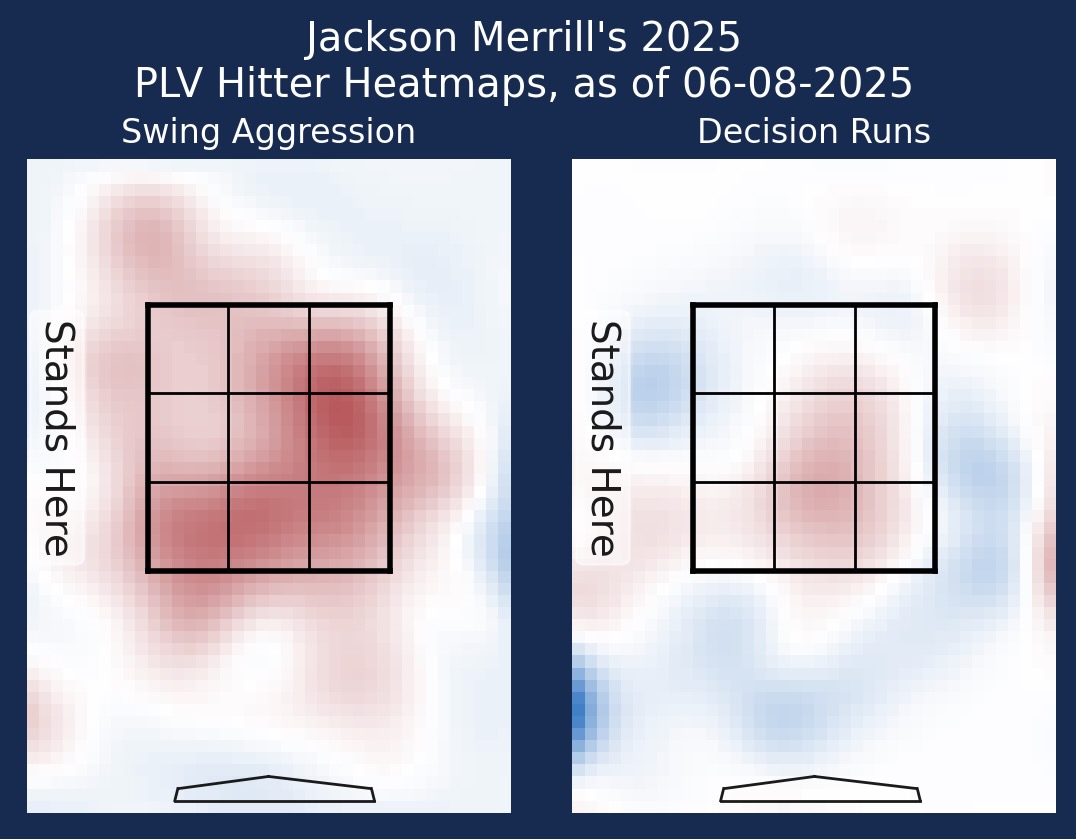
Although Merrill’s swing habits look a lot like Albies, the results have been polar opposite. Merrill’s slashing a strong .303/.343/.479, good for a 132 wRC+ and .356 wOBA. If his five home runs and one stolen base look a little light, it’s because he missed exactly one month with a hamstring injury, but he hasn’t missed a beat since returning.
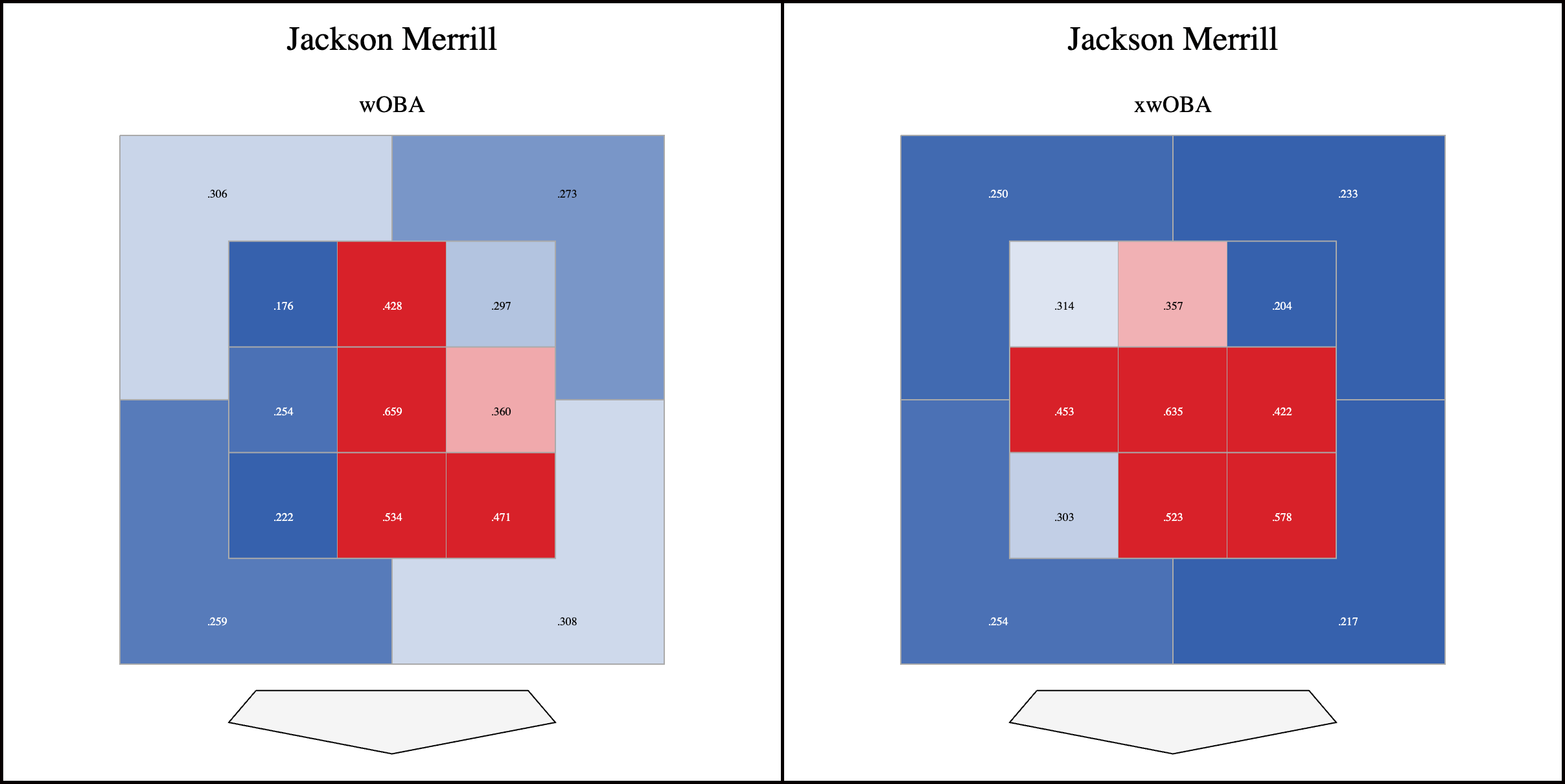
Unlike the other two players above him in this article, Merrill’s strong in-zone decision making hasn’t come with a good contact ability, at least not in 2025. In his sophomore season, Merrill’s contact rate has fallen nearly five whole points from 79.5% in 2024 to just 74.6%. That drop moved him from the upper echelon of contact rates to just the 45th percentile, but he’s been able to keep his production high due to great results on contact. Each of Merrill’s xwOBA, xBA, xSLG, and barrel rate falls in the 83rd percentile or above, and his LA Sweet-Spot% is a real standout in the 99th percentile.
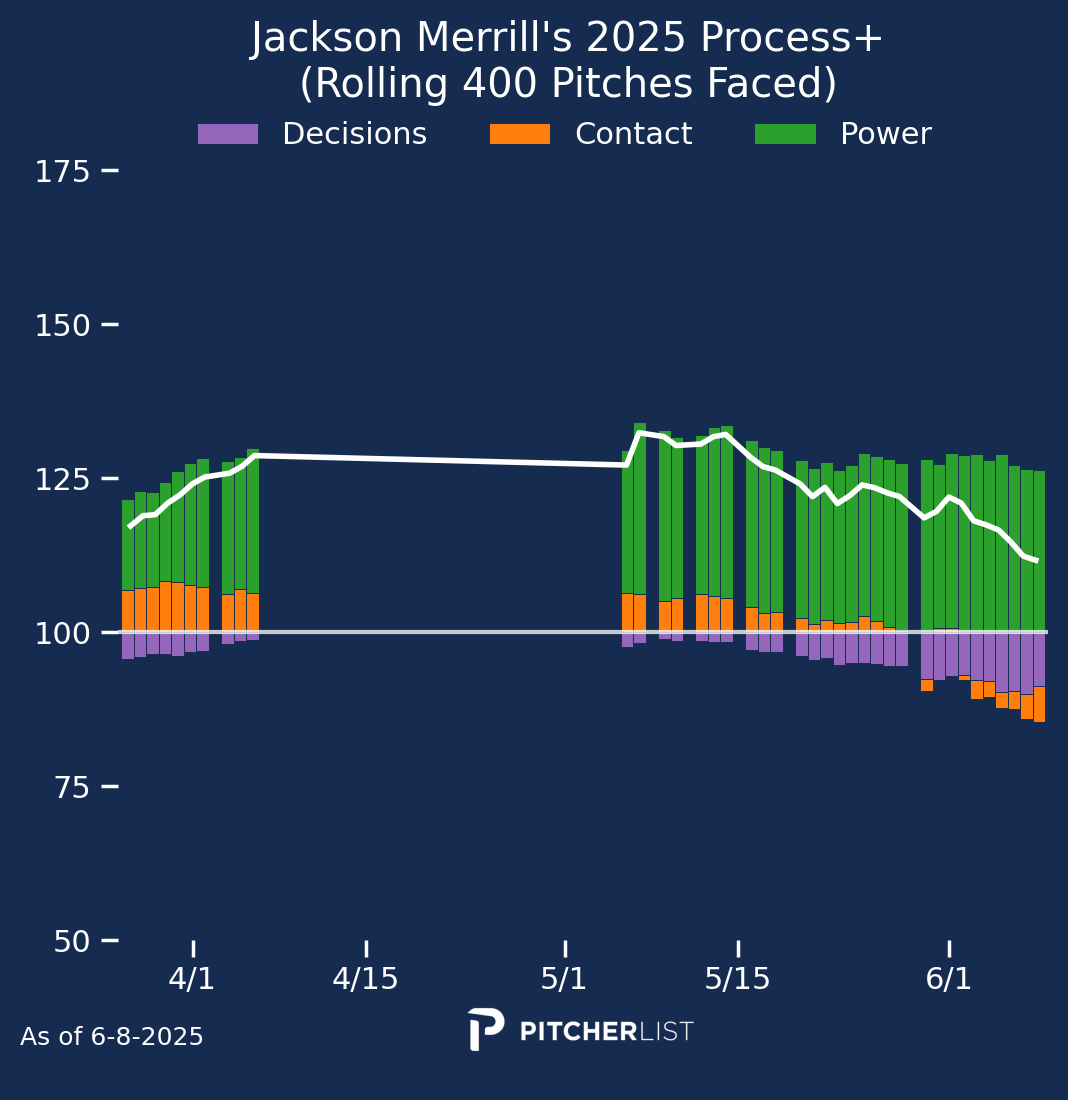
Merrill’s Process+ rolling chart captures all of this very clearly. An important note: this chart shows overall Decision Value, so although Merrill’s been excellent in the zone, his equally poor out-of-zone choices drag him down to below average overall.
Shifting focus back to strictly in-zone results, Merrill’s great decisions have led to a second-year improvement versus pitches located in the heart of the zone – his Statcast Run Value on pitches located middle-middle has nearly doubled from last year. Here’s a look at his wOBA and xwOBA broken down by zone.
Merrill’s one of baseball’s budding stars. At 22 years old, he’s already vying for his second All-Star nod. If he can take his elite in-zone Decision Value and expand that to pitches located out of the zone, he could be one of the best hitters in the sport for the foreseeable future.
Adapted by Kurt Wasemiller (@kurt_player02 on Instagram & Threads, @kuwasemiller.bksy.social on BlueSky)
