






The Pitcher Edition of the Stash List highlights the 10 best pitching prospects likely to make an impact during the 2026 season.
Prospects are often thought of as holding value only in dynasty formats. However, knowing which prospects hold value for the current season can help set you apart in redraft leagues. Several have a 2026 ETA, and getting ahead of the curve on rostering these prospects is a key part of roster management. Last year, we saw more pitching prospects make their debut than ever before, and there is no reason we should expect to see anything change in 2026. Keep reading to find out the top ten pitchers you should stash in your redraft leagues.
Ground Rules
- The Stash List is for your redraft leagues and does not consider impact beyond 2026.
- Only current minor league players who are expected to make an impact this season are included.
- Upside, proximity, health, and opportunity are all weighed for each player.
- The focus is on 12-team leagues with standard categories.
- Rankings and roster percentages will be updated weekly.
- Stats will be updated weekly for all players through Thursday’s games.
Minor League Pitcher Leaders in Pitches per Game through August 12, 2026 (minimum 10 starts and 25% strikeout rate)
The Stash List
Graduates/Call-Ups
The following prospects joined the big league clubs over the last week:
Matt Wilkinson SFG got the call for his Major League debut against Cleveland on Wednesday. Strangely, Wilkinson only threw 25 pitches across two scoreless innings. He is heavy on the fastball, so we shall see if that is enough to carry him to success.
Ethan Pecko HOU also earned the promotion for his debut with the Astros on Wednesday. He was very inefficient, needing 89 pitches to get through almost four innings. His fastballs were only touching 94 mph, but the sinker did earn six whiffs with 16 inches of break. The low 55% strike rate and 31% zone rate won’t cut it. He has a deep six-pitch arsenal, so he may need to honor some addition by subtraction in terms of the number of pitches he relies on.
Kent Emanuel CIN is a 34-year-old independent baseball starter who has one thing most of us will never achieve: a Major League start. He was DFA’d after his five-inning outing, so we will have to see if anyone snatches up the lefty with huge horizontal movement on his stuff.
Quinn Mathews STL has that frequent rider bus pass between St. Louis and Memphis. He started the first game of Monday’s doubleheader before being sent back down. He posted seven strikeouts on eleven whiffs, but also three walks and a 57% strike rate. Mathews would benefit from a longer stay with the big league club, which is more difficult due to their not insignificant chance at making the playoffs.
Ricky Tiedemann TOR made his Major League debut in long relief against the Yankees. He struck out two batters using a 96 mph four-seamer, wide-breaking sweeper, and changeup. It’s anyone’s guess if he gets to build up to a starter role in 2027.
Finally, it’s happening! Seattle plans to call up Kade Anderson SEA, for a Saturday start against the Cubs. Expect 5-6 innings as we see if the velocity plays with Major League competition.
Top 10 Pitching Prospects to Stash
1. Kade Anderson, LHP, Seattle Mariners
2026 AA Stat line: 93.1 IP | 1.06 ERA | 40.9 K% | 3.9 BB%
2025 NCAA Stat line: 119.0 IP | 3.43 ERA | 37.4 K% | 7.3 BB%
[Editor’s note: Kade Anderson will be called up on 8/22 for his MLB debut]
Including this current one, there are six weeks left in the Major League season. That range safely provides the runway for Kade Anderson to give the Mariners 30-40 strong innings to propel them into a Wild Card spot. They have resisted the temptation to promote him for so long that it has come at the expense of his fantasy value for the 2026 season. Anderson can be helpful for any fantasy manager who has playoffs in September or plays in a roto league. And once the season wraps, the Kade Anderson case study will be interesting to review as we seek to apply any insights into future stud pitchers in a similar situation.
STASH WATCH 26
Kade Anderson
AA Arkansas SEA
6’2” LHP 22yo8.14vTulsa
5.2 IP 2H 0R 1BB 7K
12whiffs/79pitchesAthletic hi 3/4 slot
FF hit 96
CU big drop
CH
SL1 pickoff
75GB%20.2 IP scoreless streak
Lines up nicely for a Friday night home MLB debut vs the Cubs 8.21 pic.twitter.com/5wM35DWAQa
— YGM Fantasy Baseball (@YGMfantasy) August 15, 2026
In the meantime, Anderson extended his scoreless-inning streak to over 20 innings. The left-handed pitcher grunted his way to another near-six-inning start under 80 pitches. If he wasn’t striking a batter out (7 strikeouts), hitters were putting the majority of balls in play on the ground. He generated ten whiffs and a 35 CSW%. In addition, he picked off one of the three baserunners that did manage to make it to first base. The four-seamer was also up to 96 on the evening. It was a stellar send-off for Anderson, who most certainly, undoubtedly, indisputably, unquestionably, without a doubt, undeniably, could have, should have made his final start with Arkansas.
OOPSY rest-of-season projections see Anderson as the tenth-best pitcher in FIP with a 32% strikeout rate and 6% walk rate. If he can manage 20-30 innings of those ratios, then he will be a major upgrade over all of the available streamer types.
2. Jurrangelo Cijntje, RHP & LHP, St. Louis Cardinals
2026 AAA/AA Stat line: 108.2 IP | 5.22 ERA | 28.2 K% | 12.4 BB%
2025 MiLB Stat line: 108.1 IP | 3.99 ERA | 26.1 K% | 11.1 BB%
Jurrangelo Cijntje is a SPINO, Switch Pitcher in name only. The 23-year-old has only thrown 19 pitches as a southpaw since being promoted to Triple-A Memphis. For any potential gloom over losing the prospect of a dual-handed pitcher in the Major Leagues, the brightness shines on the fact that he may be a really good right-handed pitcher. Any practice time spent on the mound from the left side can now be moved over to perfecting his mechanics and stuff from the right side. If TMZ Baseball were on the scene of his next start, I hope that they would find out if he still uses the glove with two thumb holes. Inquiring minds want to know!
At just under 6′, Cijntje is generating above-average extension with a three-quarter arm angle. He dips his arm a bit more for the changeup, but holds a similar release point for his other four pitch types. His slider and fastball combination have become a particularly strong duo. The slider tends to land on the bottom edge of the strike zone, dipping into the ground late. His fastball has a similar path to the plate, but keeps rising, with 16 inches of vertical break on average, at the inflection point between the rubber and home plate. The velocity has trended up over the season, and now hits 97 mph with regularity. And there is possibly a new weapon on the horizon for Cijntje. In his previous outing, Statcast began registering a 94 mph sinker with 15 inches of horizontal break. This gives him something to go up and in against right-handed batters, but more importantly refers back to the main point of the previous paragraph.
PROSPECT WATCH 26
Jurrangelo Cijntje
AAA Memphis STL8.19vJax
4 IP 4H 1ER 3BB 4K
5whiffs/82pitches95FF velo down a tick to start, but back to 96 in 4th
84SL
86CH break up 13”
93SIInefficient 61strike%
31-pitch 2nd did him in pic.twitter.com/utcaXhXk8b
— YGM Fantasy Baseball (@YGMfantasy) August 21, 2026
On Wednesday night, Cijntje wasn’t efficient and lasted only four innings. His stuff wasn’t as crisp, with a lowly five whiffs, four strikeouts, and three walks. The velocity was down a tick, and he made up for it by throwing more changeups. The offspeed offering was breaking further from lefties than usual. Cijntje once again did not throw a single pitch from the left side, so MLB Gameday can remove the following batter-by-batter notification from their summary page.
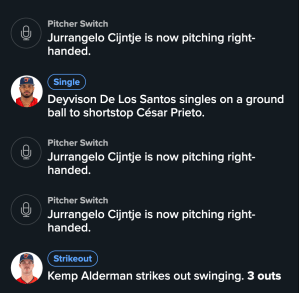
What happens when Cijntje focuses solely on being a right-handed pitcher? Will he develop new pitches? Will he carry more velocity? Development of a two-seamer and building upon it could be just the beginning of his progress.
3. Elmer Rodríguez, RHP, New York Yankees
2026 AA/AAA Stat line: 97.1 IP | 2.59 ERA | 24.4 K% | 11.3 BB%
2025 MiLB Stat line: 150 IP | 2.58 ERA | 29.0 K% | 9.4 BB%
The Yankees are almost guaranteed a playoff spot, holding on for dear life to a Wild Card spot until Aaron Judge returns to jolt the lineup awake. The rotation has seen a recent spate of poor performances and injuries, meaning that things are in need of stabilization. The same could be said for Elmer Rodríguez, who could benefit from a consistent role down the stretch. In 2025, he was the definition of solid contributor. Yet in 2026, the strike rate has dipped to below average while the strikeouts are drying up as the walk rate soars. In August, the numbers are finally moving back in the direction of where he was at the end of the last season at the top of the strikeout leaderboard in Minor League Baseball. This inning-eater, run-suppressing righty is exactly what New York needs to run out the playoff clock on Boston or other American League contender.
STASH WATCH 26
Elmer Rodríguez
AAA Scranton NYY8.18vCharlotte
5 IP 6H 1ER 0BB 5K
11whiffs/92pitches95SI
79CU 6whiffs
89CH
95FF usage down which is a good thing
80ST63strike% 33chase%
Looking sharp, ready to help for playoff run
*game replay starts in 3rd inning pic.twitter.com/SXnMrmYTKf
— YGM Fantasy Baseball (@YGMfantasy) August 19, 2026
The glue to Elmer’s arsenal is his dead-spinning two-seamer. That heavy ball is what helps him generate so many bowling balls through the infield (62% groundball rate). It has also become his best strike pitch, boosting the strike rate as it steals a lot of called strikes. Given that poor performance of his four-seamer, he has increased the usage of his sinker, which should be a boon to his game-to-game results. Another crucial pitch is his curveball, which has become his best putaway pitch to righties. He balances that out with a slower sweeper that is his best putaway pitch to lefties. Those two breakers help give him a presence on the glove side, while the changeup stretches hitters’ eyes to the lower third of his arm side. That offspeed pitch is a lefty killer, with both a high groundball rate and a high putaway rate. With all of these pitches touching each part of the zone at a variety of velocity bands, it should really be a matter of time before the success sustains for longer periods.
On Tuesday night, Rodriguez looked sharp across five innings as he induced double-digit groundballs and limited the opposition to one earned run. Rodriguez smartly reduced usage of the four-seamer and saw more whiffs and strikeouts with the 79 mph curveball. His success against the Knights continues a stretch where the runs are down, more balls are hit on the ground, and he is going deeper into the game. His velocity was also up as Rodriguez is trending back into the positive column for a Yankees team that could use a spark down the stretch.
Double-A Pitchers
A few players who have a small chance of making an impact at the Major League Level in 2026, with a higher value-add in 2027.
4. Ryan Sloan, RHP, Seattle Mariners
2026 AA Stat line: 81.2 IP | 3.75 ERA | 29.8 K% | 4.2 BB%
2025 MiLB Stat line: 82 IP | 3.73 ERA | 27.0 K% | 4.5 BB%
Ryan Sloan is being managed carefully with the organization’s sights on 2027 and beyond. Despite the shorter outings, Sloan has still managed to rack up a top-10 K%-BB% with a strong xFIP. He has maintained an elite level of command while throwing with more velocity. The accolades should be piling up, but the hitters seem cognizant enough to know that his pitches will be in the zone. Opponents have a high BABIP against him that has led to a total number of home runs that almost matches the total number of walks allowed. Sloan is living in the zone, with an arsenal that is generating strikeouts and hits.
PROSPECT WATCH 26
Ryan Sloan
AA Arkansas SEA8.15vTulsa
5.2 IP 5H 1ER 1HR 1BB 9K
11whiffs/72pitchesFF
SL whiffs & froze many hitters
CU
FS sparingly usedHi strike% = in the zone = hi BABIP
Hope to see HR/FB% decrease
More emotion than usual pic.twitter.com/5bCWnEtUD2
— YGM Fantasy Baseball (@YGMfantasy) August 19, 2026
Sloan gains above-average extension from his deep drop and drive delivery. Although the fastball has great velocity at 98 mph, it doesn’t have good vertical break, which is okay since he throws it from such a low release height. Fortunately, he supports the heater with a late-breaking sweeper that has great depth. The cutter comes in at a similar height, but obviously with more oomph. The sinker is a really good one that he uses to run up on righties at over 97 mph. Finally, the splitter is a pitch in development, something that can become a weapon, but is not really earning many whiffs or strikeouts at the moment. It is likely a sequencing issue that could see him keep hitters guessing.
Against the Tulsa Drillers last Saturday, Sloan deployed more effective use of the slider. That pitch resulted in # of whiffs and strikeouts. Unfortunately, he did leave one hanging slider in the middle of the plate that Joe Vetrano deposited way behind the center field fence. Allowing one home run per nine innings is a disappointing ratio for supposedly one of the best pitchers in the game. It’s likely not a singular fix, but rather something that will take more time for the 20-year-old, who only has 230 innings of work under his belt. Nevertheless, Sloan posted nine strikeouts on 15 whiffs across a very tidy 72 pitches. Ignoring the home run from this start, we would easily place this among his better starts of the season.
5. Liam Doyle, LHP, St. Louis Cardinals
2026 AA Stat line: 87 IP | 4.14 ERA | 30.7 K% | 13.1 BB%
2025 MiLB Stat line: 3.2 IP | 2.45 ERA | 40.0 K% | 13.3 BB%
Liam Doyle led all college pitchers in strikeout rate in 2025, posting a ridiculous 43% strikeout rate across 95.2 innings. As a top-five draft pick and one of the few members of the 2025 class to appear in a Minor League game, Doyle entered pro ball with expectations of moving quickly through the system. Instead, limitations in his arsenal and inconsistent stuff have slowed that timeline. The good news is that the organization challenged him with an aggressive Double-A assignment, where his control has fluctuated from month to month. More encouragingly, since the start of July, Doyle has begun to suppress runs and limit hits at a much better rate, hinting that the adjustment period may be starting to pay off.
Doyle’s fastball remains the foundation of the profile, sitting at 98 mph and reaching 99 mph on the radar gun. He complements that velocity with an 83 mph slider and an 87 mph splitter. The splitter is still a work in progress and currently looks more like a diving changeup, but it gives Doyle valuable east-west movement to counter a delivery that naturally carries his pitches toward his glove side. His aggressive motion begins with a deep arm hitch before he unleashes the ball from a release point well down the mound, creating both power and deception.
PROSPECT WATCH 26
Liam Doyle
AA Springfield STL8.19vArkansas
5 IP 1H 1ER 2BB 9K
16whiffs/83pitchesArm hitch to 3/4 power delivery
FF
SL
CHLast 4: 21 IP 33K 8BB 4ER 63strike% 17SwK% pic.twitter.com/WslSGCGQ2U
— YGM Fantasy Baseball (@YGMfantasy) August 20, 2026
Perhaps just as important as the stuff is Doyle’s competitive mentality. He attacks hitters rather than backing down, and that aggressive mindset should serve him well as he works through the developmental bumps that come with being a young pitcher in Double-A. The results haven’t yet matched the expectations attached to a top-five pick, but the recent improvement in run prevention and contact suppression is encouraging. Doyle may not be moving as quickly as initially anticipated, but if the control and secondary pitches continue to progress, the path to that promotion could begin to accelerate.
On Wednesday night, Doyle racked up nine strikeouts on 16 whiffs. The high heater continues to be a premium offering. He was also able to steal a few strikes by surprising hitters with a bottom-third fastball. Doyle now has a 33% strikeout rate and 13% walk rate across six second-half starts.
6. Joseph Dzierwa, LHP, Baltimore Orioles
2026 AA Stat line: 117 IP | 2.00 ERA | 29.7 K% | 6.2 BB%
2026 MLB Stat line: 7.1 IP | 6.14 ERA | 12.5 K% | 12.5 BB%
Left-handed pitchers are a dying breed. Now add a 6-foot-8 southpaw with the body control to repeat his mechanics over 80-plus pitches, and you have something truly intriguing in Joseph Dzierwa. The 2025 second-round pick has posted a 68% strike rate in his first professional season after never exceeding a 7.5% walk rate in three seasons at Michigan State. The control is already a legitimate carrying tool, but Dzierwa is pairing it with enough swing-and-miss ability to project as a starter. Before this week, he had already logged 112 innings across 20 starts and two additional appearances, putting to rest the idea that his height will prevent him from consistently repeating his delivery or competing at a high level.
PROSPECT WATCH 26
Joseph Dzierwa
AA Chesapeake BAL
6’8” LHP 22yo8.19vRichmond
5 IP 2H 1ER1HR 1BB 3K
10whiffs/77pitchesSmooth delivery w extra torso rotation
FF velo up to 95
CU
CHDespite the HR had 50GB%
Whiffs a bit down but Called strike rate is strong pic.twitter.com/60dNaIkZUe
— YGM Fantasy Baseball (@YGMfantasy) August 20, 2026
Dzierwa makes the most of his extraordinary length from the moment he sets on the rubber. His toes sit on the third-base side of the rubber while his torso is turned so that nearly his entire back faces home plate. That setup creates deception while also helping him generate additional power and cut. The slider and changeup both benefit from the added movement, while the fastball picks up some extra life. He also mixes in a cutter, giving him another look between his fastball and breaking stuff. With increased heat on the fastball and clearly differentiated secondary pitches, Dzierwa is building an arsenal that looks increasingly prepared for the next level.
On Wednesday night, Dzierwa continued to pile up positive results, allowing just one earned run over five innings. The strikeout total was modest—three strikeouts on 10 whiffs—and his swinging-strike rate has trended downward throughout the summer. Still, the bigger picture remains extremely encouraging. Dzierwa continues to limit hits, avoid free passes, and keep runs off the board. For a pitcher this tall and early in his professional career, the combination of strike-throwing ability, length, and developing swing-and-miss stuff is becoming increasingly difficult to ignore.
7. Jamie Arnold LHP, Athletics
2026 AAA/AA Stat line: 25.0 IP | 4.05 ERA | 28.0 K% | 4.8 BB%
2025 MiLB Stat line: 107 IP | 4.12 ERA | 19.8 K% | 4.2 BB%
The 2025 draft pick hasn’t received nearly as much attention as fellow 2025 selections Kade Anderson and Anthony Eyanson, but he may ultimately prove to be the more durable starter. The 6’1″ lefty has reached the sixth inning or later in 10 of his 22 appearances, putting him among the Double-A leaders in both innings and pitches per game. His full pendulum delivery harnesses the kinetic energy generated as he moves toward home plate, while the low arm-angle finish adds another layer of deception. The tradeoff is that the delivery also tends to push his pitches into a particularly dangerous part of the zone for right-handed hitters. That vulnerability has shown up in seven home runs, a .802 OPS, and an 11% walk rate against righties. They appear to be picking up the ball relatively well out of his hand, making pitch sequencing and location against right-handed hitters an important area for continued development.
PROSPECT WATCH 26
Jamie Arnold
AA Midland ATH
6’1” LHP 22yo8.11vAmarillo
6 IP 5H 3ER 2HR 0BB 7K
9whiffs/92pitchesPendulum sidearmer delivery
FF
SL
CH
FCHR concerns still present even with 52GB%
Needs attn: .828OPS 7HR vRHB
Last 4: 21 IP 27K 4BB 4HR 7ER 64strike% 12SwK% pic.twitter.com/gHmydaP6s3
— YGM Fantasy Baseball (@YGMfantasy) August 13, 2026
Arnold, however, has been putting together the kind of stretch that reminds everyone why there was so much excitement surrounding him in the first place. Over his last four starts, the former Florida State starter has compiled 31 strikeouts, four walks, three home runs allowed, a 68% strike rate, a 15% swinging-strike rate, and a 2.31 ERA. Those numbers are a significant improvement over his season-long performance and look much more like the profile fantasy managers and scouts expected to see. His latest outing was particularly encouraging: nine strikeouts on 19 whiffs with zero walks. Arnold appears to be harnessing more of his potential at exactly the right time. He also seems to have made meaningful progress with his changeup, incorporating a split-finger grip since the All-Star Break. Aside from a three-walk outing in his first game of the second half, he has consistently thrown more strikes while generating more whiffs.
If Arnold continues improving his pitch mix against right-handed hitters, he could be in for a strong finish. His Futures Game appearance showcased a four-pitch mix featuring a 95 mph four-seamer, 95 mph sinker, slider, and splitter/changeup. The standout metric was the sinker’s 20 inches of horizontal movement, giving it almost a fast-sweeper look. He primarily uses the pitch against lefties, but there may be value in incorporating it more frequently against righties as well. And while the home-run rate remains a glaring blemish, Arnold does own a 52% groundball rate, suggesting there is more to the run-prevention profile than the long balls indicate.
There is a legitimate pitcher taking shape here. If the recent command and secondary-pitch improvements hold, September could be Arnold’s best month yet.
8. Anthony Eyanson, RHP, Baltimore Orioles
2026 AA Stat line: 85.2 IP | 1.58 ERA | 36.4 K% | 9.6 BB%
2025 NCAA Stat line: 108 IP | 3.00 ERA | 33.9 K% | 8.0 BB%
Anthony Eyanson made a one-time appearance on the Week 8 Stash List back in mid-May after being promoted for his utter dominance of High-A. Since that time, his control has dipped. However, that was not the case on Thursday night, when Eyanson went the deepest into a start for his professional career. He was perfect for almost four innings, with all of the hits against him being singles. His game is still mostly north-south, highlighted by a big drop curveball that punctuated the majority of his 16 whiffs for eight strikeouts. One thing to track as he gets more familiar with the Baltimore pitching coaches is how he adjusts his approach to lefties. The walk rate is elevated there in comparison to facing righties, something that may come down to developing more east-west break in his attack strategy.
PROSPECT WATCH 26
Anthony Eyanson
AA Chesapeake BAL8.20vRichmond
7 IP 5H 1ER 0BB 8K
17whiffs/84pitchesHi slot power arm
FF
CU big drop
SL
CH
Downward tilt
mostly north-south breakvLHB: 14BB%
vRHB: 5BB%Perfect for almost 4 inn
Last 3 w BAL: 2-1 17.1 IP 24K 5BB 5ER 19SwK% pic.twitter.com/viiWk0SzhS
— YGM Fantasy Baseball (@YGMfantasy) August 21, 2026
Another question Eyanson must answer is whether his current fastball velocity and shape will hold up as he climbs the Minor League ladder. According to people with access to the data, his fastball sits between 92 and 94 mph with average vertical break. Because Eyanson throws from such a high release point, the pitch carries a steep approach angle, sending most of his fastballs toward the bottom of the zone. He can elevate the fastball above the zone, but he does so far less frequently. That makes his slider and changeup especially important, as both have emerged as his primary weapons for finishing hitters and stealing strikes. With those pitches frequently landing in the lower third of the zone, however, there have been a few outings where his strike rate has dipped to 55%. The encouraging part is that even during those bouts of inconsistency, Eyanson has never posted a swinging-strike rate below 15%. That suggests his stuff is still generating plenty of chase and swing-and-miss, even when his command isn’t allowing him to consistently finish pitches inside the strike zone.
In a new organization, Eyanson has leaped to become the number one prospect for Baltimore. One notable change is that they are letting him rip, now averaging 85 pitches per game with Chesapeake. This ramping up after a long season is a small indication that the team may view him as a legitimate contender for a rotation spot in 2027.
9. Christian Zazueta, RHP, Los Angeles Dodgers
2026 AA Stat line: 82.2 IP | 3.48 ERA | 36.7 K% | 5.2 BB%
2025 MiLB Stat line: 67.1 IP | 2.41 ERA | 29.7 K% | 5.9 BB%
Zazueta combines premium velocity, above-average strike-throwing, and legitimate swing-and-miss ability into one of the most overlooked pitching profiles in the Dodgers’ loaded farm system. His 2.91 ERA with Double-A Tulsa is now supporting underlying numbers as we expected. He is rolling into his weekend start with a 25% strikeout rate, 4% walk rate, 17% swinging-strike rate, and 69% strike rate. That combination points to a pitcher who not only has the stuff to overwhelm hitters, but also the command to consistently put that stuff in position to succeed.
PROSPECT WATCH 26
Christian Zazueta
AA Tulsa LAD8.7vCorpusChrisiti
6 IP 2H 0R 1BB 8K
14whiffs/69pitchesHas raised game to next level >30K%-BB% !
Max efficiency averaging 6+K in only 66 pitches per game.
Only ? is to sustain performance passed the 6th inning pic.twitter.com/2AKwsoWSP2
— YGM Fantasy Baseball (@YGMfantasy) August 9, 2026
Zazueta attacks hitters with a lively 96 mph four-seamer that regularly reaches 98 mph. He still has room to add a bit more extension, but his athletic, repeatable delivery creates excellent momentum toward the plate and helps the fastball play up. At times, the pitch generates so much arm-side movement that it nearly resembles a sinker. The changeup may be just as dangerous, featuring massive horizontal fade that consistently disrupts a hitter’s timing and makes the fastball even tougher to handle. The slider is currently more of an average offering, but it doesn’t need to be a dominant pitch when the fastball-changeup combination is this effective.
After a rough May, Zazueta has looked more like himself. Strikeouts are up, swinging strikes are up, and walks are down. The only oddity is the increased home run to fly ball rate. Double-A hitters aren’t necessarily making more contact than they were in the lower levels, but they are putting more balls over the fence. It will be interesting to see how he develops his arsenal to combat this bad outcome. We will also want to see him reach the sixth inning more regularly. He has been so efficient at times, but that hasn’t led to the organization allowing him to work past the fifth inning too often. Zazueta is quietly making a case for himself as one of the organization’s most underrated arms.
10. Garrett Baumann RHP, Atlanta Braves
2026 AAA/AA Stat line: 104.1 IP | 5.95 ERA | 22.2 K% | 9.9 BB%
2025 MiLB Stat line: 113.2 IP | 3.40 ERA | 22.5 K% | 6.4 BB%
Garrett Baumann is a massive presence on the mound, with his release point seemingly hovering right where the grass meets the mound dirt. Despite those long limbs, his delivery is surprisingly smooth and repeatable, helping him produce a 64% strike rate and 10% walk rate. The 6’8″ righty has bounced between Double-A and Triple-A multiple times this season, and whatever lessons he picked up during his latest stint in the upper levels appear to be paying immediate dividends. Back with Columbus, Baumann has been downright dominant, piling up 17 strikeouts and just three walks over 14 innings, including a complete-game victory. If that performance continues, another return to Gwinnett should be coming soon.
Baumann has plenty of weapons to work with, featuring a 95 mph four-seamer and sinker alongside a splitter, curveball, changeup, and cutter. Six pitches give him plenty of ways to attack hitters, although that depth could become a problem if the command remains inconsistent. For now, there is little reason to take anything away from an arsenal that is producing results. His unusually high release point makes the splitter particularly intriguing, while the curveball could become increasingly important as one of his primary weapons against left-handed hitters.
PROSPECT WATCH 26
Garrett Baumann
AA Columbus ATL8.20vMontgomery
7 IP 3H 1ER 2BB 7K
18whiffs/96pitchesSmooth tall & fall
3 fastballs
96SI is legit
FS nasty!
CU
SL
CH81GB% 66strike%
Last 3: 3-0 21 IP 24K 5BB 3ER 21SwK%
He’s on fire! pic.twitter.com/vxDIIPKoGy
— YGM Fantasy Baseball (@YGMfantasy) August 21, 2026
The pitch demanding the most attention is the four-seamer. In Triple-A, hitters were consistently getting underneath it and doing damage because of its below-average vertical break, allowing the pitch to stay relatively flat through the hitter’s bat path. That makes the splitter especially important: when hitters are gearing up for the fastball and selling out on an uppercut, the splitter gives Baumann a way to attack the bottom of the zone and disrupt that approach. Perhaps that was part of the reason for his demotion after allowing 11 home runs and a 1.000 OPS across seven Triple-A games.
Whatever the adjustment, Baumann has looked like a completely different pitcher since returning to Double-A. Through his first two starts, he has allowed zero home runs and a .497 OPS while piling up those 17 strikeouts and three walks. That’s a dramatic departure from the damage he absorbed in Triple-A and suggests Baumann may have uncovered something that can help him survive against more advanced hitters. If the adjustments stick, he may not be in Columbus for long.
More Double-A Starters to Follow
Eliazar Dishmey MIA, Gage Wood PHI, Tyler Bremner LAA, Zachary Root LAD, Daniel Eagen STL, David Hagaman ARI, and Patrick Copen LAD.
On The Bubble
Here are the next several pitchers that were in consideration for inclusion on this week’s list:
Lucas Braun ATL, Ryan Gallagher MIN, Nestor German BAL, Trey Gibson BAL, Tyson Hardin MIL, Brody Hopkins TBR, Karson Milbrandt MIA, Owen Murphy ATL, Luis Perales WSN, Jonathan Santucci NYM, Jonah Tong, and Jack Wenninger NYM.
Pitcher Stash List
| Stash List Key |
|---|
| Stash now! Upside + Proximity |
| Upside Stash |
| Proximity Stash |
Photo by David Buono/Icon Sportswire | Featured Image by Justin Redler (@reldernitsuj on Bsky/Twitter)
