





The run prevention in Arizona has not gone according to plan this season. After posting the 4th-worst ERA in baseball last year, the Diamondbacks signed Corbin Burnes to give their league-leading offense a much-needed counterpart. Two months into the season, Burnes and others are down with Tommy John Surgery, while promising arms like Zac Gallen and Brandon Pfaadt have regressed substantially.
The injuries have created an opportunity for Ryne Nelson in the rotation again, with this potentially being his last run in the desert as a starter. Nelson shifted to the bullpen primarily after starting 25 games in back-to-back seasons with underwhelming results, but the situation requires him to step up again.
Nelson posted a 5.31 ERA in 2023 and a 4.24 ERA in 2024, as he struggled to miss bats across both seasons. As a reliever this year, he’s shown a more intriguing strikeout rate and pitch mix that could work as a starter, despite the 4.60 ERA suggesting otherwise. There is still a lot of work to be done, but there’s an underlying skill to make this still work.
Encouraging Signs as a Reliever
Nelson always had a good fastball, but he’s worked on building out the secondary pitches across the better part of four big league seasons. He’s tried a variety of shapes and velocities on his breaking pitches, trying to find what breaks the ice.
His cutter is potentially the breakthrough pitch, working as a bridge that’s stronger than the slider it is supposed to bridge to.
This year, the cutter has an above-average cut (62nd percentile) while also still having some rise to it. Nelson previously struggled with doing one or the other, and this version of the cutter grades out as league average. The slider has transitioned from a sweeper-like pitch to a tighter shape at a higher velocity, but that hasn’t altered its results.
With the cutter, Nelson looks to jam lefties significantly off the inside of the zone and go similarly down and away to righties. At just a 40.3% zone rate against lefties, he’s garnered an exceptional 32.3% CSW%. Even when lefties put this pitch into play, it has a meager 12.5% ideal contact rate.
This has allowed him to stifle left-handed opponents, holding them to just a .169 average. The cutter previously was a sub-20% CSW% pitch and allowed substantially more hard contact, making this an enticing step forward.
The cutter plays well off the fastball, mainly due to Nelson’s reliance on the fastball. Nelson throws his fastball 57% as a reliever, often struggling to locate it vertically. He has shifted his approach to targeting inside to both lefties and righties alike, but the fastball is not elevated enough.
Coming in at 95 mph, Nelson gets 18.1 inches of an induced vertical break from a 51-degree arm angle. Although it’s an over-the-top release, Nelson’s fastball has the fifth-highest movement over expected among all starters’ fastballs, according to Alex Chamberlain’s Pitch Leaderboard. This means that the pitch is suited to succeed up in the zone, even if it is not doing so right now.
The cutter’s dramatic step forward has the potential to make everything work, but there’s a lot to be done otherwise.
Back to Square One… and Beyond
Nelson needs to take two steps forward: throw the fastball for strikes and revamp the slider.
Nelson’s zone rate has been below 50% in three of his four starts so far, and his fastball usage is above 60% in those starts. When he’s missing, it hasn’t been particularly close. Over 25 percent of his fastballs in those starts were in the chase or waste areas of the plate, earning just four swings on 51 thrown. Even though he’s now in the 100th percentile for pitches thrown inside to hitters, he can’t refine that location to see success. His fastball Location+ is under 100 for the first time in his career.
If Nelson wants to succeed, the fastball must be elevated more frequently and earn more strikes. This can also be achieved by throwing significantly fewer fastballs and leaning on the secondaries. His cutter has been so effective that it can be sacrificed slightly for increased usage.
However, the slider probably needs to return to its sweeper shape at increased usage. Since Nelson can handle lefties, a platoon-neutral slider shape isn’t necessary for him. But this harder pitch has been located pretty well against righties, but they don’t bite at it.
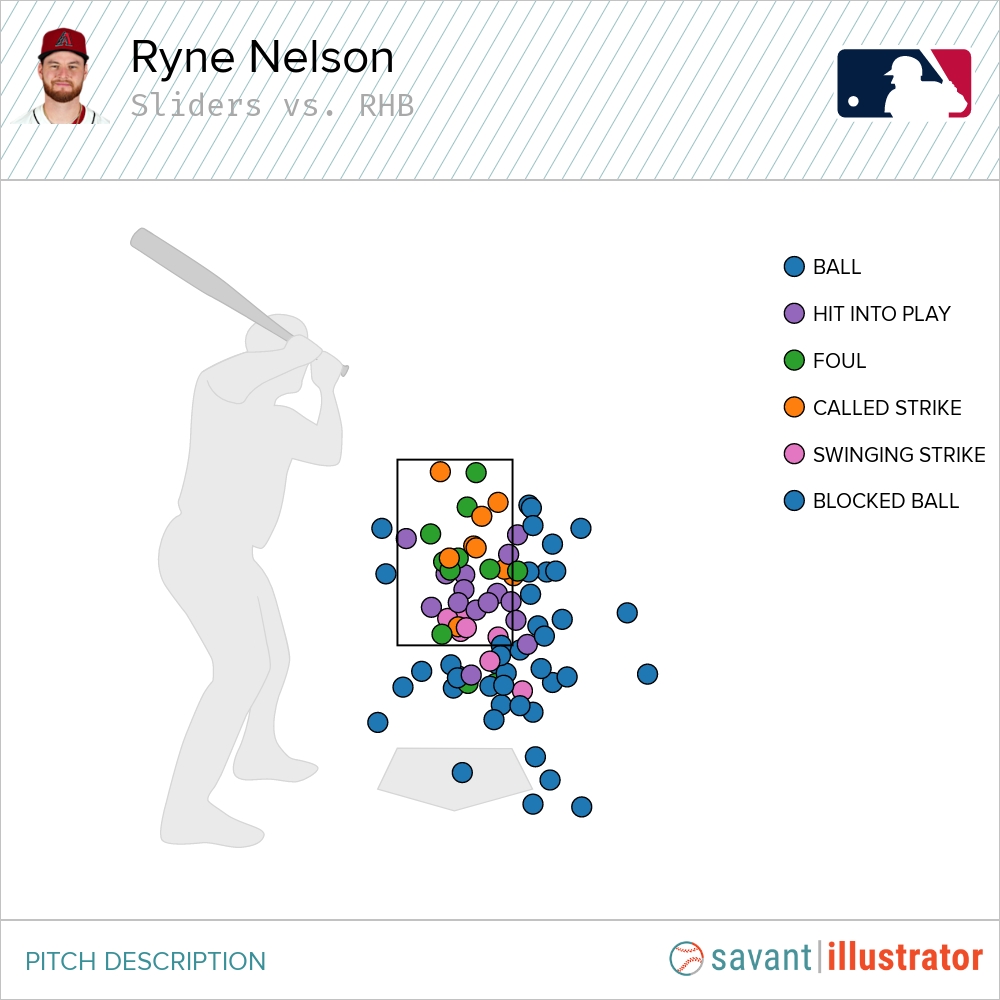
There are a lot of pitches down and away, but very few swings, let alone whiffs. The slider has a paltry 18.0% chase rate and a poor 20.0% whiff rate. His old slider, around 82 mph with 14 inches of sweep, had a much better 29.2% chase rate and 27.4% whiff rate. It’s only around average, but it would give him a much-needed effective other weapon.
Unlike the 2025 iteration, this version of the slider produced more convincing swings when it was located well.
Many pitchers would love to be in Nelson’s shoes: a great fastball foundation and the ability to handle opposite-handed hitters. It’s a great place to be, but continued tweaks are needed for him to become who we want him to be. The next few weeks are make-or-break for Nelson’s time as a starter; he’s got the runway in the rotation for a competing team, so he has to prove his worth.
