





With trade deadlines now looming within sight, it’s as important as ever to have your shopping list ready. Knowing ahead of time which players you want to target and then opening up discussions with their respective managers is almost always going to be a more productive use of time than having general trade talks with the managers you already speak to the most, and seeing what you can get from them. I much prefer to identify which player I want, analyze the roster of their current manager ahead of time, and then open up with an offer that, in theory, should help both sides.
This week’s column will focus on two first basemen who are worth targeting if you’ve been let down at that position by the likes of Christian Walker, Salvador Perez, Tristan Casas, or many others, either under-performing or languishing on the IL. We’ll then close with a veteran outfielder having a career resurgence that is more than worth signing up for.
2025 Stats: .271/.372/.495; 17 home runs; 58 RBI; 49 runs
2025 is an odd (in terms of even/odd, not ’strange’) year, so of course Matt Olson is producing at all-star levels, right? One of the more inexplicable statistical patterns in the sport continues to play out this year. The veteran first baseman for the Atlanta Braves has produced at elite levels in every odd year since 2019, with relatively disappointing seasons sprinkled in between.
There clearly aren’t any logical underlying reasons for this pattern, but a pattern is a pattern, and seven seasons is no small sample size at this point. Managers who drafted Olson in 2024 with expectations of him at least coming close to his ridiculous 2023 numbers were sorely disappointed. His 2024 numbers don’t even tell the full story for just how disappointing he was in points leagues, piling up strikeouts at an untenable rate all year long, and often posting negative points for a particular day.
In large part due to the fact that Olson has been able to drop that strikeout rate by two percentage points while raising his walk rate by three percentage points compared to last season, he is in the midst of another plus season in an odd year. His .270 average is right around where he has hit in each of those previous seasons, suggesting his average is not going to tail off any time soon. When Olson is struggling, he is more of a .240 hitter, and though that’s where his average lagged for much of this season prior to mid-June, there were always underlying signs that we were eventually going to see the ‘better’ version of Olson emerge this year. And emerge it has.
With respectable whiff and strikeout rates of 24.7% and 22.7% respectively, which place Olson just below the league average, there is a solid foundation for him to launch off his excellent power metrics. Those power metrics are truly elite, not just based on his Savant page but also based on his Process+ rolling chart.
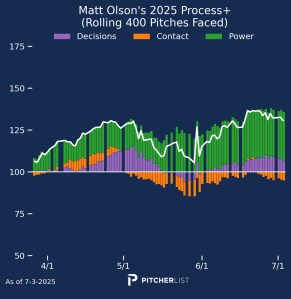
Not much actual analysis needs to be done of Olson’s chart here — that massive swath of green speaks for itself, putting him in the top-20 of the league for Pitcher List’s power metrics. His decision-making is routinely above the league average as well, allowing Olson to compensate plenty for his less-than-stellar contact metrics. Recently moved up to the No. 2 spot in a re-shifted order to try to spark a listless Atlanta team, Olson has seemed right at home in that position, providing protection for superstar Ronald Acuña Jr. Even if the bottom-half of the Atlanta lineup never comes around this season, and their pitching staff continues to flounder under mounting injuries, don’t let that scare you from going after Olson. Hitting behind Acuna Jr. is enough for Olson’s RBI production to continue to climb until it reaches over 100, and he’s well on his way to another 30 home run season. Add in a respectable .270 batting average and you have yourself a top-3 first baseman at the end of the year, albeit one who could still likely be acquired for a bit less than that cost based on his disappointing 2024. Now is a good time to try and capitalize on that value.
2025 Stats: .238/.336/.498; 20 home runs; 56 RBI; 51 runs; 1 stolen base
Written off as a bust and a huge question mark to even make the major-league roster heading into 2025 Spring Training, Spencer Torkelson has emerged at age 25 as the run-producing difference-making power bat that the Detroit Tigers hoped he would be when they selected him first overall in the 2020 MLB draft.
While Torkelson’s .238 batting average could use some improvement, he’s done more than enough damage in the power department to make up for it and has put himself squarely inside the top-50 players in most points leagues.
With a well-rounded approach that limits chasing pitches out of the strike zone at an elite level, Torkelson shows unique discipline for a hitter with his level of power. His Process+ rolling chart confirms this, as there are nearly equal amounts of decision-making and power metrics accounting for his success.
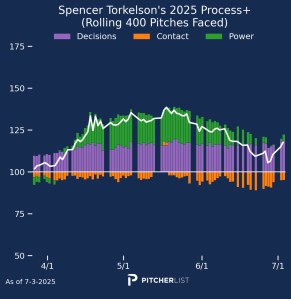
While his contact metrics have remained below league average throughout the season, Torkelson’s control of the zone allows him to still continue to give himself enough chances for success regardless. He has been especially hot of late, smashing three home runs with six RBI in only five games since the beginning of July. Hitting behind another slugger who has made an appearance in this column, budding superstar Riley Greene, Torkelson is provided with plenty of opportunities to drive in runs for the American League-leading Tigers.
The batting average should not be expected to climb much higher for Torkelson for the remainder of the year, but that shouldn’t be a deterrent from trading for him in points leagues, where that average is made up for most weeks by prodigious point-producing blasts. If you have the patience for starting a player who may be quiet for a few games in between large outbursts of power, then Torkelson is a more than worthy target.
2025 Stats: .285/.378/.520; 16 home runs; 53 RBI; 51 runs; 10 stolen bases
Normally, it would feel strange including a player who was recently available on the waiver wire in over 40% of leagues as a trade target that you want to prioritize and give up assets for, but George Springer is not having what anyone would call a normal season. Thanks in large part to a scorching hot month that has him as the second-ranked player in the last 30 days in most points leagues, and the number one player in the last 14-day and seven-day spans, Springer has put himself back on the map at age 35 as a fantasy superstar. The Toronto Blue Jays are surging, now several games ahead of the New York Yankees in the AL East after entering Week 14 several games behind them, and Springer is a huge reason why.
Moving around between the second and fifth spots in the Toronto batting order, Springer is in a prime run-producing position every night. Manager John Schnieder likes to move his big bats around a bit based on matchups, but Springer is always hitting somewhere, either in front of or behind perennial talents Vladimir Guerrero Jr. and Bo Bichette. This has put Springer on pace for close to 100 RBI and 100 runs scored, numbers that he could conceivably reach given the rate at which his production has ramped up as the season has progressed. While his whiff rate of 27% puts him down in the 32nd percentile for that metric, there are no other holes in Springer’s underlying numbers that suggest his success is unsustainable.
Showing elite plate discipline with a 12.7% walk rate and only 19.6% chase rate, Springer is controlling the zone and waiting for the pitch that he wants to pounce on. And when he pounces, he does serious damage. His barrel rate is nearly twice what it was last season (16.2% vs. 9.4%), and there has been a very similar improvement in his launch angle, leading to more extra-base hits. Springer’s Process+ rolling chart confirms the fact that he’s found a much more well-rounded approach this season than he has shown in quite a few years.
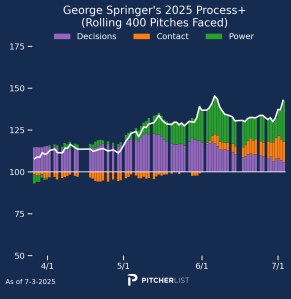
Springer’s power metrics account for the majority of his success, which is what you want to see when trying to find a potential league winner. Equally important, though, is that neither his decision-making nor contact metrics lag too far behind, with each contributing plenty to his most recent scorching hot month. The decision-making has been good since the start of the year, but it’s his contact ability that’s taken a step up in the past month, a surge that Springer has been able to maintain since the beginning of June.
The fact that many of his home runs have been going to dead-center is a very encouraging sign, too. Springer isn’t just lifting cheap shots to the pull side like he may have focused on doing back in his Houston Astros days with the infamous Crawford Boxes to aim for in left field. Instead, he’s been hitting majestic blasts to center field that are headed straight for the batter’s eye. This is as good an indication as any that Springer’s swing is in a great place at the moment, and that he feels healthy enough to be packing that kind of punch. Springer also still has slightly-above-average sprint speed at his age, and he has leveraged that speed to the tune of ten stolen bases — another good sign that he is as healthy as he could be.
With the Blue Jays rolling, Springer has fed off the packed houses at Rogers Centre. This includes a career day on Canada Day recently, piling up seven RBI and two home runs in front of a raucous, sold-out crowd. It’s hard to imagine a better way to ingrain yourself as a fan favorite for a team that in many ways represents an entire country. It’s also hard to imagine Springer’s momentum stopping any time soon. See if you can package some future draft picks, younger players, and a spare arm for an all-tool outfielder who could end up (surprisingly) being one of the more impactful points league players down the stretch.
