





The latest Tigers pitching development success story, Troy Melton, has exploded onto the scene this season. It’s been just three short years since he was picked in the fourth round as a raw college prospect, lauded more for his athleticism and potential than his polish and track record. What was once a three-pitch arsenal maxing at 97 mph with the heater has spread out into a wide array of pitches he can use in a variety of ways. Maybe it’s too soon to pat Detroit on the back for the work they’ve done with him, but it’s truly impressive the pitcher they’ve managed to build, and are continuing to develop. Let’s break down what he offers, then get into how he uses it to his advantage better than most rookies.
A Balanced Pitch Mix
Let me preface the breakdown by saying that Melton’s a bit of a unique case in multiple ways. I don’t see many arms built quite the way he is. I think he’s a supinator based on his fastballs, but the way he throws his secondaries gives me pause. I’ll explain that more in a bit. For being a 6-pitch guy, his arsenal is kind of tight on the pitch movement map. He’s not a super-supinator like a Ryan Johnson-type, but aside from the curveball, none of his pitches exactly stand out for their total movement numbers. Despite that, he doesn’t have a single pitch I’d mark as below average from a stuff standpoint. It’s a remarkable feat of pitch design that they’ve been able to maximize his arsenal in this way.
Remember in the first paragraph when I told you his max velocity in college was 97 mph? That’s what he averages with the 4-seam now. Jumps like that tend to help pitchers break out as prospects. What this pitch lacks in elite movement, it makes up for with a relatively flat approach angle and high velocity. This helps it to rack up whiffs at will.
His slider is a bit of an odd pick for his arsenal. I wouldn’t have expected a pitcher with his fastball tendencies to have a non-sweeper slider that comes in 11.4 mph slower than the 4-seam. It has great depth and some horizontal movement, and the velocity separation is probably a good thing, as we’ll get into more later. It’s just interesting that this is his slider of choice. Maybe it’s something he’s always had and is particularly comfortable with.
As is often the case with these supinators that can create a solid 4-seam fastball shape, Melton’s sinker is fine, but it doesn’t have standout movement. He does his best, creating an hour’s worth of seam-shifted wake, but it doesn’t drop as much as most sinkers from his release point, and it doesn’t stand out for movement direction compared to his arm slot either. Despite the shortcomings, he does throw it pretty hard, and it looks identical to his 4-seamer out of the hand, which could help it play up a bit.
Melton’s cutter is somewhere between a true cutter and a gyro slider, offering decent depth and glove-side movement with exceptional power. It’s the kind of pitch that shows potential but tends to leave me wondering if it might be a bit better if he could take a tick or two off of it and kill a little more of its vertical movement to get more depth and whiffs.
His offspeed of choice is a splitter that borders on forkball movement. Combining low spin rate, some gyro spin, and a lot of seam-shifted wake, this pitch falls off the table in a way that’s very difficult for hitters to track, especially when it’s out of the zone.
Melton’s curve is sort of funny to me, because it’s the kind of curve I would normally expect from a pronator. It comes in almost 20 mph slower than his 4-seam, with a near-perfect spin mirror, and maximizes total movement. He raises his arm an absurd amount to throw it, though, so I wonder if that spin deception is really doing anything when there’s a decent chance hitters are picking it up by his slot. His slider and curveball are what make me question whether or not I’ve correctly labelled him a supinator, because he should theoretically have access to more traditionally nasty breaking balls, but these fit in his arsenal well enough that it could be a stylistic choice. Or perhaps these are just what he’s most comfortable with.
Mix and Match
I find myself again wanting to preface what I’m going to say. Melton is his own pitcher; he’s not really trying to be anyone else. Some of the things he does on the mound stand out to me as similar to other pitchers, and that’s a good thing! Taking heed of what’s working for other guys is a great way to approach pitching and trying new things out there.
Melton does an interesting thing against right-handed hitters. He almost exclusively uses his fastballs and slider against them, but it’s the way he’s built his mix that interests me. With a whiff-seeking 4-seamer and much slower slider, it’s like he’s trying to do what Eury and Strider did in 2023 but without the elite fastball movement. He’s relying on angles and command more than pure dominant stuff for his 4-seam, but it’s working so far.
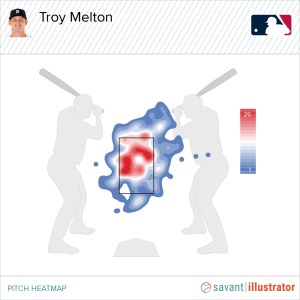
I’m going to be honest, I can’t fully explain the absurd whiff rate on this pitch given the pitch map. He doesn’t consistently elevate it above the zone; rather, it’s more that he pounds the top half of the zone. As much as I think his fastball is better than its movement, I wouldn’t expect this combination of stuff and locations to add up to a whiff rate just shy of Misiorowski’s 4-seam (31.9% vs 32.8%). I do think there’s an intangible thing going on with Melton’s 4-seam, as well as his other pitches. He hides the ball behind his head until the last second in his delivery, creating a difficult look for hitters.
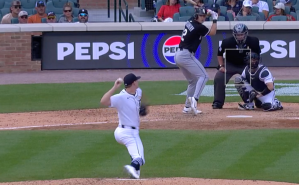
Back to the main point, fastballs and sliders against righties. He has exceptional slider command. I am convinced that is why he throws this slider specifically. Even if he’s capable of something with better stuff grades, he’s so good at spotting this pitch that he shouldn’t bother tinkering with it.
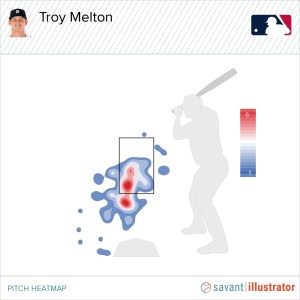
He drills the bottom half and areas below the zone with this pitch to an impressive degree. While it occasionally pops out early and leaks up into the middle of the zone, that’s an acceptable sacrifice when he’s hitting the best possible spot for this pitch as often as he is. The combination of his ability to locate it, along with how it fits into his arsenal, is what gives this pitch its effectiveness. It hasn’t gotten elite whiff rates yet, but even when hitters are making contact with it, they aren’t doing anything with it. It’s allowed just a .252 xwOBAcon against thus far.
His sinker locations need some work. While they tunnel well with his other pitches, they aren’t actually in good spots, and they’re getting crushed as a result. He has a bad habit of landing them in the lower arm-side quadrant, which is the least likely spot to get called strikes, while also not being far enough inside to consistently jam hitters. You can’t have a 46.2% ICR on a pitch that’s meant to be inducing harmless ground balls. He also hasn’t shown the most aptitude for running it in on hitters without missing the zone by too much for it to be enticing.
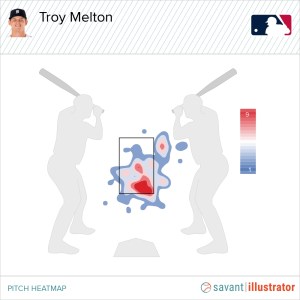
This is something he should work on or tone back. Honestly, his 4-seam and slider are probably enough to carry the bulk of the weight against righties anyway.
Against lefties, Melton opts for a kitchen sink approach. The sinker takes a backseat, as it should, but everything else is fair game. He tends to elevate the 4-seam a bit more against them, though oddly, it hasn’t worked quite as well. You’d think throwing a 4-seamer in the zone two-thirds of the time without consistently getting it above the belt would cause issues, but he’s had more success against righties than lefties with this pitch. Maybe there’s something to be taken from that.
He employs a different slider strategy against lefties, I think. While we do see some sliders buried down and in on them, we see below that far more are catching the back door arm-side, presumably hunting called strikes. Even though I don’t like this strategy as much as the one he has for righties, lefties are doing even less against the slider than they are.
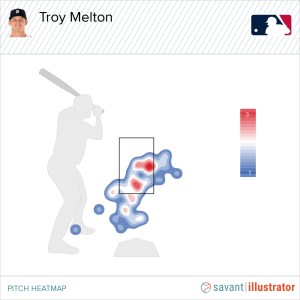
His cutter picks up the slack his slider leaves behind in these situations in terms of usage. His command of the cutter leaves something to be desired. While he is capable of zoning it regularly, it misses in hittable locations too often. Even a cutter with stuff like Melton’s will get hit in bad spots, like he has.
His splitter map isn’t comprised of an extensive sample; what we do have suggests spotty command. He is sometimes capable of dropping it directly below the zone in perfect spots, and other times it goes all over the place, never interesting a hitter. There’s a lot of potential to be had with this pitch if he can clean up his locations with it.
As you’d expect from a slow curve with a lot of movement, his goal is to zone it as much as possible to get called strikes and weak contact. The sample isn’t large enough to judge accurately, but hitting the zone with 50% of his 22 curves thrown so far is a very high rate.
What We’ve Seen and What We Hope For
It’s interesting to me how much his strategy differs between righties and lefties, especially considering the main thing that’s working for him against righties, high 4-seamers and low sliders, is typically something used against lefties, or both handedness of hitters if it’s good enough to do so. It almost feels like he’s experimenting with platoon matchups. He may not trust his 4-seam and slider enough to get the job done on their own, so he’s dabbling with his expanded arsenal to see what works and what he can use against them. I’m not against him doing that, even if it results in some growing pains as he figures out the best plan of attack. It’s far from unheard of for a righty with a lot of pitch types to choose from to use a bit of all of them to keep lefties off balance.
What I really hope to see from Melton is him figuring out which pitch is going to be his knockout blow against left-handed hitters. He isn’t striking them out or putting them away as consistently as he does righties. I imagine this winds up being the slider or the splitter, whichever one he finds the ability to locate better against lefties first.
A lot of Melton’s development is more related to sharpening up and finishing touches rather than big sweeping changes to what he’s doing. As much as the current 4-seam strategy is working, it would probably help to elevate a bit more consistently, even if that hasn’t been the case for him so far. After that, it’s mostly just about throwing better strikes and chase pitches, which is the case for almost every rookie pitcher.
I mentioned earlier that his breaking balls confused me. I do think he’s capable of throwing something with more movement or power, but I’m not sure he needs to. While I wouldn’t mind him finding a slightly better curveball, his arsenal is good enough as it is. He just needs to work to find what’s comfortable and develop that further. He’s done everything asked of him so far, from starts, long relief, short relief, high and low leverage, and all without diminished stuff in the longer outings. There’s still plenty of road left for Melton to travel before he reaches his ceiling as a borderline ace, but the way he rose so quickly makes me think he gets there sooner than we expect.
Feature image by Michael Packard (@CollectingPack on Twitter) | Photos by Joe Robbins/Icon Sportswire
