





Troy Melton’s 2026 has been a lifeline for the Detroit Tigers. After starting the season on the injured list due to right elbow inflammation, Melton debuted this year on May 24th. The Tigers were 21-33 at the time, second-worst in the American League. A team with supposed pitching depth was depleting quickly: Tarik Skubal was already sidelined, and Casey Mize would go on the injured list just a few days after Melton’s debut.
Since Melton’s debut, the Tigers have gone 26-20, the third-best record in the American League in that time. In a year where the American League is incredibly weak, remaining close to the pack can be just enough. Melton has been a massive part of their success: in 49.1 innings, he has a 1.80 ERA, 0.87 WHIP, 23% K%, and 7% BB%.
Despite throwing 45 innings last year, Melton is still considered a rookie. He was great in his first appearance in the majors, and he’s continuing to show why he’s a promising part of the Tigers’ current and future plans. There has been some luck in his early 2026 numbers, but there’s clearly a successful big league pitcher in here, even after any regression comes in.
What Is Driving The Success?
Melton has a wide arsenal, giving him a variety of weapons for both left-handed and right-handed hitters. His K-BB% against RHB is an exceptional 27%, compared to 9% against LHB. Against LHB, he’s succeeding more on contact suppression.
He throws six pitches: a four-seam fastball, a sinker, a cutter, a slider, a curveball, and a splitter. All of these pitches range from 96 to 108 Stuff+ — nothing great but nothing awful. While most pitchers rely on a standout pitch as their bread-and-butter, Melton has a kitchen sink full of offerings that can go to either type of hitter.
Against righties, it’s a three-fastball approach with a slider to supplement.
The four-seam is a relatively average pitch shape with good velocity: it has 14 inches of iVB and 6 inches of run at 96.7 mph. Melton gets 6.8 feet of extension, allowing the fastball to create a decent height-adjusted vertical approach angle. It hasn’t performed as well as last year, giving up significantly more contact. This is largely driven by a shift in location, with everything getting more central.
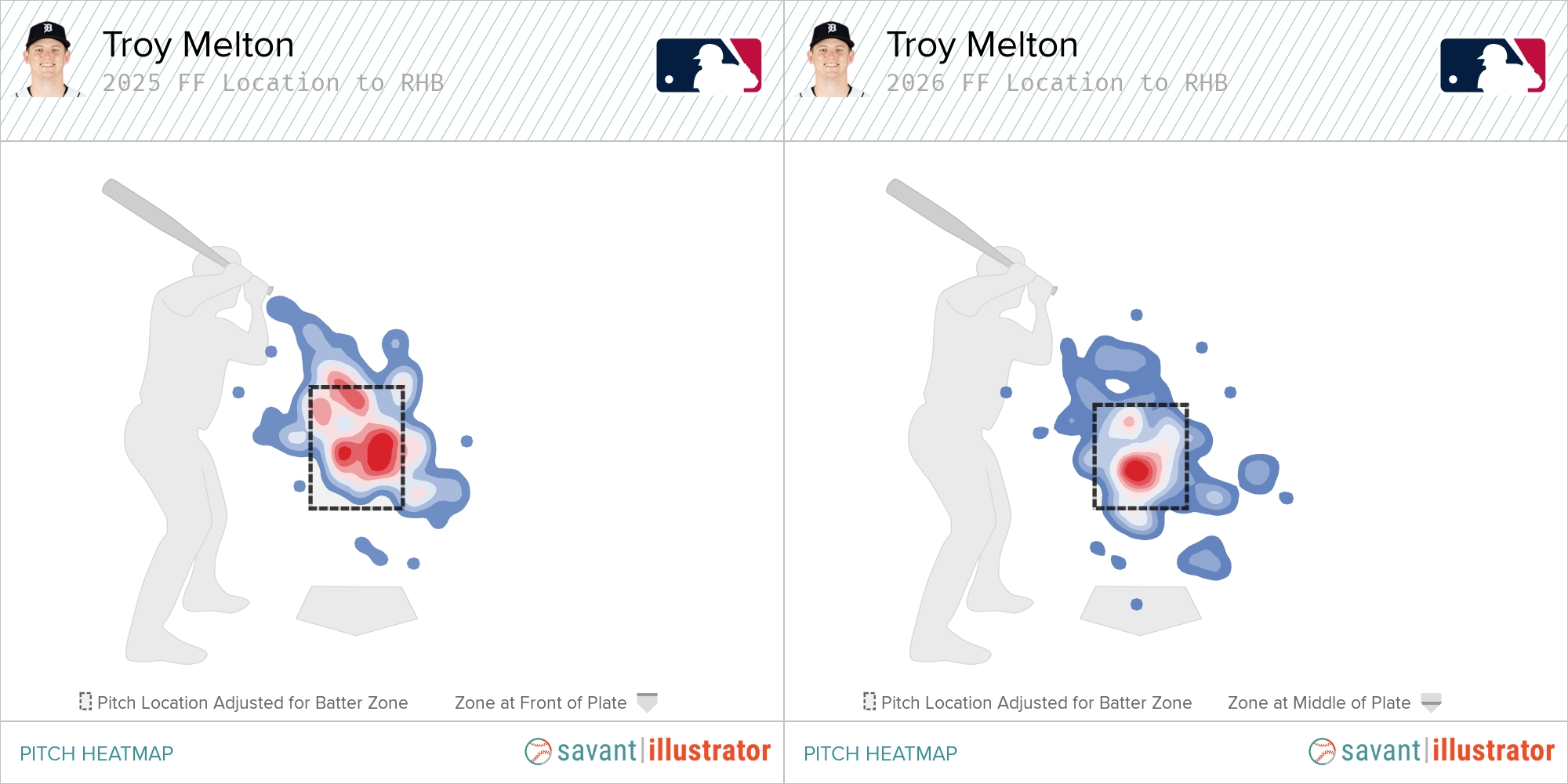
Last year, Melton had the fastball working away to right-handed hitters for called strikes and up-and-in for whiffs. This year, that called strike location has drifted to the middle of the zone and there’s a less pronounced whiff area. Its 15% middle-middle location is nearly double the MLB average, and the whiff rate has dropped 14% (though still above league average).
With a worse location comes worse contact quality: the incredible 29% ICR is now 48%, and the average has increased from .107 to .250. However, this additional damage isn’t hurting him a ton, with most of the hits being singles. A .282 wOBA on the fastball is an 83rd percentile figure.
Critically, the pitch is setting up the cutter to dominate. Melton only threw the cutter to righties 3% of the time last year, and now he’s relying on it 23% of the time. The pitch is two ticks harder than last year at 92.7 mph, and it’s added about a half-inch of extra break as well. It now sits with average break for a slider with premium velocity.
The cutter has a 36% CSW% built on equal parts whiffs and called strikes, playing exceptionally well in the zone. When hitters are making contact with it, they’re doing absolutely nothing. It has an .053 AVG and .083 BABIP — figures that are unsustainably outrageous for the sample.
On pitches inside, hitters are getting tied up and popping up everything, whereas there are weak groundballs the other way on cutters away. This will regress over time, but it emphasizes how strong of a pitch it can be. The cutter bridges to both the sinker and the slider. On the inner half, the cutter plays off the sinker (though it gets more chases).
On the outer half, the cutter and slider work hand in hand.
Both the four-seam and cutter are thrown in the zone a ton, but that leaves the sinker to be a fastball for chases. At just 42% zone rate, Melton’s sinker is in the fourth percentile for sinkers, but it makes up for it with a 42% chase rate. Melton is able to throw this inside to righties, tying them up well.
With so few pitches in the zone, it’s hard for hitters to do much with them. A .250 average is good for a sinker, and it is built off a 91% groundball rate. All hitters are doing is putting it into the ground, which is all you can ask for on a sinker.
When he isn’t throwing the hard stuff, the slider does all the work. It has a 33% CSW%, and he’s able to get whiffs everywhere. It has a decently big shape (seven inches of break, 87th percentile) that works best under the zone.
When hit, it has a 41.7% ICR, which is slightly above the league average. He does a good job of keeping the pitch down, and that prevents damage from occurring on hanging sliders.
It’s a healthy dose of well-located fastballs and a slider that puts hitters away when needed. As the fastball velocity has ticked up over the last few starts, he’s really started to shine under the hood against righties.
Against lefties, it’s more of a wide arsenal approach after the four-seam.
Melton is tied to the four-seam, and the pitch is having one of the weirder splits to it that I’ve seen. His fastball only has a 23% CSW% against lefties, worse than that against righties. Hitters aren’t doing any bit of consistent damage: a 26% ICR is a fantastic figure for an opposite-handed fastball. But when they do hit it, it turns into trouble. Melton has given up five hits on his fastball to lefties: four homers and one double. The result is a comical .029 BABIP, unsustainable in every direction.
When the fastball gets Melton deeper into the count, it allows him to primarily turn to the cutter and slider.
The cutter lives on the inner third of the plate, consistently getting earned weak contact. It plays well off the fastball that goes up-and-away, tying up hitters into weak fly balls.
The slider, on the other hand, is used primarily as a backdoor pitch.
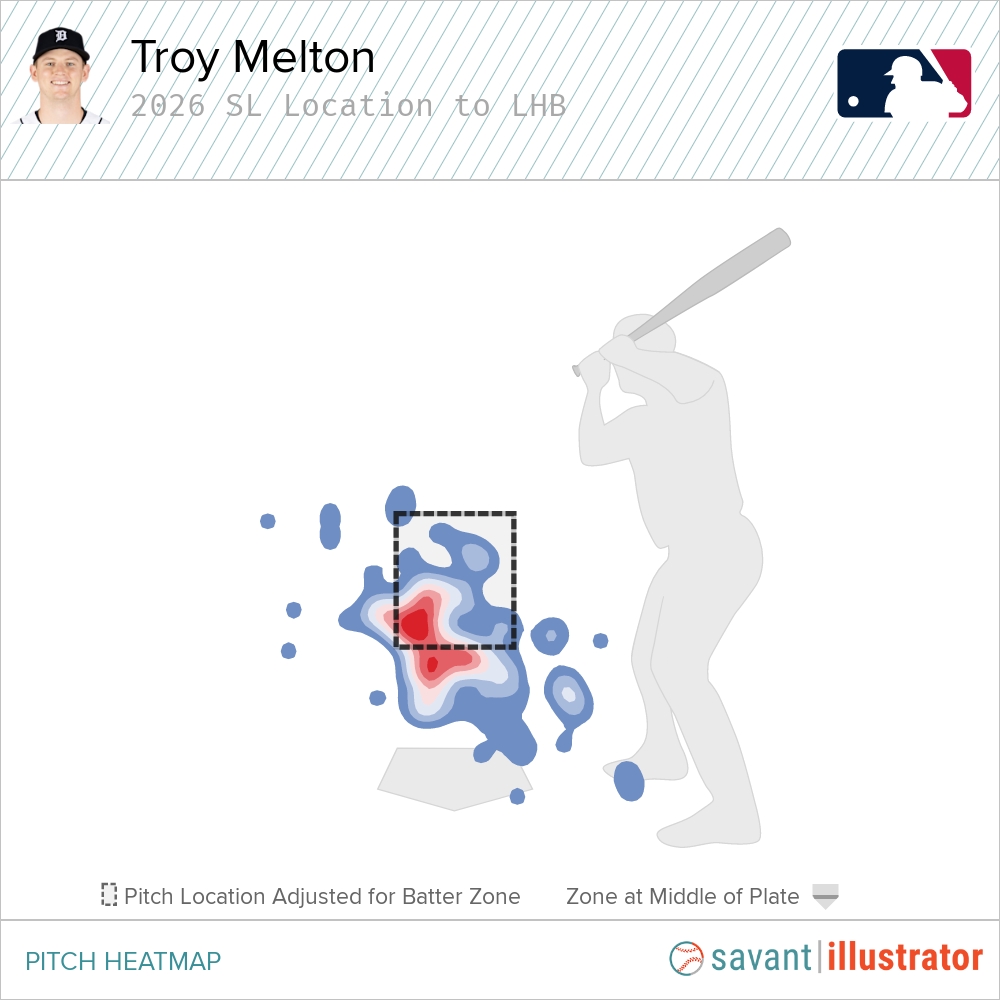
Despite the seemingly excellent location, it only has a 9% called strike rate. It makes up for it with whiffs, getting chases on half of all swings at a 30% whiff rate. Most of the whiffs, however, come from beneath the zone and down-and-in to lefties.
This leaves the two other pitches he has for lefties only: the curveball and the splitter.
The curveball is a slow curveball with a big movement profile, getting a ton of called strikes and a decent amount of whiffs too. Melton mostly deploys it early in the count, but occasionally will turn to it to get a timely strikeout.
He’s locating the pitch in much more competitive locations this year compared to 2025 — 15% of his curveballs were middle-middle last year, and just 3% are this year. It’s resulting in hitters having less aggressive approaches on it, and less early count base hits. The average on the pitch is down from .500 to .143.
Lastly, the splitter is a required offspeed for opposite-handed hitters. It’s an uninspiring shape with uninspiring results, but he’s using it enough early in the count to dampen the harm on the fastball. The splitter only has a 25% zone rate and a 23% chase rate, a subpar combo on any pitch.
How Sustainable Is It?
Melton is doing a lot of things well, but the 1.80 ERA and 0.87 WHIP are destined to creep up over the rest of the season. Regardless, we’re seeing him look better and better even as time goes on.
His fastball velocity has ticked up over the last few starts, as he settles in closer to where his velocity was last year.
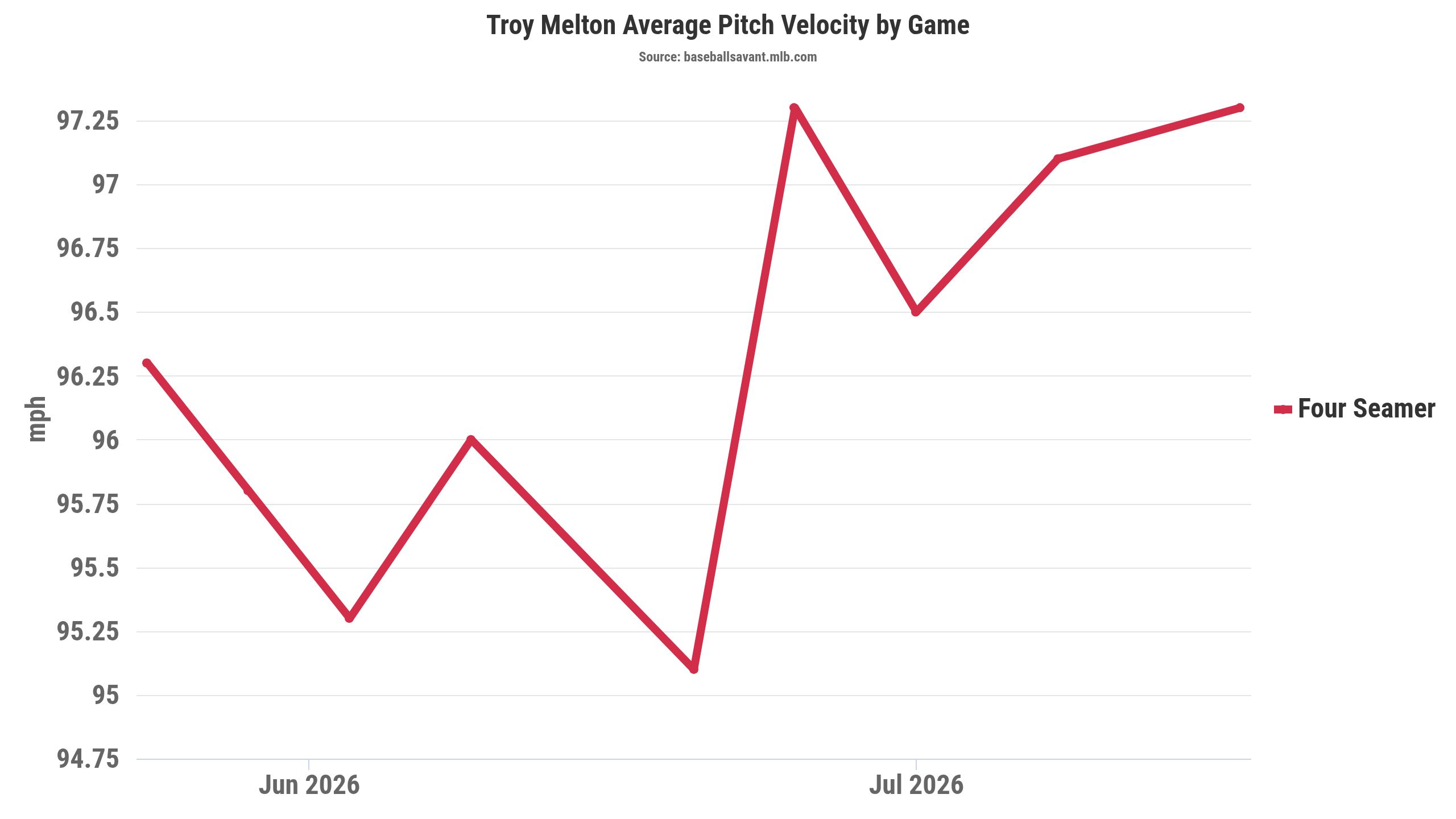
The rest of the arsenal has come along behind the fastball as well. He averaged seven whiffs per game over his first four starts, putting up a 2.81 ERA and 5.36 FIP. Over his last five starts, he’s averaging 14 whiffs per game with a 0.92 ERA and 2.55 FIP.
All of his pitches are doing exceedingly well in contact suppression, which give him the large ERA performances over his FIP. Specifically, the fastball and cutter are executing at a very high level right now, but I don’t believe that will continue at this level. The fastball location is going to create issues over time as is.
Melton has a wide arsenal and is able to use all of his pitches effectively at the moment. He’s going to continue to be a very strong starting pitcher and continues to show that there’s more in the tank. While a sub-2.00 ERA isn’t the future for Melton, he’s carved out a defined role in the Tigers rotation.
