





Baseball, in many ways, is cyclical. So are many of its characters.
The Philadelphia Phillies are officially in the downswing of the Dave Dombrowski era. Philadelphia pushed the chips in to chase a World Series, and in 2022, they were two wins away from the cost not mattering it all. Fate was not kind to the Phillies, who have since fallen short in three playoff series. With few levers to pull, little youth to speak of, and a slow start shrinking their odds of playing host in October, we’ve probably already seen the best team of Bryce Harper’s tenure.
The last vestiges of hope are right-tailed aging curves and young players outperforming expectations. Harper and Kyle Schwarber are doing their part; Zack Wheeler, fortunately, looks like himself. However, Philadelphia’s youth movement has yet to reap real rewards. Center fielder Justin Crawford has scuffled through the first two months of the year as a load-bearing piece of baseball’s 27th-best outfield. On both sides of the ball, his development is crucial, but he’s been a replacement-level player in the exact shape that his skeptics expected.
Barring a deadline deal, center field will be Crawford’s job for the foreseeable future. It’s in the Phillies’ best interest to give him the runway he needs to adjust to Major League Baseball and, perhaps, himself.
Trust the Process (+)
The book is out on Crawford. It’s always been out on Crawford because he’s been the same player since setting foot in pro ball. The bat-to-ball skills are great, the speed is exceptional, and the results are routinely less than the sum of their parts, largely due to his propensity to hit everything into the ground.
His Process+ illustrates this well, outlining the shape of his rookie season.
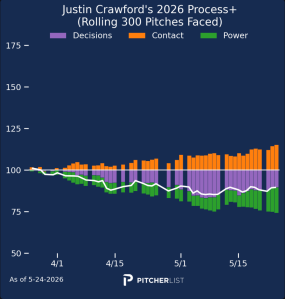
Crawford’s contact buoys his profile. Entering Wednesday’s action, his contact rates (overall, in the zone, and out of the zone) each hovered around the 80th percentile. He doesn’t swing and miss much, and when he gets to two strikes, his ability to flick balls foul makes him a nuisance. His 119 Contact+ ranks 26th among 178 batters with at least 600 pitches faced. In an ideal world, Crawford’s bat-to-ball skills would elevate his floor and insulate his production. Slashing .229/.297/.338 with a 79 wRC+ suggests otherwise.
Crawford doesn’t strike out (65th-percentile K%) and has just two home runs. Rather, he surrenders himself to the BABIP gods, without the penance to create his own luck.
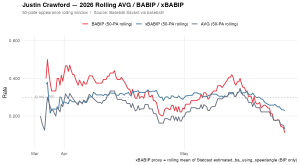
It’s no surprise that his struggles have coincided with lesser batted-ball luck. But Crawford doesn’t hit the ball very hard, rarely hits line drives, and has two barrels to his name. With an identical BABIP and xBABIP (.247), his luck isn’t to blame.
Rather, Crawford has seemingly fallen into a similar trap to Jacob Wilson and Ernie Clement. They can hit seemingly any pitch, so they try to.
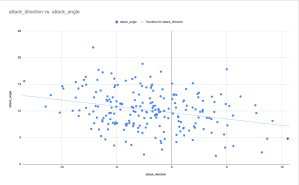
Perhaps it’s too early to tell whether Crawford’s swing decisions are an intentional approach or a lack of pitch recognition. His swing makes me think it’s the former, that he is building his game around quality contact rates and the idea that his speed can compensate for holes in his profile. He has an outlier swing, even among slap hitters, happy to go the other way. Only 16 hitters have a lower attack angle than Philadelphia’s rookie. Nobody’s attack direction is more skewed toward the opposite field.
Similarly, Crawford’s bat speed (11th percentile) isn’t creating exit velocities likely to beat defenders to their spot. The raw power is pitiful and unchanging, and it’s a driving (limiting) force in his approach. But the Phillies aren’t asking him to protect Harper in the lineup. The best-case scenario would see Crawford batting ahead of him; in the short term, Philadelphia would take any semblance of league-average production at the bottom of its lineup.
The home runs aren’t coming. That’s a given, but it shouldn’t obfuscate Crawford’s quest for more power. Instead of selling out for pull-side power, Crawford must hit more line drives, where his speed can amplify his bat-to-ball skills. Our pitch-level metrics have Crawford posting a meager 85 Power+. His Gap Power+, though, is a more tenable 98. Getting the ball in the air just a little more can pay significant dividends, mitigating the negative effect power has on his production.
Patience Is a Virtue
Undeniably, a swing change would help mitigate some of these launch angle issues. Trying to hit everything into the ground, unsurprisingly, results in lots of ground balls.
Still, Crawford’s swing is only half the battle. His plate discipline may be more important, albeit limited by the extent of his intangibles.
Crawford’s 77 Decision Value+ is not conducive to success, regardless of how well he avoids swings and misses. With below-average decisions inside and outside the zone, Crawford’s SEAGER is hurt by a tendency to chase and more called strikes than his swing rate would suggest. His strikezone judgement is significantly below average against every pitch type, while his swing aggression is incredibly high against soft stuff and average against fastballs.
Paired with his impressive contact rates against breaking balls and offspeed pitches, Crawford’s approach seems over-reliant on seeing spin and reacting quickly enough to make contact at any cost. He has a hole in his swing against high heaters, and his hesitance to hit the heater may contribute to late timing that pushes everything to the opposite field.
Crawford might not fire quickly enough against fastballs, but swinging at every breaking ball thrown his way is further muting his potency.
We can safely assume that everybody hits the ball harder in the zone. But Crawford isn’t getting enough out of his batted balls to chase more than 81% of hitters, especially with room to add walks into his repertoire. Even if Crawford keeps trying to go the other way, getting a handle on runaway chase rates should help everything play up. He’s more likely to lift the ball (albeit limited by the Crawfordness of it all) on pitches in the zone than shoe-level sliders. A greater share of swings on competitive pitches should improve his production, trading his softest ground balls into walks and, hopefully, hits.
Crawford’s batted-ball quality is among the best in the sport (119 BBE Quality+), but it seems inflated by the share of his swings coming on pitches that others wouldn’t offer at. He’s already getting more out of softly-hit balls because of his speed. Why fight a losing battle at the same time?
One potential pitfall waiting for Crawford is the caution of other pitchers. The average pitch he has faced has carried a 4.83 PLV, a sixth-percentile mark. Just 43.5% of pitches have been “quality” by PLV (8th percentile), compared to 37.9% being “bad” pitches (78th percentile). The hitters leading in Pitch Runs (think PLV against) frequently fall into two buckets: sluggers feared by everyone and guys nobody is scared of. Crawford’s willingness to chase and inability to punish incentivize pitchers to throw him junk out of the zone. Until he forces their hand, Crawford is bound to get the same pitches he is struggling to capitalize on.
A Note on Defense
Philadelphia would be content with a light-hitting center fielder whose defense carried the rest of his profile. To date, Crawford hasn’t filled that niche.
With -2 OAA and -7 DRS, Crawford has created negative value as a fielder. Baseball Prospectus’s DRP, meanwhile, has him as the 25th-best fielder in the sport.
It may be tempting to push him into a corner at the earliest convenience. I’d preach patience, much as I would for his offense. Fostering development often requires regular playing time, and as he figures out how to make an offensive impact, his defense should also improve. I tie this optimism to his athleticism. Crawford’s sprint speed is elite, and his arm strength is passable. Given enough time, elite athletes tend to make it work in center field. He isn’t making the jump from the middle infield, either.
Crawford doesn’t need to be exceptional out there. A 50-grade fielder would still create significant value with real offensive production, especially considering the alternatives Philadelphia has in its stable.
In developing the next generation of Phillies, Philadelphia would be well served to play the long game with Crawford, giving him the reps to learn center field and the steady plate appearances necessary to take a step offensively. Creating first-division regulars is how teams can sustain competitive windows, and there’s a path for Crawford to turn his top-100 pedigree into 2-3 WAR per year. As he flirts with replacement level, the Phillies can take solace in Crawford’s proximity to potential improvements.
Photo courtesy of Icon Sportswire | Adapted by Aaron Polcare (@abeardoesart on Bluesky and X)
