





Before we start with the nerd stuff, take a look at this play:
This flare hit from Austin Hedges of all people had an xBA of .024, making this an extremely unlucky hit and run allowed. That was sort of how Kevin Gausman’s first year in Toronto went, as 2022 Kevin Gausman seemed to surrender an extremely abnormal amount of balls finding grass. His year-end BABIP was .363, a mark not seen since the 19th century. The savvy baseball fan would predict regression, that in 2023, Gausman, who had a K-BB% of 24.4% the year prior, would have a much better year on account of better luck. That is… kind of true:
So Gausman’s BABIP definitely went down, but only by 40 points. It’s safe to say that Gausman got unlucky in 2022, but regressing from the “most unlucky” to the “third most unlucky” doesn’t make much sense. What’s going on here?
BABIP is one of the most misused, misunderstood, and interesting stats in baseball. This article will examine EVERY facet of BABIP, and how luck is only half the battle.
Binging With BABIP
If you like charts and tables, this article is for you. BABIP is an unusual stat because it is pretty much the only time batting average is still relevant in modern analysis. The flaws of batting average are still present with BABIP, but it is most commonly utilized not to measure skill, but luck. Anyone who’s ever watched a baseball game has seen a seeing-eye single or an excellent defensive play that suggests a robbery of a hit, one way or the other. Yet because BABIP is subject to the same factors as any other stat, its usage as a measurement of luck is… problematic. Let’s look at MLB ballparks, sorted by BABIP from visiting hitters:
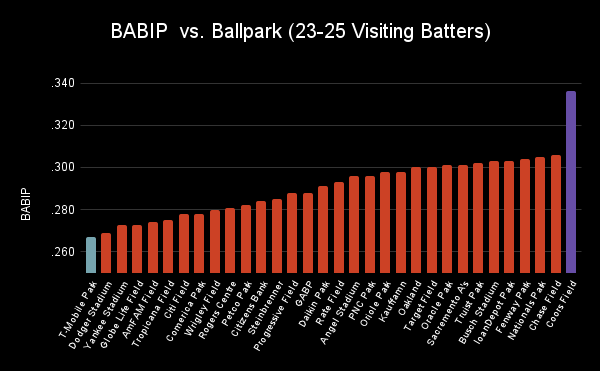
Hello, Coors. Ballparks vary quite significantly in terms of BABIP, with T-Mobile Park and Dodger Stadium having a 40-point difference in BABIP to the likes of Nationals Park and Chase Field. This is notably different than Statcast Park Factors’ Batting Average on Contact, which has Dodger Stadium 19th as opposed to second here. This is, of course, because home runs are not counted in BABIP, which is not necessarily a weakness of the stat, but can complicate matters.
In fact, there are a lot of things that affect BABIP, including some you wouldn’t expect. Take, for instance, something as simple as the time of year:
Now you may be thinking this is a negligible difference. You are partially correct, although BABIP (and baseball in general) operates on inherently small margins. However, I had a hypothesis. Could April BABIP be because of cooler weather? To test this, I looked at BABIP exclusively at home games for AL Central teams, who play in the still-cold Midwest and all play in outdoor stadiums:
Hey! That’s pretty conclusive! There are some inexplicable spikes in June and August, but perhaps the cooler temps make otherwise wall-scraping home runs become harmless warning track flyouts. So it’s clear that there’s more going on than just luck. BABIP is subject to a lot of external factors and is indicative not only of your fortune, but also of how a player plays and where. For starters, let’s look at team defense in 2025:
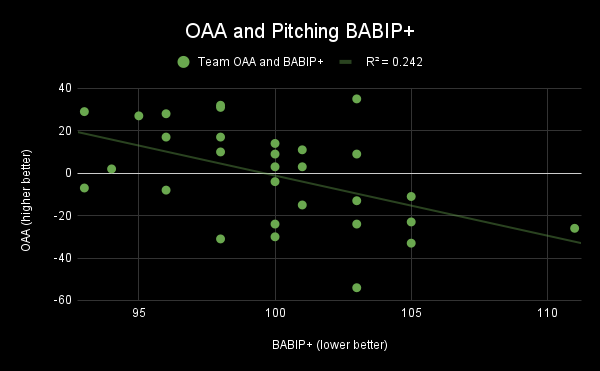
A considerable correlation, which makes sense. If you want to take it super literally, the Angels allowed about 54 hits over the course of the year off defense alone. We use BABIP+ here because of the aforementioned impact of ballparks on BABIP. Team defense is very important to overall run prevention, as you can see here:
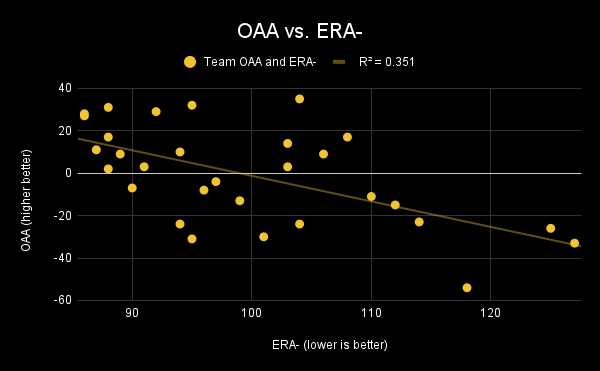
Again, not surprising, yet it illustrates the importance of defense. Now for the kicker, what’s the correlation between BABIP and ERA?
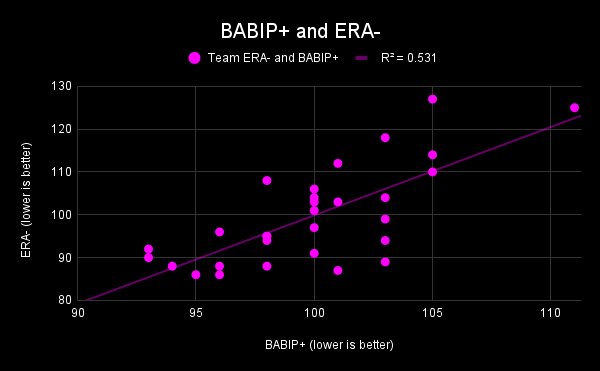
This is why BABIP is worth considering. Again, this is not a revelation and makes sense when you think about it – hits lead to runs. All these external factors affect the likelihood of a ball in play landing for a hit, but what about the internal factors? There’s a lot that the pitcher can control, and it may surprise you.
Fortune is a Pitch
Here’s something that isn’t very surprising:
You probably know that fastballs get hit the hardest and most often. That certainly is apparent here, but I still think there’s value in knowing that offspeed pitches have a 21-point gap between them and fastballs.
We can go deeper, however. Not all fastballs and breaking balls are created equally, so let’s further separate them by looking at individual pitch types.
A slow cutter is one that is below 92 mph, which, for all intents and purposes, I’m treating as a gyro slider. Anyhow, this is where BABIP is particularly fascinating. Purely on balls IN PLAY, Sweepers drop for hits at a rate 30 points lower than sinkers and 10 points lower than its cousin, the traditional slider. Note how despite a four-seamer having a considerably higher BABIP than any secondary pitch, it has an almost 20-point gap between it and a sinker.
Furthermore, where pitches are located affects BABIP quite significantly. Let’s look at Statcast “attack zones”.
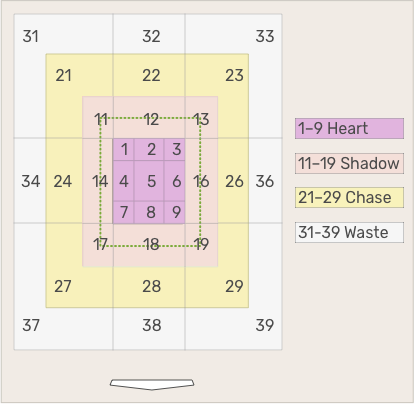
Source: Baseball Savant
This is going to be the framework for the next bit of this article, so pay attention. As you probably expect, pitches in the “chase” and “waste” zones have low BABIPs, although maybe not by the margins you’d expect:
This table is a great representation of how BABIP is dependent on approach. A zone filler will be subject to a higher BABIP simply because they throw pitches in a more hittable location. That’s not news – that’s the entire point of a strike zone – but chase pitches, even though batters rarely put the ball in play, play a significant role in determining BABIP. Most pitchers have a chase rate of around 20%, with Joe Ryan being on the very low end at 17.5% and Zac Gallen on the higher end at 25%. Now, if you look up the BABIP for those two pitchers, you’ll find it was almost exactly the same this year at .271 and .270, respectively, but there are further considerations to be made than chase rate. Let’s look at where in the strike zone pitches are most vulnerable to land for hits:
Higher: lower BABIP. That’s interesting! We know that the height of a pitch affects the launch angle, as shown here:
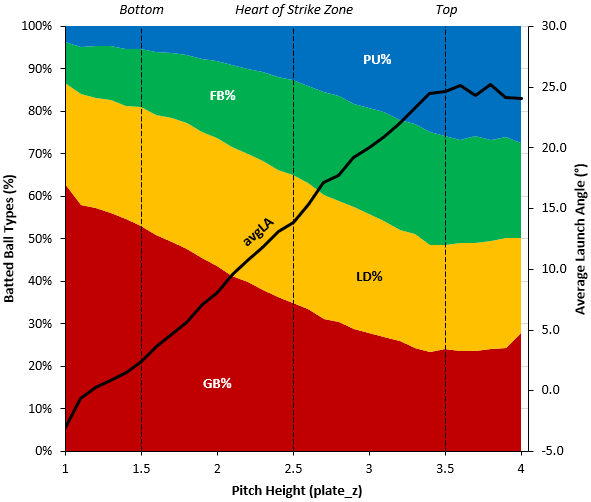
Source: Fangraphs
You can read more here, but a TLDR for our purposes is higher pitch = higher launch angle. So we’ve seen how pitch types affect BABIP and location, what if we combine the two?

This is a dangerous graph, because it’s easy to glance at this and conclude we should all start throwing high sweepers. We probably shouldn’t do that (although breaking balls at the top of the zone is an untapped market), but this shows something pretty clear: pitches low in the zone have higher BABIPs.
Enough With That Stuff
So the environment matters, ballparks matter, pitch types matter, and where a pitch is thrown matters. What else? You may think the quality of a pitch matters, that a particularly nasty pitch would have a lower BABIP than your soft tosser, right?
Well
Not at all.
Here’s a chart of every qualified pitcher in 2025, sorted by stuff and cross-referenced with their BABIP+:
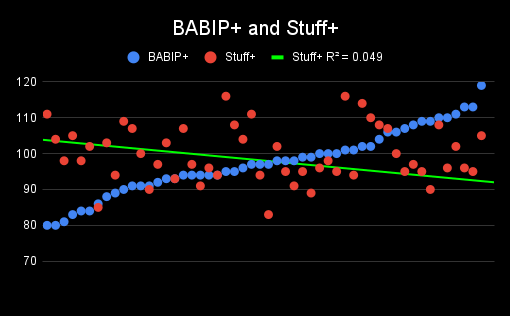
On the far left, you have obviously nasty Jacob deGrom, and on the far right, you have gnarly sinker extraordinaire Logan Webb. As you can see, there is only the faintest of correlations between stuff and BABIP.
Let’s expand on this more and only look at four seam fastballs. Four seamers are unique in that they are pretty much always chucked as hard as possible with relative consistency. There’s not really such a thing as a “hanging fastball”, so to speak. Let’s once again look at BABIP and Stuff+, but this time only looking at BABIP on fastballs in the heart of the strike zone. This is a chart of every pitcher with 50+ batted ball events off fastballs in the heart of the strike zone, once again sorted by Stuff+ cross-referenced with BABIP:
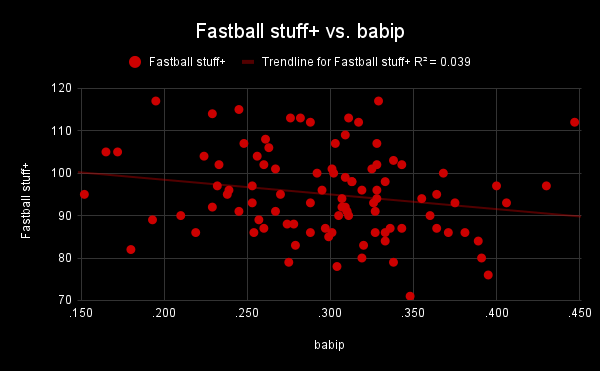
Nothin.
Garrett Crochet had 84 batted ball events off his elite fastball and had a .447 BABIP against, while Merrill Kelly had a .152 BABIP against off his mediocre 95 stuff+ fastball.
The reason for this is that BABIP only measures instances where the pitcher “loses” and the batter is able to make fair contact. That obviously isn’t always good contact, but the actual quality of a pitch does not dictate the outcome once the ball is in play.
This is one of the reasons why BABIP is so often conflated with luck. There’s no luck involved in being a pitcher that throws sinkers and sliders, but whether those sinkers and sliders are good or not is completely irrelevant. BABIP is about your strategy as a pitcher and the environment in which you enact that strategy, nothing more.
