





In Part 1, I went through all the weird quirks and oddities in BABIP, analyzing what affected BABIP for pitchers. In Part 2, we will apply this to individual pitchers and see how their BABIP reflects their actual performance. No long-winded intro here, let’s look at four pitchers, and take what we learned in part one and apply it here.
In my previous article, I used Gausman’s 2022 and ’23 seasons as examples of BABIP weirdness, but why was Gausman’s BABIP so high? Well, let’s break this down using the four main non-luck factors that go into BABIP:
Pitch Type
Pitch Location
Defense
Ballpark
There are other factors to be sure, and defense and ballparks could be considered “luck”, but these are the four elements that are most reliable for predicting BABIP. So let’s look at Gausman.
Gausman in ’22 and ’23 was almost entirely a two-pitch pitcher. Versus righties, he threw an occasional slider, but 85% of the time, he was throwing a four-seamer and a splitter. Gausman pitched in a very simple way: He’d throw strikes with the four-seam to set up a tunneled splitter down to get a chase strike three. It worked well in San Francisco because Gausman’s four-seamer was able to survive being thrown for strikes, and the splitter was particularly effective, and it… sorta worked in Toronto. We’re getting ahead of ourselves, though; a 4S/Splitter combo is a pretty average mix for BABIP purposes. Let’s see where he threw them:
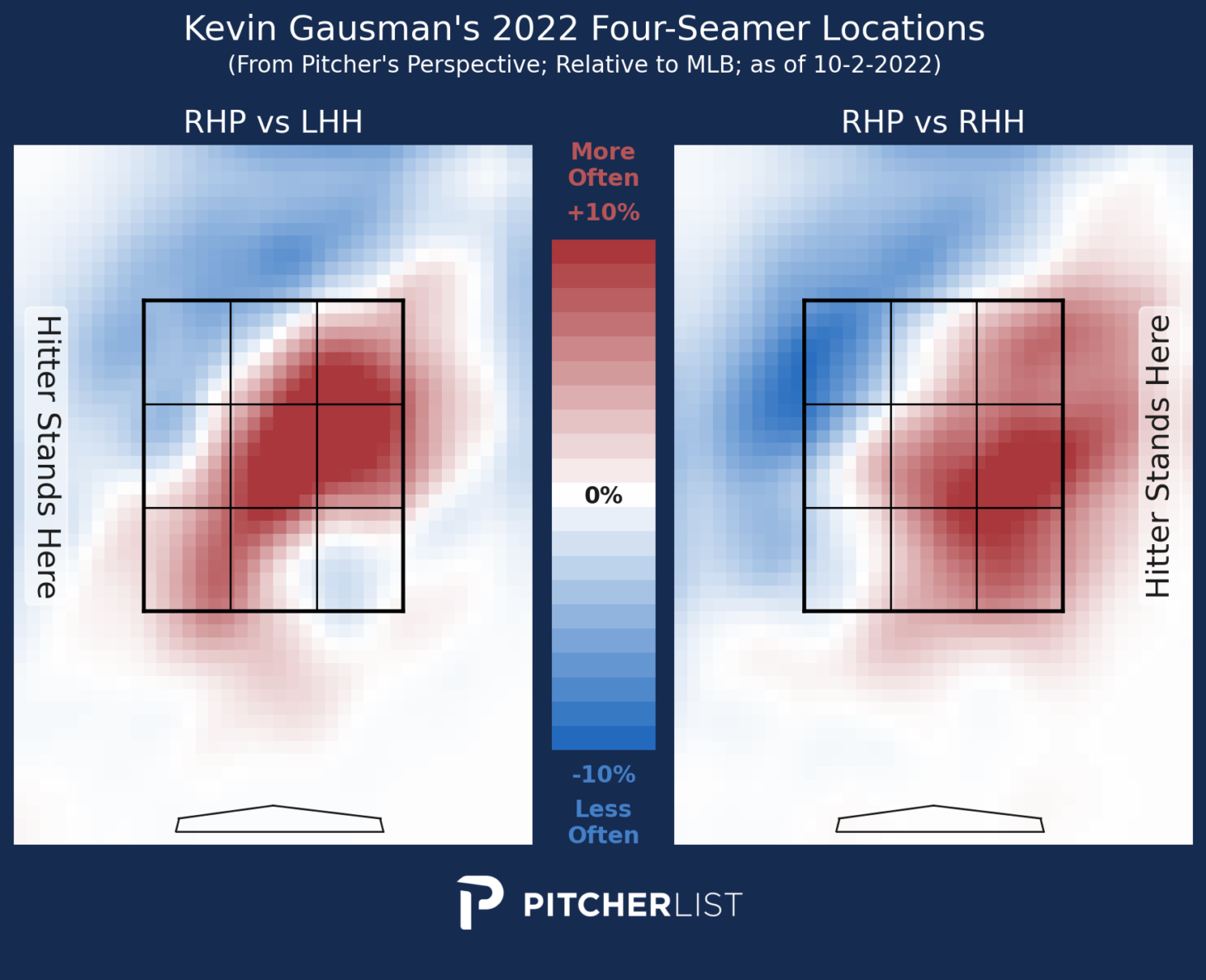
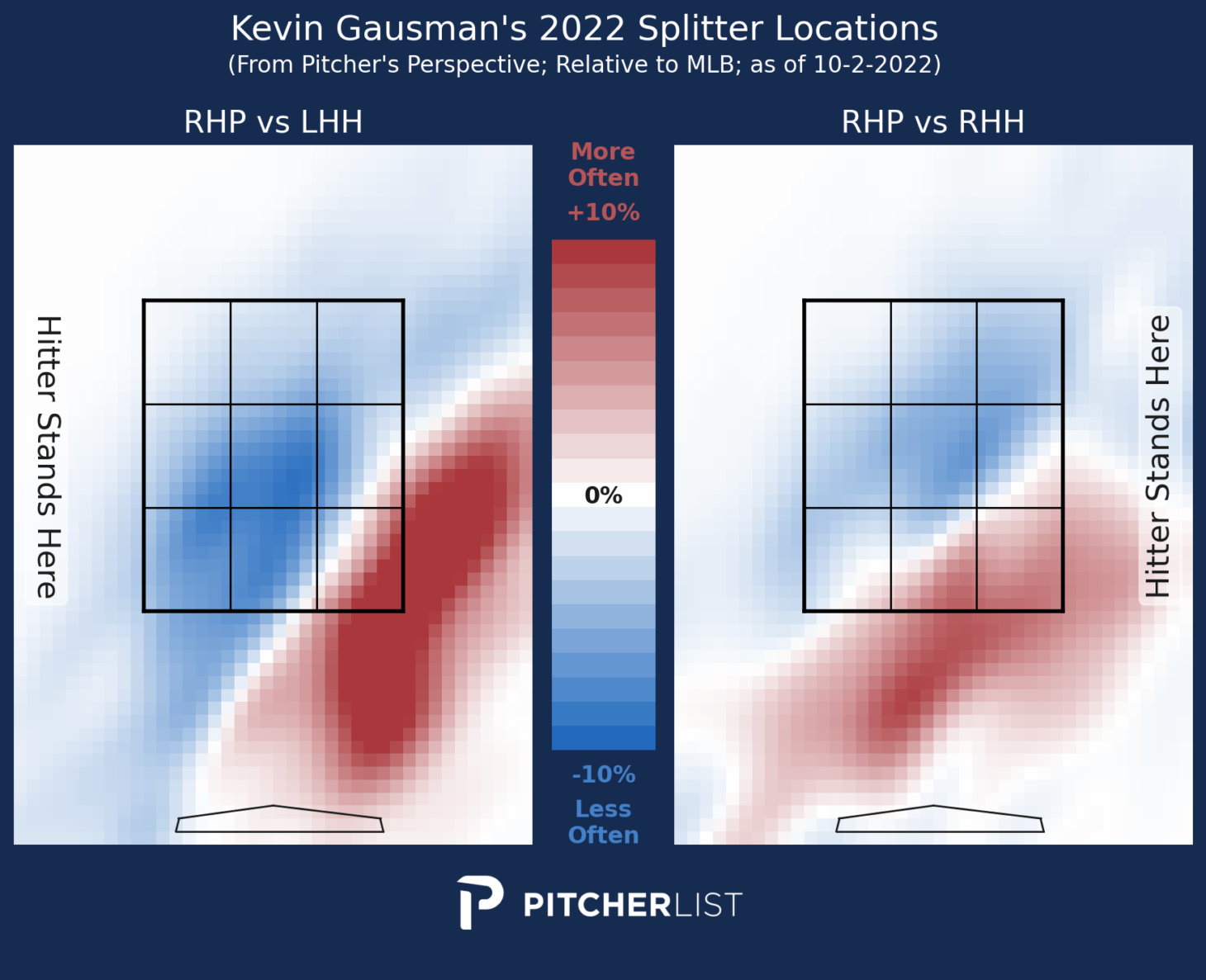
If you recall from part 1, pitches thrown lower yield a higher BABIP. That’s because pitch height affects launch angle, and BABIP doesn’t include home runs. As you can see, Gausman peppers the middle and bottom of the zone with his fastball, and then that splitter makes them swing at their ankles. This means that balls hit off Gausman are more likely to be line drives, which in turn are much more likely to fall for hits.
Now, as far as ballpark and defense are concerned, Toronto was pretty neutral, even slightly positive toward pitchers. So was Gausman unlucky?
God yes.
In 2022, Gausman’s four-seam had a PLV hit luck of +35 – the most I’ve ever seen and very likely will ever see for one pitch, and his weird luck continued:
Gausman’s fastball locations haven’t really changed in three years (2022 was actually his most balanced as far as fastball locations). Hit luck fluctuates with defense and – you know, luck – but a mark of 35 is so ridiculous that it’s way outside of normal fluctuations. As for 2025, Gausman throws pitches lower in the zone than ever, with 59% of pitches coming in well below the belt. Those pitches don’t yield favorable BABIPs, so expect Gausman’s mark to jump back up to the low .300s next year.
Carlos Rodón totally changed the way he pitched in 2025. Back in San Francisco and Chicago, Rodón was the pitcher who shoved the hardest. Not always the best pitcher, but Rodón would throw chest-high fastballs and nasty sliders with ferocity. In 2025, however, Rodón added a sinker, ticked up his changeup usage, and overall pitched way lower than usual. He used to be one of the pitchers that attacked hitters up high the most, but while in 2023 he had a hiloc% of 46.4, in 2025 it dropped to 24.3%. Rodón probably deserves his own article based on how weird he was last year, relative to the Carlos Rodón we’ve known for years, but here’s the bottom line:
I don’t buy it for a second.
Pitcher List has a stat called xBABIP, which works like xBA but for only balls in play. It’s a nice shorthand, but in this instance, I’m putting my foot down and saying no, Rodón’s .258 xBABIP doesn’t make sense either. Rodón allowed a lot of ground balls and a LOT of line drives, while the fly ball rate actually dropped a decent bit. Nice for Rodón, who has had trouble with the long ball, but for our purposes, it doesn’t help much. Remember that new sinker I talked about? Look where he throws it:
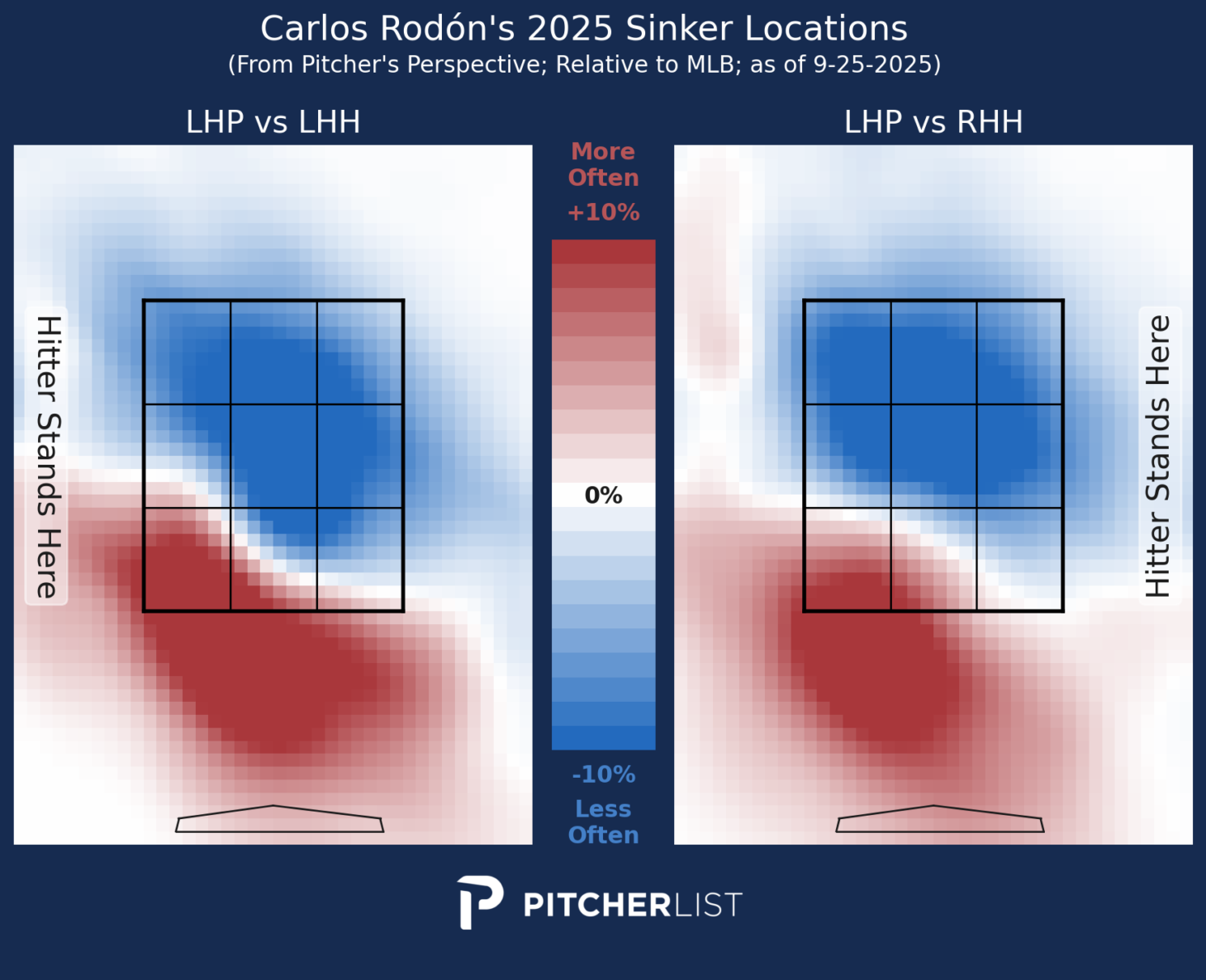
Rodón’s Sinker had a .250 BABIP against, and that makes NO sense for where he throws it. Even living on the shadow of the strike zone, sinkers don’t do well as far as BABIP is concerned. Great for limiting slugging, bad for batting average. I have no trust in Rodón’s BABIP based on his pitches and where he throws them, even if Yankee Stadium gives him a moderately sized boost.
Remember from part one how sinkers and curveballs had the highest BABIP rates? Guess what José Soriano throws more than anyone but Framber Valdez?
75.8% of the time, José Soriano will throw one of those two pitches, hoping to coax a ground ball. While Framber throws a changeup as his third pitch (remember, the pitch type that has the lowest BABIP), Soriano has a split and a four-seamer, which is likely part of the reason why Framber has a BABIP of .297, while Soriano is at .309. That mark from Soriano was 10th in MLB among starting pitchers, and for someone so reliant on low sinkers, this makes perfect sense. As long as Soriano continues to pepper the bottom of the zone with sinkers, he’s going to have a high BABIP.
The only X factor for Soriano is the defense behind him. The Angels were terrible at defense last year, with a team OAA of -52. Their infield in particular was horrendous, which spells disaster for a guy like Soriano who is so reliant on up the middle defense for his GB% focused approach. As it stands, I don’t think much will be different, but if Soriano say, gets traded to a strong defensive team like St. Louis, maybe fortunes shift.
Then again trading away a ground baller from your horrible defensive team to a good one is the kind of savvy move that I think is highly unlikely for either the Angels or Cardinals to make, so… sorry, José.
Didn’t seem like too long ago that Chapman was a long shot for Cooperstown. Now, after an outstanding season in Boston, Chapman has defied the odds and, coming into his age-38 season, is still pumping triple-digit gas with regularity, now with improved command! Chapman semi-quietly had one of the best seasons a reliever has ever had last year, posting an ERA of 1.17 across 67 outings. Chapman, once someone who relied almost exclusively on the heater, now has a four-pitch mix that the southpaw uses with great efficacy. A true article about Chapman’s resurgence is a story for another time, however, so let’s talk about his .200 BABIP last year.
That’s LOW. Even for a guy who’s been in the league for 16 years, and whose MO is high fastballs and flyballs, Chapman’s lowest BABIP prior to ’25 was a .241 posted in Yankee Stadium in 2022 – one of the BABIP friendlier parks in a dead-ball year (also his worst year by a mile). I don’t really need to break down locations because while his four-seam actually does drop towards the waist more often than you may think, everything else is straightforward, and Chapman doesn’t have too many tricks up his sleeve.
The exception, however, is that while Chapman throws a sinker, it’s… barely a sinker. It’s a two-seam fastball thrown high in the zone, which is very different than most sinkers. Normally, sinkers yield a relatively high BABIP almost regardless of where they’re thrown, but Chapman’s sinker has less sink than most four-seam fastballs, with 17 inches of iVB on that thing. Look at where he throws this:
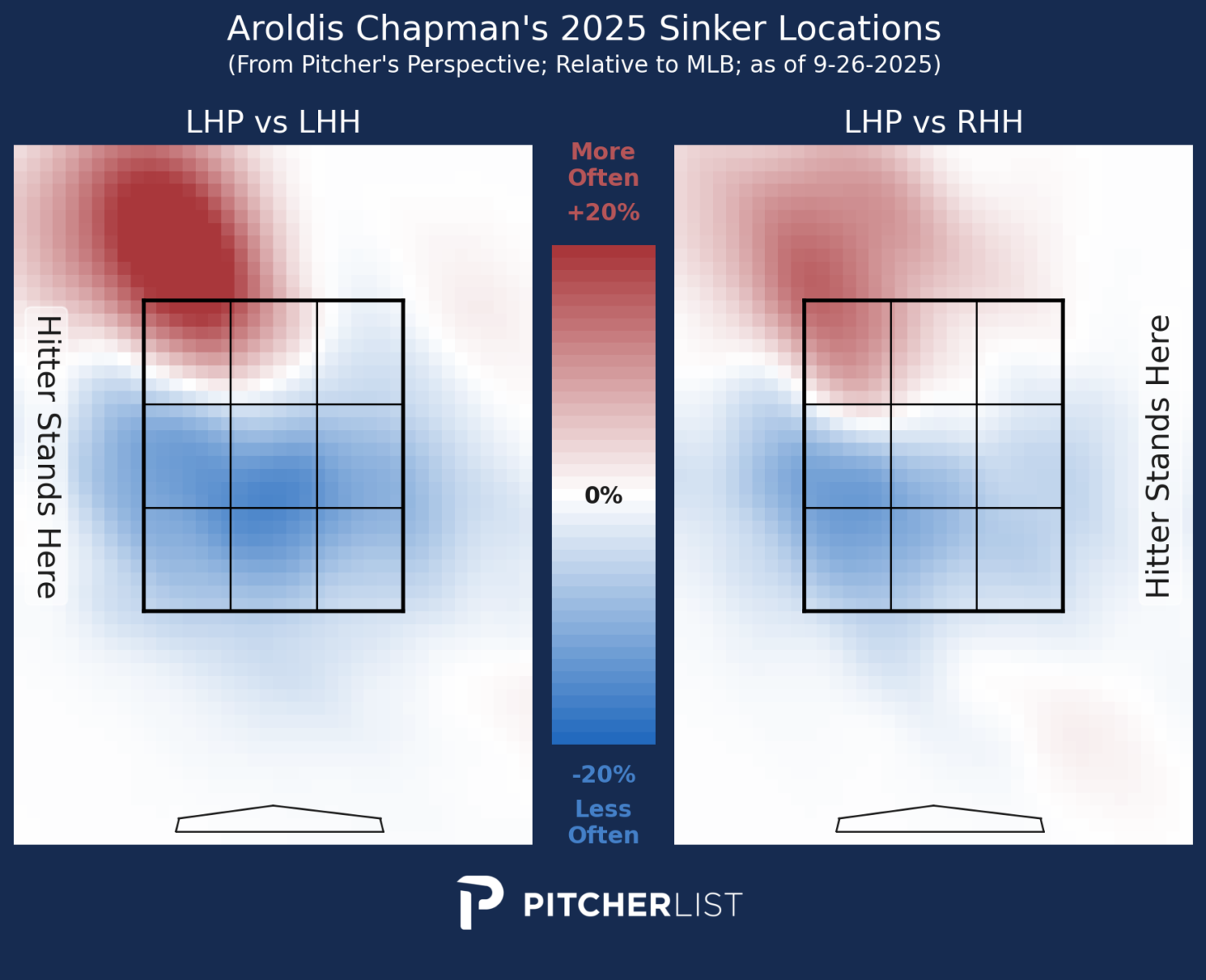
I got our resident statman Kyle Bland to adjust the scales of the chart to +/- 20%, and even then, he throws his sinker in ludicrously unorthodox locations. That “sinker” had a BABIP against of .174 last year against an xBABIP of .274. This should regress, but given his locations and how the pitch operates, I actually wouldn’t be surprised if he continues to outperform his xBABIP. Chapman’s sinker is a relatively new thing, so he may adjust his usage in the future.
So Chapman throws high fastballs a ton, then pairs it with low-ish sliders and splitters. Chapman got lucky in 2025, but if nothing changes, his BABIP should be well below .300. Dude is legit as long as the long ball doesn’t get to him.
Wrapping up
And there you have it. Several thousand words over two articles on how BABIP is weird for pitchers and can be deceptive, or not! BABIP is a great resource for judging if regression is coming, but it cannot be taken at face value. Look at how a pitcher approaches batters, and use that to decide if wacky luck is at play.
And don’t take a Rockies pitcher. But you already knew that.
