Hello and welcome to Pitcher List’s latest series: Using PLA to Evaluate Pitchers! Every week, I will examine various pitchers and break them down using PLA. There will be various themes and topics each week, which will range from topics such as waiver wire picks, to buy or sell, to awards races, to lefties/righties only, etc. I hope to mix it up as much as possible to keep you all on your toes.
Now, you might be asking, what is PLA?
PLA is an ERA estimator that was created in tandem with Pitch Level Value, which we refer to as PLV. PLV is essentially an all-encompassing stat that measures individual pitches and rates them on a 0-10 scale. The elements that factor into PLV include velocity, movement, release point, location, count, and handedness of the batter. We have an excellent primer on this by the one and only Nick Pollack that you can find right here! PLA takes this 0-10 score and translates it to an estimated ERA, which makes it easier to understand and more useful for those looking for help with their fantasy teams.
It’s important to note that PLA isn’t necessarily a catch-all estimator, just as xERA, FIP, SIERA, and pCRA aren’t either. These stats ultimately still measure outcomes, which are largely dependent on how a player is executing that day. ERA estimators are not crystal balls; however, they can provide some insight if taken with a grain of salt. For the purpose of this series, we are going to use PLA as the main factor to evaluate pitchers (hence the series title), but again, no stat is perfect, especially in the complex world of pitching.
Also, stay tuned for other PLV evaluation article series, such as one that will look at individual pitches and another that will use Process+ to evaluate hitters!
Today I thought it would be fun to look at some of the starting pitchers with the lowest walk rates in MLB. Now I realized that I’ve covered some of these guys before, so I decided to leave out pitchers who were included in the last couple of articles in this series. However, enough has changed over the course of the season that I feel like we can talk about some of the other guys here.
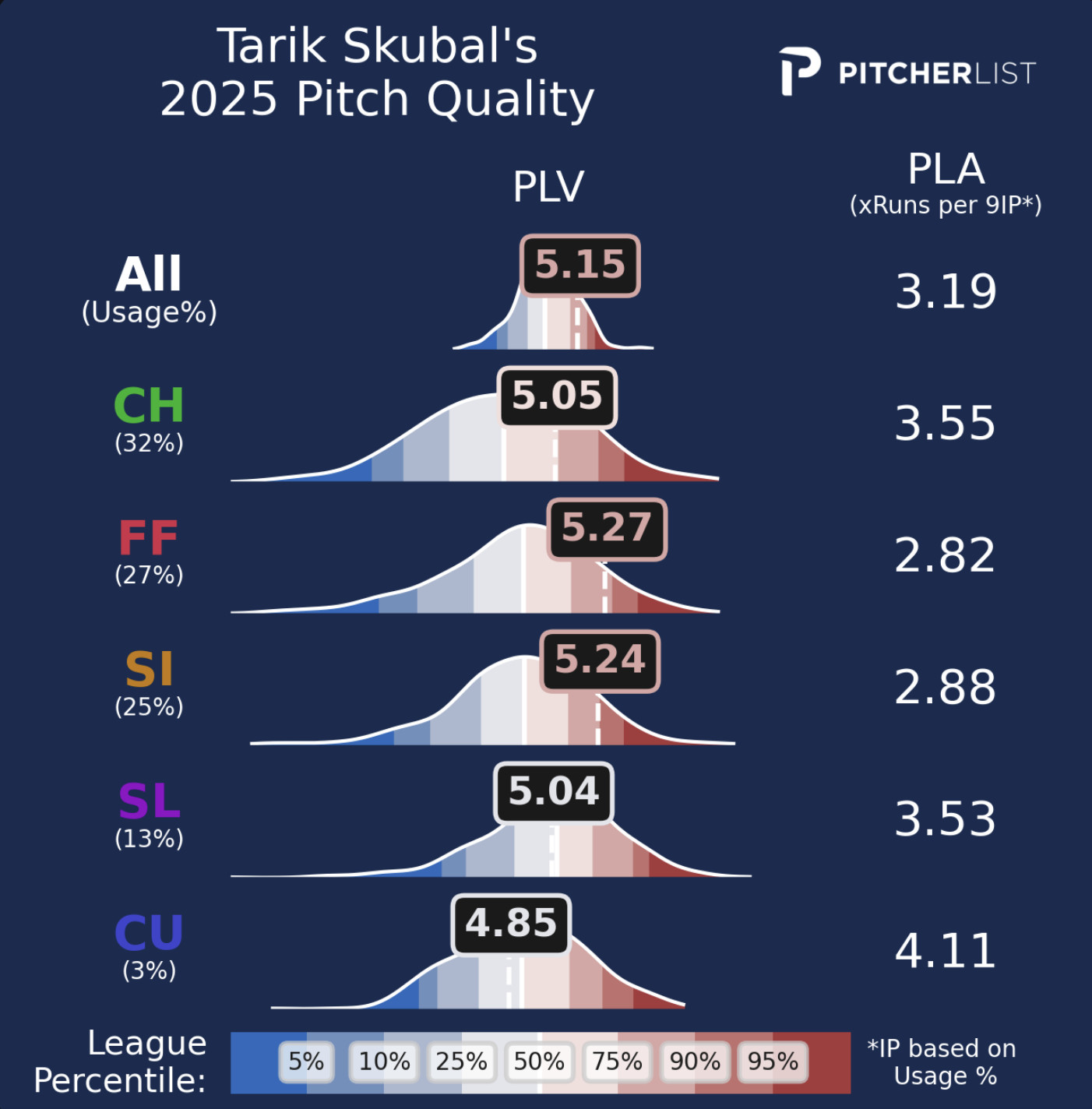
Tarik Skubal – 3.19 PLA
Ahhhh Tarik Skubal, our sweet, glorious SP1. Can you stop leading baseball in like every single stat I want to talk about?
Skubal is interesting because his estimators across the board are pretty much superhuman. That’s what you get I guess when you lead qualified starters in both strikeout percentage and walk percentage. It’s pretty rare to see this, and honestly, it feels pretty Mets Jacob deGrom-esque at this point. He is the reigning Cy Young winner and is likely to pull it off again, barring an unlikely implosion or Garrett Crochet having the stretch of his life.
Skubal surprisingly doesn’t lead starting pitchers in PLA, in fact, there are arms on here with a better grade, though it’s sort of splitting hairs at this point. The main concern from the PLA standpoint is probably the changeup being his most used pitch, as while in real life it’s proven to have some of the best results of any offering, PLA doesn’t grade it as one of the best pitches in the game.
Still, Skubal projects per PLA to be one of the absolute best starters in the game, and this is likely to continue. The stuff and command are just simply too good for him not to keep crushing.
Sonny Gray – 3.43 PLA
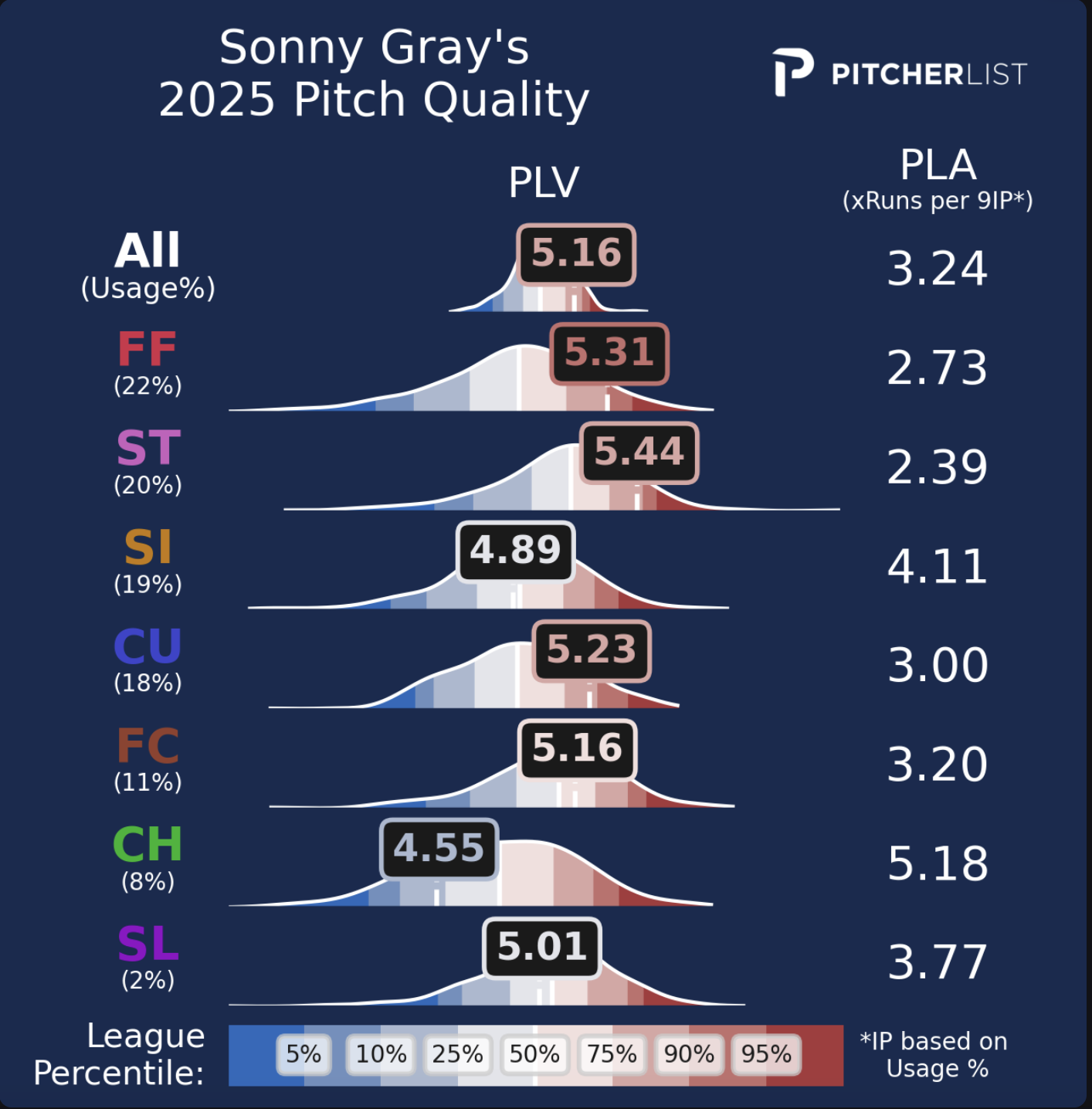
Sonny Gray has had a bit of an up-and-down season this year. He pitched the game of his life in Cleveland with an 11 K complete game shutout in Cleveland in under 90 pitches back in late June. He also had an eight-earned-run clunker a few weeks later. The results haven’t been amazing, but the peripherals showcase a pitcher who is more in line with a great number two as opposed to a back-of-the-rotation option.
Gray’s sweeper is exceptional. It’s simply his best pitch, and PLV would agree. He locates it with intent down and away to righties, but mixes it in against lefties too. This pitch is the key to his PLA being so great, though the rest of his arsenal grades out pretty well. His fastballs are, in general, pretty weak statistically, but his ability to locate them well makes up for this, which you can see in his four-seamer still grading out so well. Gray also has a strike-earning curveball and a solid cutter in his mix, which give him more options, with a changeup that grades out relatively poorly rounding out his arsenal.
Gray isn’t a guy who blows you away with crazy stuff, but he’s a crafty pitcher who can get the strikeouts up while keeping the walks down.
It isn’t a command party without one of the kings of command: Bryan Woo.
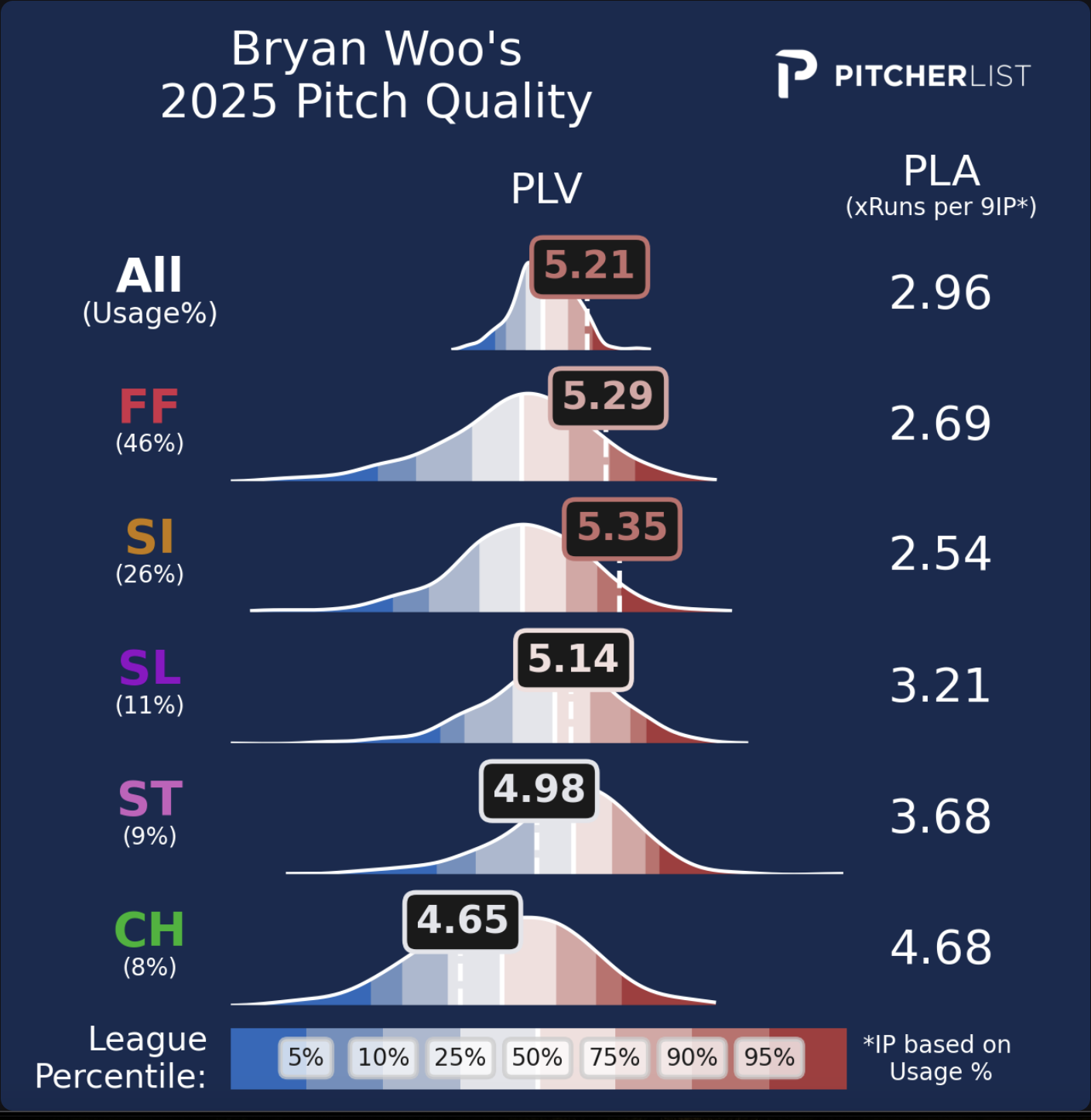
Woo’s breakout this year has been amazing to watch. Well, last year was his breakout, but this year is him breaking out as a top-of-the-line ace, the kind that can win you fantasy championships and can help real-life teams win championships.
We all know Woo for his fastballs. He’s a master of the speedy pitch. His four-seamer is similar to Joe Ryan, it has a ridiculously flat attack angle, which equates to whiff city when thrown at the top of the zone. Notably, though, Woo arguably has even better command and has some solid vertical movement on the pitch as well. He also has a great sinker that grades out even better. His two-seamer gets strikes at a crazy rate, which allows it to grade out well.
Woo hasn’t really been known for his secondaries, though they aren’t bad by any means. The issue is he doesn’t use them too often, which comes with the territory of having elite heaters to get you by. The slider is the best of the batch, but the sweeper is an average-ish pitch that can get strikes. The changeup is definitely the weak point per PLV, but overall, it isn’t used often, only against lefties.
Bryan Woo is one of the best pitchers in the game and has a low walk rate that really propels this. The key for him is elite fastballs and even more elite command.
Nick Lodolo – 3.78 PLA
Honestly, Nick Lodolo being a master of keeping the walks down was something I didn’t really expect to see this season.
His walk rate has gone down significantly from when he first joined the Reds in the Majors, but to be one of the best at preventing the free pass is seriously impressive.
Lodolo’s main offering is his curveball, which is honestly one of the more satisfying pitches to watch in the game. Curveball-first pitchers aren’t super common, so it’s fun to see one find success in Lodolo, who makes it work.
Lodolo has two fastballs that grade out very differently. His four-seamer is far from the best, with very little vertical movement on the pitch and pretty average velocity and extension. Though he interestingly has a ton of horizontal movement on the pitch. The sinker is one of the better two-seamers in the game though, grading out well due to the similar horizontal movement. He rounds it out with a changeup that grades out really well, which he throws exclusively to righties.
Lodolo has been one of the better pitchers this year, and while PLA doesn’t fall in line with the 3.05 ERA, but he has some good stuff and location that shows in his PLV.

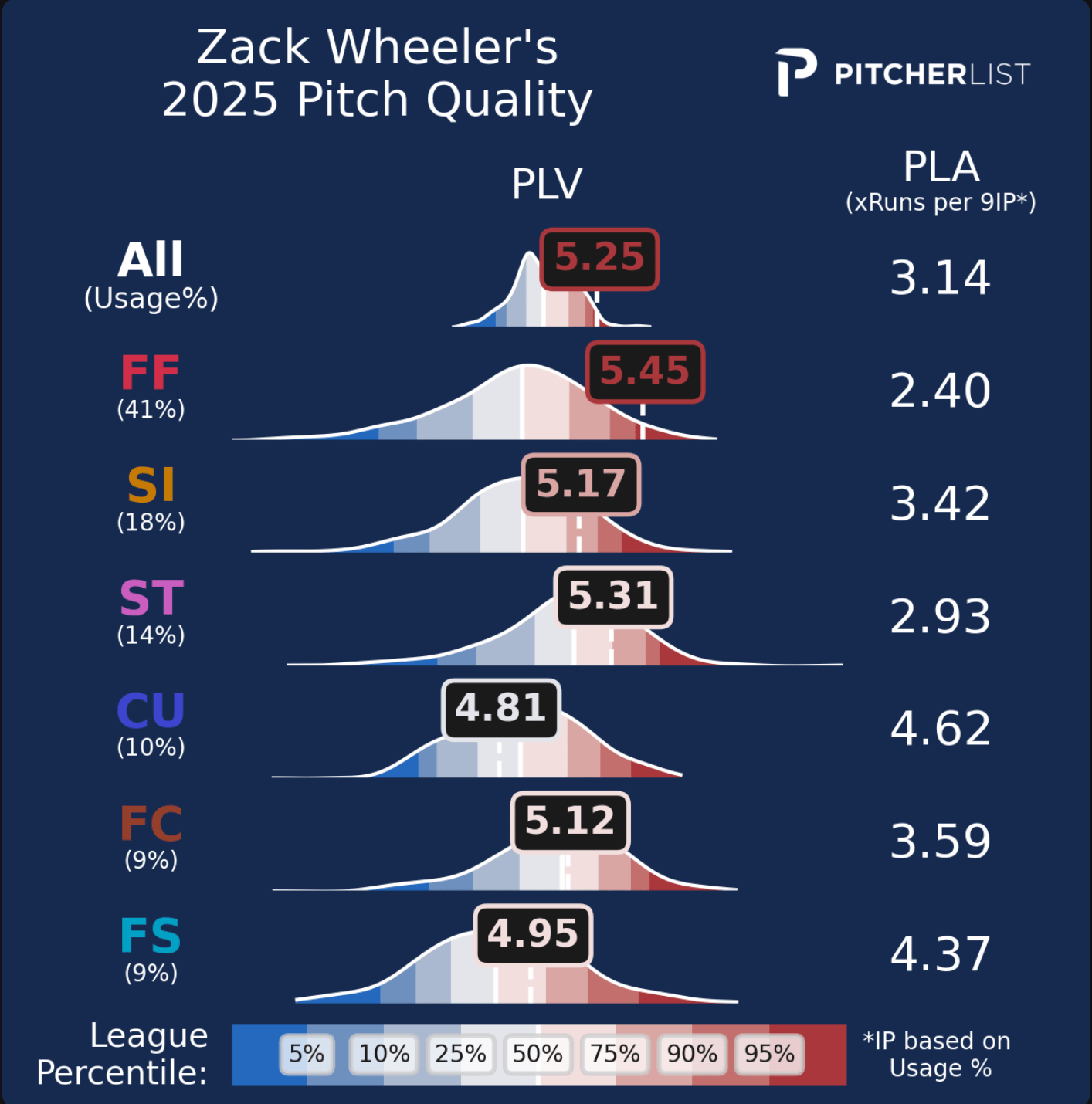
Zack Wheeler – 3.14 PLA
We started this list with one of the very best pitchers right now, so it’s only fitting we finish with another one.
Zack Wheeler actually has an even better PLA than Skubal! He even has a better mark per the stat than Paul Skenes.
Wheeler is the king of the fastball. There are faster four-seamers from starters, but few, if any, match the effectiveness of Wheeler’s. Wheeler has great velocity, elite extension and it comes in at a flat attack angle. Despite being thrown so often, it still grades out well. He pairs it with a great sinker, that grades out similarly well, though it doesn’t get the strikes the four-seamer does.
In terms of secondaries, Wheeler’s most thrown breaker is a sweeper that grades out really well. Wheeler also has a curveball, which grades out poorly, but gets tons of whiffs. Rounding out the arsenal are a cutter that grades out really well and a splitter thrown to lefties that is about average.
Zack Wheeler is an incredible pitcher and it makes sense that he is one of the best pitchers at limiting walks. His location is excellent, and his success is driven by one of the best fastballs in the game.