





Hello and welcome to week two of using PLA to evaluate pitchers! This series uses PLA, along with other run expectancy metrics, to break down results and better understand the process behind them.
This week, I will be taking a look at three starters whose early-season numbers may raise a few questions. For some more details on PLA and what goes into PLV scores, be sure to check out Nick Pollack and Kyle Bland’s breakdown here.
Matthew Liberatore
Note: does not include 4/13 start: 5.0 IP 6 H 4 ER 3 BB 2 SO, decent 25.0 CSW% and 94.9 mph four-seam AVG, but meh results. More changeups please.
Matthew Liberatore has followed up his breakout 2025 season with a few solid starts in 2026, totaling 16.0 innings and 10 strikeouts to five walks. Liberatore has also allowed four home runs, inflating his FIP and xERA to nearly double that of his strong 2.99 PLA and 3.38 ERA.
Clearly, Liberatore has struggled with the three true outcomes, but has managed baserunners well (97.8% left-on-base rate) and avoided too much damage despite a career-worst 22.2% HR/FB rate. His stuff also seems in line with 2025 and still profiles at about league average.
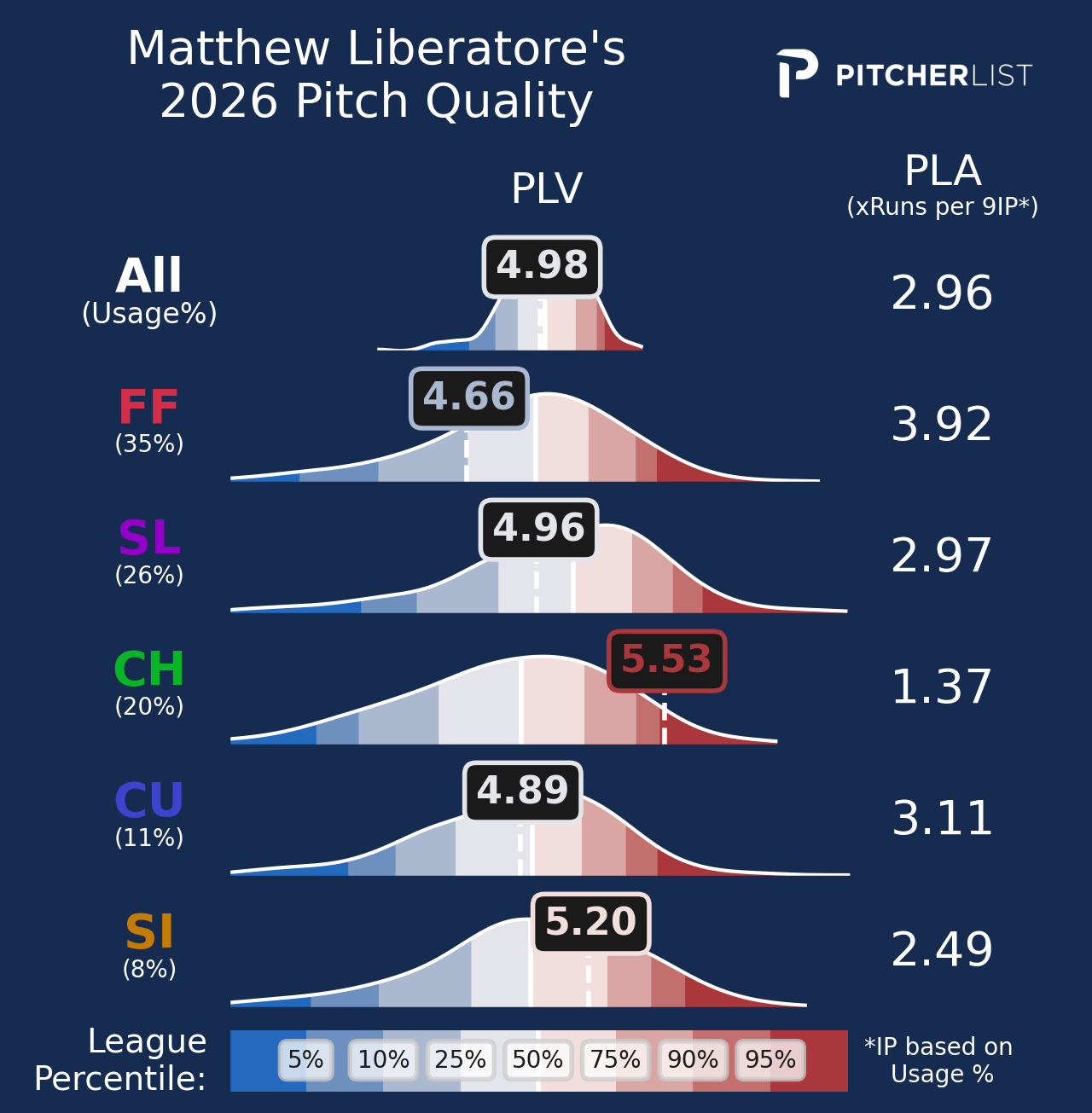
Liberatore’s changeup stands out in PLV, and it has easily been his best pitch on a results-based basis. Hitters slug just .313 against the pitch despite being thrown in-zone 48.8% of the time, roughly 15 points more often than league average. This will be key to continuing to deal with righties while his strong slider/curveball pairing settles in against both sides.
Liberatore’s ceiling is likely capped by average velocity and poor whiff rates, but his floor is bolstered by a low walk rate and high chase rates. This makes him a fairly boring yet reliable starter; a useful profile for the rebuilding Cardinals. Look for Liberatore to stay around league average and avoid too much damage against tougher lineups in 2026.
Brandon Pfaadt
Brandon Pfaadt has struggled to start 2026, getting knocked around in his first two starts vs. Detroit and division-leading Atlanta before throwing a quality start against Philadelphia. Pfaadt’s struggles with run prevention have continued despite similarly strong peripherals in each of his last two seasons, yet a strong 2.94 xERA and 3.65 PLA may indicate some positive regression is on the horizon.
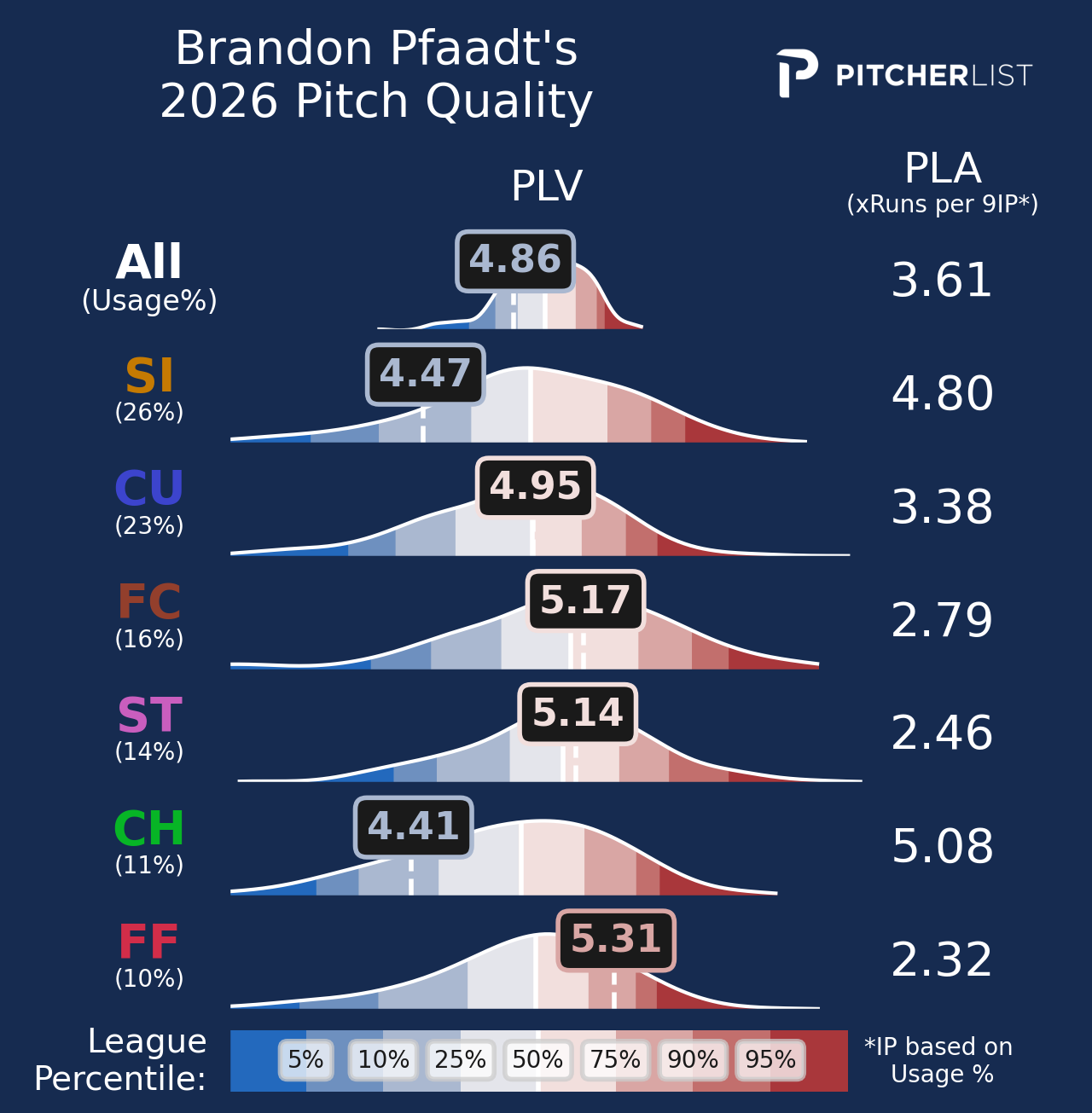
Pfaadt’s “kitchen sink” arsenal is led by a sinker/cutter pairing in 2026 after struggling to avoid barrels with his four-seam in the past. Both are doing a fairly good job of limiting hard contact and generating called strikes, yet he has failed to consistently generate whiffs outside of his nifty sweeper. His changeup, which was strong against lefties in the past, has been crushed in 2026 after losing a tick of velocity and an inch of drop.
While dominating righties (.111 AVG .185 SLG), problems with lefties (.359 AVG .641 SLG) have hurt his early-season results. To better handle lefties, Pfaadt will need to locate his cutter in on lefties, execute his changeup for whiffs, and use his four-seam when needed to set up either pitch. Pfaadt was fairly neutral against batter handedness in 2025, so look out for Pfaadt to better execute against lefties while remaining strong against righties in 2026.
Eury Perez
Note: does not include 4/13 start: 4.0 IP 7 H 3 ER 2 BB 2 SO, still problems with command, but a very tough lineup. 12 whiffs is nice, look for better matchups!
Eury Perez has also had a rough start in 2026, yet tossed solid starts against Colorado and Cincinnati at home, while a tough outing at Yankee Stadium has hurt his overall numbers. Perez, still the youngest starter in MLB, has seen his struggles on the road (5.02 FIP) and success at home (3.10 FIP) throughout his career continue across this small sample.
Perez’s ugly 6.18 FIP is hurt by a career-worst 12.7% walk rate, well up from ~8% in his first two Major League seasons. Perez has also allowed a 28.6% HR/FB rate, another career worst, which is reflected in his 4.62 xFIP and 4.12 SIERA, expecting results a little closer to league average.
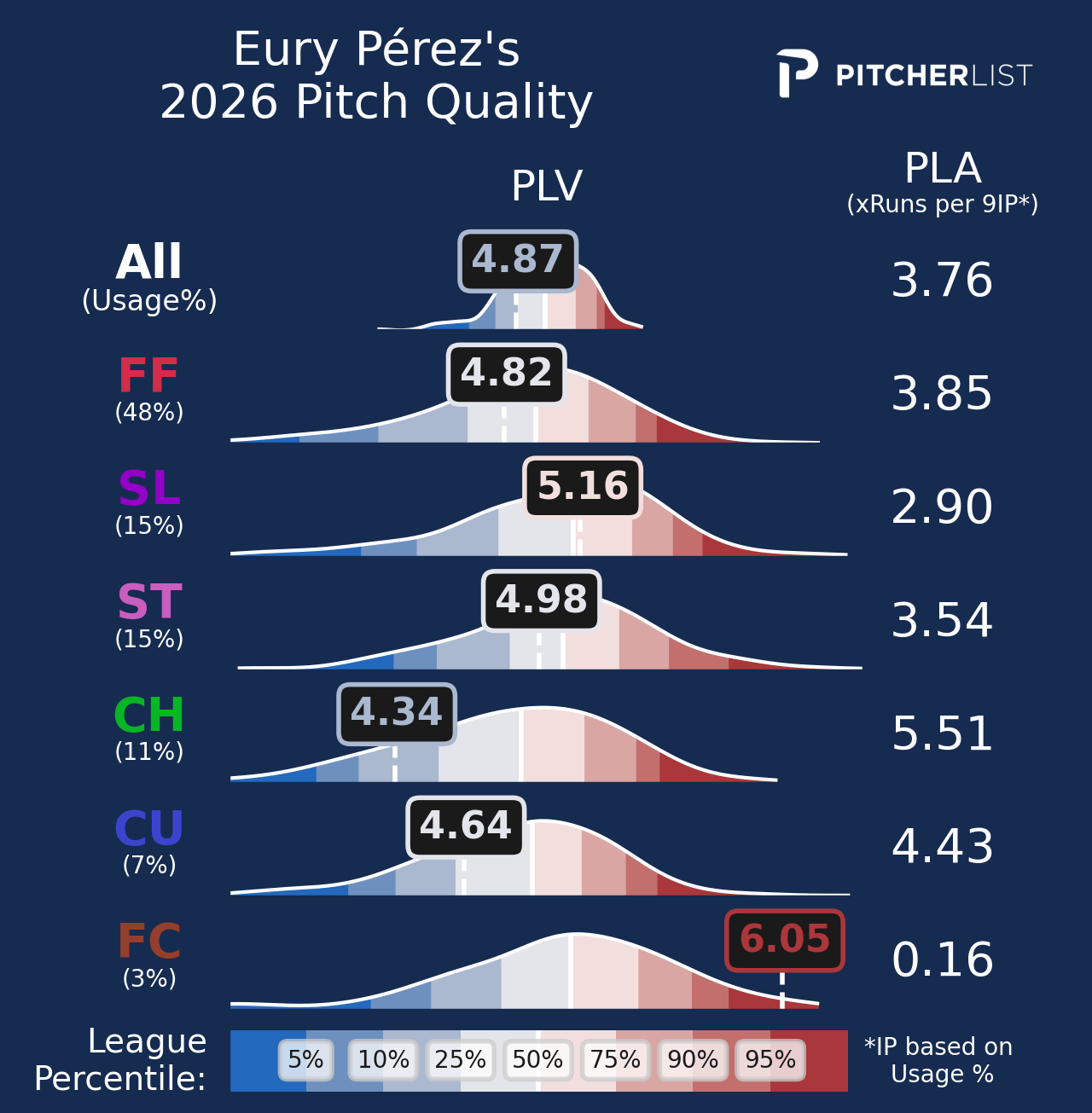
While Pérez’s elite velocity and high-carry breaking balls continue grading out well in stuff models, his poor command of bigger breaking ball shapes has led hitters to post an ugly 16.7% barrel rate. When he comes in-zone with his slider and changeup, they are crushed (1.600 and .800 SLG) despite them running 40.0% and 50.0% whiff rates, respectively.
This is to say that Pérez’s struggles have not been a stuff problem, but rather execution. Finding the correct times to utilize his expansive pitch arsenal will come with time and experience, and this season will be a long test of how the 6’8″ righty can manage a full season’s workload. Look for Pérez to stay healthy and harness his elite potential on a young, exciting Marlins team in 2026.
