





Hello and welcome back to using PLA to evaluate pitchers! This series uses PLA, along with other run expectancy metrics, to break down results and better understand the process behind them.
This week, I will be taking a look at a few starting pitchers taking the next step in the Majors down the stretch in 2026. For some more details on PLA and what goes into PLV scores, be sure to check out Nick Pollack and Kyle Bland’s breakdown here.
Brandon Pfaadt
After struggling earlier in the season, Brandon Pfaadt moved to the bullpen before returning to the rotation in early July. In 10 starts since, Pfaadt has allowed more than two runs just a single time while never going less than 5.0 innings. While his strikeout numbers are still subpar, Pfaadt’s low walk and hard-hit rate have given him an impressive 2026 season thus far.
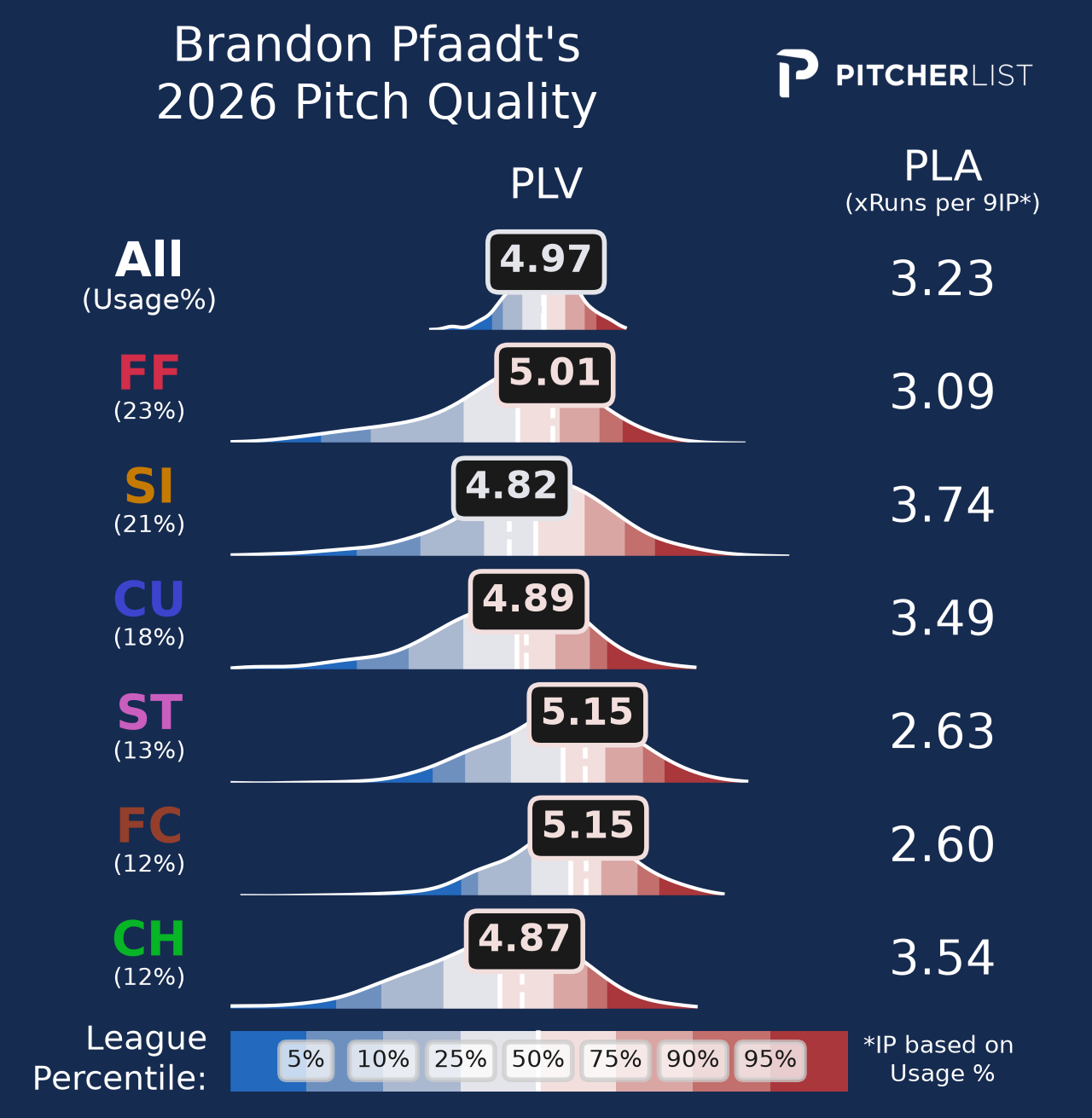
Touted as a prospect for his deep arsenal and plus fastball, Pfaadt’s major league struggles have derived from a lack of breaking ball execution and tons of hard contact. Since rejoining the rotation, Pfaadt’s changeup execution against lefties, sinker/sweeper use against righties, and general strike-throwing with each of his six pitches have been key to limiting damage.
Pfaadt’s 2.87 PLA on the season is also well above average, reflecting his solid stuff and elite strike-throwing ability. While more strikeouts will be key to his long-term success, this recent stretch has included a few excellent starts against elite offenses without pristine swing-and-miss.
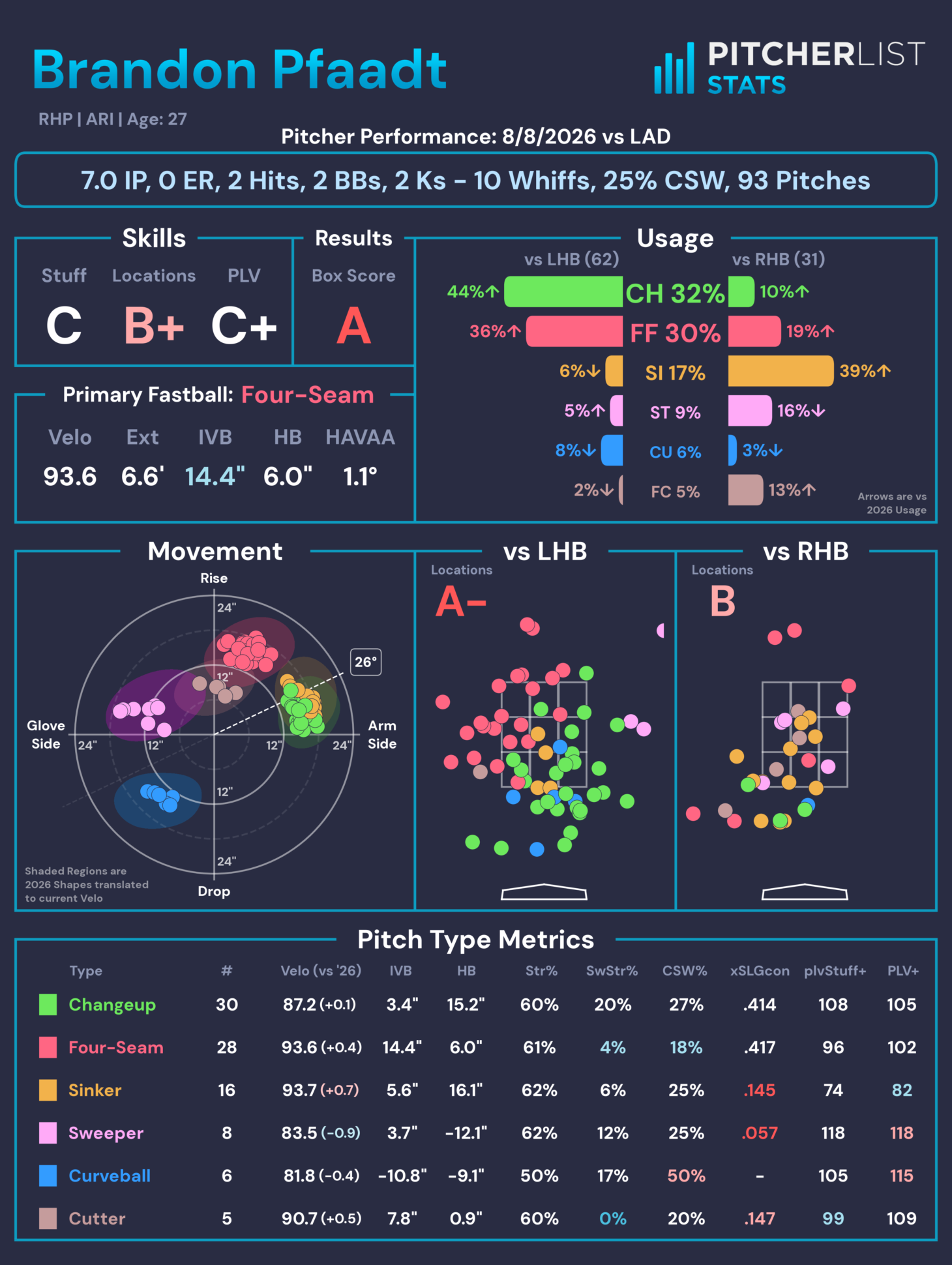
Here, Pfaadt matched Yoshinobu Yamamoto for seven innings without allowing an earned run and only generating two strikeouts. His pristine four-seam/changeup execution against lefties and command low-and-away to righties induced tons of weak contact and kept his pitch count in great shape against one of the best lineups in baseball. A >=50% strike rate with all six pitches was another impressive feat for Pfaadt.
While his most recent outing against Boston saw Pfaadt’s final pitch leave the ballpark for a three-run homer, his 69.1% strike rate with just a 37.2% zone rate reflects his elite command around the edges of the zone. While his velocity was abit down on the night, his 17 whiffs were a season best and a step in the right direction for sustaining these results. Look for Pfaadt to finish the season strong and continue making strides as an under-the-radar innings eater for the Diamondbacks.
Eury Pérez
After battling inconsistency and injuries, Eury Pérez has looked every part of the young ace he flashed in his age-20 debut in 2023. Now 23, Pérez’s big stuff and humungous stature have developed into a high velocity and swing-and-miss arm frequently going 6+ innings into starts. Pérez has also allowed just one earned run in his last three outings.
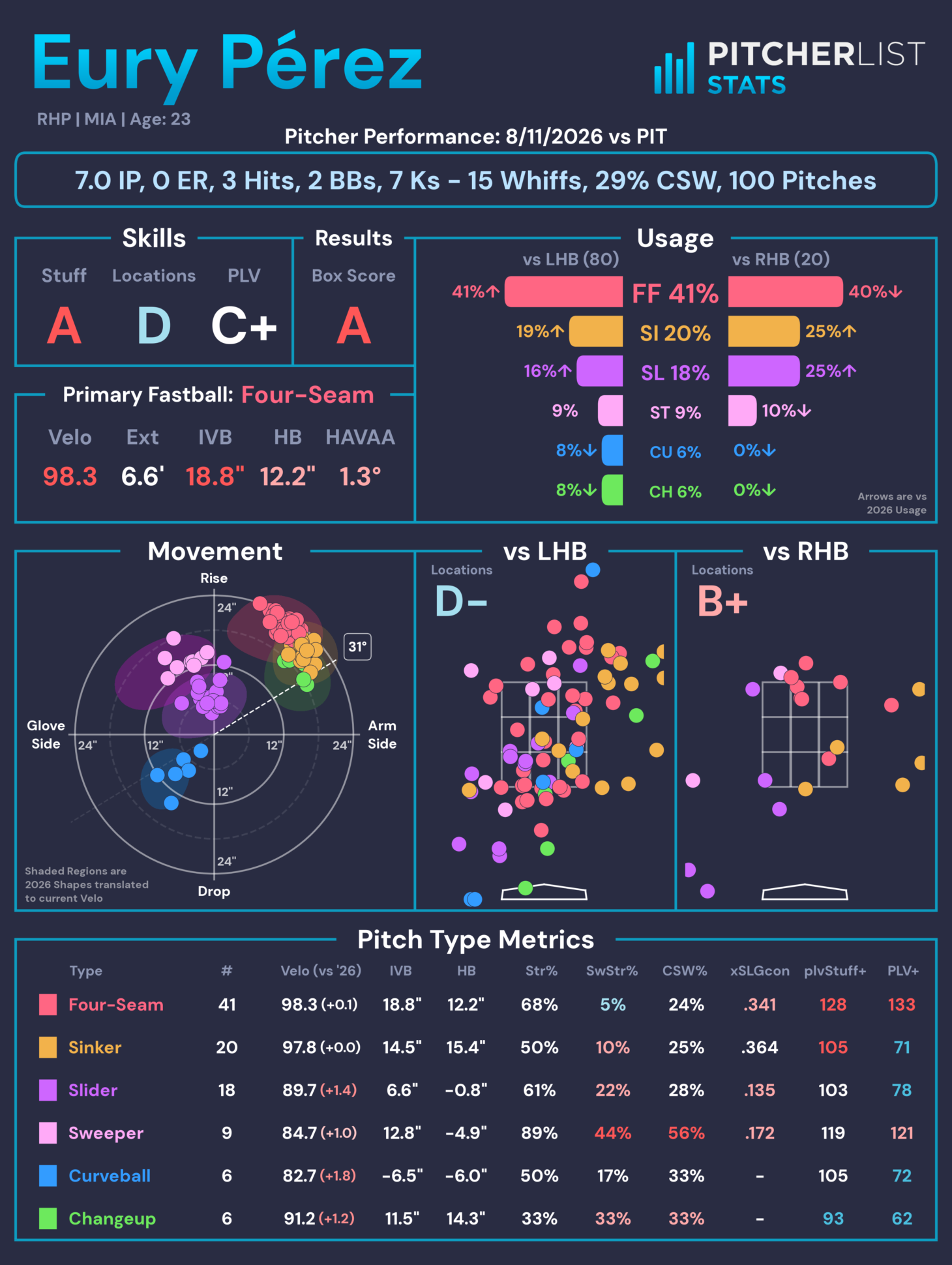
Pérez’s tall release point with a fairly low slot gives way to one of the best fastballs from a starter in the league. While this start didn’t see as many whiffs from the four-seam as usual, his now advanced arsenal got the job done while his four-seam filled up the zone. His command of these secondaries isn’t quite as developed, but their funky movement and solid velocity across the board have avoided trouble when his fastballs are on.
Overall, a PLA of 3.37 is roughly average for a starter and reflects his inconsistent command and abnormal pitch shapes. His changeup stands out, coming in at an average PLV of 4.43 thanks to a ridiculously low 21.0% zone rate. While a 18.8% swinging strike rate is nice, his inability to work in-zone without missing up has led to some damage against lefties this season.
Despite these downsides, Pérez’s upside remains elite. The young starter has seemed to take off here in the second half of 2026, and such Major League success could bring out further development down the line. Look for Perez to stay healthy and continue making strides at the Major League level as the possible future ace of a young Marlins rotation.
Jacob Lopez
Athletics starter Jacob Lopez has also been making strides in 2026’s second-half. After a disastrous first-half, coupled with a couple trips to and from the minors, Lopez has a 2.23 ERA/3.18 FIP in his last 8 starts, using his high extension and deceptive release point to limit hard contact and induce whiffs.
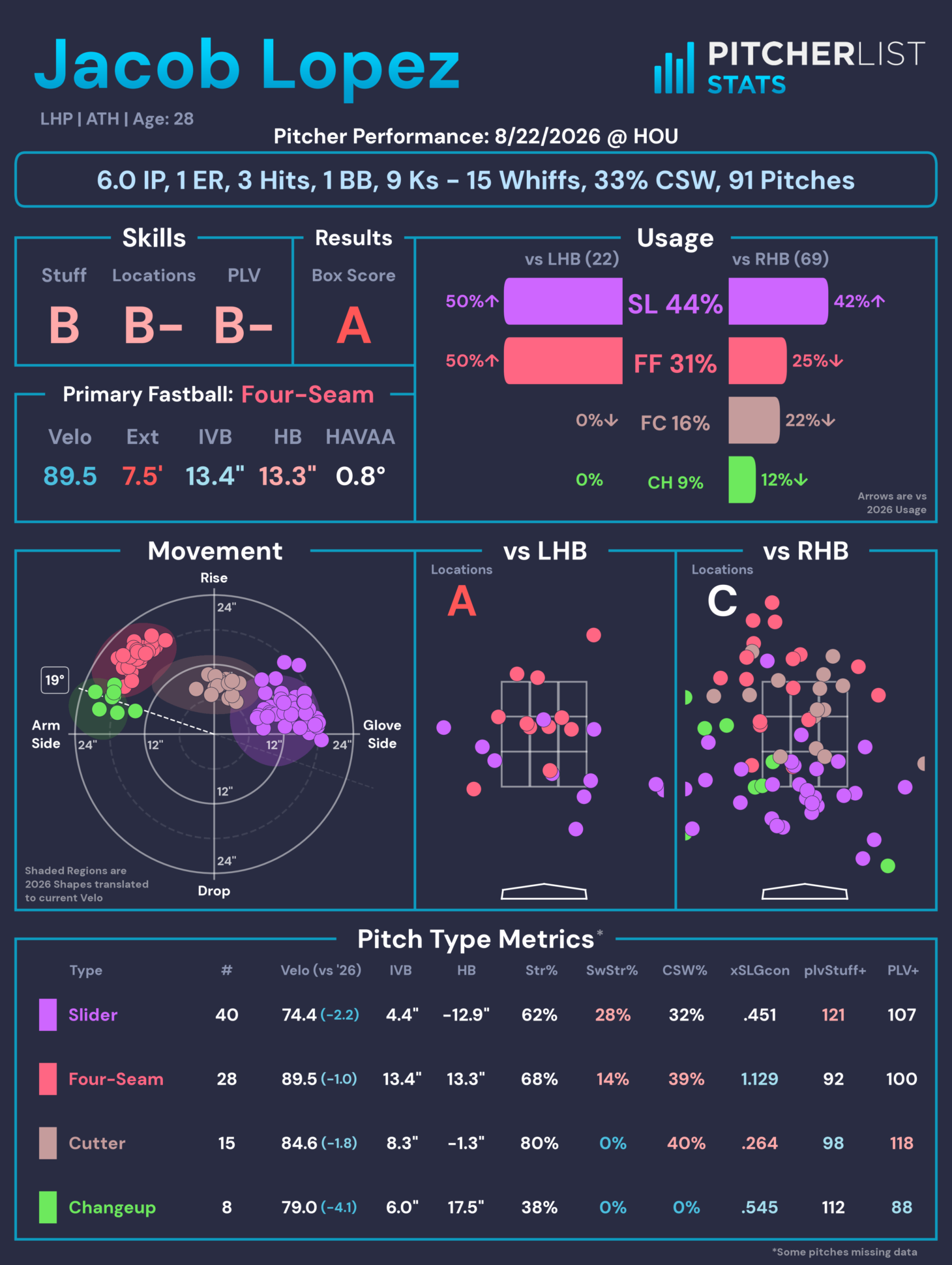
In his most recent outing, Lopez dominated a division-leading Astros lineup for six innings with an 89.5 mph fastball. His ridiculous 7 and a half feet of extension on the pitch certainly adds a few mph of perceived velocity. His slider did some heavy lifting as well, while his cutter bridged the gap for called strikes and his changeup served as another look against righties.
His changeup appears key to handling righties long-term, but it has not been the pitch this season. Batters are hitting .529 on the pitch, and it was hit hard this past start thanks to sitting just 79.0 mph. Getting its velocity a little closer to his fastball may be big for Lopez to get whiffs/avoid allowing a hit half the time.
Otherwise, Lopez makes the most of his limited arsenal by working around the edges of the zone and allowing just an 84.4 mph average exit velocity, amongst the best for starting pitchers. While a very low ground ball rate and league average swing-and-miss rate limits his ceiling, Lopez works as a funky lefty capable of dominating against lefties.
His mediocre 3.41 PLA is boosted by a strong sweeping slider, which he locates well at the bottom of the zone, while his slow four-seam/cutter/changeup brings his overall PLV down. Still, his deceptive release and funky arsenal allows him to play above his stuff, as realized by his elite 30.8% Ideal Contact rate. Hitters have struggled to hit his stuff hard in the past, and Lopez has started to convert that tendency into results in second-half 2026.
