





Hello and welcome back to using PLA to evaluate pitchers! This series uses PLA, along with other run expectancy metrics, to break down results and better understand the process behind them.
This week, I will be taking a look at three left-handed starters working their way through the 2026 season. For some more details on PLA and what goes into PLV scores, be sure to check out Nick Pollack and Kyle Bland’s breakdown here.
Reid Detmers
After working out of the bullpen in 2025, Reid Detmers has returned to the starting rotation as a different pitcher in 2026. Through his first 11 starts, Detmers has produced a lackluster 4.57 ERA, 4/11 quality starts, and a 1-5 record; however, everything under the hood looks far better.
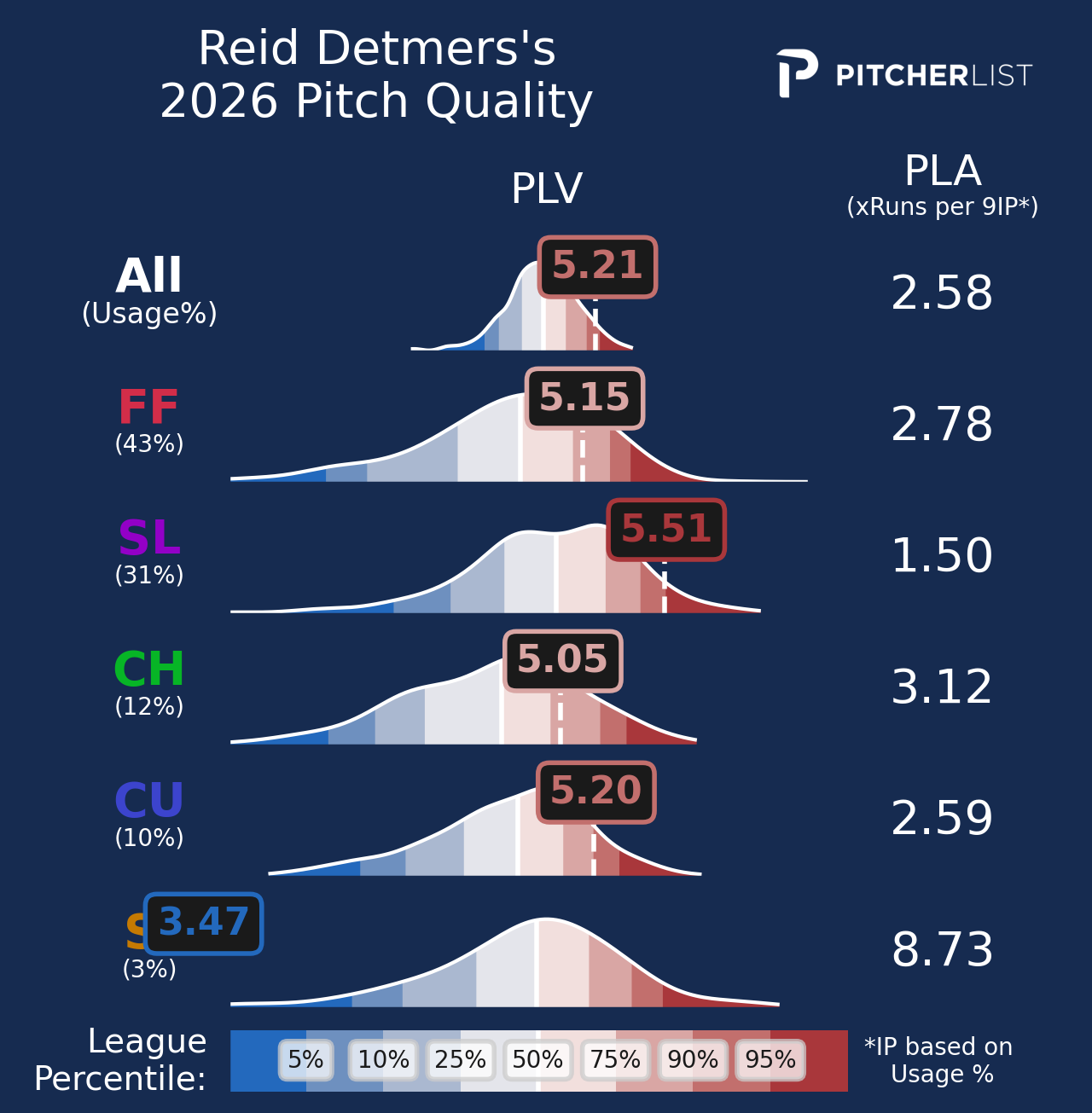
PLV grades 4 out of 5 of Detmers’ pitches as above average, culminating in an impressive 2.58 PLA, in line with other ERA estimators like xERA (2.87) and SIERA (3.20). His two-seam, thrown 3% of the time with a comically low 3.47 PLV, has been thrown out of zone 75% of the time and has decent results, but obviously doesn’t have the sample for a fair PLV grade.
While Detmers showed promise as a starter in 2022-2023, consistently above-average results evaded him. A disastrous 2024 season of poor results and bad luck sent Detmers back to the minors after posting a 6.70 ERA in 17 starts. A year in the bullpen last season brought his stuff to an elite level, and since joining the rotation in 2026, it’s remained a strength. Let’s compare his current offerings to his last full season in the rotation, where Detmers made 28 starts to a 4.48 ERA/4.13 FIP back in 2023:
Returning to the bullpen brought Detmers’ average PLV to a career-high 5.44 in 2025, and Detmers has partially retained this improvement with a second-best 5.21 average PLV in 2026. While his overall results may not reflect this trend, his most recent start against the Rangers at home certainly did. Detmers went eight innings, allowed just a solo home run to Jake Burger, and struck out 14 in one of the most dominant starts of the season. Detmers, however, failed to earn the win, although the Angels managed to score again in the ninth to prevail in Detmers’ dominant outing.
Regardless of his team’s competency, Detmers has shown the ability to generate strikeouts (28.3% strikeout rate, best as a starter), limit walks (7.2% walk rate, career best), and avoid too much hard contact (29.5% hard contact rate, career best). While some home run to fly ball luck (6.8%, averaged ~13% as a starter) suggests a career-best home run rate is due to regress, an unlucky 59.4 LOB% is likely to prevent his ERA from remaining too inflated. Look for Detmers to continue finding his groove as part of a surprisingly fun Angels rotation in 2026.
Ryan Weathers
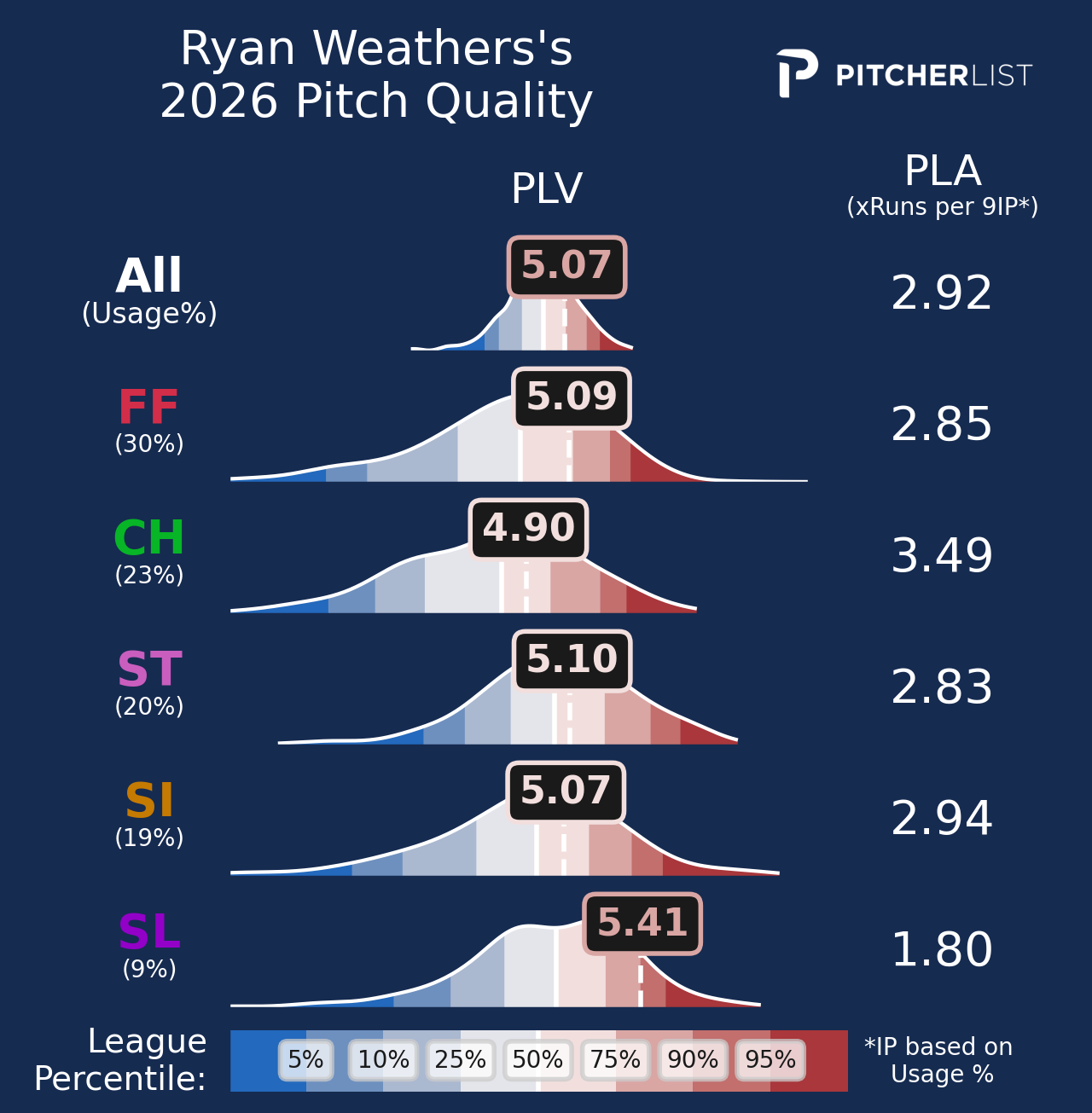
Weathers’ first season in the Bronx has seen a few adjustments to his arsenal, particularly in his approach against lefties.
- 2025 vs. LHB – 45% four-seam, .567 SLG against, 18.8% K-BB rate
- 2026 vs. LHB – 15% four-seam/37% sinker, .222 SLG against, 31.9% K-BB rate
Weathers’ strong changeup and four-seam combo remain a key part of his formula, giving him a reliable pair of offerings to handle righties. This pairing has improved since joining the Yankees, too, as Weathers added a few inches of run to his four-seam and four inches of drop to his changeup compared to 2025.
Still, Weathers’ greatest weapon is a strong pair of breaking balls. His sweeper, especially, has generated an elite 44.6% whiff rate and average EV of 74.8 mph, while his slider has an impressive 5.41 PLV. While his sweeper shape is fairly generic, his command of the pitch has been a huge difference maker in 2026, and a 112 Location+ overall has easily been a career-best.
A strong arsenal and impressive command have culminated in an above-average 2.92 PLA, as most run estimators do not see many warning signs of regression in Weathers’ results. Generally, home runs have been the kicker in most of his shorter outings, keeping Weathers from meeting IP qualifiers as a starter. Look for Weathers to remain healthy and limit the long ball down the stretch in 2026, either in a full-time starter role or an eventual shift to the bullpen.
Connelly Early
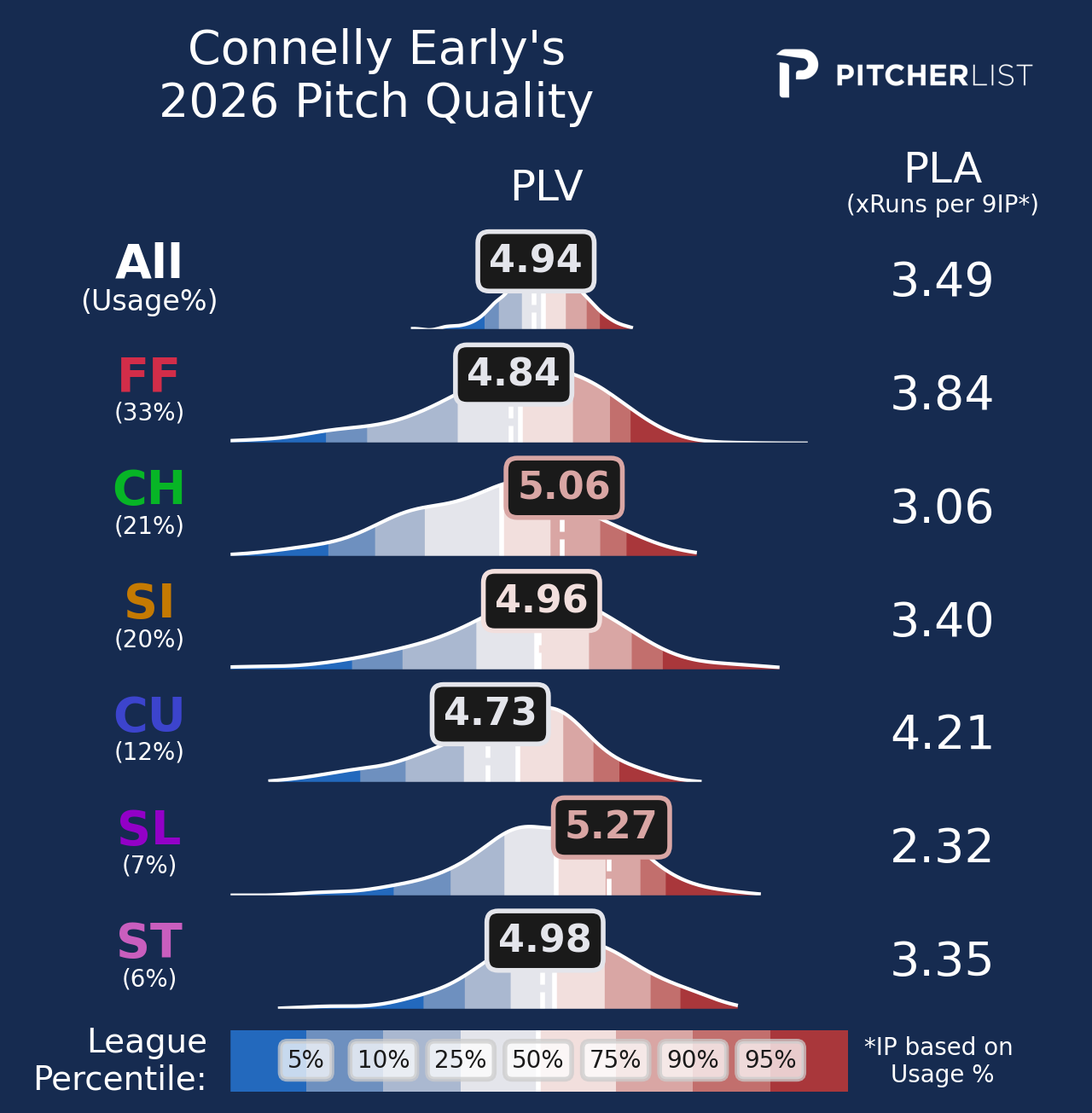
Early’s six-pitch arsenal gives him the means of handling both righties and lefties, as they’ve generated a mediocre .318 and .302 wOBA against Early, respectively. Still, Early is a vastly different pitcher against the two:
- vs R – 5 pitches > 7%, mostly FF/CH/CU, 11.9 K-BB%, 5 home runs in 39.2 IP, .271 BABIP, 4.35 xFIP
- vs L – 43% SI, 24% ST, 20% FF, 19.0 K-BB%, 4 home runs in 14.1 IP, .194 BABIP, 3.80 xFIP
Early’s struggles with home runs (1.50 HR/9) have mostly come against lefties, where hitters haven’t been reaching base as much as righties. His 86.9% left-on-base rate and .252 BABIP have also helped keep runs off the board, giving him a 3.33 ERA despite weaker run estimators like xERA (4.66) and xFIP (4.21). A 3.49 PLA is slightly below average for starters, too.
Overall, while Early’s results haven’t taken a huge step back from 2025, his process looks far less sustainable. Finding the same plus command he showed in 2025, or maybe some of the elite velocity he flashed in Spring Training, would be key to Early taking the next step in the Majors. His next start against the Braves in Boston will be key to seeing what Early has to offer throughout the rest of 2026.
