





Hello and welcome back to using PLA to evaluate pitchers! This series uses PLA, along with other run expectancy metrics, to break down results and better understand the process behind them.
This week, I will be taking a look at a few more starting pitchers already covered and recently dealt at the Trade Deadline to compare their first starts with their new clubs to their previous ones. For some more details on PLA and what goes into PLV scores, be sure to check out Nick Pollack and Kyle Bland’s breakdown here.
Clay Holmes
| PLA | ERA | xERA | FIP | xFIP | SIERA |
| 3.18 | 2.56 | 4.01 | 3.40 | 3.73 | 4.03 |
After an impressive start to the season with the Mets, Clay Holmes missed some time with a lower-half injury before being traded to the Cubs at the Trade Deadline. Now back to pitching in the Majors, Holmes has made two starts with his new club, most recently firing 6.2 IP with no runs and two baserunners allowed.
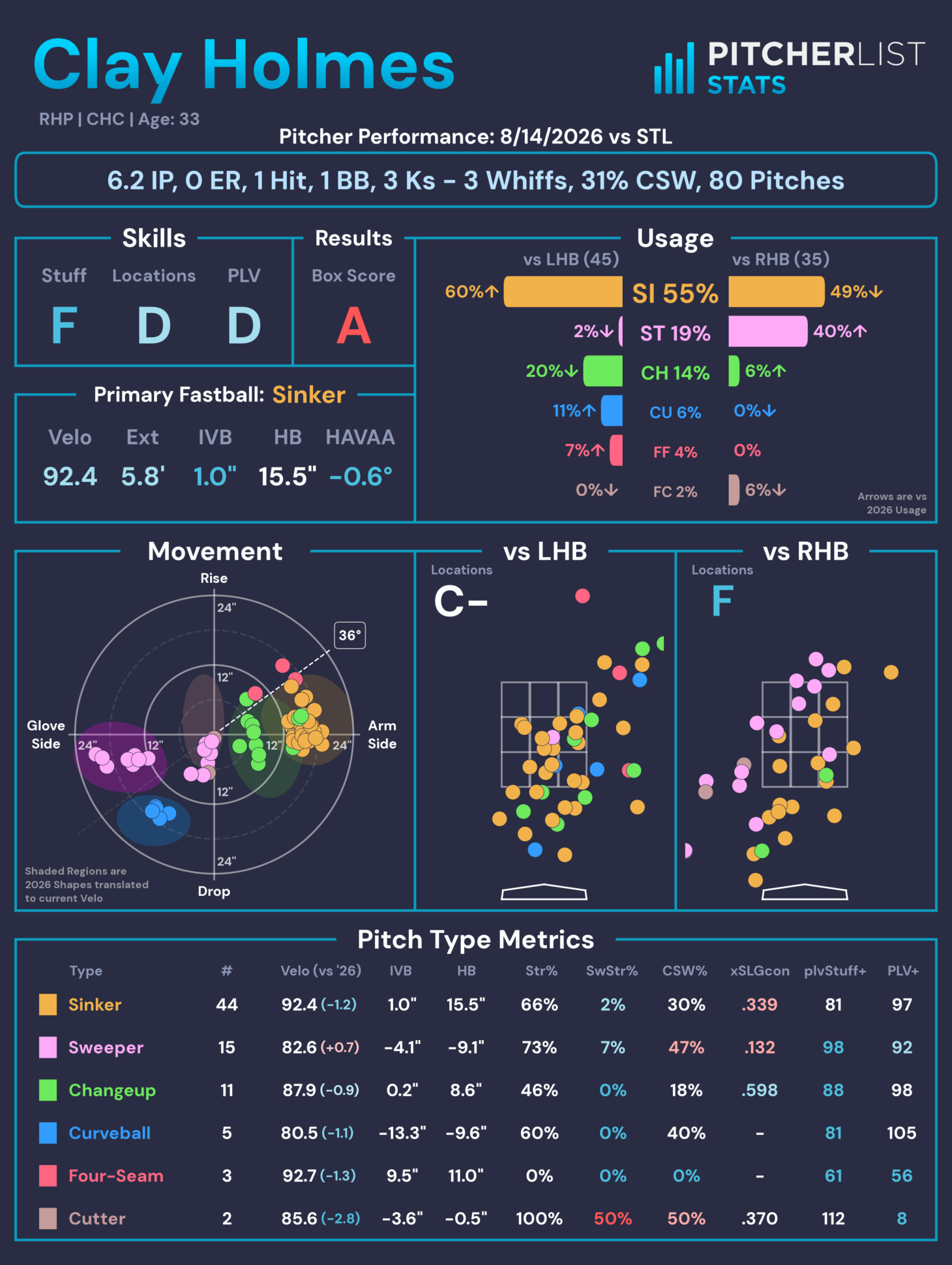
While his velocity hasn’t fully returned post-injury, Holmes used his deep arsenal and east-west approach to neutralize a fairly tough Cardinals lineup by pounding the strike zone, generating a remarkable 22 called strikes on just 80 pitches.
The skill grades on the night may be deceiving too, as some new shapes affected his pitch classification. Holmes threw ~8-10 bullet sliders with negative iVB on Friday, a newer pitch for him as a starter with serious promise. Having a bridge between his nasty seam-shifted sinker and two big breaking balls will be a big tool for Holmes to work deeper into games.
On the season, Holmes’ 3.18 PLA is solid for a starter, although making a few starts with diminished stuff hurts his overall numbers. I went a little deeper into Holmes’ numbers in each of his last two seasons as a starter in my pre-trade deadline PLA article, which can be found at this link.
Overall, Holmes projects to be a valuable starter for the Cubs down the stretch. Look for him to rebuild his velocity closer to pre-injury figures and earn some playoff innings near the top of the rotation.
Freddy Peralta
| PLA | ERA | xERA | FIP | xFIP | SIERA |
| 3.70 | 5.27 | 4.10 | 4.57 | 4.37 | 4.35 |
Freddy Peralta has had a wildly confusing 2026 season, taking major steps back with the Mets before being traded to the Rays and struggling in his first few starts there. While a team debut against the Rockies in Colorado was an unfortunate stroke of luck, Peralta’s lack of strikeouts and struggles with the long ball have continued throughout the year.
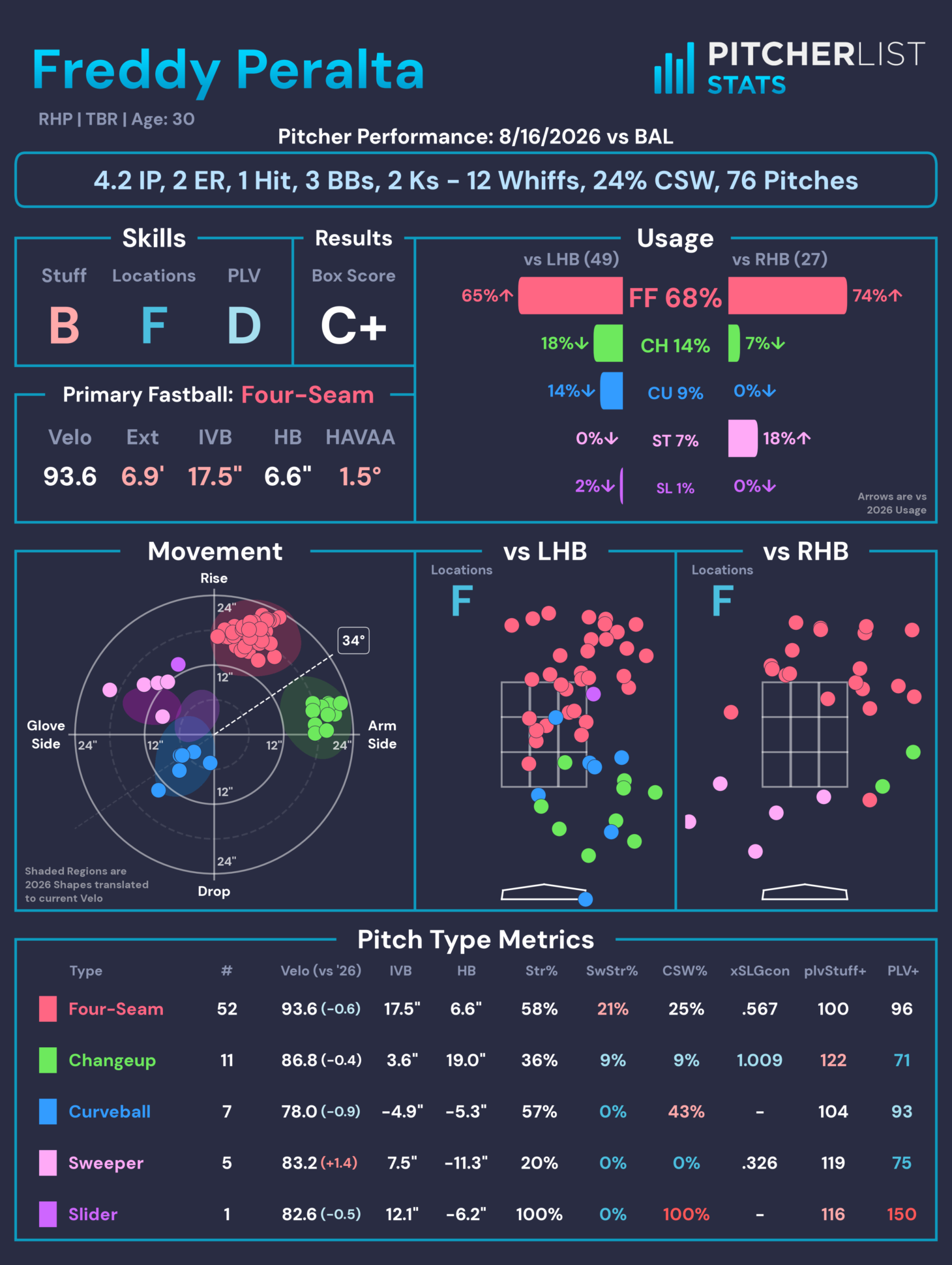
In his third start with the Rays and first in Tropicana Field, Peralta threw a ridiculous 68% four-seam fastball and just 37% of pitches in-zone. While 12 whiffs on 76 pitches is nice, Peralta avoided damage this time simply by living outside of the strike zone.
In his other two starts, Peralta has been emphasizing his changeup while working on extension, pitching exclusively out of the stretch and adding a couple inches of extension to his four-seam. Doing so can help supplement his weaker four-seam while adding deception to some of his weirder breaking ball shapes.
As one of if not the smartest pitching orgs in baseball, the Rays certainly have some changes in mind to get Peralta back to form. His 3.70 PLA overall is poor, thanks to inconsistent command and diminished velocity at times, but a profile of consistency (30+ starts in each of his last 4 seasons) and solid results with the Brewers gives him big time upside for the Rays in 2026.
Casey Mize
| PLA | ERA | xERA | FIP | xFIP | SIERA |
| 3.00 | 3.18 | 3.32 | 2.88 | 4.01 | 3.92 |
After an exceptional first half, Casey Mize was traded to the Padres at the deadline before allowing 8 earned runs in 3.1 innings in his team debut. Since, Mize has posted two quality starts against the Brewers and Guardians, quickly settling into his new uniform and continuing his strong season.
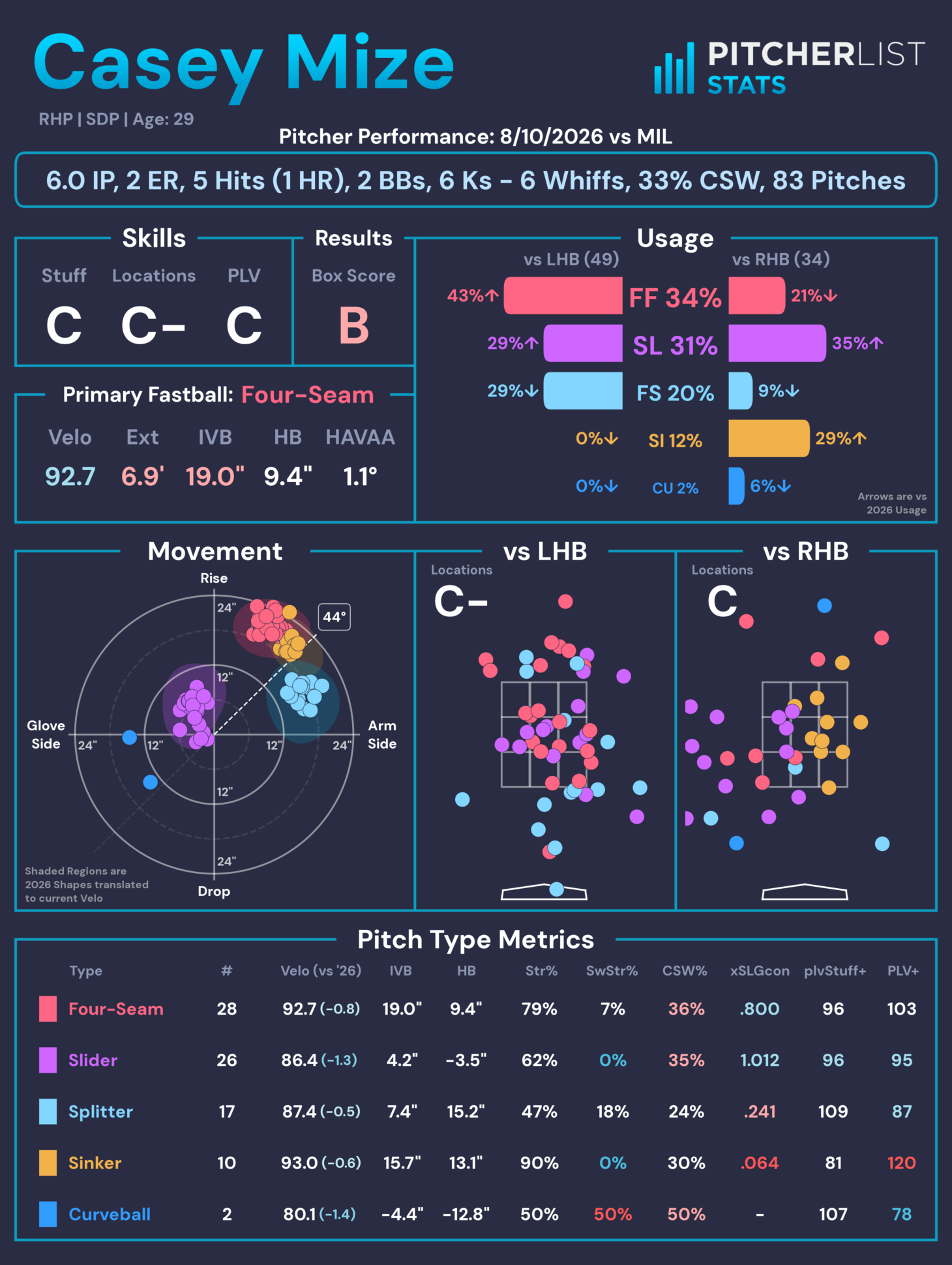
In that Brewers start, Mize generated an elite 21 called strikes against the Best Team in Ball despite sitting below 93 on his four-seam and not consistently executing his secondaries. His sinker carried the load against righties, pairing up nicely with his slider while a shaky four-seam/slider/splitter combination against lefties got the job done.
Mize’s pair of fastballs had elite carry in this start, sitting 19.0 inches of iVB on his four-seam. This helped generate poor contact/the occasional whiff at the top of the zone while his splitter worked below. In addition, his slider got enough strikes against lefties despite being thrown in the heart of the zone and sitting a couple ticks below ideal velocity.
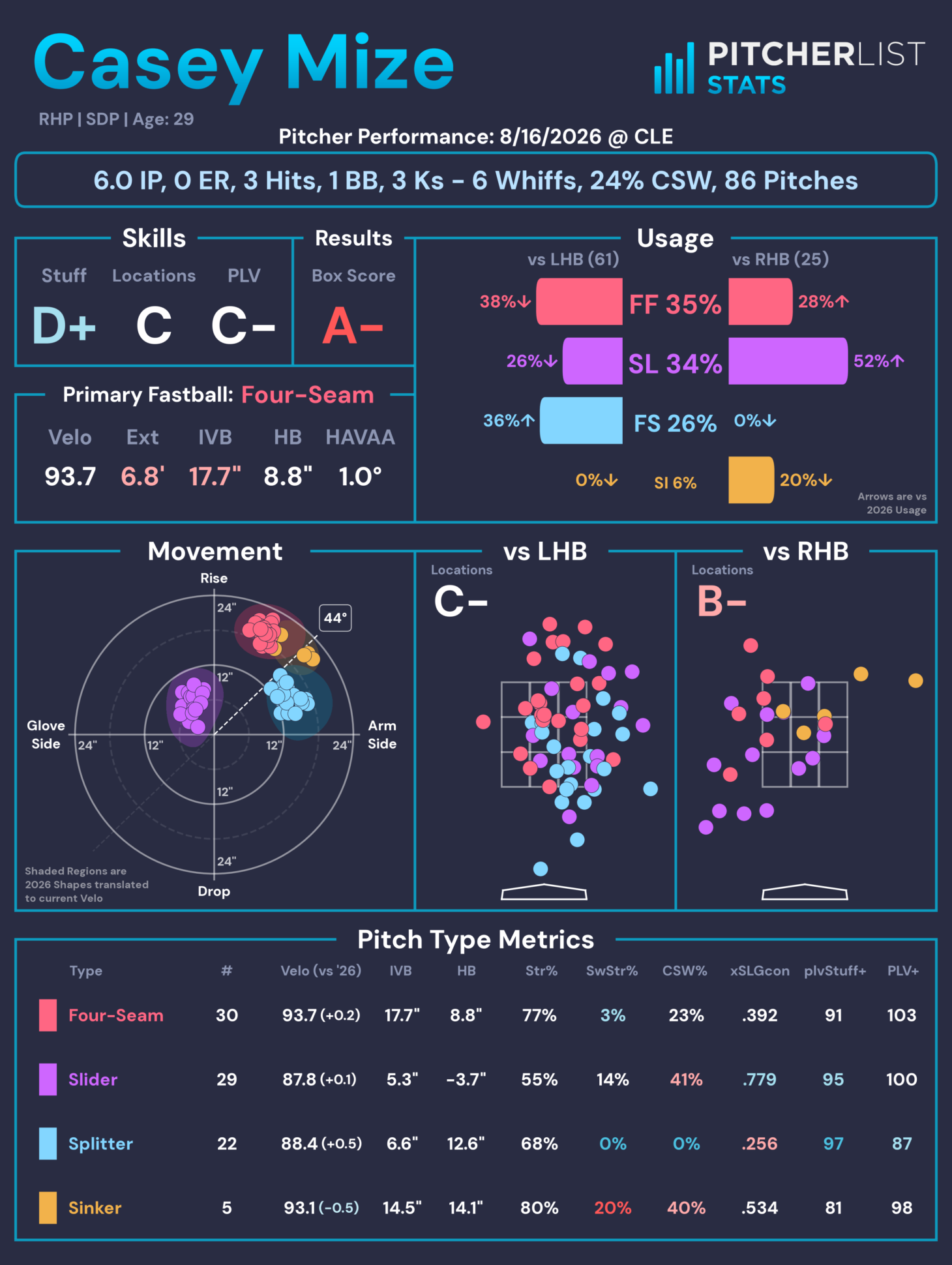
In a far more favorable start against the Guardians, Mize’s velocity and secondary execution looked far better. Like in his previous start, Mise filled up the zone with four-seam/splitter/slider against lefties while throwing his slider for chases and sinker/four-seam for called strikes against righties.
While such a simplified arsenal may be ideal for a pitcher like Mize, his velocity staying at a solid level will be imperative for his continued success. His slider looked far better in this second start at 87.8, and his pair of fastballs either retaining the elite carry from his Brewers start or slightly better velo from this Guardians start will be necessary.
However, somewhat of a common denominator from these two outings has been the lack of execution on his splitter. A .241 and .256 xSLGcon on the pitch in the two starts is nice, but zero called strikes or whiffs in his Guardians outing is bad for what’s been one of his most valuable offerings. In 2024, a season with his worst results as pro, his splitter was his least valuable offering, despite its frequent usage.
The pitch has been left in-zone and elevated too frequently for it to continue avoiding damage. Having a strong slider complement his splitter’s arm-side break has been helpful for called strikes, but some more usage inside against lefties or mixing in his bigger curveball may help the splitter earn whiffs outside and below the zone.
On the season, Mize’s 3.00 PLA is solid and carried by his much improved slider and surprisingly valuable two-seam fastball. Ensuring his four-seam also remains effective at the top of the zone and splitter at the bottom will be key for Mize to continue his strong 2026, now with the Padres in the midst of a playoff chase.
