





Hello and welcome back to using PLA to evaluate pitchers! This series uses PLA, along with other run expectancy metrics, to break down results and better understand the process behind them.
This week, I will be taking a look at a few starting pitchers whose names have recently popped up in trade discussions. For some more details on PLA and what goes into PLV scores, be sure to check out Nick Pollack and Kyle Bland’s breakdown here.
Kevin Gausman
Kevin Gausman is pitching in the final year of a 5-year, $110 million contract with the Blue Jays in 2026, a contract where Gausman has yet to produce a season with fewer than 31 starts and less than 3.0 fWAR. While a 4.51 ERA is his highest since 2019, his ERA estimators like xFIP (3.82) and SIERA (3.85) remain above average and relatively unchanged over his last few seasons.
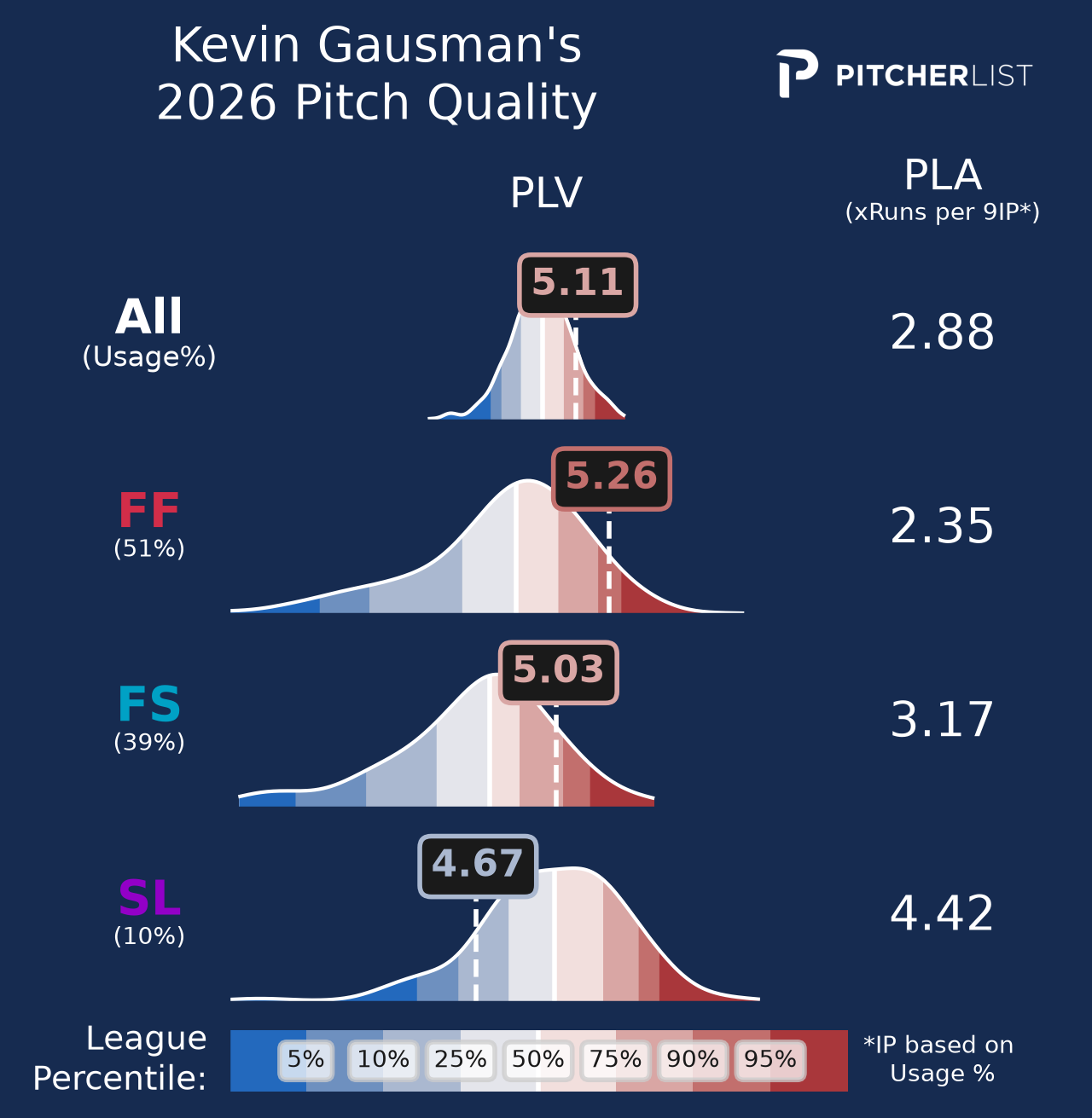
Gausman’s unique profile as a relatively two-pitch starter has made him a unicorn in the modern era. In a time where most young pitchers reach the Majors with at least four pitches to work with, Gausman has defined himself as an uber-consistent workhorse capable of topping 180 IP in all but one season (2022) since the COVID-shortened 2020.
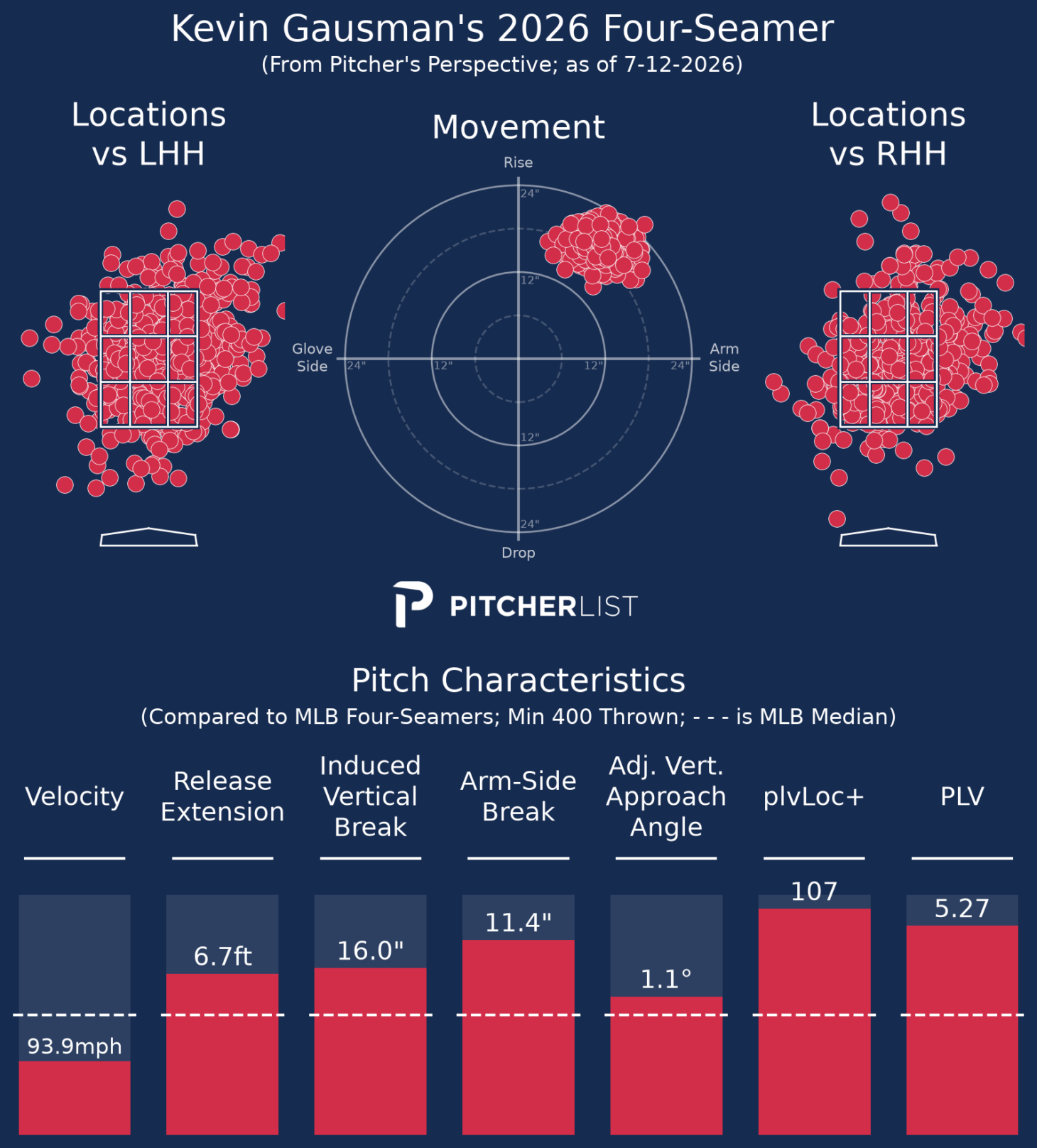
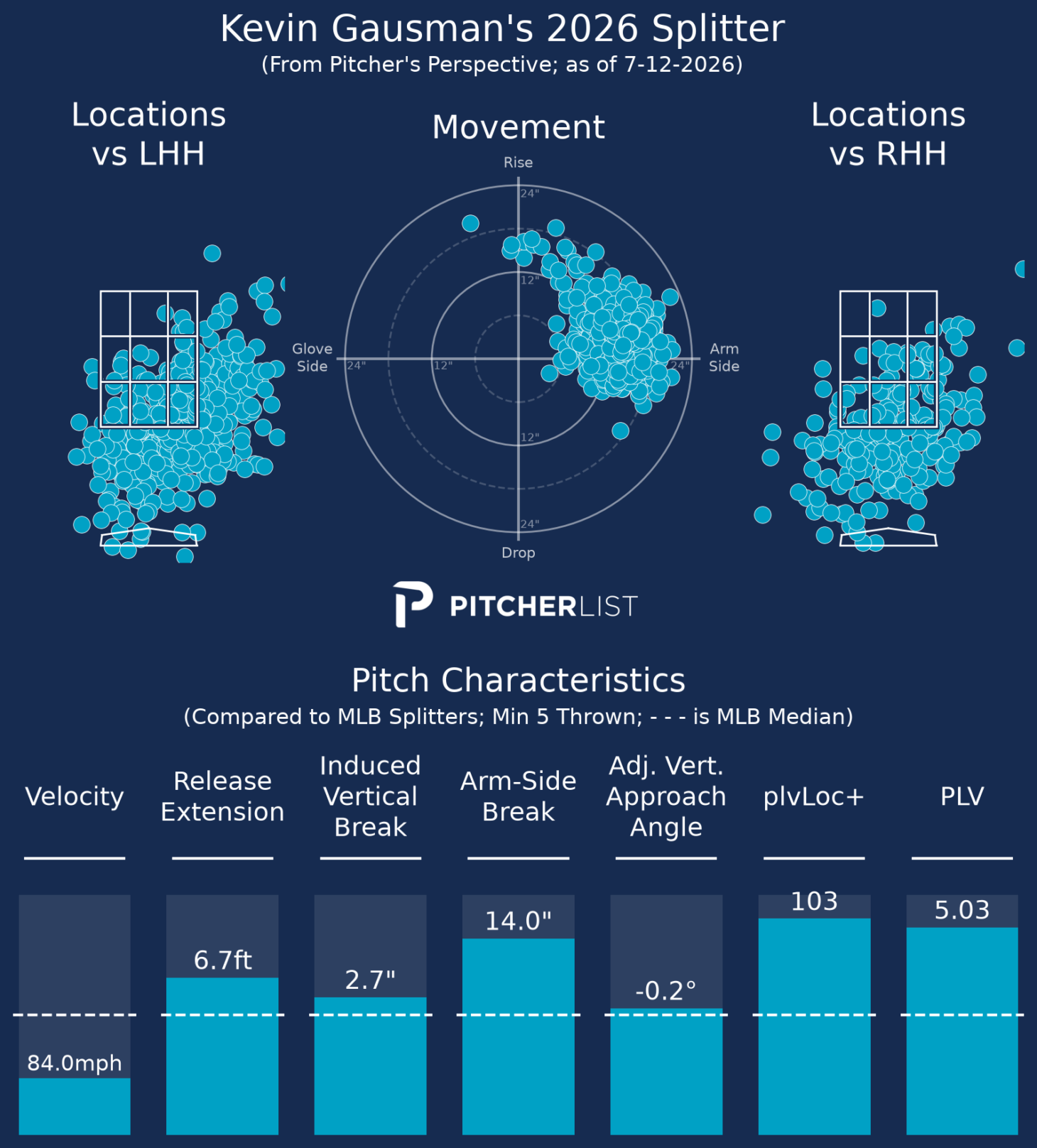
The approach giving Gausman a borderline-HOF worthy career is four-seams in the zone and splitters for chases; his high-carry four-seam has a 23.1% called strike rate, and his lethal splitter has a 20.3% swinging strike rate in 2026. While his bullet slider has seen fairly regular usage this season, its low velocity and predictable shape haven’t induced great results. Still, it serves as a necessary change of pace against righties and gets whiffs when necessary.
So what’s caused the ERA spike? In his age-35 season, Gausman’s four-seam averaging 93.9 mph is its lowest since 2018 and his splitter at 84.0 is its lowest since 2021. While his command remains excellent, every tick of velocity matters as a two-pitch starter relying entirely on deception.
A 65.7% strand rate being his lowest since 2019 also indicates a bit of bad luck has factored into his raised ERA. A few blow up starts also seem to be a contributing factor. Allowing seven earned runs in two innings against the Cubs, six in 4.2 against the Rays, and six in 6.0 against the Rangers have stood out the most. Outings like these typically end with Gausman battling through to give the Blue Jays length in spite of poor results, excluding the Cubs catastrophe.
All-in-all, 2026 has been another season of Gausman giving his team a full season’s workload (so far) with serviceable results. His 2.5 fWAR is top-25 in the league, and the highest for anyone with an ERA as high as his, and his 2.89 PLA is roughly in line with his other ERA estimators. Look for Gausman to finish strong in 2026 and earn another big contract in the offseason.
Casey Mize
Casey Mize has impressed massively in 2026, leading the Tigers pitching staff in fWAR through 16 starts with a career-best 2.70 ERA/2.59 FIP. While an unsustainably low 4.5% home run to fly ball rate suggests both those figures are to increase, ERA estimators like xFIP (3.80) and SIERA (3.70) still project him as above-average, while a 19.4% strikeout minus walk rate is easily a career best.
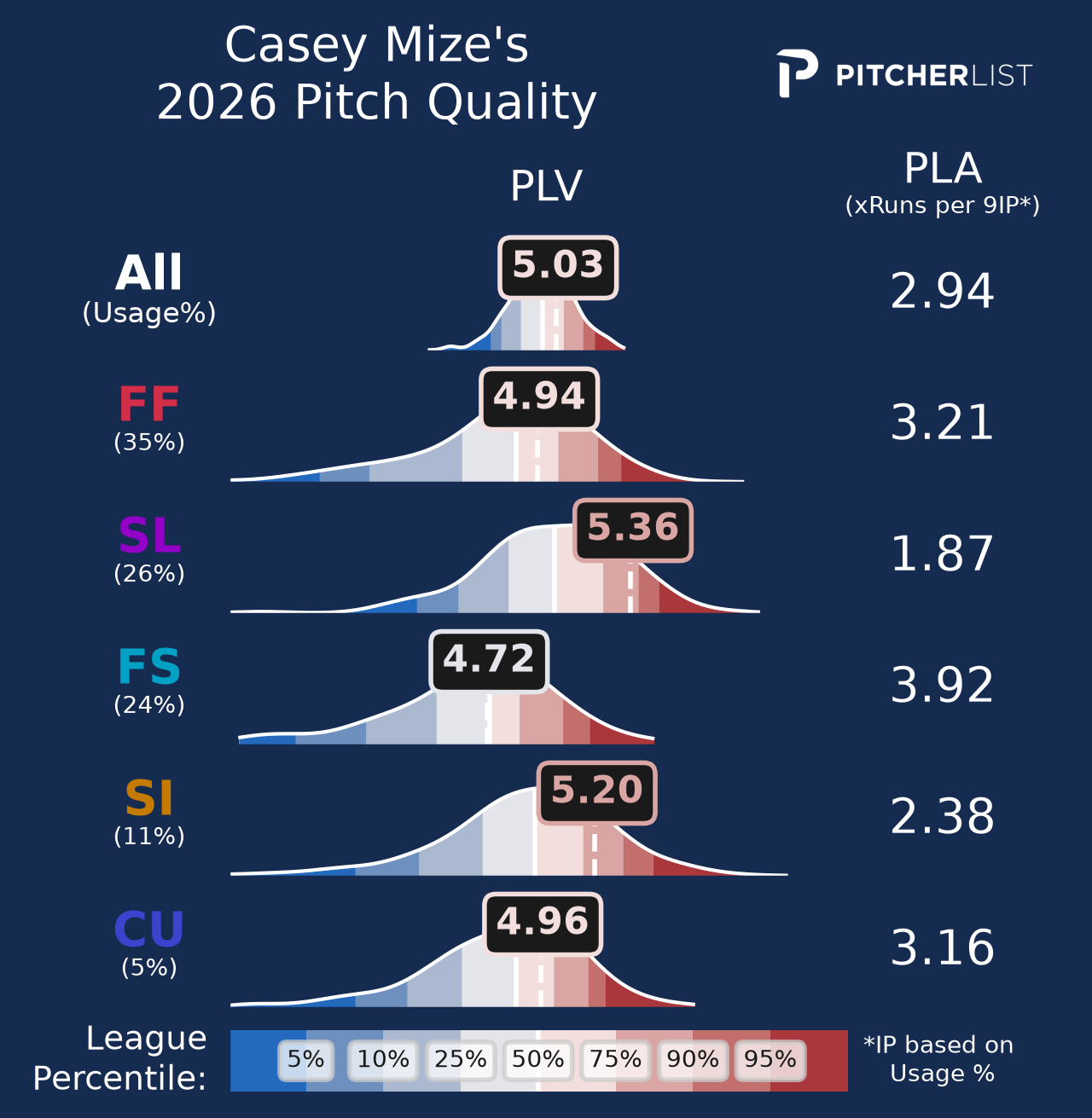
Compared to 2025, Mize’s stuff has seemingly taken a step back. His velocity, one of his biggest traits as a developing prospect, is down about a tick across the board, and now seemingly taking the next step in the Majors, Mize has found results without throwing as hard as some of his contemporaries. However, he’s made jumps in other parts of his arsenal that have supplemented such a change.
Like Gausman, Mize’s four-seam/splitter pairing has given him means of neutralizing lefties, but developing his arsenal around that has been somewhat of a challenge. Finding a sweet spot for his slider has been one of those challenges, as the pitch has taken many forms over the past few seasons. With his results now improving and his slider generating an elite 1.87 PLA in 2026, let’s look at how the pitch has aged in recent years.
- 2024 – 85.8 mph, 0.2 iVB -3.6 iHB, -6 Run Value – approaching “death ball” shape but too slow, limited whiffs (20.8%) and only slow curve as alternate breaking ball shape
- 2025 – 88.2 mph, 4.5 iVB -2.2 iHB, +4 Run Value – new cutter-esque shape with better velo, still not enough whiffs (19.5%) and slurve returns as alternate breaking ball
- 2026 – 87.7 mph, 5.3 iVB -3.5 iHB, +4 Run Value – might be the sweet spot? Plus velocity and 18 inches of separation from splitter, still has slurve with now plus movement at 81.4 mph!
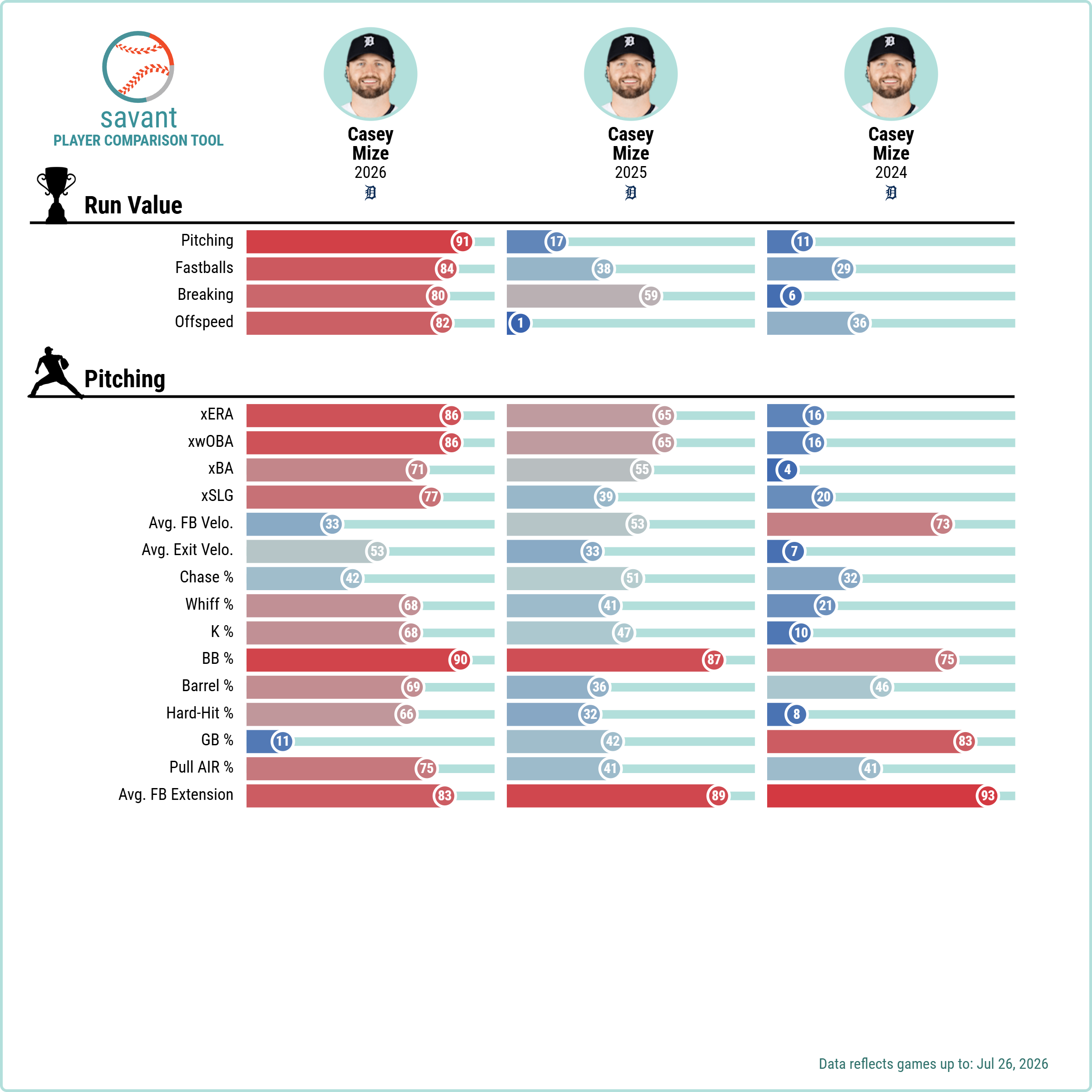
Back in Spring Training 2025, I looked into Mize as a rebound candidate thanks to his elite prospect pedigree and deep arsenal with a few missing pieces. His slider taking a jump in chase and whiff rate seemed like a target for his development at the time, and two years later, it’s become one of the keys to his success.
Mize’s slider taking a big step forward has also made his split better; while grading out well in 2025, the pitch was absolutely crushed, as the rest of his arsenal wasn’t all there. Now tossing an improved slider and a four-seam/sinker pair with better carry, his splitter has become more of a threat and helps his fastballs generate called strikes and swing-and-miss.
A free agent following the 2026 season, look for Mize to finish strong and hopefully earn himself a payday in the offseason.
Clay Holmes
Prior to a mid-May lower leg injury, Clay Holmes impressed in his first nine starts, following up a breakout 2025 season as a starter with the Mets. While injured players are rarely traded, Holmes is currently rehabbing in AAA and should be up almost immediately after the trade deadline. Holmes is also on year two of a three-year contract with the Mets, containing a player option for 2027 he’d be likely to opt out of, assuming a healthy finish to 2026.
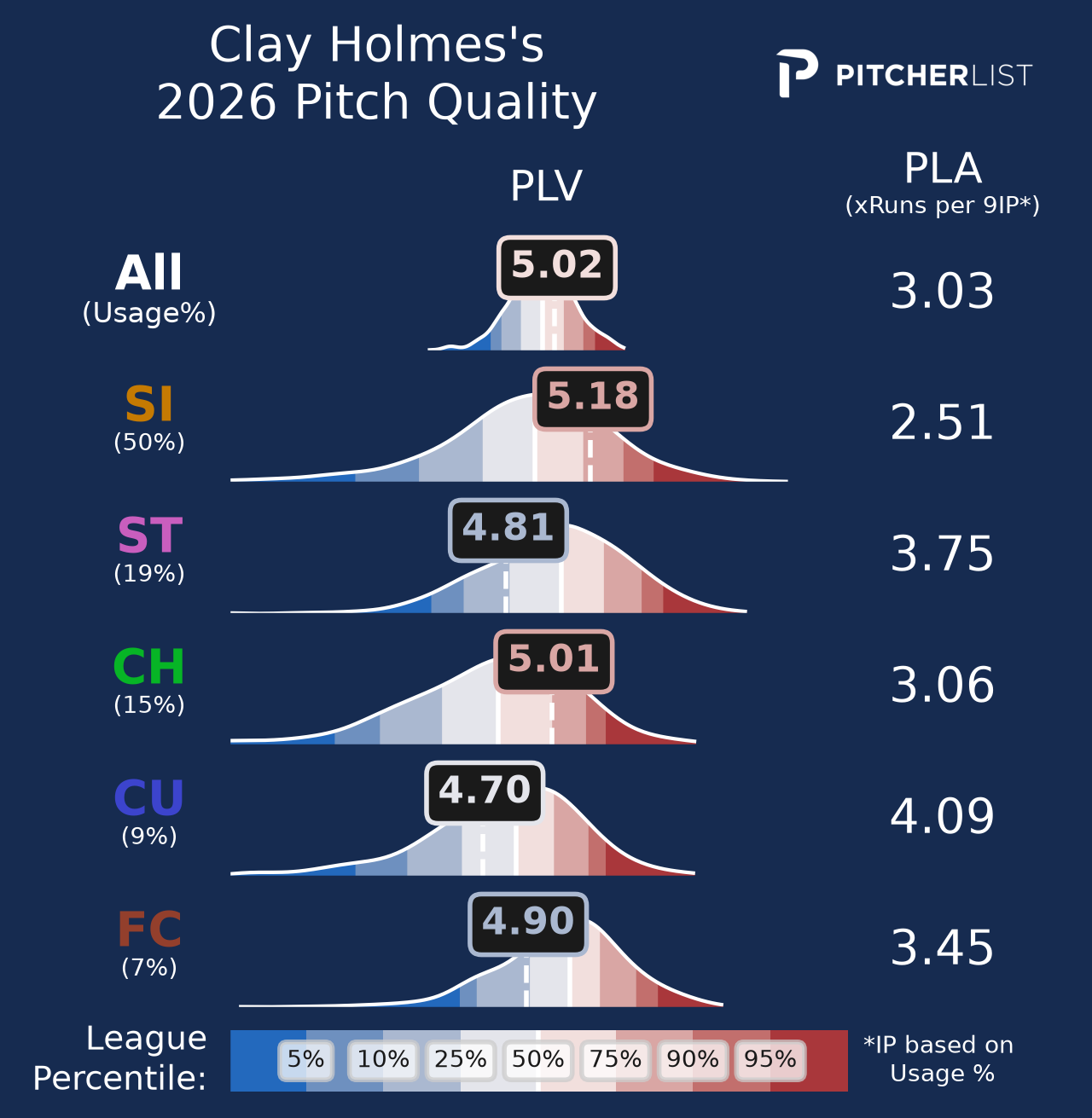
In 2025, Holmes translated his sinker/slider/sweeper approach as a reliever into a six-pitch arsenal as a starter, adding a kick-change, four-seam, and cutter to help against lefties. While losing a few ticks of velocity hurt his swing-and-miss, his ridiculously high ground ball rate mostly translated and he continued to limit hard contact in the air. This gave Holmes a very successful first season as a starter, pitching to a 3.53 ERA in 165.2 innings as possibly the Mets’ only reliable starter.
In 2026, Holmes appeared to take yet another step forward, making a few key changes to his arsenal in his nine starts as he further adjusts to starting:
- Added CU – -14.7 iVB -10.3 iHB at 81.6 mph is pretty strong! Elite results (.063 BAA, .125 SLG) in small sample, seems to have replaced slow bullet slider
- Changed FC (new SL?) – 2.9 iVB -1.7 iHB at 88.7, although there seems to be a split between ~0 iVB bullet sliders around 87-88 mph and ~6 iVB cutters at 90-91 – this is very nice
- Improved CH – -1.8 iVB (wow) 8.8 iHB at 88.8, compared to 2025 has 2 inches more drop/3 inches less run – big separation from sinker, ridiculous shape from fairly neutral arm slot, gives him 5-7 pitches with distinct shapes, plus movement and average velocity
In his nine starts back in April/May, Holmes pitched to an above-average 3.04 PLA while averaging nearly six IP/start. ERA estimators like xFIP (3.71) and SIERA (4.00) have him in a similar place, and now returning from injury, Holmes will hope to sustain these results with roughly 10 starts left in the season. While whatever we get of Holmes following injury remains to be seen, here’s to hoping we get more of this.
All in all, this version of Clay Holmes is very impressive. As a reliever, his ability to play with depth and generate elite movement made him a lethal ground-ball and swing-and-miss weapon. Now as a starter, he’s developed the arsenal of a seasoned veteran and will look to prove his status as such down the stretch in 2026.
