





Hello and welcome back to using PLA to evaluate pitchers! This series uses PLA, along with other run expectancy metrics, to break down results and better understand the process behind them.
This week, I will be taking a look at a few starting pitchers already covered and recently dealt at the Trade Deadline to compare their first starts with their new clubs to their previous ones. For some more details on PLA and what goes into PLV scores, be sure to check out Nick Pollack and Kyle Bland’s breakdown here.
José Soriano
José Soriano broke out early in 2026 before cooling off in June, showing off enough potential to earn a hefty return in a trade to the Blue Jays. The 27-year-old is pitching in his fourth MLB season and will enter arbitration for the first time at the conclusion of the 2026 season.
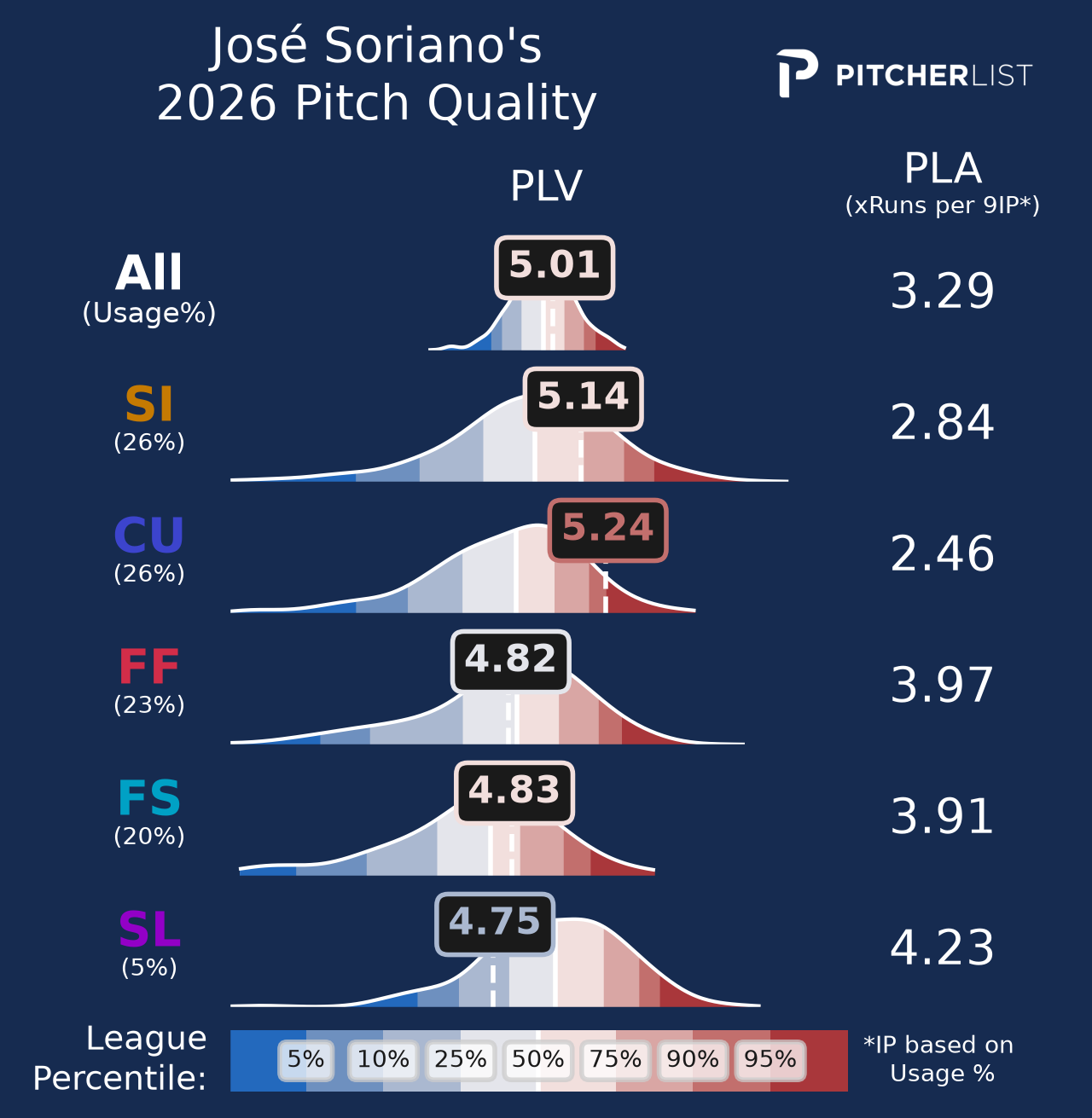
Soriano’s biggest challenges with the Angels stemmed from command struggles and bizarre usage trends, relying on his mediocre four-seam too often and surrendering 8 home runs on the pitch (4 on other pitches). Still, Soriano’s nasty sinker/curveball pairing, combined with a strong splitter and hard bullet slider, gives him a high velocity arsenal capable of generating elite whiff and ground ball rates.
Soriano was one of the first pitchers I looked at during this season’s PLA articles; back then his stuff was nastier than now, and command troubles seemed like the only thing holding him back. Now with the Blue Jays, a team that cut fellow high walk rate starter Dylan Cease’s ERA in half in 2026, let’s look at some pitch usage changes in his first start with the team that seem to be a trend in the right direction.
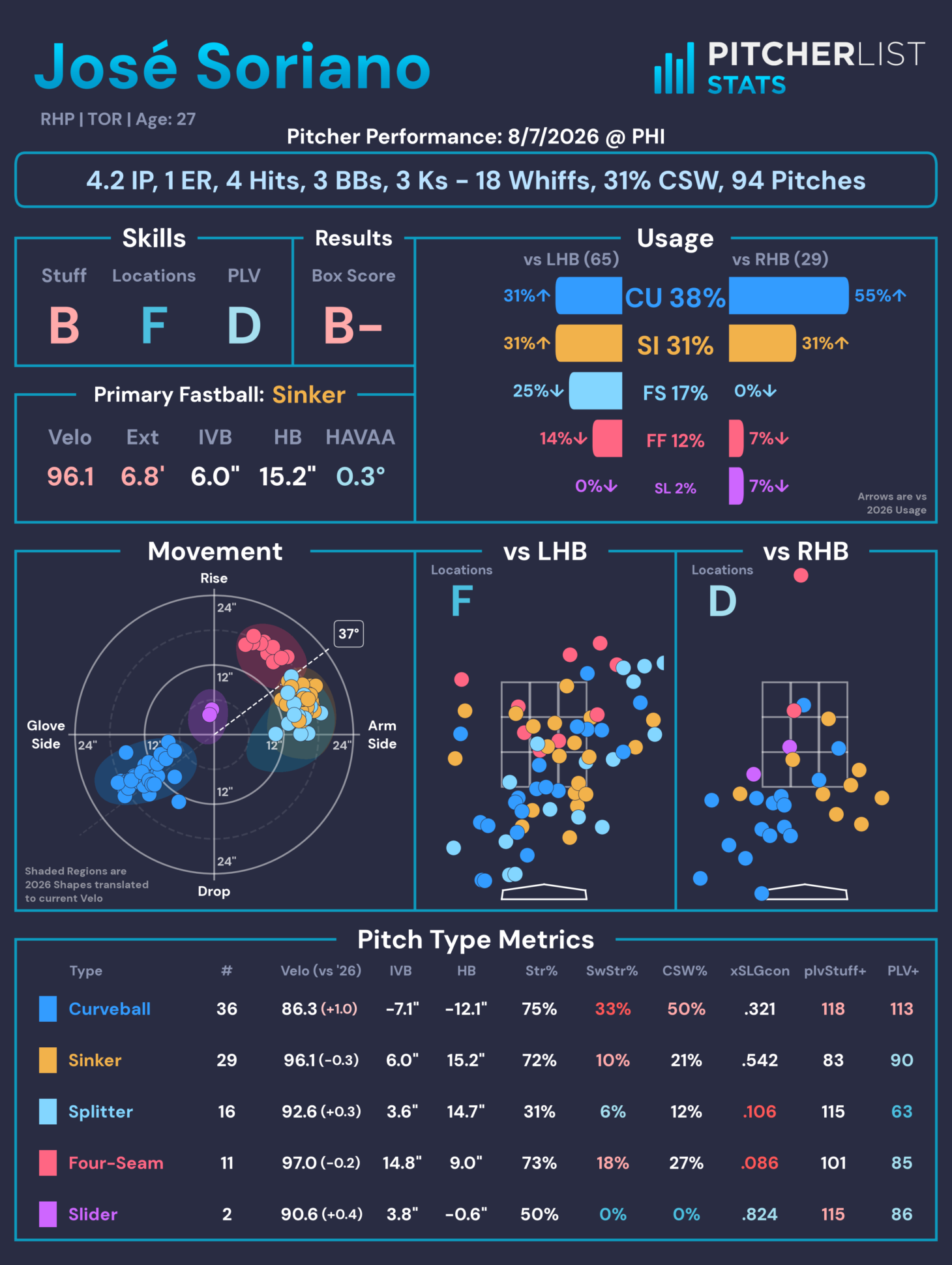
In Philadelphia for his first start, Soriano threw his curveball ~40% of the time for a ridiculous 33% swinging strike rate and 75% strike rate despite being out of zone quite a lot. He was also throwing the pitch about a mph harder than average without a step down in shape. Soriano struggled to locate his splitter and didn’t have his best sinker, giving him a B- box score with otherwise promising usage trends.
In addition, his four-seam looked better than it has in the past, carrying another inch and a half and avoiding loud contact. With an improved shape and ~15% usage, it becomes a far more usable pitch.
On the season, Soriano’s 3.36 PLA is fairly average and reflects his poor command coupled with plus stuff. While the Blue Jays may not compete for a playoff spot down the stretch in 2026, look for Soriano to make sustainable changes and settle into a top of the rotation spot for the Blue Jays in the future.
Kevin Gausman
After being included in my pre-trade deadline edition PLA article, Kevin Gausman was traded to the Chicago Cubs as a rental to boost their rotation down the stretch. The veteran starter has had a relatively down 2026 in terms of ERA but carries similarly strong peripherals to past seasons, and now pitches with the best infield defense in baseball behind him in Chicago.
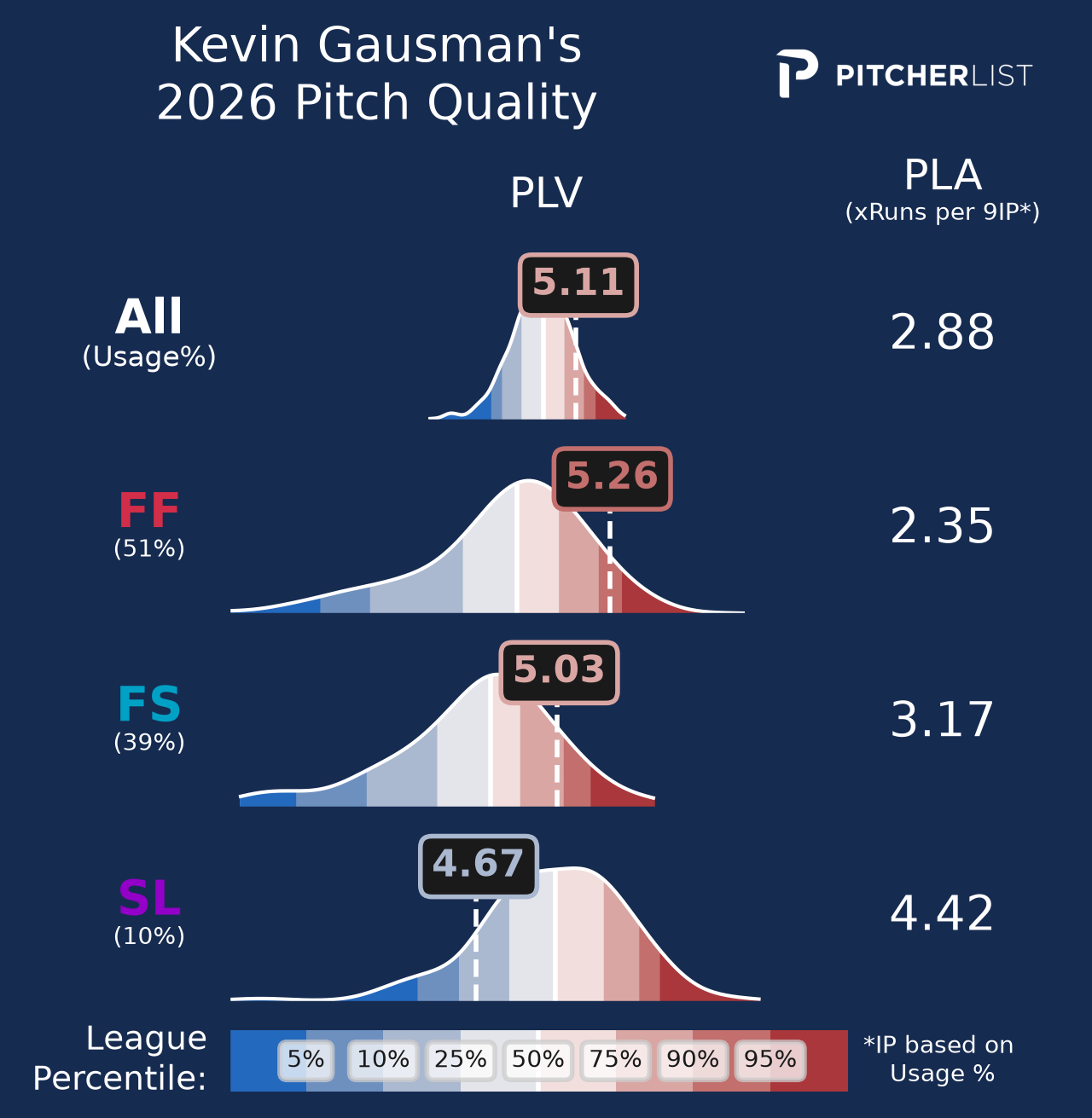
Gausman’s iconic two-pitch arsenal has given him a career of consistency despite a competitive run environment, especially in the 2020’s AL East. Back in July, Gausman’s biggest faults in 2026 have been hurt by a minor decline in velocity leading to louder contact than usual. In his first start with the Cubs, this seemed to be less of a problem.
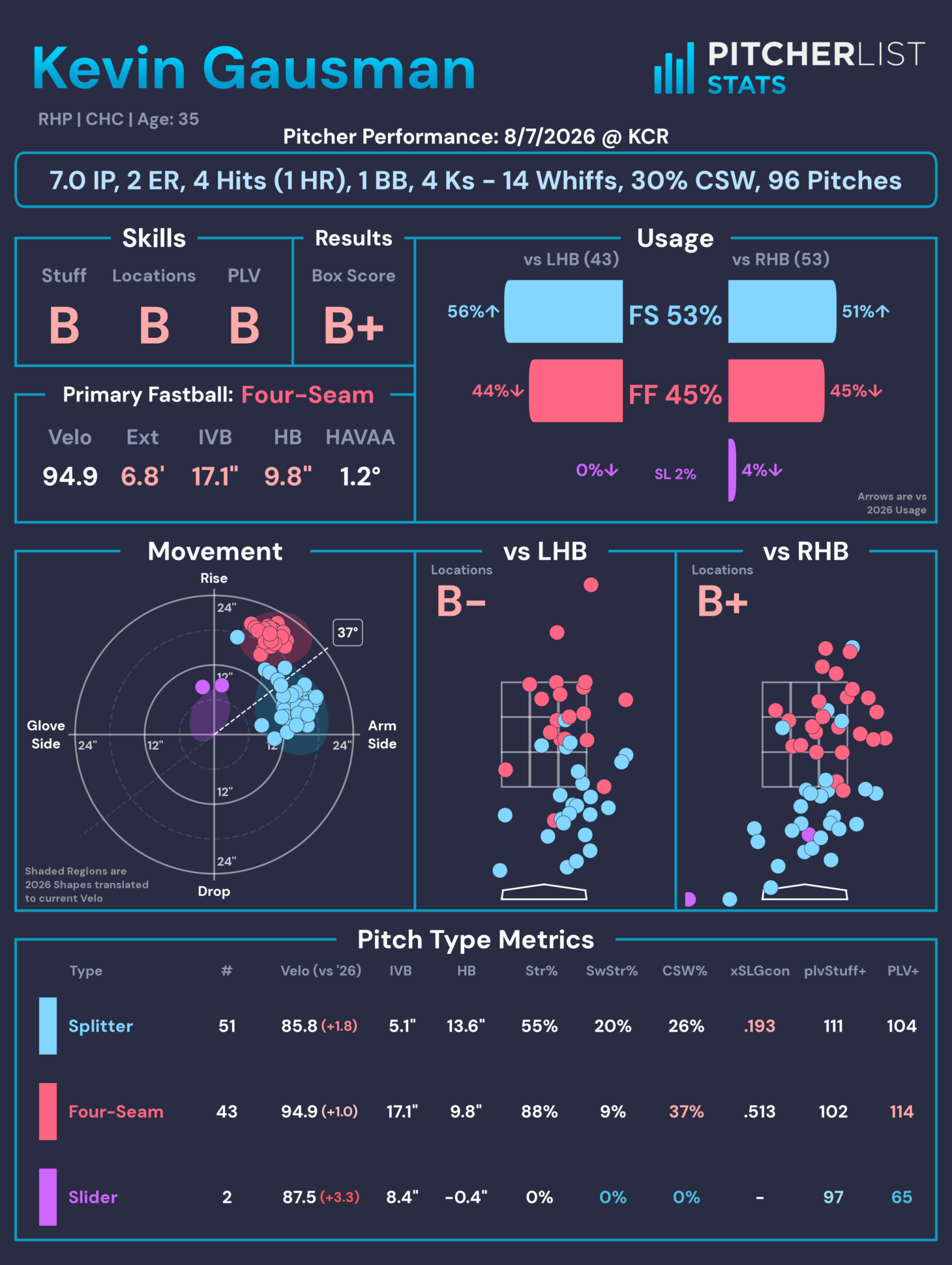
Pitching in Wrigley with the best defense in baseball behind him (and likely a ton of adrenaline), Gausman flipped his four-seam/splitter usage and thrived. The Cubs sharp infield defense consistently generated ground ball outs from his splitter while his four-seam’s ridiculous 88% strike rate kept his pitch count in great shape. Gausman also seemed to try out a new slider shape as his third offering, looking far more like a cutter at 87.5 mph.
In addition to these usage trends, Gausman’s ridiculous command looked as sharp as ever and remains key to his success, especially in the postseason. Look for Gausman to sustain this command (and hopefully some of this velocity!) as one of the Cubs’ top starters down the stretch in 2026.
Dustin May
Dustin May has pitched for four teams in the last two seasons, now settling into the Brewers’ rotation leading up to the 2026 playoffs. After a rocky 2025 and start to 2026, May has been a remarkably valuable starter, pitching to a 3.26 FIP in 22 starts, which would be second to Jacob Misiorowski in the Brewers’ rotation.
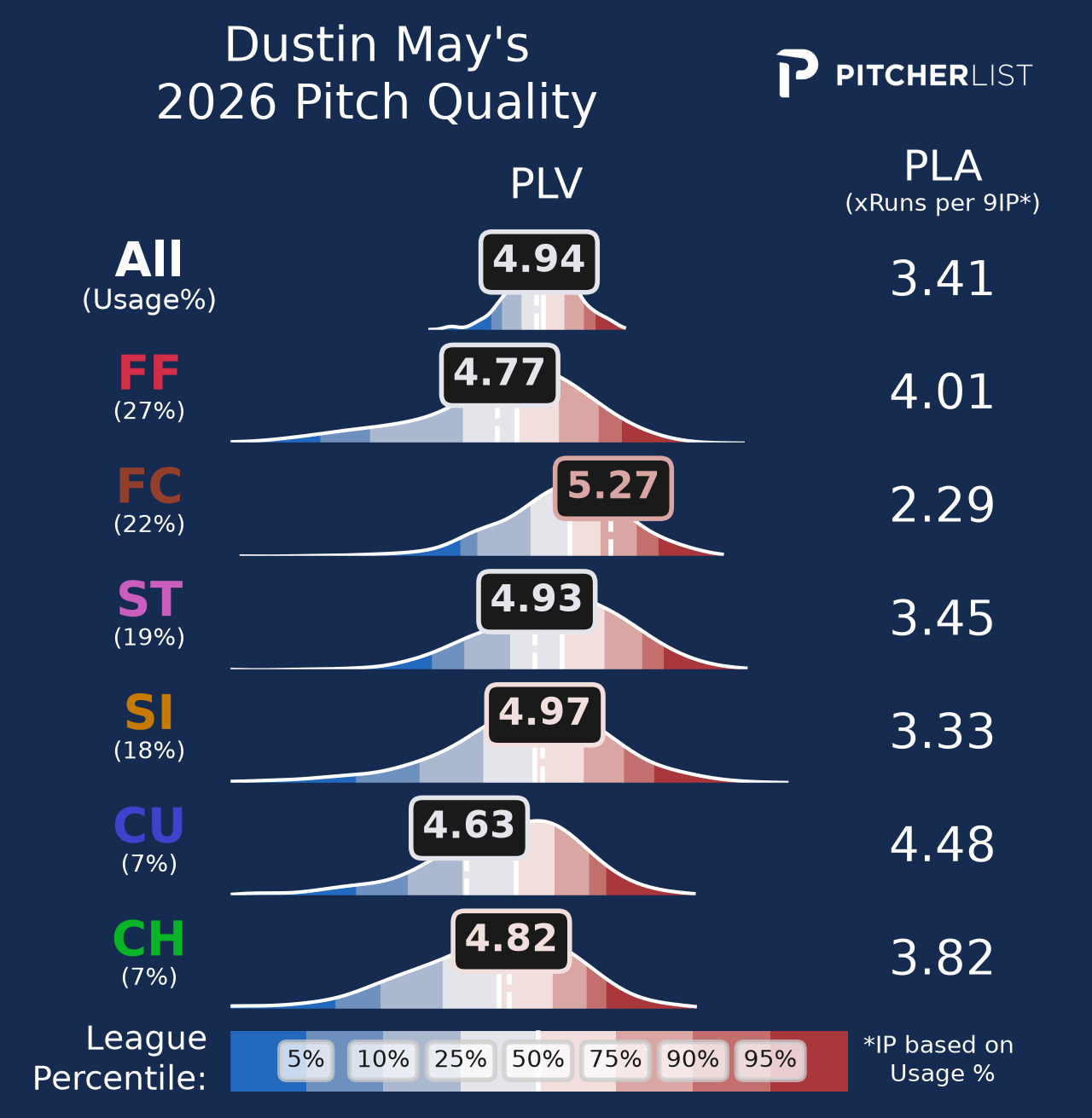
May’s deep arsenal gives way to a mostly sinker/sweeper approach for righties and six-pitch mix against lefties. Despite a 45.7% hard-hit rate landing far below average, May’s strong strikeout minus walk rate (15.1%) and ground ball rate (42.3%) give him a few ways to get tough batters out.
I last looked at May in early June, where his breaking ball command seemed an issue and his trio of reliable fastballs carried the load. This trend has continued, with his cutter especially standing out, and all three pitches making stark improvements compared to 2025:
- FF: +1.5 mph (now 96.9 mph), +2 inches of iVB and -1.5 iHB – more separation from SI and higher velocity, decent enough command, good pitch!
- FC: +2 mph (now 93.4 mph), +2.5 inches iVB and -1.5 iHB – more cut, more velocity, yes good
- SI: +2.1 mph (now 96.6), no IVB change and -1 iHB – practically no movement difference and higher velocity
These remarkable changes seemingly stem from a higher arm slot, bumping up from 21 degrees in 2025 to 34 in 2026. Both his four-seam and cutter have taken big steps forward in shape thanks to the change, yet his sinker has kept its great shape and while adding two mph of velocity.
While his other secondaries are still struggling, May’s strong trio of fastballs give him means of handling all types of batters. It seems re-unlocking his breaking balls may be key to taking that next step back to elite form, as we’ve seen flashes of, yet this version of Dustin May looks as impressive as ever.
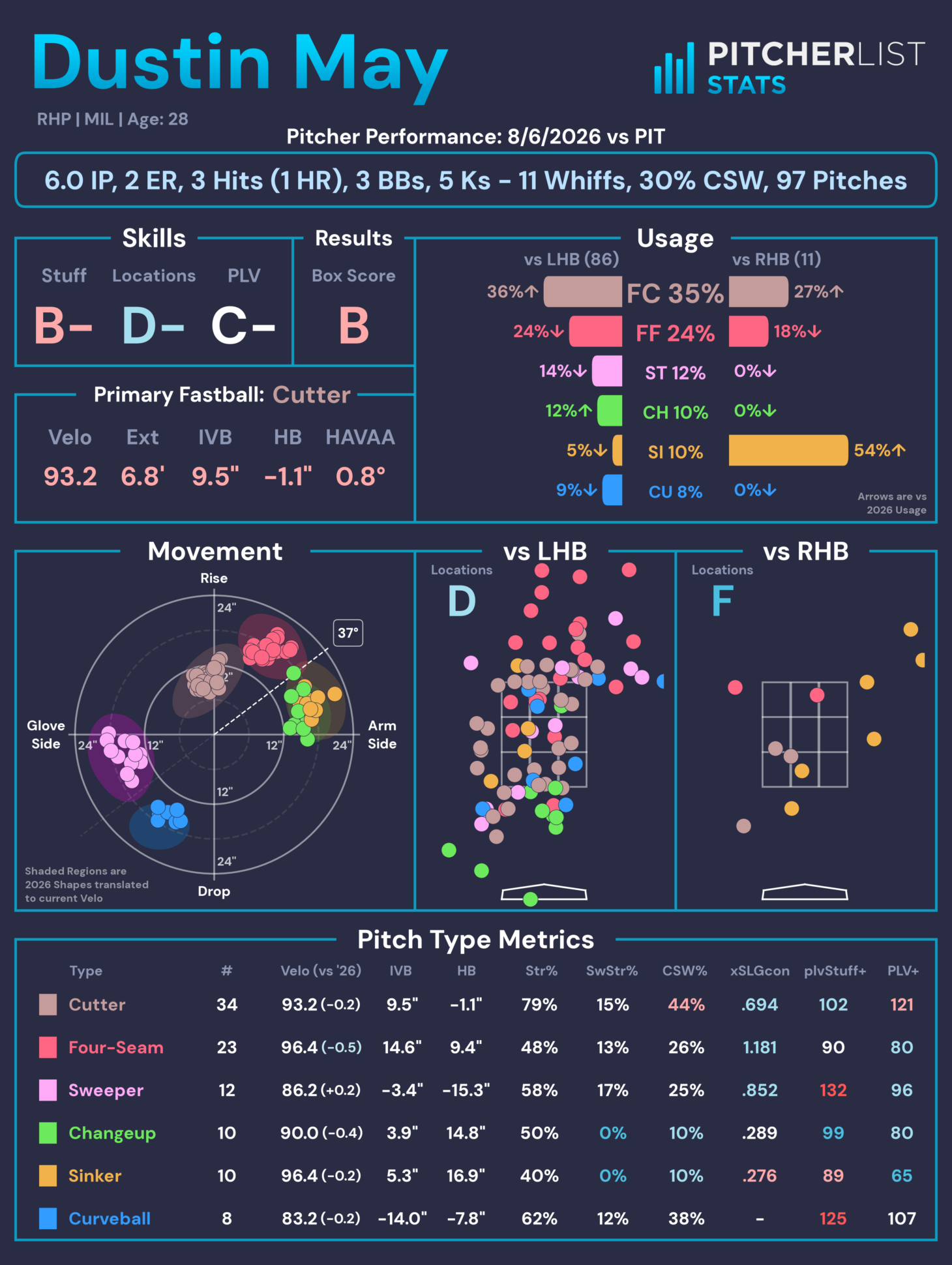
In his first start with the Brewers, May filled up the strike zone while mixing in each of his six pitches fairly consistently. Going against an almost entirely left-handed lineup, May’s cutter and four-seam led the way, with his cutter especially generating a 44% called-strike-whiff rate. His sweeper/curveball present to be solid zone fillers, both generating ~60% strike rates, while his changeup continued to struggle results-wise.
An overall solid start gives May a great first step with the Brewers, one of the smartest pitching organizations in baseball, who will hopefully continue to optimize May’s high-spin arsenal. Down the stretch in 2026, look for May to continue showing promising results and have a dominant 2020-esque postseason performance for the Brewers.
