





Hello and welcome to Pitcher List’s latest series: Using PLA to Evaluate Pitchers! Every week, I will examine various pitchers and break them down using PLA. There will be various themes and topics each week, which will range from topics such as waiver wire picks, to buy or sell, to awards races, to lefties/righties only, etc. I hope to mix it up as much as possible to keep you all on your toes.
Now, you might be asking, what is PLA?
PLA is an ERA estimator that was created in tandem with Pitch Level Value, which we refer to as PLV. PLV is essentially an all-encompassing stat that measures individual pitches and rates them on a 0-10 scale. The elements that factor into PLV include velocity, movement, release point, location, count, and handedness of the batter. We have an excellent primer on this by the one and only Nick Pollack that you can find right here! PLA takes this 0-10 score and translates it to an estimated ERA, which makes it easier to understand and more useful for those looking for help with their fantasy teams.
It’s important to note that PLA isn’t necessarily a catch-all estimator, just as xERA, FIP, SIERA, and pCRA aren’t either. These stats ultimately still measure outcomes, which are largely dependent on how a player is executing that day. ERA estimators are not crystal balls; however, they can provide some insight if taken with a grain of salt. For the purpose of this series, we are going to use PLA as the main factor to evaluate pitchers (hence the series title), but again, no stat is perfect, especially in the complex world of pitching.
Also, stay tuned for other PLV evaluation article series, such as one that will look at individual pitches and another that will use Process+ to evaluate hitters!
Today we will be looking at pitchers who have found some form of redemption, whether that be a bounceback from last year or an in-season bounceback.
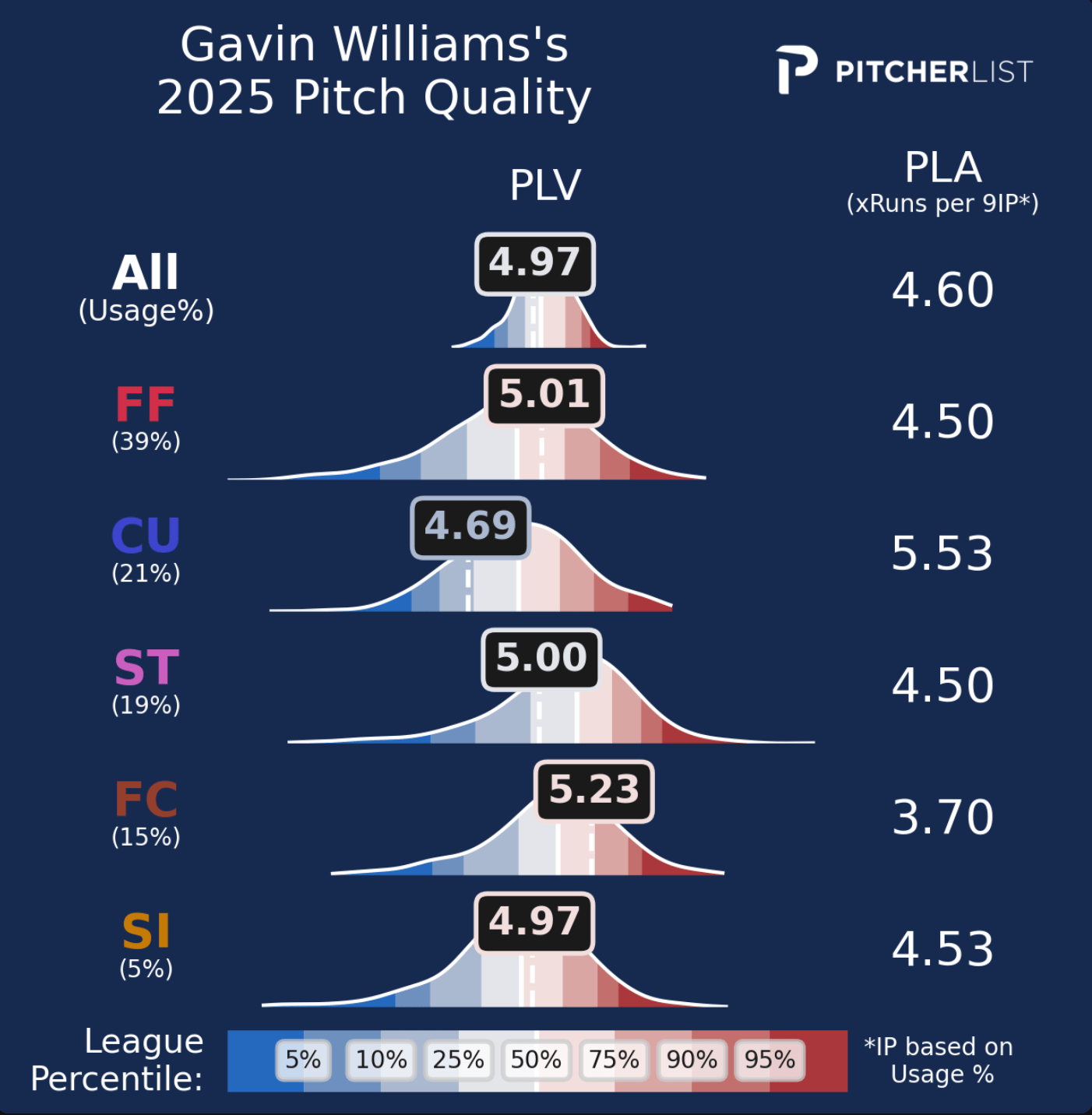
Gavin Williams – 4.60 PLA
For some of these guys, redemption comes season to season; with Gavin Williams, the adjustment seems to have come in the current season.
Williams was a pretty common breakout pick going into the season, especially as he had a ridiculous swinging strike rate in tracked games. Once the season began though, fans and fantasy managers were treated to an insane roller coaster of ups and downs, making him a true HIPSTER type.
One of the main concerns with Williams over the season was the massive swing in feet of extension. His incredible extension was what was really driving his potential breakout, as 7.1 feet can add a tremendous amount of perceived velocity to an already 97mph offering. The extension would also allow him to tunnel better, making his arsenal fare significantly better. Unfortunately, this extension was down at several points in the year, including starts where it hovered around 6.5 feet. This level of drop off is a huge deal, and can lead to inconsistent results like we’ve seen from Williams.
Williams’ main pitch is his four-seam fastball. It combines velocity and extension to make up for a kind of mediocre shape and spotty location. It gets decent results, but could be better if he located it with even more precision. His main secondary is a curveball, which grades out poorly due to very questionable location, and he also has a sweeper that’s in a similar boat. His most talked-about secondary is his cutter, which makes sense. Cutters can be very successful when utilized by pitchers with strong extension, and Williams is no exception. Many clamored for him to throw one, and it’s been a good addition to his arsenal. He also has a sinker, which grades out pretty average.
Overall, Williams’ control issues combined with inconsistent extension have led to his PLA being a bit inflated. Use caution when considering drafting him next year. He has a high ceiling but there is also plenty of room for him to be messy now and then.
Trevor Rogers – 3.57 PLA
Last year, Trevor Rogers was moved to the pitching-needy Orioles in exchange for two young players: Connor Norby and Kyle Stowers. Norby had a hot streak last year down the stretch, while Stowers proved to be one of the better hitters in all of MLB this season. Rogers, unfortunately, was optioned by the Orioles and thus, the trade looked like a bust.
Well, Rogers eventually was called back up this year and has been one of the very best pitchers since then. His ratios have been outstanding, with some thinking he deserves some Cy Young votes despite not starting the season on the big league roster.
Rogers’ four-seam fastball is his most used pitch, and it honestly isn’t that impressive. It’s impressive that he’s been able to use his arsenal in a way that the numbers are that impressive with such an unimpressive fastball. Like many lefties, it’s the changeup that is incredibly effective, as PLV gives it a grade in the 95th percentile. Rogers also incorporates a sinker, slider and sweeper, and each grades out as being around average.
Rogers is the classic lefty who is able to leverage an elite, deceptive changeup to success. This offering keeps his PLA at a respectable level, which means that even with regression, Rogers is likely to continue being a solid middle-of-the-rotation option at worst.

Jacob deGrom – 3.01 PLA
Jacob deGrom? More like Jacob deGOAT.
Yeah, we love deGrom here. But how can you not? After all the concerns of injuries and whether we’d ever see him bounce back after Tommy John surgery, he’s given us 155 innings of 2.78 ERA ball.
deGrom is still basically the same guy we’ve seen for a long time in terms of pitch mix. It’s fastball/slider, and both are still effective. The four-seamer has always been known for great velocity and solid extension, which it still has. What is extra impressive about it, though, is its attack angle, which is incredibly flat and allows for whiff city when the pitch is thrown at the top of the zone. Speaking of whiffs, the slider is also an impressive offering, as it gets strikes and puts batters away. The fun thing is that both the slider and four-seamer are about equally good per PLV, which is always a great thing to see from a pitcher who prioritizes two pitches.
deGrom also features a changeup and curveball, though he doesn’t throw either often. The changeup grades out particularly poorly, but the curve is a decent option against lefties.
While some thought we wouldn’t see elite deGrom again, we’ve seen it, as deGrom is looking to finish top 5 and maybe even top 3 in the Cy Young race. He’s a top-notch pitcher, and PLA further proves that.

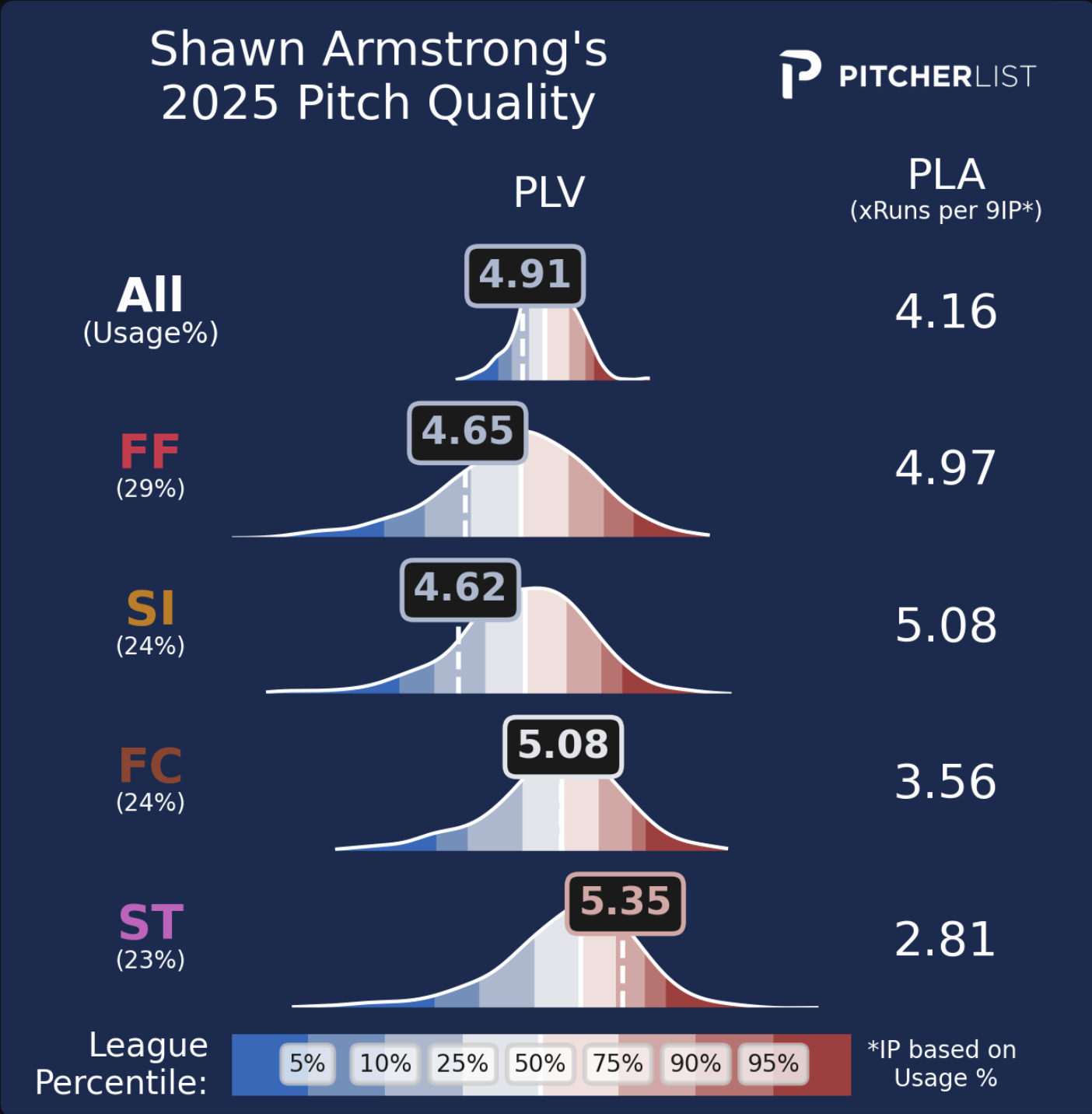
Shawn Armstrong – 4.16 PLA
It was a disaster season last year for Shawn Armstrong, who got traded by the Rays at the deadline and then cut by the Cardinals shortly after. He finished the year on the Cubs, and some were wondering if he’d get another role.
The Texas Rangers swooped him up and now, due to a variety of factors, he’s found himself as the team’s primary closer. It’s crazy how quickly things can change in the relief pitcher world.
Despite his name, Armstrong doesn’t really showcase super velocity on his pitches. He throws three different fastballs, and only the cutter is above average in terms of velocity among its contemporaries. Surprisingly, his fastball that grades out poorly has a pretty impressive swinging strike rate, one which is higher than a fair bit of the game’s deadlier fastballs. His cutter is the best per PLV, though it hasn’t had the best results. If you had to mae a guess based on our pitch-modeling stats, you could probably expect regression from his four-seamer and then an uptick of results from his cutter. Armstrong also has a sweeper which grades out extremely well and gets lots of called strikes + whiffs.
Armstrong doesn’t have the best stuff with his fastballs, but he’s making the most of them in a closing role. He probably won’t have a better season than this next year, but he’s definitely a better arm than what he was last season.
David Bednar – 3.76 PLA
Last season, David Bednar had shockingly bad results. This year, he was optioned. Once he came back though, he looked elite, and thus, the Yankees took a swing on getting him. He’s now in their closer role, beating out the struggling Devin Williams and the also newly acquired Camilo Doval.
Bednar features an interesting mix of pitches. Like other lockdown relievers, it starts with a solid four-seam fastball. The fastball truly has all the characteristics of a great one. It has solid vertical movement, comes in at a flat attack angle, and is, of course, a great combination of velocity and extension. His main secondary is a curveball, which doesn’t grade out the best. It’s a slow curve, which isn’t always the best offering to have as a mainstay in an arsenal, which is reflected by his PLV. His splitter, on the other hand, grades out impressively well, especially considering how splitters can often get sub-par marks by PLV.
Bednar is a great reliever, and PLV seems to agree. His fastball and splitter are amazing, and while his curveball doesn’t get the highest grades, it still doesn’t inflate his PLA too much.

