





We’ve been analyzing individual hitter performances all season long using PLV Decision Value, but now that we’re at the midpoint of the season and the playoff races are starting to shape up, it seems like a great time to take a look at how teams as a whole are faring with their swing decisions. Are the elite lineups making good choices, or are they creating runs in other ways? Which otherwise unremarkable offenses are at least attacking good pitches to hit?
To analyze swing decisions, we’ll use PLV’s Decision Value. If you’re unfamiliar with the stat, it’s one of our very own metrics here at Pitcher List. Decision Value grades a hitter’s ability to recognize the pitches he can turn into favorable contact and then make the appropriate swing decision. It’s measured on a scale where 100 is the league average, and every 15 points above or below 100 is one standard deviation. We can even break Decision Value down a little bit further to specifically look at pitches thrown inside (zDV) and outside (oDV) the strike zone.
For a more in-depth description of Decision Value, check out the intro to this piece. You can support Pitcher List and get access to full leaderboards for Decision Value and other PLV statistics by joining PL Pro.
Los Angeles Dodgers — 122 Decision Value (1st)
Well, well, well, what a surprise. Yet another stat where the Dodgers rank at the top of the league. They’re not the only heavy hitter at the top, though. Four of the top five teams in Decision Value also fall in the top 10 in runs scored this season. Unsurprisingly, making good swing choices leads to good run production.
The reigning World Series Champions sport two of the top 13 hitters in Decision Value with Will Smith (127, 10th) and Max Muncy (126, 13th) playing big roles in L.A.’s pole position. Only a handful of the Dodgers’ key lineup cogs rank below league average. Tommy Edman, Andy Pages, and Hyeseong Kim all have Decision Values under 100, but all of them are still sitting within a standard deviation of the league average.
The Dodgers have been particularly good at laying off pitches outside of the strike zone. They have a collective 121 oDV, which is second only to the next team mentioned in this article, and appropriately, they’ve walked quite a bit — the club’s 9.4% walk rate is the third-highest in the majors.
Milwaukee Brewers — 118 Decision Value (3rd)
The Brewers have been the hottest team in baseball over the last six weeks. Since June 1st, they’re 25-12 and have shrunk their deficit in the NL Central to just 1 game. Milwaukee’s lights-out pitching has been the main story — their 3.10 ERA over that period is the second best — but their scrappy lineup has been no slouch either.
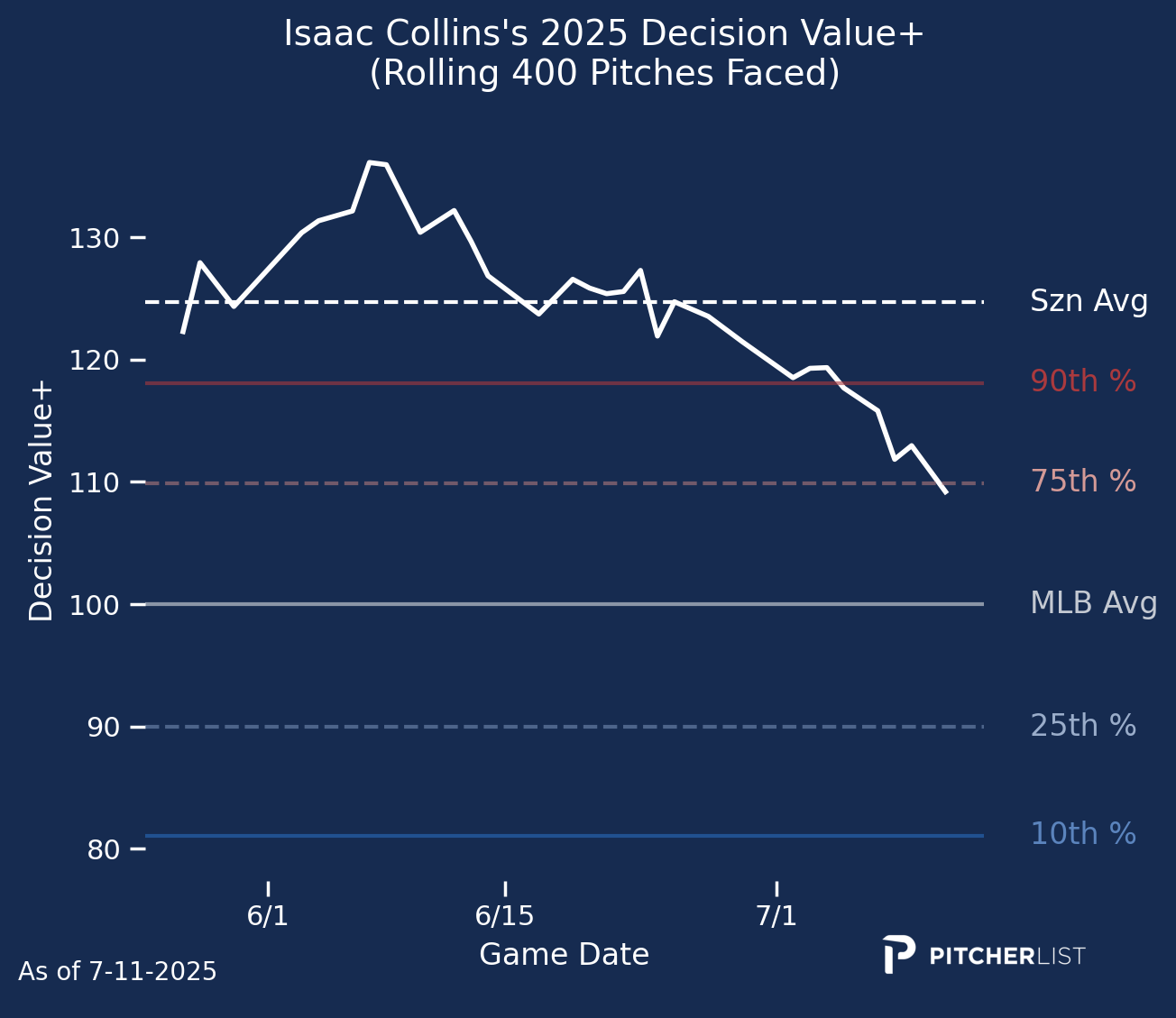
William Contreras and Rhys Hoskins have led the way for the Brew Crew in the Decision Value department, but rookie Isaac Collins has been a standout too. His 120 mark is the 26th best overall. The late-blooming rookie is already 27 years old, but perhaps that’s played a factor in his early success. Collins went to the plate nearly 2,000 times as a minor leaguer, and although those long-winding journeys aren’t necessarily viewed as a positive for a player, I have to think that ample experience has helped him look right at home facing the toughest competition the game has to offer.
Here’s a look at Collins’ Decision Value over the course of the first half. The recent drop is notable, but he started at such a high mark that even with the decline, he’s still well above average. He’ll be one to watch in the second half to see if he can adjust and return to that elite level of decision-making in the batter’s box.
Like the Dodgers, the Brewers are excelling at laying off pitches outside of the strike zone. Their 124 oDV is the best of any team, as is their 25.7% Chase rate. From an organizational standpoint, Milwaukee seems to preach patience. Not only are they not swinging at those bad pitches, they’re not swinging much at all. Their 45.4% swing rate is the lowest in the sport.
The Brewers’ lineup may lack the star power of other high-performing lineups, but they have their squad bought into a patient approach at the plate, and it’s paying dividends. That kind of offensive game can work really well in October, and with their current level of play, they should once again see Postseason action.
Los Angeles Angels — 117 Decision Value (4th)
The Angels are the only team in the top five of Decision Value that doesn’t rank among the top scoring offenses. They’re exactly middle of the pack, sitting at 15th in runs scored with 418. Where they do rank well, though, is the power department. The Angels have blasted the fifth-most home runs in baseball, and PLV’s Power metric puts them in a tie for first place with the Dodgers and Yankees. Not bad company there.
Zooming back in on swing decisions, the Angels are just solid all around. They don’t have any specific player dragging the team’s results down. Almost all of their main contributors are hovering right around the league average mark, while Mike Trout and Taylor Ward lead the way with Decision Values of 127 and 118, respectively. Recent acquisition LaMonte Wade Jr. is also a standout in Decision Value, but he hasn’t seen enough playing time with his new squad to really factor much into their season-long numbers.
Chicago White Sox — 114 Decision Value (9th)
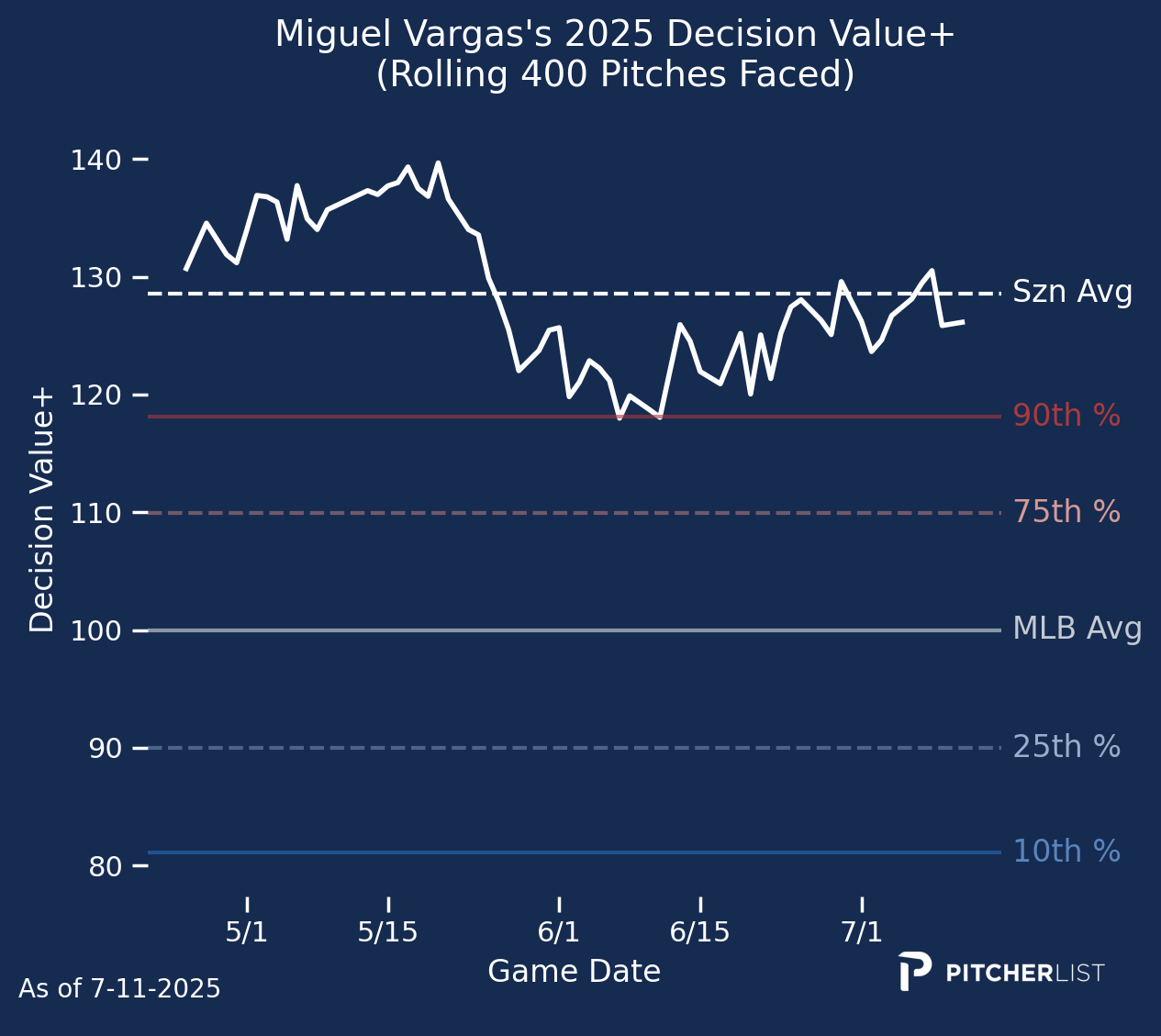
The first real surprise of these team rankings comes with the White Sox cracking the top 10 teams despite being the third-lowest scoring offense. Although they’ve struggled to push runs across the plate, the Sox have guys up and down the lineup who are thriving in their decision-making ability, the most notable being Miguel Vargas.
In his first full season on the South Side, Vargas is finally getting a chance to play every day and flash some of that top prospect potential he carried through his time in the Dodgers’ system. He’s slashing .218/.297/.383 with 10 homers on the season. That comes out to just a 90 wRC+, but he’s excelling in the plate discipline department. His 17.4% strikeout rate and 8.9% walk rate are good indications of his strong eye at the plate. That’s further backed up by his 128 Decision Value, the ninth-best mark among qualified hitters. Vargas should continue to get every opportunity to develop in the second half.
Vargas isn’t the only one making good swing decisions in Chicago. Mike Tauchman and Josh Rojas are two veterans also attacking good pitches to hit, and are candidates to be dealt at the deadline. Among their young building blocks, Chase Meidroth (114) and Kyle Teel (111) are both nearly a full standard deviation better than the average player in Decision Value and represent the start of what will hopefully be a quick rebuild in the Windy City.
Pittsburgh Pirates — 109 Decision Value (11th)
The Pirates are another surprise to see this high in the rankings. Like the White Sox, they’re an anemic offense that’s still managed to make good swing decisions, but they just aren’t turning them into runs. Like no runs at all. The Pirates rank dead last in runs scored at the halfway point, a stat that Paul Skenes is all too familiar with.
The picture in Pittsburgh is a little less rosy than what we just saw in Chicago. Most of the top-ranking players in Decision Value for the Pirates are veterans. Andrew McCutchen leads the way — he was just named to the Decision Value All-Star Team — with Bryan Reynolds and Tommy Pham not far behind. The two young guys to watch in Pittsburgh are Nick Gonzales (117) and Henry Davis (107). Gonzales has managed to turn his good decisions into meaningful production at the dish with a .265/.319/.424 slash line and a 105 wRC+. On the other hand, Davis, the former number one overall draft pick, is still searching for a breakthrough. He’s hitting just .198/.259/.328.
Atlanta Braves — 107 Decision Value (12th)
Atlanta is at an interesting spot in these rankings. They’re a little above average rank-wise, but they’re the last team with a Decision Value that’s notably better than average. Atlanta checks in at 12th with a score of 107, but right after them, there’s a significant drop-off to the 13th-place Rays at a 101 Decision Value. They’re followed by a group of five teams sitting in the 99-97 range.
Unlike most of the teams we’ve already covered, Atlanta doesn’t have an elite oDV score boosting their overall Decision Value mark. It’s actually the opposite. The team’s 111 zDV is the 7th best in baseball, meaning Atlanta’s hitters are doing an excellent job of picking pitches in the strike zone to attack. Ozzie Albies is leading the way here, both for his ballclub and the league. His results haven’t been up to his usual standard, but his 135 zDV is the highest in MLB.
Boston Red Sox — 89 Decision Value (23rd)
Let’s take a look at a couple of teams that you may not expect to see this far down the Decision Value leaderboard. The Red Sox have one of the most potent lineups in the game, but they haven’t pushed those runs across the plate thanks to their swing selection; they’ve done it with power. Fenway is a boon to the offensive numbers for sure, but Boston’s ranked fifth in runs scored, largely thanks to the 122 home runs the team has hit. That’s the 10th most in MLB. PLV’s Power metric ranks them just a touch higher at 7th.
I originally thought the Red Sox’s youth movement may be a factor in their poor Decision Value score, but of their notable rookie trio, only Marcelo Mayer ranks below average at 88. He’s joined on the lower end of the Decision Value leaderboards by his teammates Trevor Story (85) and Ceddanne Rafaela (84).
Houston Astros — 83 Decision Value (27th)
This one caught me off guard. I don’t think I’m alone in still thinking of the Astros as one of the better run-scoring clubs in baseball, but although this new-look roster has continued the success of previous years, they haven’t been a top-notch offense. They ranked 16th in runs scored in the first half. Not awful, but not the run-producing juggernaut they had been for the better part of the last decade.
In that same vein, the Astros rank near the bottom of the league in Decision Value. Only three teams have struggled more in that regard. This may come as an especially painful result, given that two of their former building blocks place high on the individual hitter leaderboards – Kyle Tucker is 12th overall with a 126 Decision Value while Alex Bregman clocks in as the fourth-best third baseman with a mark of 119.
Colorado Rockies — 63 Decision value (30th)
I’m not trying to pile on here, but c’mon. If you had just one guess as to which team had the worst Decision Value in baseball, you probably would’ve nailed this one. The Rockies can’t catch a break right now, so it’s perfectly fitting to see them sitting in dead last in Decision Value.
It’s not just being in last place that’s bad, but the magnitude by which they’re in last place. Colorado’s 63 Decision Value is 16 points lower than the two teams tied for the second-worst mark, the Royals and Twins. That 16-point gap that separates 29th from 30th is the same as the gap that separates 29th from 19th and 19th from 10th.
Adapted by Kurt Wasemiller (@kurt_player02 on Instagram & Threads, @kuwasemiller.bksy.social on BlueSky)
